We are a non-profit organization dedicated to helping governments and citizens make better decisions through open platforms and artificial intelligence.
Discover our open source Policy Synth platform where citizens, GPT-4 and genetic algorithms team up to evolve policy ideas head-on, fostering democratic innovation. #GPT4#Democracy#Innovation https://t.co/7hx6tFjChr
Life update — I’m moving to the OpenAI Foundation to lead AI resilience.
AGI will bring tremendous benefits and potential disruptions, such as impacts on children and youth, model malfunctions, emergent bio-risks, and more.
AI resilience is about minimizing these disruptions so society can fully realize the benefits.
https://t.co/xCHIbaotfu
Ten years after AlphaGo, we’re still building on its foundations to advance AI.
The techniques pioneered have helped us prove mathematical statements and are now assisting the scientific community in making new discoveries.
Read more from @DemisHassabis ↓
https://t.co/RHKgdoPPo3
tl;dr: @OpenAI will not be deploying to the NSA or other DoW intelligence agencies for now, so that there's time to address potential surveillance loopholes through the democratic process.
Over the weekend it became clear that the original language in the OpenAI / DoW agreement left legitimate questions unanswered, especially around some novel ways that AI could potentially enable legal surveillance. The language is now updated to address this, but I also strongly believe that the world should not have to rely on trust in AI labs or intelligence agencies for their safety and security. Deployment to the NSA and all other DoW intelligence agencies will be withheld so that there is time to address these loopholes through the democratic process before deployment.
I know that legislation can sometimes be slow, but I'm afraid of a slippery slope where we become accustomed to circumventing the democratic process for important policy decisions. When there is bipartisan support and urgency, I have faith that government can act quickly. And as AI becomes more powerful, it's more important than ever that ultimate authority be vested in the public.
I am also planning to become more personally involved with policy at OpenAI. I think now more than ever it's important for researchers to be in the loop so that policy is informed of the extremely fast progress we are seeing.
(I also would like to share this, which I wrote after thinking a little more.)
There is a lot we will talk about in the coming days, but since this is one of the first "real deal" decisions we have faced, I wanted to share a few things that have been heavily on my mind the past few days.
These are the principles I care most about for this decision: alignment, democratization, empowerment, and individual agency.
The democratic process must stay in control, and we must democratize AI. OpenAI should not decide the fate of the world; no private company should. We need to work with governments, but also we need to make sure individuals get increasing power.
Things are moving so fast that we need to urgently educate the world so that the democratic process has time to catch up. I think one of our most important strategic decisions ever was the principle of iterative deployment.
In particular, the key element required for democracy, such as protection of privacy, must be defended by all of society.
I believe that, as some of the creators of this new technology, we deserve to and are obligated to have a loud voice about the risks, pitfalls, and benefits we see.
I think we are heading towards a world where the relationship between governments and AI efforts is critical. This will be difficult but it has to happen; I do not see any good future where we don't get there. There should not be games and fights in the press like this; drastic government action should be avoided.
I think there are real dangers coming to the world, and maybe pretty soon; I tried to put myself in the mindset of how I'd feel the day after an attack on the US or a new bioweapon we could have helped prevent.
New Anthropic Research: Disempowerment patterns in real-world AI assistant interactions.
As AI becomes embedded in daily life, one risk is it can distort rather than inform—shaping beliefs, values, or actions in ways users may later regret.
Read more: https://t.co/gyMB2AtOuq
AlphaGenome is our latest & most advanced genomics model published in @Nature today including making the model & weights available to academic researchers. Can’t wait to see what the research community will do with it. Congrats to the team on our newest front cover! #AI4Science
💥 Today we’re introducing Prism—a free, AI-native workspace for scientists to write and collaborate on research, powered by GPT-5.2.
Accelerating science requires progress on two fronts:
1. Frontier AI models that use scientific tools and can tackle the hardest problems
2. Integrating that AI into the products scientists use every day
Prism is free to anyone with a ChatGPT account, with unlimited projects and collaborators.
Try it today at https://t.co/cmEsJYRtW9—would love to hear your feedback.
Humans and organizations pour untold resources into complexity management and still do it poorly. AI reasoning can now handle this. We'll prefer it not because it's cheaper but because it's better.
Op-ed in @Fortune by @GoogleOrg's Maggie Johnson & Shannon Farley of @FfwdOrg:
Nonprofits are on the front lines of social impact but need 21st-century tech like #AI. We must fund the tech, fund the future, and fund together.
Read why: https://t.co/i1v5yhtCR6
New paper with @robertchisciure !
"Cognition all the way down 2.0: neuroscience beyond neurons in the diverse intelligence era"
https://t.co/e6SI2WGlN4
"This paper formalizes biological intelligence as search efficiency in multi-scale problem spaces, aiming to resolve epistemic deadlocks in the basal “cognition wars” unfolding in the Diverse Intelligence research program. It extends classical work on symbolic problem-solving to define a novel problem space lexicon and search efficiency metric. Construed as an operationalization of intelligence, this metric is the decimal logarithm of the ratio between the cost of a random walk and that of a biological agent. Thus, the search efficiency measures how many orders of magnitude of dissipative work an agentic policy saves relative to a maximal-entropy search strategy. Empirical models for amoeboid chemotaxis and barium-induced planarian head regeneration show that, under conservative (i.e., intelligence-underestimating) assumptions, even ‘simple’ organisms are from two-hundred- to sextillion-fold more efficient in problem space exploration. In this sense, the deep insights of neuroscience are not about neurons per se, but about the policies and patterns of physics and mathematics that function as a kind of “cognitive glue” binding parts toward higher levels of collective intelligence in wholes of highly diverse composition and origin. Therefore, our synthesis argues that the “mark of the cognitive” is perhaps better sought in the measurable efficiency with which living systems, from single cells to complex organisms, traverse energy and information gradients to tame combinatorial explosions-one problem space at a time."
So it starts, the transformation of education
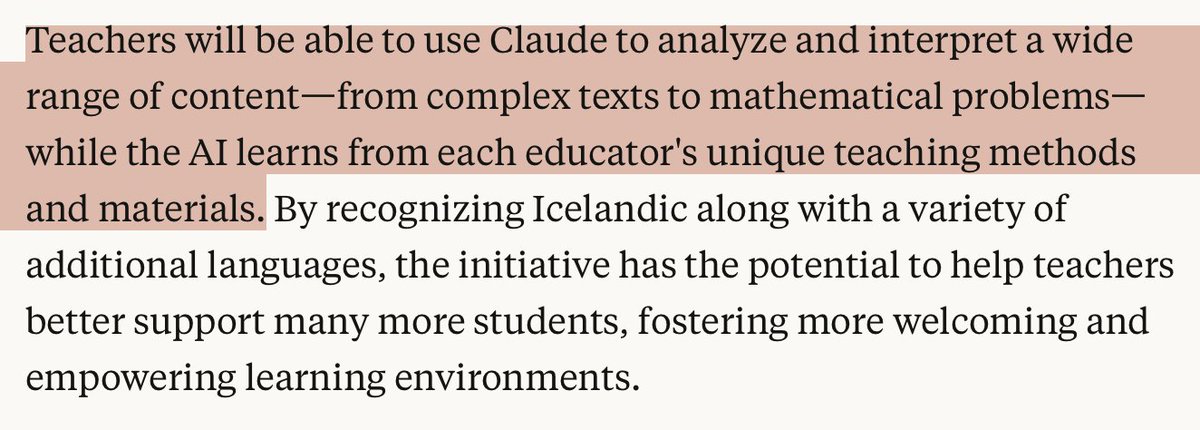
In a bold move, Anthropic and the Ministry of Education and Children of Iceland are launching one of the world’s first nationwide AI-education pilots: hundreds of teachers across Iceland will gain access to the AI tool Claude, educational resources and training to explore how AI can transform lesson preparation and student learning.
A win-win situation for Anthropic
Jakub and I are going to do a livestream and answer questions today at 10:30 am pacific.
We have a lot of things to talk about--of course we will cover our new corporate structure, but we will also discuss our new goals for research, the evolution of our product offerings, an update on our infrastructure buildout, the initial funding areas for the nonprofit, and more.
It is probably the most important stuff we have to say this year.
TL;DR on the structure--the non-profit remains in control and, if we do our jobs well, will be the best-resourced non-profit ever. We are excited to get to work immediately deploying the capital. Our LLC becomes a PBC.
I am grateful to the Delaware and California AGs, our partners at Microsoft, all our investors, and especially to our tireless team for their work in getting to a good place here.
Introducing a new type of civic tech made possible by AI. Every citizen should have a live, systems view of their government and today we bring that to SF!
Track gov entities, spending, news, and more in real time. With LLMs, we can bring this to every city. Who's next?
🎉Congratulations to Burnes Center and GovLab Director @bethnoveck for being highlighted in @govtechnews's Center for Public Sector AI 50, alongside @TheGovLab.
Read the full article here: https://t.co/9adSbD4Soi
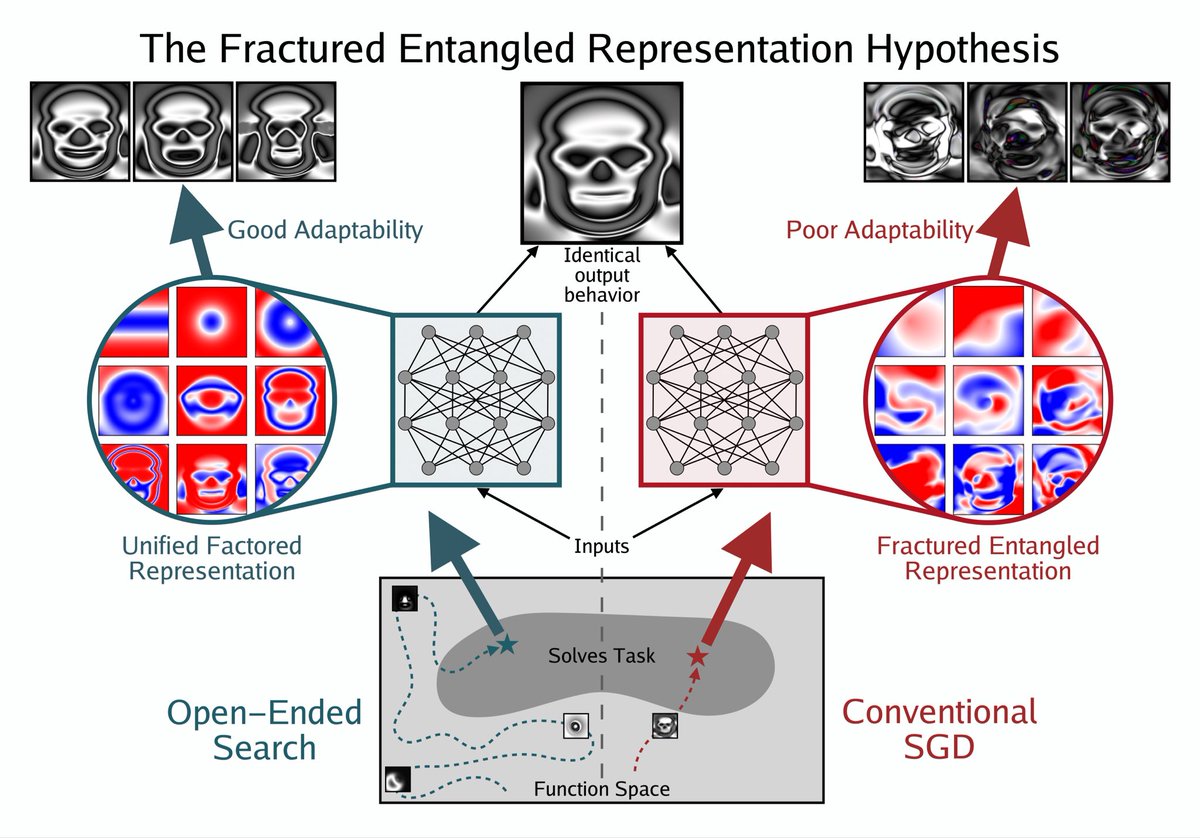
Those who intuit something is lacking in LLMs struggle to pinpoint the gap beyond inadequate metaphors like “stochastic parrot” or “glorified autocomplete.” What you’re groping for is fractured entangled representation (FER). That’s the concrete crux of your slippery intuitions.
It’s why these models can keep improving in dramatic and genuinely nontrivial ways yet still suffer from an underlying sickness. It’s where real opportunity and hope lie for revolutionary progress,
Representation is at the heart of thought, of creativity, and indeed of intelligence itself. It is possible to “know” an unfathomable amount and yet still represent it poorly.
And it’s possible for representation to be better. And it will ultimately happen one way or another.
As ChatGPT becomes a go-to tool for students, we’re committed to ensuring it fosters deeper understanding and learning.
Introducing study mode in ChatGPT — a learning experience that helps you work through problems step-by-step instead of just getting an answer.
*Diffusion Models are Evolutionary Algorithms*
by @YanboZhang3@drmichaellevin et al.
They develop novel evolutionary algorithms based on an analogy between mutation / natural selection and the forward / reverse processes in diffusion models.
https://t.co/33oquCgKpW