⭐ ⭐ ⭐ Columbus Cybersecurity and Infrastructure Leaders ⭐ ⭐ ⭐
You're invited! Come and join us
Realtime Active Directory Ransomware Recovery with Live Simulation
Clarify360 is hosting an invite only Lunch & Learn
⭐ When: Friday, July 17
⭐ Where: Topgolf Columbus.
Seating is limited to 25 participants.
DM me for Registration Link
#Ransomware #Cybersecurity
📌 Gerald Auger, Ph.D. brought the educator, GRC, and practitioner-community lens to this ClearTech Loop conversation.
Gerald is the chief content creator of Simply Cyber, has a PhD in Cyber Operations, and is an adjunct professor of cybersecurity at The Citadel. He has built a large cybersecurity community around practical education, daily threat briefings, career development, and helping people understand what is actually happening in the field.
Gerald did not stay in theory for long. He went straight to adoption.
AI is already easy to use. It is being built into everyday tools. Employees do not have to be technical to start using it, and that is what makes shadow AI so difficult to contain.
The conversation kept coming back to a practical reality: organizations may not be able to slow AI down, but they can give people safer places to use it, teach them what the risks are, and start treating AI governance like a real discipline.
👉 Listen to the full episode: https://t.co/1zxZB7dsjX
👉 Stay in the Loop. Subscribe for new episodes: https://t.co/pQP1sp2Kux
👉 Check out full videos on our YouTube channel and subscribe: https://t.co/aHLSELaCDI
#AISecurity #Cybersecurity #CISO
📌 Q: In AI Defense and Mitigation, what is (HITL) Human in the Loop?
A: Human-in-the-Loop (HITL) is a safety measure that requires a human to review and approve high-stakes AI actions or outputs before they are finalized
v/ @wallarm#AISecurity#Cybersecurity#CISO
📌 Q: What is an AI Harness?
A: An AI harness (often called an agent harness) is the software infrastructure that wraps around an AI model, handling everything except the model's actual reasoning.
The general industry rule is: Agent = Model + Harness. While the AI model acts as the "brain," the harness provides the "body" and environment, such as memory, tools, and safety guardrails
v/ @LangChain
#AIOps #AIInfra
📌 Q: Why don’t traditional DLP tools work on AI?
A: Traditional Data Loss Prevention (DLP) tools were built for a different era. They struggle to secure Artificial Intelligence (AI) environments because AI fundamentally breaks the three basic assumptions that legacy DLP relies on:
🐈⬛ Channel Coverage (Where Data Goes)
Legacy DLP secures predictable channels like email, USB drives, and defined cloud apps. In contrast, AI interactions happen in web browsers, copy-paste clipboards, and integrated API workflows.
🐈⬛ Data Type (What the Data Looks Like)
Traditional DLP relies on rigid pattern-matching (like regex) to spot highly structured data, such as credit card numbers or Social Security numbers. AI interactions heavily utilize unstructured data.
🐈⬛ User Intent (How Data is Handled)
Older DLP tools assume that moving data out of the enterprise perimeter is a deliberate, malicious event, or a file transfer. With AI, data exposure is typically accidental or driven by regular employees trying to speed up their daily workflow.
v/ @ForcepointSec
Cc: @DavidLinthicum
#AISecurity
📌 The Amazon Web Services (AWS) Summit New York City 2026 is taking place on June 17, 2026, at the Javits Convention Center. This year’s summit pivots sharply from basic cloud migration toward building, deploying, and scaling enterprise-grade generative AI and agentic systems.
I expect to see a shift in focus to Agentic AI and Modern Infrastructure. One of the key themes I believe will center on moving past isolated AI experiments to deploying autonomous AI agents and full stack agentic workflows to handle complex business logic
Excited to be part of the analyst community taking part in this event.
Thanks to Kim Gibbons and Philip Bues for the invite!
#AIInfra #AIOps #AISecurity
📌 Q: If the OSI model were built for #AI, what would happen at Layer 6?
A: In an OSI model built for Artificial Intelligence, Layer 6 would serve as the Semantic Presentation and Action Layer.
Instead of just formatting basic text and images, it acts as a universal translator, digesting unstructured human language, converting intent into actionable commands, and normalizing heterogeneous data into unified schemas.
A purpose-built AI Presentation Layer would execute several transformative functions like Semantic Translation, Contextual Compression, Semantic Security and Alignment and Modal Normalization
How do you see it?
#AIOps #CIO
📌 #CiscoLive Day 3 Security update.
Today, I'm focused on the security angle with @Cisco IQ.
There are two points of consideration: protecting your network through proactive risk assessments, and ensuring strict data privacy within your environment.
Take a look at how that plays out.
⭐ Pre-emptive Security & Threat Mitigation
Instead of reacting to breaches, Cisco IQ acts as a proactive security advisor by translating complex technical documents and vulnerability data into actionable insights via Security Advisory Insights, Quantum Safe Assessments, Peer Benchmarking (I like this one) and Configuration and Compliance policy deviation and remediation
⭐ Deployment Flexibility and Data Privacy
Cisco built the Cisco IQ architecture to fit different security and compliance requirements. The deployment options are SaaS, On-Premises Tethered, Air Gapped/Offline and data sovereignty is built in across all deployments
⭐ ⭐ ⭐ So in what type of organizations does this product shine? ⭐ ⭐
Organizations managing large-scale hybrid networks, highly regulated industries (e.g., finance, healthcare, government), and critical infrastructure benefit most from Cisco IQ. These organizations leverage its AI-powered capabilities for predictive threat anticipation, asset lifecycle management, and complex digital resilience.
1️⃣ The on-premises deployment model is appealing to highly regulated and air gapped sectors.
2️⃣ Manufacturing and heavy industry can map vulnerabilities and assess their exposure to new frontier model threats.
3️⃣ Enterprises with large asset inventory deal with widespread network infrastructures and Cisco IQ can instantly track hardware and software lifecycles—no more spreadsheets people!
4️⃣ Resource constrained IT teams that are drowning in data but starving for insights can use the platform’s Peer Benchmarking to compare their vulnerability exposure against similar peers…go this feature!
cc: @JoelyUrton
#AISecurity #AI #CISO #CIO
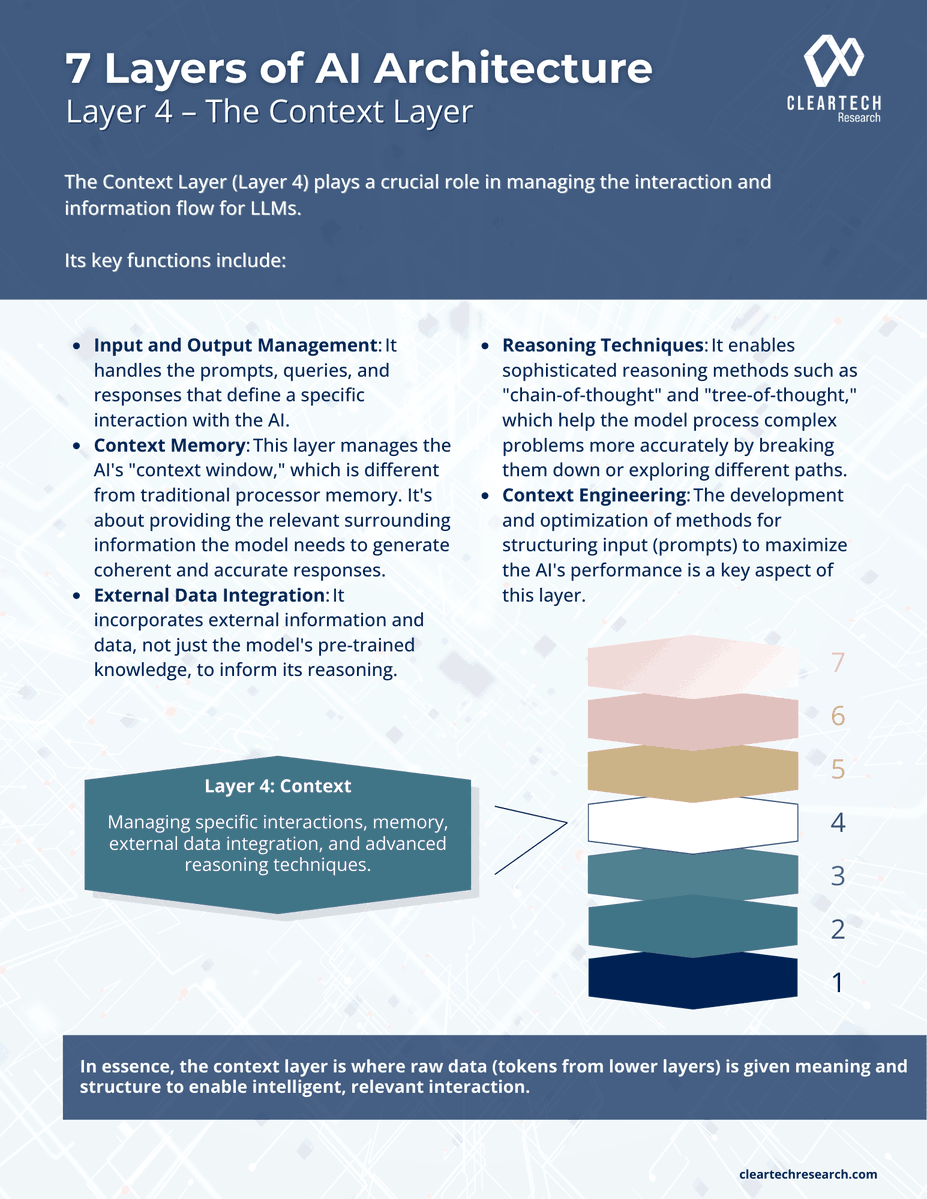
📌 Q: If the traditional OSI model were built for #AI, what would be happening at Layer 5?
A: If the OSI model were rebuilt specifically for AI, Layer 5 (traditionally the Session Layer) would transform into the Context and State Management Layer.
Instead of managing network connections between software applications, it would manage the ongoing "relationship" and memory state between a user, an AI agent, and external tools.
Functions Happening at AI Layer 5:
🤖 Token Window Management: Optimizes what fits into the current context limit.
🤖 Memory Routing: Switches between short-term (working context) and long-term (vector database) memory.
🤖 Multi-Turn Continuity: Maintains the thread of conversation across multiple prompts.
🤖 Agent Coordination: Manages active sessions between primary models and specialized sub-agents.
🤖 State Checkpointing: Saves the progress of complex, multi-step reasoning chains
#AI #AIOps #CIO
📌 Day 2 Security News #CiscoLive. To automate security operations, @Cisco introduced new "AgenticOps" within Cisco Security Cloud Control. AI agents can now autonomously analyze firewall traffic, capacity, and health to surface prioritized recommendations and remediate issues.
How It Works
Rather than requiring operators to manually write scripts or investigate alerts, AgenticOps proactively observes IT environments, clusters events, and acts based on operator-defined governance.
🤖 The Agentic Loop: Agents automatically spot trouble, identify the root cause, carry out fixes, test changes before deployment, and verify that the system has recovered.
🤖 Digital Twin: Before an agent executes a change in a production environment, it tests the remediation against a simulated digital twin of the network to ensure accuracy.
🤖 Cross-Domain Telemetry: The system pulls data from networking, security, observability, and third-party tools to ensure decisions are based on real-time infrastructure context.
This is great but I’m sitting here thinking about how an enterprise ensures that this work isn’t happening without a human in the loop or within a black box.
We all know that autonomous AI agents can make catastrophic mistakes if left completely unchecked.
In critical enterprise infrastructure, a single bad AI decision can crash networks, leak data, or violate compliance laws
Cisco's Human In the Loop (HITL) framework is designed to prevent "black-box" autonomy. Every agentic action generates an audit trail, reasoning rationale, and is tracked.
For high-risk changes or unapproved actions, the system routes the decision to human approval queues, ensuring operators remain in control.
So what are some of the things that matter to an enterprise security team and how has Cisco addressed those concerns as it relates to Human in the The Loop (HITL) specifically?
I think there are 4 areas to highlight
⭐ "Black Box" Risks-- Cisco's HITL model requires AI agents to provide a clear reasoning rationale and a detailed audit trail for every proposed action.
⭐ "Hallucination" Disasters-- Cisco’s HITL ensures that high-risk actions are routed to human approval queues, preventing automated disruptions.
⭐ Context and Nuance-- A human operator provides the contextual business judgment that algorithms lack.
⭐ Transition Safely to Autonomy--Most enterprises are not ready to hand full control of their data centers over to an AI. HITL allows organizations to build trust. Companies can start by requiring human approval for all agent actions, and gradually grant the AI full autonomy over low-risk, repetitive tasks as it proves its reliability over time.
cc: @JoelyUrton
#AISecurity #AgenticOps #Cybersecurity #CISO #CIO
📌 Maybelyn Plecic brought something especially practical to this ClearTech Loop conversation: the lens of a builder, educator, and security minded adoption leader.
Maybelyn is the Manager of Training and Adoption at Network to Code. She is CISSP certified, AWS certified, and has spent her career helping teams strengthen security posture, drive compliance initiatives, and make technical change usable.
That lens shaped the entire conversation.
AI security is not only about policies, platforms, and controls. It is also about whether people understand what is expected, whether approved tools are practical, and whether leaders make safe use easier than the workaround.
Maybelyn kept coming back to a simple point organizations often miss. People are not always trying to create risk. Sometimes they are just trying to get their jobs done faster.
That means AI security has to include trust, plain language, hands on enablement, and enough flexibility to meet different teams where they are.
Listen to the full episode: https://t.co/mwYylduc05
Stay in the Loop. Subscribe for new episodes: https://t.co/pQP1sp2Kux
#AISecurity #Cybersecurity #CISO #CIO
📌 #CiscoLive is happening this week in Las Vegas. Of course I'm all over the security announcements that are expected to come out of the conference
I'm betting (Vegas pun intented 😀) that @Cisco will heavily emphasize Agentic AI security and AI-Aware Secure Access Service Edge (SASE).
When of the platform updates that I think will matter for customers is the Cisco AI Defense Expansion. This AI Defense platform is designed to govern, inspect, and protect autonomous AI workflows from threats like "poisoned tools" and manipulation.
Enhancements we'll see include:
🤖 AI Bill of Materials (AI BOM): Provides centralized visibility into AI software assets, models, and third-party dependencies across the supply chain.
🤖 Advanced Algorithmic Red Teaming: Uses multi-turn testing for models to observe how an agent behaves over longer interactions to identify manipulation attempts.
🤖 Real-Time Agentic Guardrails: Actively inspects agent interactions to prevent them from executing unauthorized tool use or commands.
So why do these enhancements make a difference?
Cisco AI Defense matters to businesses because it eliminates the tradeoff between AI innovation and risk. It provides end-to-end security for both using third-party AI tools and building proprietary AI, protecting organizations from data leaks, malicious models, and AI-specific cyberattacks like prompt injection.
Let's talk specifics:
⭐ Eliminates Shadow AI Risks: Automatically discovers and tracks which unauthorized third-party AI applications employees are using, allowing security teams to enforce policies that prevent data leakage and intellectual property loss.
⭐ Secures the AI Supply Chain: Scans open-source models, datasets, and third-party dependencies for hidden backdoors, malicious code, or vulnerabilities before they are introduced into your development environment.
⭐ Real-Time Runtime Guardrails: Intercepts both inputs and outputs to block adversarial manipulations and prevents sensitive proprietary data from being exposed or leaked during AI interactions.
⭐ Automated AI Testing: Accelerates the development process by using algorithmic "red teaming" to algorithmically test and stress-test AI models against hundreds of attack techniques, saving weeks of manual labor.
⭐ Agentic Security: Monitors and restricts "agentic workflows" and Model Context Protocol (MCP) servers, preventing AI agents from being hijacked or making unauthorized actions across your systems.
⭐ Ensures Regulatory Compliance: Helps businesses easily adhere to evolving industry standards and government regulations, such as the NIST AI Risk Management Framework
cc: @JoelyUrton
#AISecurity #Cybersecurity #CISO
📌 Join Us! @cloudsa June AI Bytes Webinar
When: 6/23/26
Time: 1PM EST
Topic: Regulatory & Executive Liability in an AI World
Regulatory and executive liability for AI encompasses the legal, financial, and reputational risks that corporate leaders and organizations face from the development, deployment, and oversight of artificial intelligence systems.
As AI transitions from experimental to critical infrastructure, boards and executives face increasing scrutiny over bias, data privacy, and malfunctioning, leading to potential regulatory action, shareholder lawsuits, and personal liability for breach of fiduciary duty In this session we’ll discuss:
⭐ Key Aspects of AI Regulatory & Executive Liability
⭐ Key Risk Areas
⭐ Mitigation Strategies
An outstanding panel helping me shape this conversation includes Brad Moldenhauer| Billy Spears| Joshua Copeland
Register: 👉 https://t.co/uKJx71NP6J
#AISecurity #Cybersecurity #CISO
📌 Q: So how would the OSI model look at layer 4 if it were built for AI?
A: If the OSI model were reimagined as an "AI Stack," Layer 4 (traditionally the Transport Layer) would handle Inference Transport and Payload Optimization.
Instead of managing network packets (TCP/UDP), this layer ensures the reliable, efficient, and orderly delivery of data chunks between the user and the AI model.
What functions would be supported?
⭐ Context Window Segmentation: Splitting massive prompts into optimal token chunks.
⭐ Stream Assembly: Managing real-time token delivery to prevent stuttering outputs.
⭐ Payload Routing: Directing traffic between CPUs, GPUs, and specialized TPUs.
⭐ Reliability Control: Retrying dropped requests when an AI node times out.
⭐ Token Flow Control: Throttling requests to prevent overloading the model's memory.
So what's the Real-World Parallel?
Traditional Layer 4: TCP ensures all bytes of a downloaded image arrive in the correct order.
AI Layer 4: Ensures the first 500 words of a story generate and stream smoothly before the next 500 words begin.
#AIInfra #AI
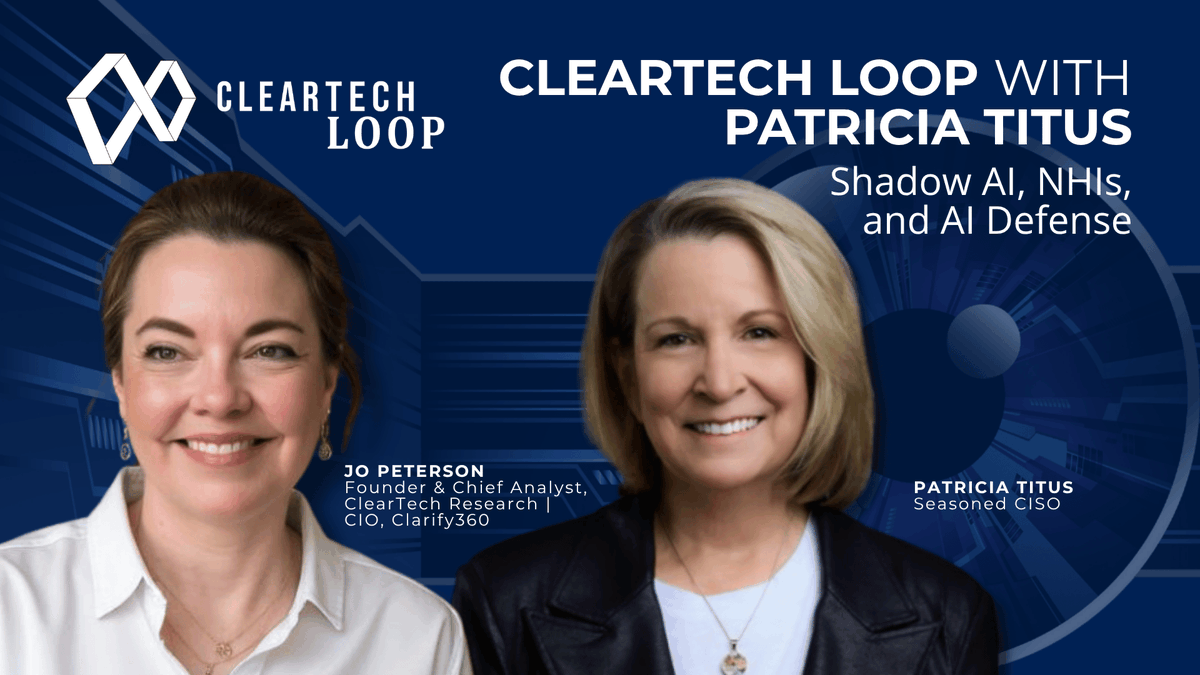
📌 Patricia Titus brought a deeply practical CISO lens to this ClearTech Loop conversation.
Patricia is a seasoned CISO who has more than 25 years of experience leading security organizations across public and private sectors, including financial services, technology, and government. She has held executive roles at Booking Holdings, Markel Corporation, Freddie Mac, Symantec, Unisys, and the TSA, and she brings a global perspective to risk, resilience, and cybersecurity leadership.
What came through in this episode was her focus on how AI risk actually shows up inside organizations.
Not as one neat problem. As a governance problem. A risk problem. A productivity problem. An identity problem. And eventually, if leaders do not get ahead of it, a security problem.
That made this conversation feel especially connected to what CISOs and CIOs are dealing with right now: AI adoption moving quickly, agents becoming more capable, and security teams trying to build controls without slowing the business down completely.
⭐ Listen to the full episode: https://t.co/9iLFrOV5RH
⭐ Stay in the Loop. Subscribe for new episodes: https://t.co/pQP1sp2Kux
#AISecurity #CISO #Cybersecurity
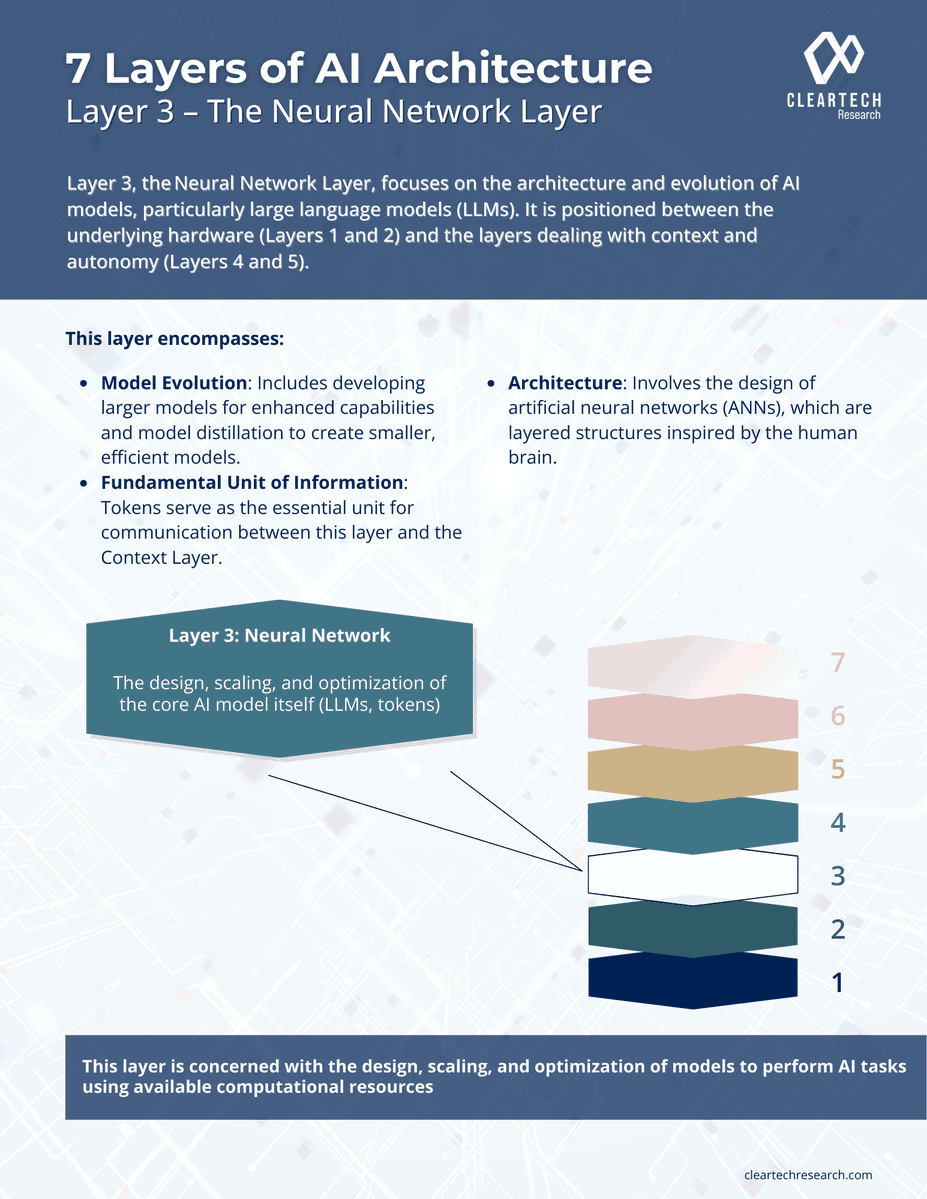
📌 In #AI the OSI model looks a bit different. Layer 3 is composed of three structural sub-layers
1. Structural Sub-Layers
2. Primary Mathematical & Algorithmic Components
3. Operations
At this tier of the AI stack, execution relies heavily on parallel processing hardware (GPUs/TPUs) running core frameworks like PyTorch, TensorFlow, or JAX
What are you seeing?
#AIInfra #AIOps
📌 In standard networking, the Layer 2 Data Link Layer handles physical addressing, error detection, and data framing between adjacent nodes.
AI models do not have internal networking layers. However, AI infrastructure utilizes Layer 2 protocols to connect clusters of Graphic Processing Units (GPUs) so they can train large models efficiently.
So what's the purpose of Layer 2, the Data Link Layer, in AI Infrastructure?
🤖 High-Speed Scaling: Connects thousands of GPUs across servers.
🤖 Direct Memory Access: Supports Remote Direct Memory Access (RDMA).
🤖 Bypassing the CPU: Transfers data directly between GPU memories.
🤖 Reducing Latency: Lowers data travel time during training.
🤖 Preventing Data Loss: Uses lossless Ethernet protocols like RoCE.
🤖 Managing Congestion: Controls traffic flow to prevent bottlenecks
#AIInfra
📌 Okay y'all, I'm working on my Claude Architect Certification. Anyone else?
It got me thinking about the architecture of Claude if it were a taco
If you know me, you know:
A: I'm a nerd
B: I'm a California girl that loves a good taco!
🌮 The Claude Code Taco Architecture
1. Sauces & Herbs: Intelligent Responses & Suggestions
The Analogy: The final, flavorful topping that ties the dish together.
The Tech: This represents the user-facing output. It includes accurate code completions, smart inline explanations, and highly optimized, refactored code blocks ready for production.
2. Premium Fillings: Contextual Understanding (NLP)
The Analogy: The main protein that gives the taco its substance and core flavor.
The Tech: Driven by Natural Language Processing (NLP), this layer parses your complex prompts, deeply understands human problem statements, and captures subtle technical nuances that rigid code compilers miss.
3. Beans & Cheese: Programming Knowledge Base
The Analogy: The dense, foundational filling holding everything in place.
The Tech: This is Claude's vast repository of code examples. It spans multiple programming languages, frameworks, syntax rules, and architectural best practices required to build functional software.
4. Fresh Veggies: Developer Tools & Integrations
The Analogy: The crisp, fresh layer connecting the fillings to the outer shell.
The Tech: This represents system interoperability. It includes IDE and terminal support, version control interaction (like Git), and external tool/API connectivity that lets Claude interact with a live development environment.
5. Crunchy Taco Shell: Robust Model Architecture (LLM)
The Analogy: The sturdy structural vessel holding the entire taco together.
The Tech: The core Claude Large Language Model (LLM). This foundational architecture provides the massive parameter scale, reliability, and computational muscle required to process and generate complex code structures securely.
cc: @DavidLinthicum
#AIInfra
📌 The CDN as a Solution Approach--AWS CloudFront
Cloud pricing has a way of looking simple right up until the bill arrives.
You start with an application. Then you add performance. Then security. Then logging. Then DNS. Then monitoring. Then someone asks about DDoS protection, bot traffic, certificates, and what happens if usage spikes.
Suddenly, the architecture makes sense, but the pricing model takes a meeting, a spreadsheet, and at least one person quietly questioning their life choices.
That is why I wanted to sit down with Cristian Graziano, Principal Product Manager at Amazon Web Services, for this ClearTech Loop Special Edition.
Cristian works on the customer experience for AWS CloudFront, including onboarding, console experience, and pricing.
In this conversation, we talked about the new AWS CloudFront flat rate plans and the bigger issue they are trying to solve: helping customers deliver and secure internet facing applications without having to piece together every cost variable one service at a time.
⭐ Listen to the episode: https://t.co/I8tYi0q0bt
⭐ Stay in the Loop. Subscribe for new episodes:
https://t.co/pQP1sp2Kux
#CloudSecurity #Cybersecurity #CISO