Exchange hot wallets are some of the most active addresses onchain — and most of them sit unlabeled.
Codatta's Cex Hot Wallet task lets contributors map them, address by address, and earn rewards for every verified submission. A cleaner map means better compliance and analytics downstream.
Trade on a CEX? Start contributing: https://t.co/9hF7F8h0fg
Data work usually pays once. You label, you get paid, and the value you helped create moves on without you.
Codatta is built around a different model — every contribution is fingerprinted onchain, turning it into an ownable asset. When that data earns downstream, smart contracts can route royalties back to the people who made it.
Own what you contribute.
Two Truths and a Lie — AI data edition.
One of these is false. Which one?
1. A single mislabeled image can quietly degrade an entire model.
2. Most public AI datasets list who labeled them.
3. Codatta verifiers re-check contributions before they count.
Drop your guess 👇
Caught an AI getting it wrong? That's a Frontier contribution.
Codatta's Correct LLM's Mistakes task: find a flawed model response, screenshot it, submit the correct answer. Earn up to 100 points per approved contribution.
Tutorial below 👇
AI training runs on human data. Contributors rarely get to prove — or own — what they gave.
Codatta is building the missing layer: Proof of Contribution, on-chain.
- every submission is fingerprinted and traceable
- every contributor holds an Ownership Token
- every use triggers royalties back to the source
Ever thought about joining a Hackathon without any coding?
Just describe your idea in natural language
Bitget AI will turn it into a strategy and bring it live
That’s the vibe of Bitget Hackathon S1
$50,000 USDT in prizes
Register now:https://t.co/jas25fmDWB
Have you ever asked two AI models the same question and gotten different answers?
That's exactly what this task is about.
Find an objective question where two AI models give different answers. Submit both responses with screenshots, plus what you believe is the correct answer.
Each valid submission helps pinpoint real knowledge gaps in today's top models — and earns you 100 points.
Watch the tutorial 👇
Most data pipelines give you a choice: accuracy or scale.
High-quality labels? Slow and expensive.
Fast, scalable collection? Noisy and unreliable.
Codatta's hybrid validation doesn't ask you to pick.
Every contribution goes through a transparent flow — contributor submits, verifier confirms, result gets recorded with a risk rating. Each step is traceable.
Accuracy and scale. Both.
💡 The Answer: STATIC!
Look at the base — it's bolted directly to the workbench rail. The arm can't go anywhere. 🔩
Reminder: "mobile/static" = does the robot platform move from place to place?
The arm itself can swing, extend, rotate — but if the base stays in one spot, it's static. Don't be fooled by all the movement! 🦾
Annotate crypto addresses and earn rewards.
Southeast Asia CEX Hot Wallet Collection — Indonesia · Thailand · Cambodia.
Trade on a local CEX? This one's for you.
Submit the exchange hot wallet addresses — 50 points each.
https://t.co/bFRCpM9zb3
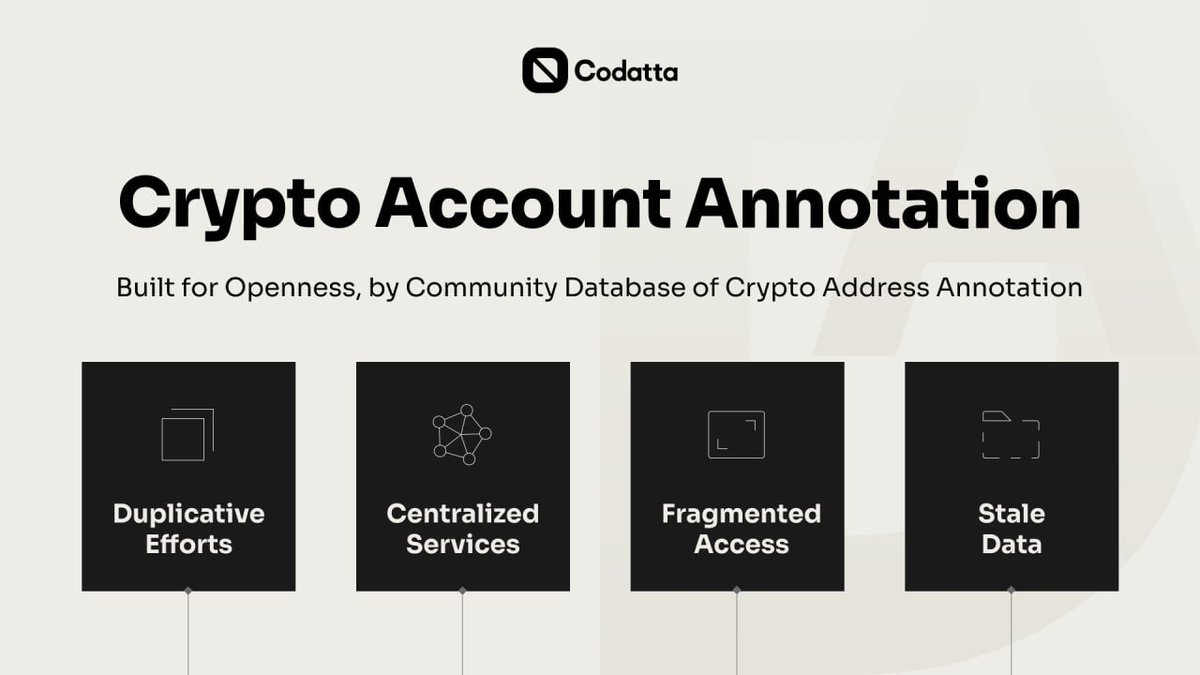
Crypto address metadata is fragmented.
Teams duplicate the same research. Centralized providers gate access. Data goes stale right when markets move fastest.
Compliance, market analysis, trading — all running on incomplete maps.
Codatta is building Crypto Address Annotation — a community-driven database where contributors enrich, verify, and update address data across chains.
A shared intelligence layer for the whole crypto ecosystem. Open, current, community-built.
No winning model uses one layer alone. But only the bottom layer can flip the data flywheel—it is the only layer cheap enough to learn from deployment loops. Whoever cracks consumer-scale structured human video quietly powers every humanoid above them.
The embodied AI field is starving for data. Sourcing high-quality robotic data is extremely difficult. To understand how the industry is solving this, we need to look at the Data Pyramid, which consists of three main layers: Real Robot Data, Simulation Data, and Internet / Human Video.
3️⃣ Internet / Huan Video
Internet and human-centric videos are the most abundant and lowest-cost raw materials available.
The Pros: Scale. It helps foundation models build basic physical cognition—understanding how the world works, spatial reasoning, and human intent.
The Cons: It lacks force, torque, and tactile feedback. A video shows the result of an action, but not the exact motor signals needed to execute it. The AI knows "what" to do, but not "how" to move its joints to do it.
The Trend: Silicon Valley pioneers like Physical Intelligence, Figure AI, and Sunday Robotics are aggressively pivoting here. By combining Reinforcement Learning with crowdsourced, ego-centric (first-person) video collection, they aim to bypass heavy teleoperation. Projects like Apple’s EgoDex and NVIDIA’s EgoScale are exactly about this: extracting high-signal, usable action data from massive, low-cost human videos.