When CodecFlow started last year, robotics was barely on crypto’s radar.
The goal was to change that by bringing the whole robot development cycle into the crypto-native world, from the first test to the finished machine.
Talking to other builders and looking at the problem as a whole, the same conclusion kept coming up: building a robot is brutally hard, for three reasons.
I. Nowhere to test it.
Labs and hardware cost more than most ideas are worth, so the first thing we built was a way around them. SimArena lets anyone check whether a robot idea works in simulation before spending anything on equipment. This week, around 80 teams at the robo.innovate hackathon in Munich are using it for their challenges.
II. Nothing to train it on.
Robots learn from examples, and the examples they need either don’t exist yet or aren’t labelled in a way a robot can learn from. It’s one of the quietest bottlenecks in robotics and one of the hardest to fix, but there’s news on it coming soon.
III. No money or network to build it.
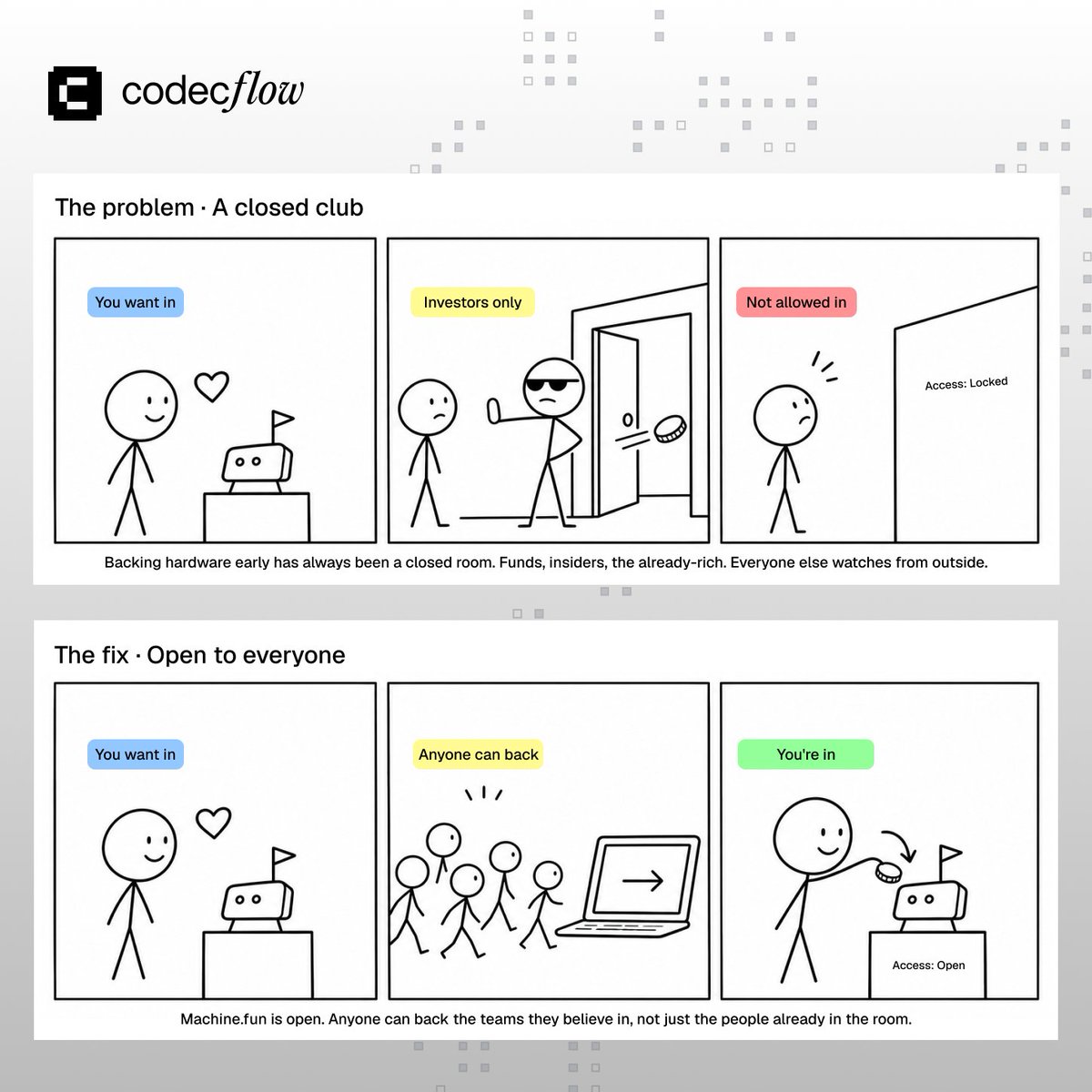
Once a robot works in simulation, getting it into production takes real capital, factory connections, a supply chain and customers waiting to buy it. This is where most robotics startups die. That’s why we teamed up with @machinedotfun and @peaq on a launchpad and accelerator built for exactly this stage.
Through partnerships and integrations with @solana, @Raydium, @sunrise and @peaq, the goal is to give machines something they’ve never had: capital markets of their own, where a robot is tradable from day one, and anyone who believes in it can take a position before the rest of the market catches on.
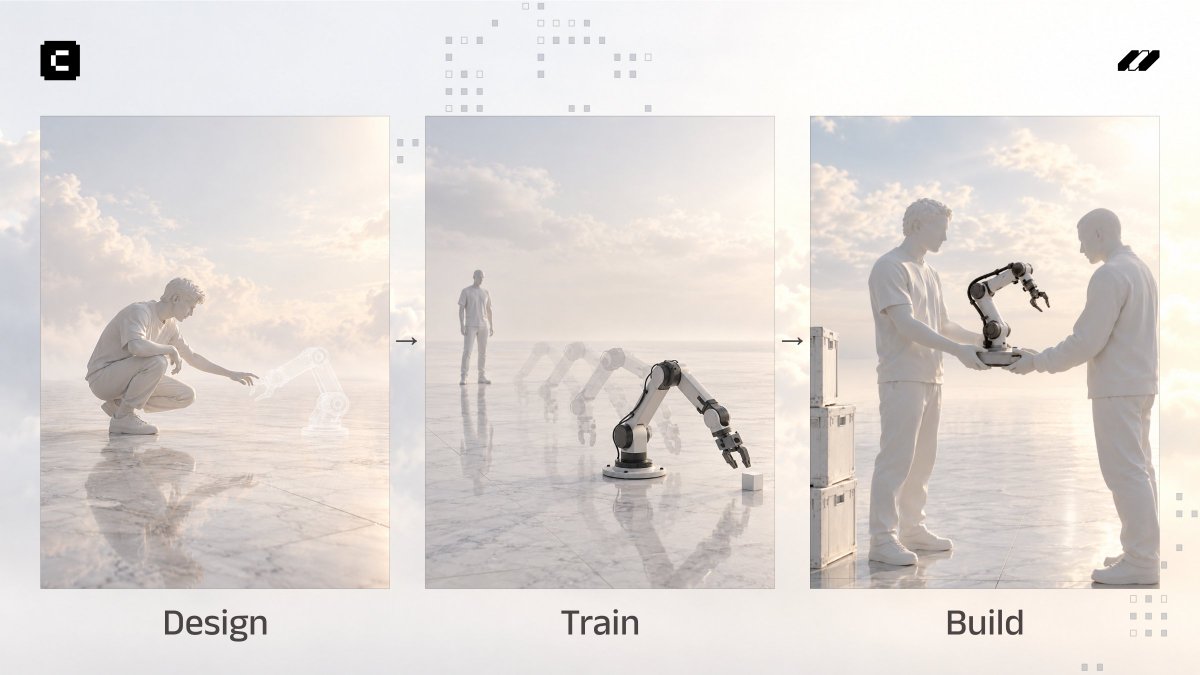
For the first time, the whole robotics lifecycle, in one place: design it → train it → build it.
We’re excited to open that door to anyone, anywhere, and help them take a machine from prototype to business.
@machinedotfun launches in the next 48H.
Our revenue dashboard is live.
In the first two weeks, the platform recorded $5.96M in trading volume and generated $80.9K in trading fees, split as follows:
Creators ($29.2K): claimable by each team at any time, giving founders operating capital without selling tokens.
Rewards ($11.5K): a per-project reserve for traders and the community, which can fund future distributions, buybacks or liquidity, allocated with each team.
Platform ($40.2K): funds project support, trader incentives, operations, marketing, treasury, and open-market buybacks of $CODEC and $PEAQ. Buyback details to follow.
Live figures: https://t.co/vRWwdfP9NB
NVIDIA’s GR00T 2 is a world-action model that predicts future video and robot actions together. This allows it to learn how physical interactions unfold and use that information to control different robot embodiments.
Its results also show why simulation is becoming central to robot-model development. Adding simulated data raised GR00T 2 Turbo’s success on out-of-distribution real-world tasks from 6.7% to 63.3%. Across 14 policies and 25 tasks, digital-twin evaluations closely tracked physical evaluations, with a Pearson correlation of 0.92.
For robotics teams, this changes how scarce hardware time can be allocated. Simulation can screen policies, expose failure modes and guide iteration before tests reach a physical robot.
CodecFlow is building the browser-native workspace for that process.
Robotics is becoming one continuous loop.
From simulation and data generation to training, evaluation, and deployment, CodecFlow keeps every stage connected in the browser.
As the loop gets tighter, robots reach the real world faster.
We integrated SimArena into @machinedotfun, so a project can show more than a pitch.
A simulation on the project page is a robot doing a task you can watch, before the hardware exists.
The Garage Era should compound in public.
CodecFlow is building the shared technical ground where one team’s simulations, failures and breakthroughs give the next team a head start.
Robotics’ Garage Era has begun.
From the late 1930s to the 1990s, several of the world’s most important companies, Apple and Amazon among them, were founded in residential garages. The garage became shorthand for how industries begin: small teams with little capital, building ahead of the market.
In practice, it was a deeply inefficient way to build.
First, most of these founders did not choose the garage. What they were building had no market yet. Banks and investors had no way to value it, suppliers and factories demanded guarantees the founders could not provide, and established companies, sometimes their own employers, saw no reason to back them. With every door closed, they funded the work themselves and built in whatever space they had.
Second, the garage was never tied to one decade or one industry. It is a recurring phase that appears whenever the price of a key component drops far enough that building no longer requires the resources of a large company.
The number of people who can build grows faster than the support available to them. This imbalance, more than talent or ideas, often determines who succeeds.
The personal computer is the clearest precedent. In the mid-1970s, volume production made microprocessors cheap enough for hobbyists to build computers at home, and they formed clubs to trade parts and designs years before the major manufacturers took the market seriously. The earliest machines had no screen or keyboard, and outside that core group they were seen as expensive toys. Each new use case then expanded their reach: spreadsheets for businesses, email, online shopping and eventually the modern internet.
None of this is unique to computers. It follows from the economics of physical products, and it will recur wherever a critical component becomes cheap enough.
Robotics has now reached that point, and it is in the same phase of early discovery.
Most people picture robots as arms welding car frames behind safety fences, or humanoids doing backflips in viral videos. Those images obscure how much of the world’s work still depends on human hands: picking and packing orders in warehouses, harvesting and weeding crops, laying bricks and inspecting building sites, lifting patients and preparing meals in hospitals and care homes.
As capable machines get cheaper and easier to teach, each of those jobs becomes a market a small team can build for.
Our vision starts from the constraints that shaped so many of today’s largest companies. Apple’s early growth could have been accelerated by a global network of people working on similar problems, and a community willing to support it before the market understood what it was building.
Machinefun brings that foundation to robotics’ garage phase.
Builders who would never have found each other can solve problems together, and the strongest ideas can rise to the surface in the open.
Every attempt, successful or not, adds to a body of knowledge the next team can learn from. Those closest to the frontier can identify breakthroughs early and accelerate new discoveries, all while allowing the speculative upside to be captured in public.
No technology boom has ever had that. The garage phase of the personal computer reshaped society, but that premium went to the small circle on the inside.
Robotics can be the first technological revolution to build its foundational phase in public.
Machinefun opens the doors.
Robotics companies can start in SimArena, with builders turning ideas into working simulations long before production.
Machinefun gives those teams a place to raise, find their community and reach production. CodecFlow is here to help them prove the work and keep building.