I am excited to share my new article that explains how we can apply insights from complexity and evolution to guide humanity through a planetary phase transition and live regeneratively on the other side.
Please read and share widely!
https://t.co/RvYARSawqx
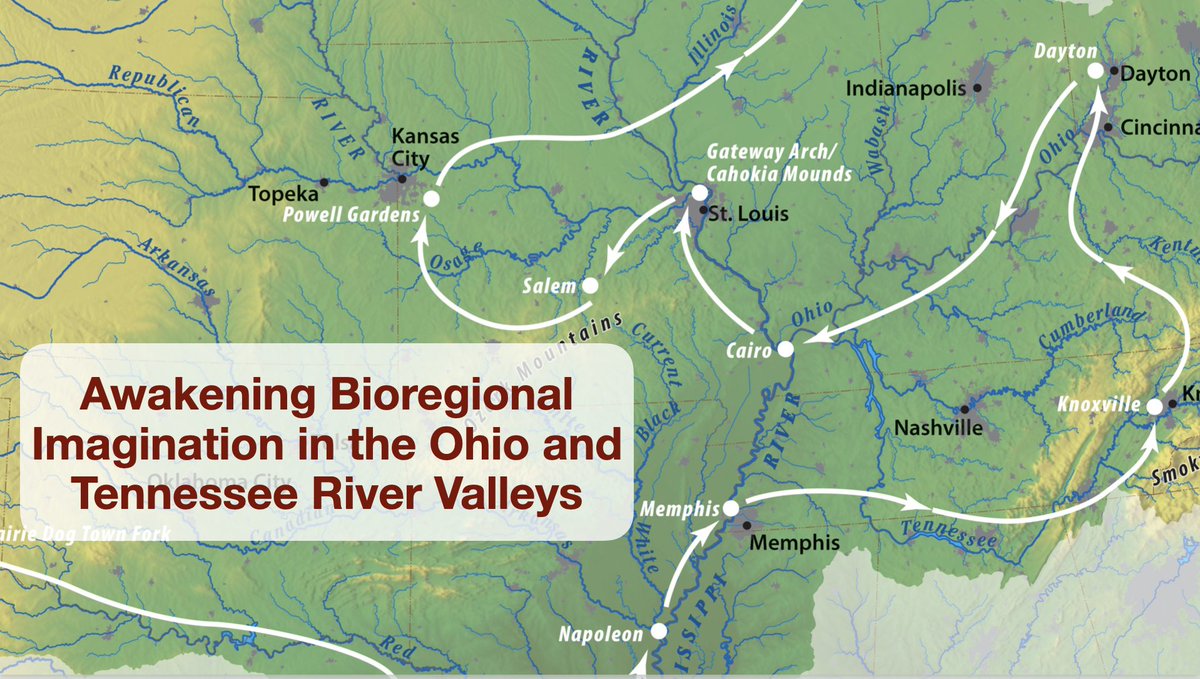
Today we journey north to Dayton and will spend the next two days participating in community gatherings to catalyze a bioregional learning center into being for the Miami Valley that is part of the vast Ohio River Basin.
Will we meet you while we are in the area? Come join us!
@alexpdiggs Let us know if you'd like to drive out to meet us in Cairo -- though I should add that we are just passing through and will only stay there an hour or two on our way to St Louis.
Today begins the next phase of the bioregional pilgrimage into the Heart of Turtle Island.
Penny and I travel to Memphis, then out into the Tennessee and Ohio River Valleys. Our mission is to plant seeds for bioregional learning centers while listening deeply to these sacred landscapes.
Do you know anyone who lives in these regions? Please help spread the word.
You can follow our journey on Substack here:
https://t.co/67caHCKgP5
And see the entire route of their journey here:
https://t.co/w8AfR1RjcU
@alexpdiggs The lines are to connect words in a way that don't get in the way of the places we are going. Basically, we will go in this sequence: Smoky Mountains -- Tennessee River Headwaters -- Dayton Ohio -- Cairo Illinois.
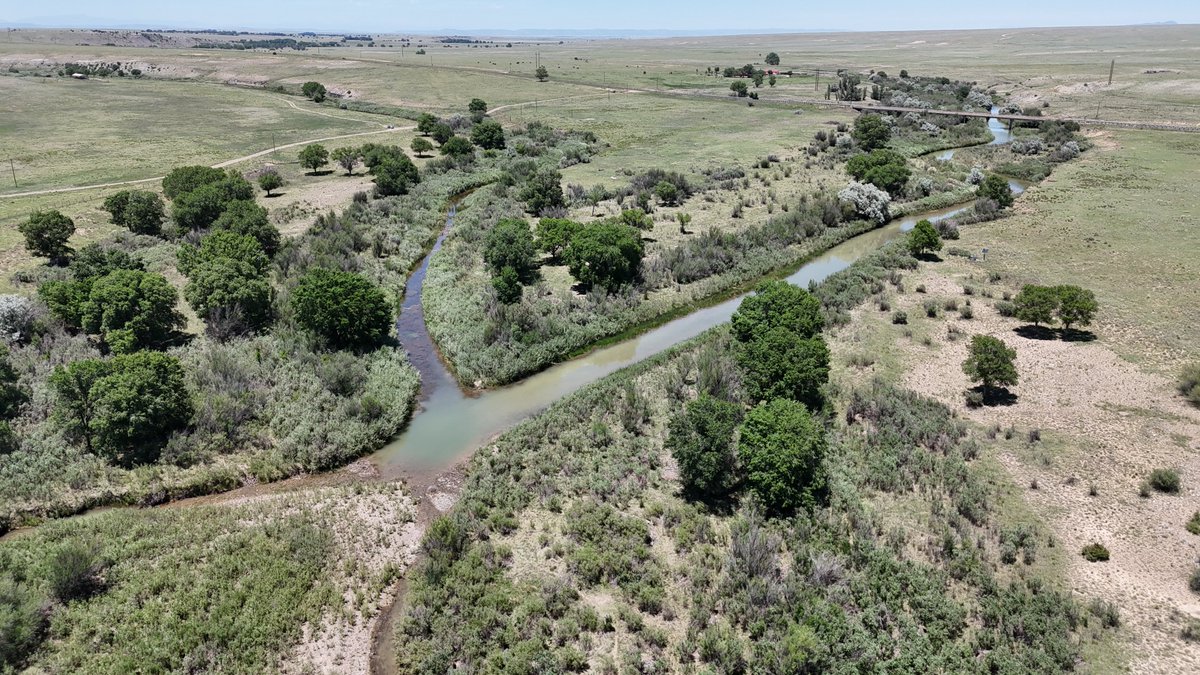
Yesterday Penny and I spent four hours driving to different places in the hopes of getting close enough to the confluence with the Arkansas River that we could take a photo with our drone. This is what we managed to get — flying the drone 500 meters up and 1.5 km away.
Why was it so hard to get to the confluence? Because the sheer overwhelming power of flooding and shifting river courses makes the land too dangerous to enter without going in a boat! We have a LOT of respect for the upper delta now. ;-)
One of the towns we visited yesterday was Arkansas City — where in 1927 there was a massive flood. One day the town had a port on the edge of the Mississippi. Five months submerged by flood waters. Then the river had moved more than a mile away and the port now sits abandoned in the middle of agricultural lands far from the river.
This hydrological system is amazing!
Today we travel to Memphis and then we head out towards the Smoky Mountains and the headwaters of Tennessee River.
@hartsellml Sadly we didn't go there -- but we did see a LOT of sites with earthen mounds as we drove through Mississippi yesterday on our way to the confluence with the Arkansas River.
We continue our bioregional pilgrimage through the heart of Turtle Island -- following the sacred headwaters and major confluences of rivers.
Today we will leave the Mississippi Delta that gathers waters from half a continent and mingles them into the sea. A great sharing of stories and energies. Sediments that bring life gathering in ancient waters together with the largest "dead zone" on Earth from chemical runoff.
Our journey takes us northward to the confluence where the Arkansas River meets the Mighty Mississippi. We will visit those hallowed grounds today before continuing on to Memphis The Tennessee and Ohio Rivers are calling us to their incredible landscapes.
We are traveling in an unusual way. Our primary focus is on what is real in these places. How is life happening and what is so important about waters connecting them all with each other. The stories hidden just below the surface of human drama -- some hidden on purpose through genocide and others hidden in plain sight because people have lost the ability to see them.
We are planting seeds for bioregional learning centers everywhere we go. Earth Regenerators meet us along the way. Sometimes we hold community gatherings, give talks, visit regenerative projects. Other times we simply go and sit with the water, listening with open hearts and clear minds.
This is part of our Dandelion Strategy for Regenerating the Earth. I wrote an essay two days ago about how we can learn from the living flows of our incredible planet to know how to create regenerative economies at all necessary scales. This journey is grounding those ideas in what is real today.
Here is the essay if you'd like to read it:
https://t.co/yJF8TVHh5v
Onward, fellow humans.
Who do we know that lives near Dayton, Ohio? We will be in the area for local gatherings and events as part of our bioregional pilgrimage on June 29th and 30th. Message me if you’d like to join our WhatsApp group for local updates.
Hope to see you there!
Are you curious how regenerative finance works? What it looks like to structure a bioregional funding ecosystem? How it is all informed by living processes of the Earth?
Then you’ll want to read this!
https://t.co/D5DdvXEQAF
What are you doing to make the world a better place? I am celebrating Father's Day on a different continent than my daughter because I want her to have a future where humanity is coming back into harmony with life.
She is in Colombia right now where a fascist regime may take over during the elections today. I am in Wichita Falls, Texas on a bioregional pilgrimage through the Heart of Turtle Island -- where we are planting seeds for bioregional learning centers all across this beautiful continent.
Yet the most important work I contribute to the future may well be my child. As many of you know, we have invested deeply in creating learning ecosystems for children in Colombia. Kids and their families learning how to restore the tropical dry forest, heal the badly damaged streams, and cultivate a human capacity for healthy emotions and ethical living.
We created Sueños del Bosque three years ago when we saw how traumatized and broken the adults around us were behaving -- and that was among the people who claim to promote regenerative living. It became clear to us that the kids are much more powerful for guiding change in the world.
Invest in them and there might be a future for our species. I am doing this as a father. And it really brings deep love and light into my life.
Being a dad is the best thing I've ever done.
Onward, fellow humans.
It was a wonderful experience! Planting seeds for bioregional learning centers -- this one in the Ogallala Aquifer. Will and the team are doing great work there.
@Myceliyum19 We work closely with Indigenous leaders through the work in the Greater Tkaronto Bioregion through what is called the "Two-Eyed Way of Seeing" that has nuances to care for but is quite powerful when approached well.
Look into this and you'll get some ideas.
Yesterday we visited the confluence of the Cimarron River (left) and the Canadian River (right) on the High Plains of New Mexico. Our bioregional pilgrimage through the Heart of Turtle Island is connecting us with water in ways that are hard to imagine.
Now we see how the snowpack in the Rockies creates headwaters that flow out into the high plains. Glacial tills from ancient ice sheets provide pathways for water to infiltrate into the ground. All that moves over the surface coming into alignment with the "Father of Waters" -- as the Ojibwe called the Mississippi River.
Water connects most of the continent. And we are witnessing the connections with our own eyes. Touching it with our hands. Sensing how to participate in regeneration within and among bioregions that form a tapestry of culture and ecology that spans Turtle Island.
Onward, fellow humans.
That is one of the key questions that local stakeholders in the bioregion will need to address.
The regeneration of these sacred lands involves ancestral knowledge and land management practices that come into healthy collaboration with ecosystem restoration and land-system monitoring that can be enabled by contemporary science.
Say hello to the Ogallala Aquifer. I like to describe this as THE most important groundwater system on Earth. It is the source for most of the agricultural production on the Great Plains. And it is being depleted much more quickly that it can recharge.
Today we will be at Wildcat Bluff Nature Center in Amarillo, Texas talking about how a bioregional learning center could be one of the key design elements for bringing together all the ways to regenerate this incredible hydrological system. Maybe we’ll see you there? Our gathering starts at 4 PM.
Also, check out the work of our friends who take this mission to heart:
https://t.co/QeLrHdhFvt
While Penny and I travel through Turtle Island planting seeds for bioregional learning centers, our team in Barichara Colombia continues the earnest work of weaving a regenerative learning ecosystem.
Here is a photo of our teacher, Milena, offering a workshop to parents and teachers in a rural school. Another teacher, Jonatan, began training the first cohort this week in our regenerative pedagogy. Today is the closing celebration for the first half of the year with children and families who enroll in our programs.
We have been sending them notes and photos from our journey to inspire them about what bioregional learning could become — as they prepare to move up to the bioregional scale of tne entire Northern Andes.
Onward, fellow humans.