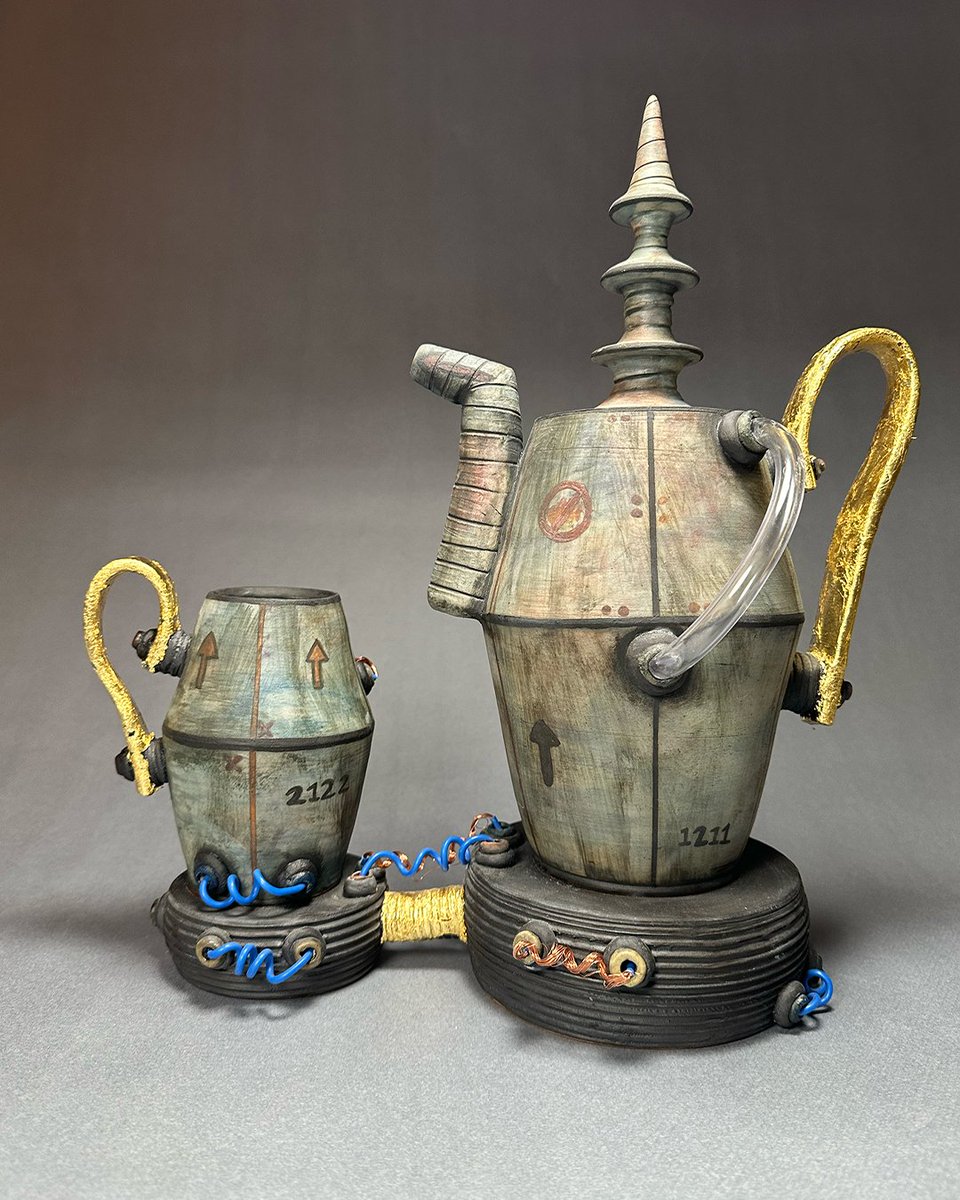
“Reboot Rebooted” by Denver Whaley | AP 3-D Art and Design
Denver Whaley's work was selected for the 2025 AP Art and Design Digital Exhibit, which features exceptional artwork from AP students’ final portfolios.
🎨Learn more about Denver's work: https://t.co/9b7vQkWHMw
We're almost there! This weekend, we'll be in New Orleans for ASCA 2026.
Find us at Booth 719 and let's celebrate the counselors who open doors toward opportunity, possibility, and college and career success for students every day.
Reply with your answer to this #SATPractice question, and we'll post the right one later today!
💻 Register for the August SAT today: https://t.co/rE9ArNkfZ2
Rural and small-town students bring real talent and strong community ties to the college-going process. Join us Thursday, July 30 at 11 a.m. ET for a free CSI26 session on outreach strategies and partnerships that are working for these communities. Free. 0.1 CEU.
Register: https://t.co/CoSdFvflEN
Ok, that’s a wrap – all of the 2026 AP Exam results have been posted.
Special thanks to my colleagues Priscyla and Karlie, who helped with the drafting, proofreading, and posting, as we’ve expanded the amount of commentary from ~40 pages to ~110 this year. Big thanks as well to the dozens of AP course experts who, after the fatigue of weeks of AP Readings, also provided help reviewing and improving the descriptions of the exam questions, as I’m (obviously) not a content expert across all 40+ subjects.
AP teachers, AP students: wishing you a restful and joyful summer break, and an extra note of gratitude to the 30,000 AP teachers and professors who scored more than 20 million essays and free-response questions these past few weeks.
Looking ahead . . .
Here’s a reminder of when and how STUDENTS can view their scores on July 6: https://t.co/u2bTSrgujK
And here’s a reminder of when and how EDUCATORS can view scores on July 6: https://t.co/mTHPXSa239
The 2026 AP Physics C: Electricity & Magnetism Exam scores:
5: 24%; 4: 24%; 3: 27%; 2: 17%; 1: 8%
The 2026 AP Physics C: Electricity & Magnetism Exam was taken by ~32,000 students — less than 1% of the U.S. high school population.
Multiple-Choice Questions
Students scored evenly and well across most topics of the course, but distinctly strongest on questions related to Electric Circuits (Unit 11). Students achieving AP 5s typically answered 100% of these questions correctly.
The questions about Electromagnetic Induction, overall, were slightly more challenging than the other units’ questions; 15% of students answered all of these questions right.
Free-Response Questions
https://t.co/Tn47pf5xmL
FRQ #1, the Mathematical Routines question about Magnetic Fields and Forces due to Two Parallel Current-Carrying Wires, considers two long cylindrical wires carrying the same total current I₀ in opposite directions, where Wire S (radius 2a, centered at the origin) has a nonuniform current density that varies radially as J = Cr, and Wire T (radius a, centered at x = 10a) has uniform current density. In Part A, students applied Ampère’s law to derive the magnetic field in Wire S at x = a, requiring them to integrate over the nonuniform current density enclosed by the Amperian loop before applying the law. The students then sketched the magnitude of the total magnetic field as a function of position x along the x-axis from x = 2a to x = 9a, which is the region between the wires. In Part B, students derived the net magnetic force on a charged sphere moving with speed v in the +x-direction at x = 5a, requiring them to determine the superposition of fields from both wires at that location and apply F = qvB.
This was the distinctly the most difficult FRQ on this year’s exam, with three of the possible points proving especially useful in identifying the advanced proficiency characteristic of students achieving AP 5s.
FRQ #2, the Translation Between Representations question about Electric Fields, Electric Potential, and Superposition from Two Charged Rods, begins with two finite, uniformly charged rods: Rod S oriented along the x-axis from −3L to −L, and Rod T oriented along the y-axis from L to 3L, both with positive linear charge density +λ. In Part A, students drew the direction of the net electric field at Point P, located at (−2L, 2L), and at the origin, as well as the direction of the acceleration of a negatively charged sphere released at the origin. In Part B, students derived a symbolic expression for the magnitude of the net electric field at the origin by integrating over the rods and using superposition principles. In Part C, after Rod T is removed, students sketched the electric potential at the origin as Rod S moves away in the −x-direction. Finally, in Part D, students compared the sketch from Part C to the case where a negatively charged Rod W (charge density −λ) simultaneously recedes in the +y-direction at the same speed. This question showcases the full calculus machinery of the electrostatics units: vector field superposition, integration over finite charge distributions, and qualitative reasoning about potential as a scalar sum.
In contrast to FRQ 1, this FRQ provided multiple opportunities for students receiving AP 1s and AP 2s to demonstrate their knowledge and skills, such that this question best differentiated students receiving AP 2s, who were generally able to earn a significant number of points on this FRQ, from students receiving AP 1s, who could usually earn just a few.
FRQ #3, the Experimental Design and Analysis question about Inductance from LC Circuit Oscillation and RL Circuit Data Analysis, challenged students across two distinct experiments. In Experiment 1 (Parts A and B), multiple charged capacitors of known capacitance and a voltmeter that measures potential difference as a function of time are available. Each trial connects the inductor L₁ to a different capacitor in an LC circuit. In Part A, students identified which measured quantities would allow determination of L₁ via a linear graph − for example, by measuring the potential difference across the capacitor long enough to determine the period of oscillation. Students also described a method to reduce experimental uncertainty. In Part B, students identified the quantities to plot that would produce a linear relationship – for example, by recognizing that the oscillation period T is related to L₁ by T² = 4π²L₁C, so L₁ could be found from the slope of a plot of T² vs. C. In Experiment 2 (Parts C and D), a new inductor L₂ is connected to a 12 V battery and a 10 Ω resistor; five measured pairs of current I and rate of change of current dI/dt are provided. Students were expected to recognize that the Kirchhoff’s loop rule equation ε - IR - L(dI/dt) = 0 linearizes as LdI/dt = ε − IR. Therefore, one approach would be to plot ε – IR vs. dI/dt to yield a line whose slope equals L₂. The students then graphed the data, drew a best-fit line, and calculated L₂ from the slope.
Similar to FRQ #2, this FRQ, overall the least challenging on this year’s exam, provided multiple opportunities to differentiate between AP 1s, 2s, and 3s, with students achieving 3+ scores typically able to earn the majority of the points, and students earning AP 2s able to obtain significantly more points across these various tasks than students receiving AP 1s.
FRQ #4, the Qualitative/Quantitative Translation question about Electromagnetic Induction in a Square Conducting Loop, asked students to reason about the induced current in a square conducting loop held in a time-varying magnetic field Bz = B₀ cos(2πt/t₁) initially directed in the +z-direction. In Part A, students indicated the direction of the induced current during the interval 0 < t < t₁/4 using Lenz’s law and justified the answer using qualitative reasoning that addressed the magnetic field due to the induced current in the loop opposing the change in the external magnetic field. In Part B, the students derived a symbolic expression for the induced current I as a function of time by applying Faraday’s law and Ohm’s law. In Part C, the students compared the maximum induced current in a new loop with both side length and resistance doubled relative to the original loop and justified their answer by referencing the functional dependence of the expression for the induced current derived in Part B – specifically, that the maximum emf is proportional to s² and inversely proportional to resistance, so I₂ = 2I₁.
This final question focused squarely on the more advanced students in the course, providing many opportunities for students earning AP 3s to distinguish themselves from performance at the AP 2 level. Students achieving AP 5s typically earned perfect scores on this FRQ, so if you’re wondering whether you’re on track for a 5, take another look at this question, and if you can answer all parts of it thoroughly and accurately, odds are that you’re among this year’s AP 5s.
All subjects’ AP score distributions for 2026 will be posted here when available: https://t.co/OrkaQhPZYO
Graduates of colleges with higher graduation rates tend to have higher earnings. Degree completion matters.
Get additional findings on college pathways and future earnings in our Education Pays 2026 report: https://t.co/6OQ4jeNwfn
The 2026 AP Physics C: Mechanics Exam scores:
5: 20%; 4: 25%; 3: 27%; 2: 17%; 1: 11%
The 2026 AP Physics C: Mechanics exam was taken by ~70,000 students — less than 1% of the U.S. high school population.
Multiple-Choice Questions
Students soared through the questions related to Linear Momentum (Unit 4): an impressive 41% earned perfect scores across this topic area.
Students also generally scored well on questions related to Unit 5 (Torque and Rotational Dynamics) and Unit 6 (Energy and Momentum of Rotating Systems). Students achieving AP 5s typically missed no more than a single point across all of these questions.
Free-Response Questions
https://t.co/SljLV548E6
FRQ #1, a question about Velocity-Dependent Resistive Forces, Normal Force, Friction, and a Sliding Cube Inside a Decelerating Box, opened the exam with a rich, multi-layered application of Newton’s second law. A box of mass M decelerates horizontally under a resistive force F_r = −bv, while a cube of equal mass M remains against the box’s interior right wall. Because the resistive force is velocity-dependent, the deceleration is not constant — it decreases over time as the system slows — and so the normal force F_N exerted on the cube by the wall decreases with time as well. The nonzero normal force causes friction between the cube and the wall, preventing the cube from moving down the wall until the normal forces decreases to a critical value. In Part A, students determined the acceleration of the cube in terms of F_N, derived F_N as an explicit function of time (requiring them to solve the equation of motion for the decelerating box-cube system, yielding F_N = ) 1/2 b(v_0)e^(-bt/2M) for the combined system), and sketched the frictional force on the cube versus time — a curve that begins at a constant value and later decreases exponentially, proportional to F_N, after static friction can no longer support the cube’s weight. In Part B, students derived t_crit, the moment when the decreasing friction force can no longer support the cube’s weight against gravity, which requires setting the maximum static friction equal to Mg and solving for the time at which the exponentially decaying F_N causes the friction force to cross that threshold.
This was an exceptionally challenging FRQ, by far the toughest of this year’s exam, aimed at providing the most advanced students – students qualifying for AP 5s -- with opportunities to demonstrate their knowledge and thereby differentiate themselves from students receiving other scores, who could not typically earn most of the possible points across this beast of an FRQ.
FRQ #2, the longest question on the exam (suggested 30 minutes), about Projectile Motion, Midair Explosion, Momentum Conservation, and Center-of-Mass Kinematics, requires students to translate concepts across several different representations. A projectile of mass 4M is launched at angle θ with speed v_0; at the apex of its trajectory, it explodes into Piece Q (mass M) and Piece R (mass 3M), with the pieces separating horizontally. Piece Q lands back at x = 0; Piece R lands at x = x_2. Across four parts, students drew scaled momentum bar diagrams for each piece at the moment of explosion — requiring them to apply momentum conservation graphically and recognize that Piece Q’s horizontal momentum is one fourth the magnitude of and opposite to the center-of-mass momentum, and that both pieces have zero vertical momentum at the apex — then derived a symbolic expression for x_2 starting from conservation of momentum, extended a velocity-vs-time graph from pre-explosion through post-explosion for both pieces and the center of mass (Piece Q moving backward at speed (v_0)cosθ to land at x = 0, Piece R moving forward faster than (v_0)cosθ, and the center of mass continuing at (v_0)cosθ as required by Newton’s first law for the system), and finally reasoned whether Piece R lands farther when Piece Q instead drops straight down — correctly concluding x_new < x_2 because Piece Q retaining zero horizontal velocity results in less horizontal momentum for Piece R than when Q moves backward.
This was a challenging question, and provided students earning AP scores of 3+ with multiple opportunities to earn points and show their proficiency in calculus-based physics, differentiating themselves from students receiving AP 2s, who generally earned just 1 of the available points here.
FRQ #3, a question about Kinetic Friction Measurement with a Spring and Block, and Spring Constant Determination via Energy Conservation, challenged students across two experiments. In Experiment 1 (Parts A and B), a block of known mass m rests against a spring of known constant k; beyond position x = 0, there is friction. Students — with only a meterstick — identified which distances to measure, proposed an uncertainty-reduction method, and designed a linearizing graph: by measuring the initial compression x_0 and the distance d the block slides before stopping on the rough surface, energy conservation gives 1/2 k(x_0)^2 = (μ_k)mgd, so plotting x_0^2 vs. d yields a line whose slope is 2(μ_k)mg/k. In Experiment 2 (Parts C and D), a new spring k_new launches a 2.0 kg block up a ramp with negligible friction; students measure maximum height h for five compression distances s and are given five (s, h) data pairs. Energy conservation gives 1/2(k_new)s^2 = mgh, so plotting h vs. s^2 yields a line through the origin with slope k_new/(2mg). Students graphed the data, drew a best-fit line, and extracted k_new from the slope.
Students overall earned higher scores on this FRQ than any of the others on this year’s exam, and provided students across the range of AP 2-5 with opportunities to show how far they could go along the spectrum of skills measured by this FRQ, as the distribution of points across these different levels of proficiency was very even.
Part B served to differentiate AP 4s and AP 5s from other students, as this was the most difficult section of this FRQ. In turn, Part D served to differentiate AP 4s from AP 3s, as AP 3s generally found Part D to be beyond their skills.
FRQ #4, a question about Rotational Dynamics, Work-Energy Theorem, and the Effect of Crank Arm Length on a Unicycle Wheel, asked students to reason about three scenarios involving a unicycle wheel of rotational inertia I_W being spun by a crank arm with a constant perpendicular force F. In Scenario 1 (crank arm length ℓ_1), in Scenario 2 (crank arm length ℓ_2 > ℓ_1), and in Scenario 3 (the wheel on the ground, free to roll without slipping). In Part A, students indicated that ω_2 > ω_1 and justified conceptually that the longer crank arm exerts a greater torque and does more work over one full rotation (the force travels a larger arc length 2πℓ_2 vs. 2πℓ_1), so the wheel gains more rotational kinetic energy. In Part B, they derived ω_1 from the work-energy theorem: the work done is F·2πℓ_1 (force times arc length of one rotation), setting this equal to 1/2 (I_W)(ω_1)^2 and solving. In Part C, students argued that ω_3 < ω_1 because when the unicycle is on the ground, the same applied torque must now also accelerate the translational motion of the unicycle — the wheel’s rotational kinetic energy and the system’s translational kinetic energy are both supplied by the same work input F·2πℓ_1, leaving less energy available for rotation alone.
Students receiving AP 2s could typically begin the question and earn a point, but it was sufficiently challenging to serve primarily for providing a range of difficulties well suited to distinguishing between AP 3s, 4s, and 5s.
All subjects' AP score distributions for 2026 will be posted here when available: https://t.co/OrkaQhPZYO
The 2026 AP Physics 2 Exam scores:
5: 20%; 4: 29%; 3: 23%; 2: 21%; 1: 7%
The 2026 AP Physics 2 exam was taken by approximately 25,000 students — less than 1% of the U.S. high school population.
Multiple-Choice Questions
Students scored highest on questions related to Thermodynamics (Unit 9); 15% of students earned perfect marks across all of these questions.
Overall, the most challenging sections were related to Electric Force, Field, and Potential (Unit 10) and Waves, Sound, and Physics Optics (Unit 14). 8% of students earned all of the points possible across the questions for these units.
Free-Response Questions
https://t.co/FrwzG7yWZV
FRQ #1, a Mathematical Routines question about Ideal Gas Behavior, Maxwell-Boltzmann Distributions, and Thermal Energy Transfer, initially presented students with a scenario that included a monatomic, ideal gas in a fixed-volume container that also contained a very small, thermally conducting sphere. The students sketched a Maxwell-Boltzmann distribution representing the number of atoms per unit speed as a function of atom speed for the gas after a heating process, based on a similar distribution for the gas at a lower temperature. The students then derived expressions for both the temperature change of the gas due to the heating process and the specific heat of the sphere. The students were then presented with a scenario in which a thermally conducting sphere was submerged in a liquid, with the initial temperature of the sphere greater than that of the liquid. The students had to qualitatively justify why the absolute value of the temperature change of the sphere had to exceed that of the liquid, given that the sphere had both smaller mass and smaller specific heat. This question illustrates the connection between microscopic models of ideal gas behavior, as represented by Maxwell-Boltzmann distributions, and macroscopic thermal energy transfer, as described by changes in temperature and specific heat.
This question contained a number of tasks generally attainable by students receiving AP 2s, providing opportunities for these students to earn a number of points. Student attaining an AP 3 or higher needed to earn the majority of this FRQ’s points, and students achieving AP 5s typically earned all points possible here.
FRQ #2, a Translation Between Representations question about Energy Levels of a Hypothetical Atom, Photon Emission from an Atom in an Excited State, and the Classical and Modern Theories of Electromagnetic Radiation, initially presented students with a scenario that included an energy-level diagram of a hypothetical atom. The students were asked to draw arrows on the diagram to represent all possible transitions that resulted in the emission of a photon. The students then derived an expression for the wavelength of the highest-energy photon that could be emitted from the hypothetical atom. The students were then presented with a scenario in which a device could emit electromagnetic radiation across a continuous range of wavelengths. The students sketched a graph of photon energy as a function of wavelength and then made and justified a claim about whether the hypothetical atom could emit a photon with the same energy as a photon of a particular energy that could be emitted by the device. This question illustrates the distinction between quantized energy levels, as described by the modern theory of electromagnetic radiation, and the continuous spectrum available from a device, as described by the classical theory of electromagnetic radiation.
Part A of this FRQ contributed to differentiating between scores of 1, 2, and 3, as some points here were attainable by less proficient students, while students receiving AP 3s were typically able to earn full points on Part A. What set AP 5s apart here is their general ability to earn all 12 points possible across the full scope of this FRQ.
FRQ #3, an Experimental Design and Analysis question about Electric and Magnetic Forces Exerted on a Charged Sphere and the Circular Motion of Charged Particles in a Uniform Magnetic Field, presented students with two different experiments. In Experiment 1, the students analyzed a velocity selector that used a variable-emf power supply and parallel, charged, conducting plates to balance the electric and magnetic forces exerted on charged spheres. The students identified which quantities to measure with the available equipment to determine the magnitude of the magnetic field, indicated a method to reduce uncertainty, and designed a linearized graph whose slope could be used to determine the magnitude of the magnetic field. In Experiment 2, identical, charged particles were launched into an external, uniform magnetic field of varying, known magnitude between trials, and the resulting circular orbital radii were provided. The students had to identify which quantities to plot to linearize the relationship between the magnitude of the magnetic field and the orbital radius of the charged particles, plot the provided data, draw a best-fit line, and calculate the mass of the particles based on the slope of the best-fit line. This question illustrates the connection between the physics of charged objects in external fields and the methodology of experimental design and graphical data analysis.
Part A differentiated between AP scores of 3 and 2, as students achieving AP 3s were consistently able to earn full marks on Part A, whereas students receiving AP 2s typically could not.
Part B differentiated AP 3s from AP 4s and 5s; the higher scoring students typically earned full points on Part B, whereas AP 3s earned partial.
Part C was relatively easy, serving to differentiate students receiving AP 2s, who did not usually attain all of the points possible on this part, from students earning 3+ scores, who did.
Part D was the playground for AP 4s and 5s, providing opportunities for them to show their knowledge and skills, as other students generally could not obtain these points.
FRQ #4, a Qualitative/Quantitative Translation question about Electric Potential, Kinetic Energy, and Conservation of Energy Associated with a Charged Sphere in an Electric Field, initially presented students with a scenario in which an electric field was represented by equipotential lines and a positively charged sphere moved from a lower electric potential to a higher electric potential between two indicated points. The students had to indicate and justify whether the final speed of the positively charged sphere was greater than, less than, or equal to the initial speed of the positively charged sphere. The students then derived an expression for the final kinetic energy of the positively charged sphere. Lastly, the students were then presented with a scenario in which a negatively charged sphere with the same mass and initial speed as the original positively charged sphere moved from a lower electric potential to a higher electric potential between the two original indicated points. The students were asked to compare the final kinetic energy of the negatively charged sphere to that of the positively charged sphere. This question illustrates the relationship between electric potential energy of a charged sphere-electric field system, kinetic energy, and the sign of the charge when applying conservation of energy to the motion of charged objects in an electric field represented by equipotential lines.
Too challenging for students receiving AP 1s, the difficulty of these points ranged from a point that students receiving AP 2s could typically earn, to a significant number of advanced points designed to separate students achieving AP 5s, who usually earned all points possible on this FRQ, from students earning AP 4s, who could earn mot but not all of the advanced points.
All subjects' AP score distributions for 2026 will be posted here when available: https://t.co/OrkaQhPZYO
The 2026 AP Physics 1 Exam scores:
5: 19%; 4: 24%; 3: 25%; 2: 15%; 1: 17%
The 2026 AP Physics 1 exam was taken by approximately 184,000 students — 1% of the U.S. high school population.
Multiple-Choice Questions
Students scored highest on questions related to Unit 1, Kinematics, with 25% of students earning 100% of the points possible here.
Students also did very well on questions related to Unit 3, Work, Energy, and Power, with AP students who earned scores of 3+ generally earning most or all of these points.
Free-Response Questions (FRQs)
https://t.co/bvHZrzplHC
FRQ #1, a Mathematical Routines question about Projectile Motion and Fluid Flow from a Fountain Nozzle, opened the exam with a rich kinematics scenario: a water droplet that exited a fountain nozzle at an angle above the horizontal, rose to maximum height, and then returned to nozzle height. In the first part, students sketched graphs of both components of velocity as functions of time and then derived symbolic expressions for the exit speed of the water and the volume flow rate through the circular nozzle. In the next part, students transitioned to a comparative reasoning task. The nozzle was replaced by a smaller nozzle, with all other quantities held constant. Students made and justified a claim about how changing the nozzle affects the maximum height of the water. This question requires students to integrate kinematics, continuity of flow, and qualitative reasoning simultaneously.
Across all of this year’s FRQs across the ~40 AP subjects, this is the most pristine I’ve yet seen in the way it so evenly spreads the difficulty of the points across the full 10-points possible, designing points of differing difficulty so that there are at least two points aimed at identifying students qualified for each of the AP score categories of AP 2 to AP 5. It’s a brilliantly designed question, all credit to the Physics professors, teachers, and staff who collaborated to create it. AP students achieving 5s typically earned at least 9 points, students achieving 4s, at least 6 points, students achieving 3s, at least 4 points, and students receiving AP 2s, at least 2 points. A specific example:
In Part B, students receiving AP 2s were typically able to indicate the maximum height of the droplet from the new nozzle, but only students earning AP 3+ scores were typically able to justify their response with qualitative reasoning.
FRQ #2, a Translation Between Representations question about Linear Momentum, Collisions, and Center of Mass Motion, was the most multi-layered question on the exam and showcased multiple representations across four parts. The scenario presented a collision between Disk R and Disk S. First, students drew scaled momentum vectors for the disks after the collision, which required them to illustrate momentum conservation graphically. Students then derived an expression for the kinetic energy of Disk S after the collision, starting from conservation of linear momentum. Next, students sketched a graph of the position as a function of time for both disks and the center of mass after the collision. Finally, students made and justified a claim about the magnitudes of the momentum changes of Disk R and Disk S during the collision. Each part of this question requires a different representational skill: vector diagram, algebraic derivation, graphical reasoning, and conceptual justification.
This FRQ had several components that made it, overall, slightly easier than the others, providing opportunities to differentiate students earning AP 2s from students receiving AP 1s, as students receiving AP 2s were able to attain at least 3 points, several of which were in Part A, across this FRQ.
FRQ #3, an Experimental Design and Analysis question about Blocks Moving Along Surfaces With and Without Friction, presented students with two different experiments that involved frictional forces. In Experiment 1, a block slid down a smooth, curved ramp and onto a rough horizontal surface. The students identified which quantities to measure using a meterstick, indicated a method to reduce uncertainty, and described a linearized graph that could be used to determine the coefficient of kinetic friction between the block and the horizontal surface. In Experiment 2, a block slid various distances down a different rough ramp and passed through a photogate that recorded the speed of the block. Students received data for the distances and the speed of the block, and an equation that relates the distance and the speed. Students identified which quantities to plot to linearize the equation, plotted the data with an appropriate scale, drew a best-fit line, and then calculated an experimental value for the coefficient of kinetic friction based on the slope of the best-fit line. This question illustrates the connection between the physics of frictional forces and the methodology of experimental design and graphical data analysis.
Part D is by far the most challenging part of this FRQ, and served to differentiate students achieving AP 5s from other students. In other words, take a look at Part D of this question and if you’re able to answer it fully, odds are that you’re among the group qualifying for an AP 5.
FRQ #4, a Qualitative-Quantitative Translation question about Rotational Dynamics and the Work-Energy Theorem Applied to Spinning Toys, required students to reason about two spinning toys, Toy X and Toy Y, one with a smaller rotational inertia than the other. A string of the same length was wrapped around the upper portion of each toy. The same constant force was exerted on each string, causing the toys to rotate. Students made and justified a claim as to whether Toy Y reaches a greater, lesser, or equal angular speed as Toy X when the string fully unwound. Students then had to justify their claim using qualitative reasoning. Next, students derived a symbolic expression for the angular speed of Toy X, starting with the work-energy theorem or Newton’s second law in rotational form. Finally, students verified whether their derived expression was consistent with their qualitative reasoning from their claim. The three-part structure of predict qualitatively, derive quantitatively, and verify consistency exemplifies the reasoning cycle AP Physics 1 students develop throughout the course.
This was the most difficult of this year’s FRQs, overall, so its spread of 8 points served to provide opportunities for students aiming at AP 3s, 4s, and 5s to show their stuff, as students receiving AP 2s typically earned just a single point here.
All subjects' AP score distributions for 2026 will be posted here when available: https://t.co/OrkaQhPZYO
The 2026 AP Biology Exam scores:
5: 15%; 4: 25%; 3: 31%; 2: 21%; 1: 8%
The 2026 AP Biology Exam was taken by 318,000 students, about 2% of the overall U.S. high school population.
Multiple-Choice Questions
Students scored highest, overall, on questions about Ecology (Unit 8). Generally, students achieving AP 5s earned all 10 points possible here, students achieving AP 4s earned 9/10 points, and students achieving AP 3s earned 8/10 points.
Students scored nearly as well on questions about Natural Selection (Unit 7). Students earning AP 5s generally earned all 8/8 points possible here, students earning AP 4s attained 7/8 points, and students earning AP 3s attained 6/8 points.
Questions related to the Chemistry of Life (Unit 1) were overall, and by far, the most challenging for students; 7% of students earned perfect scores on this unit’s questions, suggesting a need for more review / focus on these topics.
Free-Response Questions
The six FRQs collectively span the AP Biology curriculum — from molecular signaling and gene regulation to cellular energetics, meiosis, natural selection, and ecological analysis — asking students to interpret experimental data, construct graphs, evaluate hypotheses, and reason across biological scales. It’s terrific how the Development Committee designed these questions to embed classic content knowledge inside authentic scientific investigations, so that students who have truly mastered the material reveal themselves through how they apply their knowledge, not merely through what they recall.
Since AP scores are reported on a 5-point scale, the free-response questions deliberately include some very difficult points, designed to differentiate AP 5s from AP 4s, points of varying difficulty to differentiate AP 4s, 3s, and 2s, and more foundational points to separate AP 2s from AP 1s.
FRQ #1 asked students to investigate how molecular signals regulate plant stomatal closure. Students first recalled the structural components of a nucleotide, then interpreted experimental figures comparing stomatal size responses to different chemical treatments, justified the use of controls, and predicted outcomes based on mutation data. In the most integrative steps, students had to reason from molecular receptor function to transcriptional regulation — tracing a signaling cascade from cell surface to nucleus.
The real mix of difficulty levels across the 9 points available in FRQ #1 helped to identify a wide range of abilities:
Parts B.i. and B.ii. helped differentiate students receiving AP 1s from students receiving AP 2s, as students receiving AP 1s could typically only earn point B.ii, whereas students receiving AP 2s could typically earn both of these points, the two easiest in FRQ #1.
Parts C.i., C.ii, and C.iii helped differentiate students earning AP 4s, who could typically justify, describe, and predict here, whereas students earning AP 3s were less effective at part C.i., justifying.
Part D differentiated well between students achieving AP 4s and those achieving AP 5s, as D.ii. was the most difficulty point in FRQ #1, usually only earned by students receiving an AP 5, whereas students achieving AP 4s could typically answer part D.i. accurately. So if you’re able to complete both sections of Part D accurately and well, you’re very much performing in the AP 5 range.
FRQ #2, a long free-response question about gene expression regulation, presented students with data on mRNA levels across cells with different AGO2 genotypes and asked them to construct a bar graph, interpret statistical overlap, calculate percent change, and connect molecular-level findings to a cellular phenotype (meiotic arrest). The multi-step quantitative and reasoning demands — including graphing with appropriate error bars, applying statistical reasoning to determine equivalence, and explaining how the absence of a protein leads to a downstream meiotic failure — make this question an excellent showcase of the scientific reasoning AP Biology teaches.
Part A effectively distinguished students achieving AP 3s, who can consistently describe where ribosomes are found in eukaryotic cells, from students receiving AP 2s, who could not.
In Part B, students receiving 2s could typically earn partial credit, whereas students earning AP 3s were much more able to work effectively across the various tasks here of appropriately plotting and labeling their graphs and interpreting the statistical overlap.
Part C differentiated AP 4s, as they were generally much more able to succeed on this part than AP 3s. Similarly, Part D differentiated AP 5s, as they were the only group consistently successful at supporting the scientific claim and explaining the effect on the dividing cells.
FRQ #3, a short free-response scientific investigation about cyanide and cellular respiration, tested students' ability to analyze an experimental design, identify control groups, predict outcomes, and connect inhibited cellular respiration to the switch to fermentation. Across 4 points, students had to demonstrate understanding of electron transport chain function and the metabolic consequences of its disruption.
This question aimed at identifying performance at the AP 3, 4, and 5 levels, as students receiving 1s and 2s were not usually able to earn any of the points on this somewhat challenging FRQ. Students achieving AP 5s were generally able to sail through all parts of this question thoroughly and well. And the clearest boundary point between students receiving AP 4s and AP 3s was Part D, the most challenging part of this question, and one that AP 3s were not likely to earn.
FRQ #4, the most difficult question in this year’s free-response section, asked students to describe chromosome movement in Meiosis I, explain why chromosomes are visible during cell division, predict mRNA production differences from nondisjunction, and justify why triploid organisms cannot produce normal gametes. The progression from descriptive recall to predictive reasoning to mechanistic justification models precisely how AP Biology builds scientific argument across four parts in a single short-response format.
Similar to FRQ #3, this question focused squarely on differentiating performance across the scores of AP 3, 4, and 5. Students earning AP 3s could typically only succeed on Part A, whereas students earning AP 4s could also generally succeed on Part B, and only AP students achieving 5s were able to earn the especially difficult points in Parts C and D.
FRQ #5 required students to connect abiotic selective pressures to phenotypic shifts, read a geographic map figure, identify a region by storm intensity, and explain how divergent selective pressures could drive speciation through reproductive isolation. The question integrates Units 7 and 8 and demonstrates that AP Biology students are expected to reason about evolution at both the mechanistic and population levels simultaneously.
This was the easiest question on this year’s free-response section, and thus provided opportunities to differentiate students receiving AP 2s from those receiving 1s, as students receiving 2s were able to earn points in Part B and/or Part C, but unable to describe the role that changes in abiotic factors have in natural selection in the ways students receiving AP 3s and especially 4s were able to do. Part D served to identify students achieving AP 5s, so if you were able to earn that point, it’s likely you’re on track for a 5.
FRQ #6 asked students to interpret a box-and-whisker plot comparing annual percent change in raptor populations across three African regions, identify medians and extremes, evaluate a scientific hypothesis using the data, and explain ecosystem-level consequences of losing top predators.
This question aimed to differentiate clearly among students receiving AP 3s, 4s, or 5s, as the high difficulty level was generally above the knowledge and skills of students receiving AP 1s and 2s. Specifically, students receiving AP 3s were expected to succeed on Part A, while students receiving credit for Part B and Part C were students earning AP 4s or 5s, and students succeeding on part D were achieving an AP 5.
All subjects’ AP score distributions for 2026 will be posted here when available: https://t.co/OrkaQhPZYO
The 2026 AP Seminar Exam scores:
5: 10%; 4: 21%; 3: 57%; 2: 10%; 1: 2%
The 2026 AP Seminar exam was taken by approximately 167,000 students — about 1% of the U.S. high school population.
The 2026 AP Seminar assessment is a portfolio-based program comprising three components, each evaluated by trained AP Readers: Performance Task 1 (Team Project and Presentation), Performance Task 2 (Individual Research-Based Essay and Presentation), and an End-of-Course Exam.
Because AP Seminar has no multiple-choice questions, I’ll focus my commentary below on the various scored projects, presentations, and essays.
2026 AP Seminar Assessment Tasks
Performance Task 1 — The Individual Research Report (IRR) and the Team Project and Presentation (TMP): Student teams collaboratively researched a complex problem or issue, produced Individual Research Reports, and delivered a multimedia team presentation, followed by an oral defense. The team task required students to identify a shared research question, divide analytical labor across the team's Individual Research Reports, and then develop and present an argument for the best solution to their problem. In the IRR, Readers evaluated each student's ability to understand and analyze context (row 1), understand and analyze arguments (row 2), evaluate sources and evidence (row 3), understand and analyze perspectives (row 4), and apply conventions of citation and grammar (rows 5–6).
IRR Row 6 — Apply Conventions: 50% of AP Seminar students earned all 3 available points on this dimension, making it the highest scoring row in the IRR.
IRR Row 1 — Understand and Analyze Context: Students earning scores of 3 or higher earned at least 4 of 6 available points on understanding and contextualizing the team's research problem, and students achieving AP 4s and 5s typically earned all 6. Earning full marks required students not only to identify relevant context but to articulate its significance with precision — a differentiator for AP 4s and AP 5s.
Performance Task 2 — The Individual Research-Based Essay and Presentation (IWA + IMP + OD): Each student independently developed a research question arising from the 2026 stimulus materials on the theme Connections — analyzing sources spanning urban geography, public health, ecology, memoir, sports, and satellite technology. They gathered additional credible sources representing diverse perspectives and composed a 2,000-word written argument. They then developed and delivered a 6–8-minute multimedia presentation conveying their argument, followed by a two-question oral defense with their teacher. The IWA rubric assessed seven dimensions: understanding and analyzing context (rows 1–2), understanding and analyzing perspectives (row 3), establishing an argument (row 4), selecting and using evidence (row 5), and applying conventions of citation and grammar (rows 6–7).
The 2026 stimulus materials are remarkable in their disciplinary reach and intellectual substance. The committee juxtaposed a peer-reviewed geography study, a U.S. Surgeon General's advisory on the health consequences of social isolation, a Smithsonian excerpt on road infrastructure, Haruki Murakami's memoir essay on returning to earthquake-devastated Kobe, an Associated Press photojournalism piece on remnants of the Berlin Wall, Ann Killion's personal essay on Candlestick Park and shared memory, and a rigorous arXiv sustainability assessment of low-Earth-orbit satellite megaconstellations.
• IWA Rows 1–2 — Understand and Analyze Context: 67–69% of students earned all 5 available points on the contextual understanding rows — where students needed to accurately situate their argument within a broader intellectual and disciplinary context. These were the highest full-marks rates of any IWA row.
• IWA Rows 3-6 – students achieving AP 4s and AP 5s were typically able to earn full marks across these rubric row, while AP 3s consistently earned most but not full points here.
End-of-Course Exam: Part A asked students to read a single source — a Nature editorial titled "More-Powerful AI Is Coming" — and respond to three short-answer prompts: identifying the author's argument (A1), explaining the line of reasoning and connections between claims (A2), and evaluating the effectiveness of the evidence (A3). Part B presented four sources connected by a shared theme — Robert Frost's "The Road Not Taken," a Forbes article on nonlinear career paths, an OECD report on global teenage career preparation, and a Barbara Bush commencement address — and asked students to identify a connecting theme, develop an original perspective, and write a logically organized, well-reasoned argument incorporating at least two of those sources. Some highlights:
EOC Part A Row 1 — Understand and Analyze Argument: This row best differentiated students achieving AP 5s, who were able to earn all 3 points possible on this row, from students achieving AP 4s, who could not.
EOC Part B overall: Students achieving AP 3s typically earned the majority of these points, while students achieving AP 5s generally earned perfect scores of 24/24 points possible here.
All subjects' AP score distributions for 2026 will be posted here when available: https://t.co/OrkaQhPZYO
The 2026 AP English Language and Composition Exam scores:
5: 15%; 4: 28%; 3: 32%; 2: 15%; 1: 10%
The 2026 AP English Language and Composition exam was taken by 631,000 students, ~4% of the U.S. high school population.
The exam questions and essay topics were developed by a committee of college faculty, including English professors from Duke University, Florida State University, the University of Maryland and the University of California systems — and master AP teachers from across the nation.
Multiple-Choice Questions (MCQ)
1.The highest-performing area were questions assessing students’ ability to accurately identify Claims and Evidence within texts across a wide range of styles and complexities. These students are reading arguments carefully and identifying how evidence functions. Students achieving AP 5s typically answered 100% of these questions correctly, while students achieving AP 4s generally only missed a single point, and students achieving AP 3s typically earned 75% or more of the possible points.
2.Students also scored very well on questions related to analyzing and understanding the Rhetorical Situation in reading (about 81%). Students earning AP 4s and 5s generally answered 100% of these questions right, and students earning AP 3s missed only a single point here.
3.The most challenging MCQ area was Style — questions in which students were asked to identify features and aspects of writers’ style in the passages they analyzed. Only 5 MCQs focus on this area, and they neatly differentiated across student abilities: generally, students achieving AP 5s earned all 5 points possible, students earning AP 4s earned 4 of the 5 points, and students earning AP 3s earned 3 of these 5 points. Attending to a writer's word choice, syntax, and tone at the sentence level remains the area with the most room for further growth and improvement.
Free-Response Questions (FRQ)
https://t.co/27iWcsSm6G
Over a single 2-hour-and-15-minute session, students wrote three complete essays — a source-based synthesis argument, a rhetorical analysis, and an original argument — each demanding sustained reasoning and control of written English.
These three free-response questions span the core of the discipline — synthesizing sources into an argument, analyzing another writer's rhetorical choices, and constructing one's own argument — and I love that the committee anchored them in sources and ideas that students are not likely to already have examined in class: the value of napping and how we rest, what it means to do creative work, and how much weight we should give to other people's opinions. This is part of what the committee must do: select source material that students will not already have studied in class, so that on exam day students are drawing upon their own skills, not an interpretation already given to them by a teacher or AI.
Moreover, unlike AP English Literature and Composition, which focuses on novels, stories, drama, and poetry, AP English Language and Composition focuses on reading and analyzing non-fiction (speeches, essays, articles) and on writing argumentative, evidence-based, rhetorically effective essays, a powerful skill that is an anchor for a wide variety of career pathways.
Because AP scores are reported on a 5-point scale, the free-response rubrics deliberately include foundational points that separate AP 1s from 2s, mid-range points that distinguish 2s, 3s, and 4s, and a small number of advanced points designed to differentiate AP 5s from AP 4s.
FRQ #1, the Synthesis question on the value of napping, required students to read six authentic sources — reporting from national and international news outlets, a research university's findings, a data graph from a nonprofit health foundation, and a documentary photograph — then weigh competing evidence and build a defensible position. In short: college-level information literacy: evaluating real sources and putting them into conversation.
Nearly every student — about 98% — earned the thesis point, stating a defensible position. This is the foundational move that is expected even among students receiving AP 1.
The evidence-and-commentary rubric row is what most meaningfully differentiates across scores of 2, 3, 4, and 5. AP students receiving a 2 were usually able to earn just one of these points, whereas AP students receiving a 5 typically earned perfect scores on this row, not missing a single point. Selecting apt evidence from the sources and using commentary to explain how the evidence supports a line of reasoning — rather than merely quoting the sources — is what moved an essay up this scale.
FRQ #2 asked students to analyze how writer Laura Amy Schlitz uses rhetorical choices—including an extended kite-flying metaphor—to convey what it means to be a writer.
Why include a speech by a children's-book author, whose syntax and vocabulary in this speech are quite simple, on a college-level exam? Because the professors and educators who build the AP exams select passages the way college English faculty do: by stylistic, rhetorical, and interpretive complexity—not by Lexile scores, which measure only syntax, sentence length, and vocabulary. By that narrow metric, Ernest Hemingway, John Steinbeck, Elie Wiesel, Richard Wright, Zora Neale Hurston, and Toni Morrison would all be disqualified: their Lexile scores are similar to Schlitz’s.
The statistics for this question are clear. FRQ #2 had a mean/max difficulty of .57—the hardest question on this year's exam, and consistent with the difficulty of FRQ #2 in prior years. Rhetorical and thematic complexity simply aren't the same as syntactical complexity, which is rarely the deciding factor when faculty choose what's worth analyzing.
As in FRQ #1, AP students receiving a 2 were usually able to earn just one of the evidence and commentary points, whereas AP students receiving a 5 typically earned perfect scores on this row, not missing a single point.
An impressive ~30,000 students earned the sophistication point for the skill with which they unpacked Schlitz’s rhetorical choices and strategies.
FRQ #3, the Argument question based on a claim by physician, engineer, and former astronaut Mae Jemison, asked students to argue the extent to which they found Jemison's claim valid.
Students generally found this essay slightly less challenging than FRQ #1, and significantly less challenging than FRQ #2, as demonstrated in their points earned.
Almost all students — about 98% — established a defensible thesis, the foundational point expected even of students receiving an AP 1.
Students receiving 2s were typically able to generate more effective evidence and commentary than in their other two essays, earning 2 of the 4 points possible here, so the real differentiation this essay provided was for students achieving AP 4s and AP 5s, who consistently earned all or all but one of the points possible.
So: real kudos to the students who succeeded on this exam. Three full essays, six sources to weigh, an artful piece of rhetoric to analyze, and an original argument to defend — all in a single sitting. The committee built a demanding, content-rich measure of college-level reading and writing, and it’s exciting to see such a significant number of students meeting these high standards.
All subjects' AP score distributions for 2026 will be posted here when available: https://t.co/OrkaQhPZYO
The 2026 AP Latin Exam scores:
5: 20%; 4: 29%; 3: 24%; 2: 17%; 1: 10%
The 2026 AP Latin exam was taken by 4,500 students, representing roughly 0.03% of the U.S. high school population.
This is an especially high-ability AP population, as you’d expect of students who persist and thrive in the multiple years of Latin that preceded taking AP Latin. The average SAT student of AP Latin students who received an AP 5 last year was a whopping 1500. (Of all AP subjects, only students taking AP Physics C: Electricity & Magnetism have a higher average SAT score, 1512.) And to give you a sense of how high the AP Latin standards are, compared to colleges’ standards nationwide, look at these comparisons:
AP 5s compared to College As:
• Colleges awarded As to 43.6% of their Latin students in their AP-equivalent courses. Those college students’ average SAT score was 1322.
• AP awarded 5s to 20% of AP Latin students, maintaining a high, traditional academic standard in an era of college grade inflation. As noted above, the avg SAT score of AP Latin students who earned a 5 last year was 1500.
AP 3s vs College C/C+/B-:
• Colleges awarded Cs or higher to 92.6% of their Latin students in their AP-equivalent courses. Those college students’ average SAT score was 1214.
• AP awarded 3s or higher to 73.4% of AP Latin students, maintaining a high, traditional academic standard in an era of college grade inflation. The average SAT score of AP students earning a 3 last year was 1381.
AP Latin Multiple-Choice Questions (MCQ):
• AP Latin students scored slightly higher on questions about Vergil syllabus readings than those from Pliny: 31% of students answered virtually all Vergil questions correctly, while 24% answered virtually all Pliny questions right.
• The most challenging MCQ questions required Skill 1.B: Describe How Grammar Contributes to Meaning; 10% of students answered virtually all of these questions correctly.
AP Latin Free-Response Questions (FRQ):
Since AP scores are reported on a 5-point scale, the free-response questions deliberately include points of varying difficulty to differentiate across the full score range.
Q1, the Aeneid 4.347–355 Short Answer: this question presented students with nine lines from Book 4 of the Aeneid — Aeneas's famous speech defending his departure from Carthage — and asked eight discrete sub-questions spanning translation, grammatical analysis, scansion, vocabulary identification, passage comprehension, and historical knowledge. Students had to identify one of Aeneas's justifications for leaving Dido, describe the grammatical use of terra, scan an entire hexameter line, describe the setting in lines 5–6, define the word imago in context, identify the case of capitis, translate the clause fraudo fatalibus arvis, and name the Punic Wars — demanding simultaneous grammatical, literary, and historical knowledge within a single question. The combination of linguistic precision and cultural knowledge required here is part of what makes AP Latin so rigorous.
This question is a good example of the way a multi-part FRQ differentiates student abilities across the AP 1-5 scale:
•Students receiving AP 1s could typically answer Part D correctly, providing a description of the setting.
•Students receiving AP 2s could also generally respond effectively to Parts E (the meaning of imago) and H (the Punic Wars)
•Students receiving AP 3s could also typically identify one of Aeneas’s justifications (Part A)
•Students receiving AP 4s could also indicate the scansion of line 4 (Part C) and and identify the case of capitis (line 8)
•Students receiving AP 5s could also perform the two most challenging tasks, Part B and Part G.
Q2, the Epistulae 6.16 Translation: Students received five lines from Pliny the Younger's eyewitness account of his uncle's brave approach toward the eruption of Vesuvius — sailing directly into the danger while dictating scientific observations. Students were required to render the Latin as literally as possible, a demanding task that tests not only vocabulary recognition but precise syntactic parsing of complex subordinate clauses, participial phrases, and comparative constructions. There is little room for interpretation in a literal translation ; students must demonstrate exact grammatical understanding.
This was far and away the most difficult FRQ on this year’s exam, and it provided many opportunities for the top AP Latin students to differentiate themselves. Only students achieving AP 5s were able to earn the majority of the points available for this translation.
Q3, the Aeneid 12.931–938 Short Answer: This question drew from the final dramatic confrontation of the Aeneid — Turnus's dying plea to Aeneas — and asked students to describe Turnus's attitude with a supporting Latin citation and a translation of that Latin, then write a 3–4 sentence analytical response explaining how Turnus attempts to persuade Aeneas to show restraint. The requirement to cite specific Latin and explain its support of an interpretive claim is precisely the kind of evidence-based literary argument that college Latin courses demand.
In contrast to Q2, this was the least challenging of this year’s FRQs, and effectively differentiated students receiving AP 2s, who were typically able to earn a variety of points here, from students earning AP 3s, who were generally able to earn most of these points.
Q4, the Confessiones Project Passage Short Essay: This question used Course Project Passage 1: Augustine's Confessiones 1.14.23, in which Augustine reflects on why he hated learning Greek as a child while happily learning Latin, ultimately arguing that free curiosity is a more powerful teacher than strict compulsion. Students first summarized the passage in 4–5 sentences, providing a summary sentence and then addressing beginning, middle, and end. Then they wrote a 7–8 sentence analytical essay describing how the passage develops Augustine's attitude toward the Greek language, supporting it with at least two specific Latin citations and one piece of relevant contextual or stylistic information. This two-part structure — a comprehension task followed by sustained analytical writing — represents the high level of literary engagement this course demands.
Students receiving 1s and 2s struggled with the summarizing the passage; these points were typically only earned by students achieving 3s, 4s, and 5s.
Q5, the Ovid Fasti Project Passage Short Essay: This question used Course Project Passage 3: Ovid's Fasti 2.83–116, the story of the legendary musician Arion — threatened by greedy sailors, leaping overboard in full regalia, and rescued by a dolphin charmed by his song. Students first summarized the passage in 4–5 complete sentences, then wrote a 7–8 sentence essay describing how the power of music is portrayed across the narrative, supported by at least two specific Latin citations and one contextual or stylistic observation. I find it especially impressive that the Development Committee chose to anchor one of the two Project Passage Short Essays in Ovid's Fasti — a work rarely encountered at the high school level — requiring students to engage seriously with a poem of calendar mythology well outside the standard curriculum.
This essay provided opportunities for students achieving AP 4s and AP 5s to stand out. AP 5s generally received perfect scores of 11/11 points possible on this FRQ, while students receiving AP 4s typically earned 9/11 points.
The AP Latin Course Project's In-Class Checkpoints rounded out the free-response section. A strong 83% of AP Latin students earned all 5 available points here, a sign of solid engagement with the course's in-class component. Congratulations, AP Latin students! Congratulations, AP Latin students!
All subjects' AP score distributions for 2026 will be posted here when available: https://t.co/OrkaQhPZYO.
The 2026 AP Computer Science A Exam scores:
5: 25%; 4: 26%; 3: 15%; 2: 11%; 1: 23%
The 2026 AP Computer Science A exam was taken by ~81,500 students, less than 1% of the U.S. high school population.
AP Computer Science A Multiple-Choice Questions (MCQ):
• AP Computer Science A students demonstrated their strongest MCQ performance on Unit 3: Class Creation; 50% of students earned all possible points on these questions.
• The most challenging MCQ content area was Unit 4: Data Collections; 28% of students earned virtually all available points on these questions.
AP Computer Science A Free-Response Questions (FRQ):
https://t.co/5j6q8LsgRD
I’m grateful for the ways the Development Committee of professors and teachers designed these four questions. Each FRQ is grounded in a recognizable real-world context — username management in an online platform, modeling a refillable bottle, analyzing student attendance records across courses, and computing scores across a game board — making the computational thinking feel authentic rather than artificially contrived.
Since AP scores are reported on a 5-point scale, the free-response questions deliberately include some very difficult points designed to differentiate AP 5s from AP 4s, points of varying difficulty to differentiate AP 4s, 3s, and 2s, and more foundational points to separate AP 2s from AP 1s.
FRQ #1, a Methods and Control Structures question about the Account class, required students to implement one constructor and one method of a website username-management class across seven points. In Part A, students wrote the Account constructor: given a requested username, they had to use the provided isAvailable method to check availability and, if the username was taken, iteratively append increasing integers (“Luis-Cruz1”, “Luis-Cruz2”, …) until an available username was found — a task that requires a correct loop structure with a termination condition, correctly calling a method, and proper string concatenation. In Part B, students wrote getShortenedName: given a username that may contain hyphens (but never at the start, end, or consecutively), return a version with each hyphen and the character immediately preceding it removed, so that “Amy-Marie-Lin” becomes “AmMariLin”. This requires students to traverse the string character by character, correctly identify hyphen positions, and build the return string while skipping two characters at each hyphen occurrence.
The overall difficulty of this question was such that it differentiated well across the 1-5 AP scale. Students receiving AP 1s were typically unable to earn any of these points, whereas students achieving AP 5s typically earned all points possible on Part A of this FRQ, and all or all but one of the points possible on the slightly more difficult Part B.
FRQ #2, a Class Design question, asked students to write the complete Bottle class from scratch across seven points. The class models a refillable liquid container with a fixed capacity: students needed to declare appropriate instance variables, write a constructor that initializes the state of the bottle, and implement an updateAmount method that subtracts a given amount of liquid and — crucially — automatically refills the bottle back to capacity if the remaining amount falls below 25% of capacity. The method returns the amount remaining after the update. A worked example table was provided, showing a case where the amount of liquid fell below 25% of capacity (triggering a refill) and an edge case where the amount of liquid was exactly equal to 25% of capacity (showing that a refill is not triggered). This question tests the full class-design skill: choosing the right instance variables, correctly maintaining the state of the bottle as liquids are removed, and handling boundary thresholds precisely.
This was the least challenging of this year’s FRQs, designed to collect significant data points to enable differentiation of students receiving AP 1s from students receiving AP 2s, who could typically earn a moderate number of points, and then to differentiate students receiving AP 2s from students acheiving AP 3s, who, like AP 4s and AP 5s, earned most or all of the available points.
FRQ #3, a Data Analysis with ArrayList question, asked students to write a single method across 5 points. The method, moreHistoryThanMathAbsences, in the Attendance class, maintains two ArrayList<CourseRecord> objects representing students enrolled in a history course and a math course, respectively. The method must return the count of students enrolled in both courses whose absence count in history exceeds their absence count in math. This requires students to iterate over one list, look up each student’s ID in the other list using getStudentID() to find a match. If a match is found, getAbsences() is used to compare the two absence totals — a cross-list lookup pattern that tests their ability to work with multiple ArrayLists simultaneously, apply string comparison correctly, and maintain a count of absences that meet the criteria.
This was a good question for determining which students should receive an AP 3 or higher, as these students consistently earned the majority of the 5 points, whereas students earning AP 4s generally earned 4 of these points, and students earning AP 5s typically earned all 5 points here.
FRQ #4, a 2D Array question, asked students to write a single method across 6 points. The method, getPointsForRow in the GameBoard class, maintains a 2D array of Space objects (each with a color and a point value). The method returns the sum of point values in a specified row — with a scoring bonus: if every space in the row is the same color, the sum is doubled. Students had to correctly traverse the given row in the 2D array, call the getColor() and getPoints() methods on the Space objects in the row, accumulate the point total, determine whether all spaces in the row share a color (requiring comparison of each space’s color to a reference), and apply the conditional doubling. A concrete worked example was provided: a mixed-color row returning 1300, and an all-red row returning 2000 (double the sum of 1000). The color-uniformity check, requiring students to iterate and compare colors across all elements in the row, is the most syntactically and logically demanding element of this question.
This question was laser focused on the skills expected of students achieving 3s, 4s, and 5s, and students receiving 1s and 2s were not usually able to engage with this especially challenging content. Students achieving AP 3s were expected to earn 1-3 of these points, students achieving AP 4s were expected to earn 4-5 of these points, and students achieving AP 5s were expected to achieve all 6 points possible here.
All subjects' AP score distributions for 2026 will be posted here when available: https://t.co/OrkaQhPZYO
The 2026 AP Precalculus Exam scores:
5: 29%; 4: 29%; 3: 24%; 2: 11%; 1: 7%
The 2026 AP Precalculus exam was taken by ~300,000 students, roughly 2% of the U.S. high school population.
AP Precalculus Multiple-Choice Questions (MCQ):
• Students generally scored higher on questions about exponential and logarithmic functions than other functions (polynomial, rational, trigonometric and polar).
• Students performed especially well on questions that required them to deploy their skill of supporting conclusions with a logical rationale or appropriate data. Students achieving AP 5s typically earned 100% of these points, and students achieving AP 4s, all but one. And students achieving AP 3s were also able to answer most of such questions correctly. This is exciting to see, as one of the focus areas in AP Precalculus is helping students develop the ability to communicate with precise language and provide rationales.
AP Precalculus Free-Response Questions (FRQ):
Each AP exam has multiple versions, for different time zones. I’ll focus the commentary below on the version taken by most students:
https://t.co/JXwXWjn0pq
The four FRQs reflected major strands of the course — functions, modeling with exponential and sinusoidal functions, and procedural and symbolic algebraic fluency — and required students to work with equations, graphs, tables, and real-world contexts alike.
Since AP scores are reported on a 5-point scale, the free-response questions deliberately include some very difficult points, designed to differentiate AP 5s from AP 4s, points of varying difficulty to differentiate AP 4s, 3s, and 2s, and more foundational points to separate AP 2s from AP 1s.
FRQ #1, Q1, the Function Concepts question, presented students with the graph of an increasing function and an analytic presentation of a logarithmic function. Students had to evaluate a function composition, find inputs satisfying each of the functions presented, express limiting behavior using formal limit notation, and identify function behavior from a graph. This was a somewhat challenging question, suited to differentiating performance across the AP scores of 2, 3, 4, and 5, as students receiving AP 1s typically earned no points on this FRQ.
Part C.i. (identifying a key feature of the function from the graph) and Part A.ii were both typically earned by all students earning AP 3s, differentiating them from students receiving AP 2s, who did not typically earn both of these points.
Part B.ii. (correctly expressing the behavior of a function using formal limit notation as x approaches a value) was the most challenging point to earn on this FRQ, generally only earned by students achieving AP 5s. But C.ii, (providing a rationale and reasoning for their answer) was the clearest borderline between AP 4s and AP 5s, as students achieving 5s consistently earned this point whereas students achieving 4s did not.
Part B.i. was the clearest differentiator between students earning AP 4s and students earning AP 3s, as students earning AP 4s were consistently able to answer this part correctly, whereas students earning AP 3s did not.
FRQ #2, Q2, the Modeling a Non-Periodic Context question, asked students to model the decreasing value of a a car. To do so, they needed to write a system of equations from real-world data and solve for unknown constants, compute an average rate of change, use it to estimate a value, and then determine a domain limitation for the function model. I’m impressed by the way this question mirrors the kinds of quantitative reasoning that students will be expected to use in college courses across math, business, science, and social science – it's a terrific, and quite challenging, question, servinging to identify students who should receive AP 3s, 4s, and 5s, and students receiving AP 1s and 2s were usually unable to engage with this level of rigor.
Parts A.i. and B.i. were the points that differentiated students earning AP 3s from students receiving AP 2s, who were usually unable to write these equations and find the average rate of change for the value of the car.
Parts A.ii and B.ii differentiated students earning AP 4s, who were much more likely to be able to find these values and estimate the favlue of the car using the average rate of change, than students earning AP 3s.
Parts B.iii (understanding the relationship between average rate of change, the secant line, and the function model) and C (explaining how to determine a domain limitation) were designed to identify the most advanced students, and were generally only earned by students achieving an AP 5, as both of these tasks required students to explain advanced mathematics accurately.
FRQ #3, Q3, the Modeling a Periodic Context question, asked students to determine the coordinates of five labeled points on the graph of the sinusoidal height function, then construct an explicit formula for the function by identifying the values of amplitude, period, phase shift, and vertical translation. Notably, this question was completed without a calculator, requiring students to work with the geometric and algebraic structure of sinusoidal functions from first principles.
Overall, students scored highest on this FRQ, which contained tasks at a variety of difficulty levels. Students receiving AP 2s could usually only perform one of the tasks within this FRQ correctly, students earning AP 3s could typically perform 2-3 of the tasks right, students earning AP 4s could typically perform 4-5 of the tasks accurately, and students earning AP 5s generally completed 100% of the tasks effectively.
FRQ #4, Q4, the Symbolic Manipulations question, was the most demanding of the four FRQs and did not allow a calculator. Students had to solve equations involving logarithmic and exponential functions, rewrite an exponential function in an equivalent form, rewrite a trigonometric expression using the double-angle identity for sine, and find all solutions to a trigonometric equation within a specified interval. The breadth of symbolic and procedural demands made this question, the hardest of the FRQs, an excellent measure of overall precalculus mastery among the top students, as these points were aimed at providing students receiving AP 5s multiple opportunities to distinguish themselves from AP 4s, as this question was generally beyond the abilities of students receiving AP 1s, 2s, and 3s.
Students achieving AP 4s consistently earned points A.ii. and B.i., differentiating themselves from students earning AP 3s, who could not typically perform these tasks, while all other points on this FRQ were earned much more consistently by students achieving AP 5s than by students who achieved AP 4s.
I'm grateful to the AP Precalculus Development Committee for crafting an exam with such substantial and wide-ranging mathematical demands. Within a single exam, they asked students to evaluate compositions of functions and express limiting behavior in formal notation, fit exponential models to real-world data, construct and interpret sinusoidal functions from geometric context, and execute multi-step symbolic manipulation across logarithmic, exponential, and trigonometric functions — all without a calculator on half the FRQ section.
Congratulations to the AP Precalculus students who rose to meet these challenges!
All subjects’ AP score distributions for 2026 will be posted here when available: https://t.co/OrkaQhPZYO
The 2026 AP Music Theory Exam scores:
5: 18%; 4: 17%; 3: 24%; 2: 26%; 1: 15%
The 2026 AP Music Theory exam was taken by approximately 18,000 students, less than 1% of the U.S. high school population.
AP Music Theory Multiple-Choice Questions (MCQ)
• Students scored exceptionally well on questions related to Modes and Form (Unit 8). 55% of students answered all of these questions correctly, making this the highest-scoring non-aural MCQ content area on the exam.
• In the aural MCQ section, students performed especially well on questions related to Form and Musical Design, areas where pattern recognition and textural discrimination were rewarded.
• The most demanding aural MCQ questions were related to Pitch. Such questions span 45 points and require students to identify melodic and harmonic intervals, major and minor scales, and chords through listening — tasks that require practice in ear-training every day throughout the entire school year.
• The most challenging non-aural MCQ content was related to Harmony and Voice-Leading IV: Secondary Function (Unit 7); 10% of students earned all available points here.
AP Music Theory Free-Response Questions (FRQ)
Each AP exam has multiple versions, for different time zones. I'll focus the commentary below on the version taken by most students:
https://t.co/NfiaNGIfDu
The nine FRQs collectively cover the full breadth of the AP Music Theory curriculum — aural melodic and harmonic dictation, four-voice part-writing, melody harmonization, and sight-singing performance — requiring students seeking a score of 3 or higher to demonstrate command of both written and performed musicianship.
Since AP scores are reported on a 5-point scale, the free-response questions deliberately include some very difficult points, designed to differentiate AP 5s from AP 4s, points of varying difficulty to differentiate AP 4s, 3s, and 2s, and more foundational points to separate AP 2s from AP 1s.
FRQ #1 and FRQ #2, the Melodic Dictation questions, required students to listen to and notate a short melody in both pitch and rhythm. The melody of Q1, in F major and compound meter, eased students into melodic dictation through a mostly stepwise, diatonic melody. Q2, written in C minor and a simple meter, challenged students with more rhythmic variety and chromaticism. Both were played multiple times, with students notating on staff paper using only the provided key signature and a single given starting pitch.
These questions were both difficult, as they each contained a number of points that only students receiving AP 5s were able to attain. Accordingly, the measurement value of these questions was differentiation between AP scores of 3, 4, and 5, as students receiving 1s and 2s generally did not have the knowledge and skills to earn multiple points on these questions.
FRQ #3 and FRQ #4, the Harmonic Dictation questions, required students to listen to a four-voice harmonic progression and notate the soprano and bass lines, then supply correct chord symbols — Roman numerals with Arabic numeral inversions — for each of nine chords. Q3 was in E major; Q4 was in B minor. The minor-key progression in Q4 — with its raised leading tone and secondary dominant— added some challenges for the students.
Despite the complexity of Q4, Q3 proved more difficult for all but the most advanced students, largely because of leaps in the bass line and the challenges of hearing the chordal 7th in V7 and differentiating between different types of predominant chords.
Q4 illustrates how a well-designed 24-point question can measure the full range of student ability. To generate AP scores of 1–5, multi-point questions should distribute difficulty evenly across score levels, with roughly 20% of points targeting each tier. Q4 achieves this balance effectively. Students earning a 5 can access points at every difficulty level, while students earning a 4 cannot reach the hardest 20% of points. A 3 cannot reach the hardest 40%, and so on down the scale.
FRQ #5, the Part-Writing from Figured Bass question, was the highest-scoring FRQ on this exam. Set in E minor, students were given a bass line with figured bass symbols — including a 6/5 chord and a cadential six-four chord resolving to a dominant seventh chord — and asked to realize the remaining three voices (soprano, alto, and tenor), while also supplying the Roman numerals.
Students earning AP 5s generally earned at least 23 of the 25 points across all three scoring dimensions — Roman numeral identification, chord spelling and doubling, and voice leading. Students earning AP 4s tended to earn the Roman numeral and chord realization points but dropped voice-leading points on the more chromatic resolutions. Students earning AP 3s generally earned the more accessible Roman numeral points but showed inconsistency in realizing all chords correctly.
FRQ #6, the Part-Writing from Roman Numerals question, was considerably more challenging for students than Q5: Students were given only the chord progression and had to part write the chords in four voices. Set in B-flat major, the provided progression — I, vii°6, I6, V7/vi, vi, ii6/5, V — required students to notate a secondary dominant (V7/vi) and correctly resolve it to vi.
Students earning AP 5s generally realized the full progression with an accurate bass line and clean voice leading. This question differentiated students who earn AP scores of 3 or higher, who are expected and able to earn a significant number of points on this question, from students earning AP 1s and 2s, who typically earned very few points on this question. Generating a correct bass line from Roman numerals alone requires a depth of harmonic understanding that often takes the full course to develop.
FRQ #7, the Melody Harmonization question, is the most open-ended and musically creative task on the exam. Set in D major, 4/4 meter, students were given a two-phrase soprano melody with a complete first phrase (including bass line and chord progression) and asked to compose the bass line and chord progression for part of the second phrase, and the full third and fourth phrases independently, ending with a perfect authentic cadence (PAC).
The phrase-by-phrase scoring model, which evaluates bass line quality and Roman numeral accuracy separately for each phrase, provides a candidate-oriented measurement of students' stylistic control and cadential awareness. This question effectively identified students qualified for AP scores of 3 or higher, as they were able to earn the majority of the points on this task, whereas students receiving 1s and 2s could not.
FRQ #8 and FRQ #9, the Sight Singing questions, are unique tasks within the suite of AP Exams: Upon seeing a melody for the first time and practicing for one minute and fifteen seconds, students are asked to sing the line with accurate pitch and rhythm. This task asks students to demonstrate genuine musical fluency (i.e., audiation) in real time. Each melody is worth 9 points, scored on pitch accuracy, rhythmic accuracy, and continuity.
• An impressive 19% of students – generally the students achieving AP 5s – earned all points possible on Sight Singing Q1 (FRQ#8), which was a four-measure melody in B-flat major, 6/8 meter, notated in bass clef at a Moderato tempo. The diatonic melody featured an outline of a tonic triad as well as one dotted-eighth note rhythm.
• Sight Singing Q2 (FRQ #9) Q9 was the single most challenging FRQ on the 2026 exam. This was a four-measure melody in E minor, 4/4 meter, notated in the treble clef at a Moderato tempo. Because of its descending opening, varied rhythms, and chromaticism, the melody was more challenging than most. Accordingly, this question provided the most advanced students with many different opportunities to demonstrate their exceptional proficiency, and thus best differentiated students achieving AP 5s from students achieving AP 4s, as other students struggled to earn more than several points on this especially difficult task.
All subjects' AP score distributions for 2026 will be posted here when available: https://t.co/OrkaQhPZYO.
One of the aims of AP courses is to whet students’ appetite for further study in that discipline when they reach college. And studies over the past two decades have consistently found a strong relationship between taking an AP subject and selecting a major or simply enrolling, out of interest, in further classes in that field. These findings hold true across the range of AP subjects.
But some AP courses are especially noteworthy for fueling students’ appetite for subsequent college courses in that same discipline. We surveyed AP students worldwide last summer to gauge their interest in the subject upon completing their AP course.
The highlights:
AP Music Theory ranked #1 for how interested students were in the subject at the close of their AP course.
Other subjects with similarly high ratings for student interest levels: AP Biology, AP Calculus, AP Italian, AP Physics, and AP Psychology.