Reddit's lawsuit against Perplexity AI questions whether the DMCA Section 1201’s ban on circumventing tech measures that control access to copyrighted works prevents AI from scraping websites with anti-scraping measures.
Author: Naomi Bonilla Hoshikawa
https://t.co/uavqnB8JlN
Although the Biosimilar Red Tape Elimination Act has not been passed, It is a reflection of the United States’ shifting approach towards interchangeability and could have major implications for the biologics market.
Author: Alex Denhart
https://t.co/iTYRxmzcMD
What happens when AI starts believing its own lies?
As synthetic data floods the web, generative models are beginning to learn from their own fictions, creating a fake-news feedback loop that regulators are only beginning to confront
Author: Serena Jeon
https://t.co/wjdzO1nJtq
AI is booming. It demands more data centers, and federal and state governments are racing to meet this demand. The Trump administration’s AI Action Plan heralds the race to deregulate and incentivize data center development.
Author: Lily Zheng
https://t.co/iaHVuWWdqi
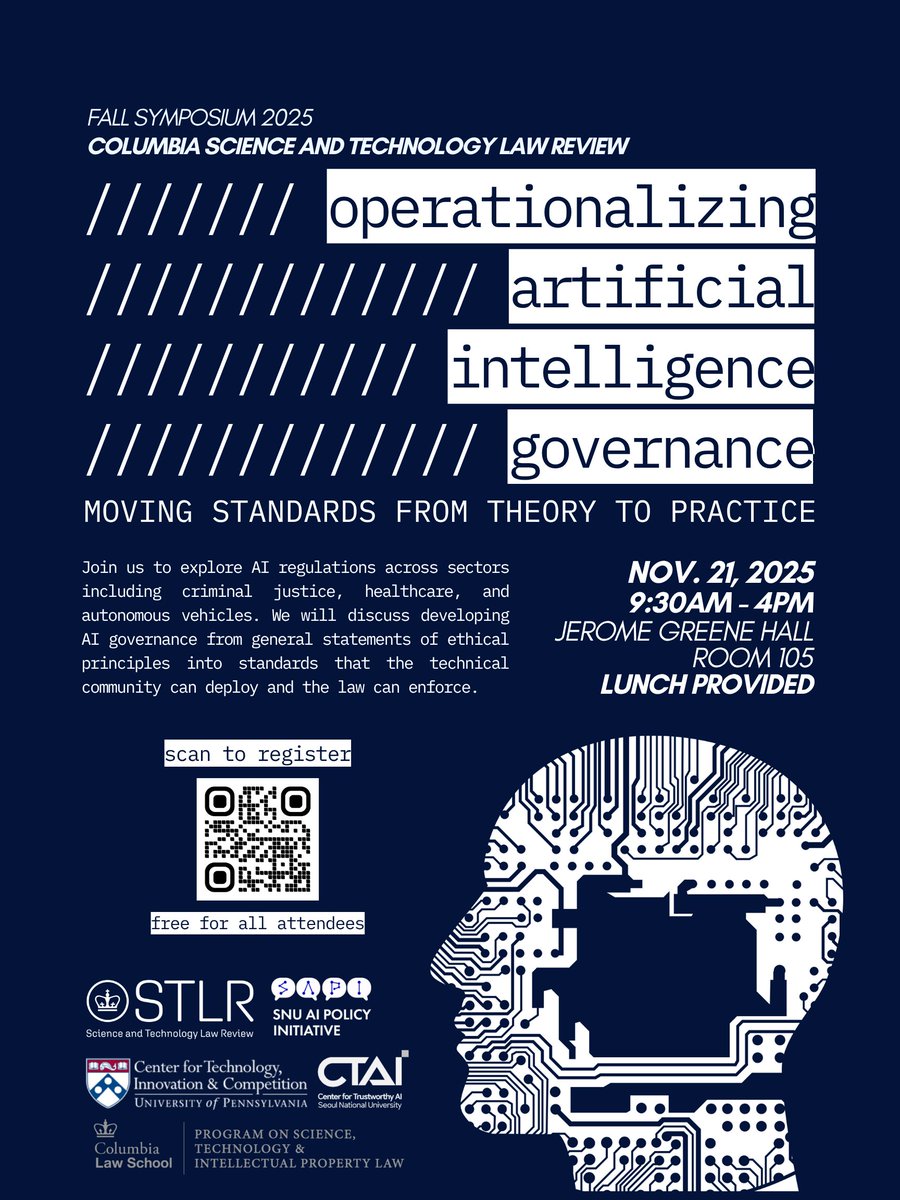
📢 Our Symposium, "Operationalizing AI Governance: Moving Standards from Theory to Practice," takes place this Friday 11/21 at Columbia Law School! Lunch will be served. Please register in advance at https://t.co/El0ji5SMLZ to get access to the building. 🤖
OpenAI's push into healthcare has created a legal paradox: Sam Altman promotes GPT-5 for medical use, but recent court orders require OpenAI to preserve all user data indefinitely, directly contradicting their 30-day deletion promises.
Author: @BY_0626
https://t.co/YVpzsAzgfM
The U.S. Court of Federal Claims has jurisdiction over a wide range of scientifically-oriented lawsuits. Adam Prucka encourages scientist-lawyers to apply for clerkships and practice law before this court, given this emphasis.
Author: Adam Prucka
https://t.co/DssmIcIvvr
With regulators cracking down on mergers, Big Tech has found a new pseudo-acquisition strategy: hiring and licensing agreements.
Read more on: https://t.co/HLsknatreg
A “Single Piece of American Cheese” becomes the first copyrighted AI-generated image. In his blogpost, Wang explores the reasoning behind the decision and some of its potential implications.
Author: John Wang
https://t.co/mipedRWzng
AI-generated deepfakes are blurring the line between truth and fiction, threatening election integrity. Can democracy survive in a world where any content can be fake—and any truth dismissed as AI-generated deception?
Author: Nora Nahae Kim
https://t.co/DQeCdoQP5u
Should legal research be controlled by a few dominant platforms? Are there strategies to allow companies to lawfully enter the legal research market, or should legal research databases be regulated as an open-access resource?
Author: Anisha Amurthur
https://t.co/BUJxMdOc2p
What is the best way to regulate AI? The answers may be hiding in plain sight. Dive in to see how cybersecurity informs AI regulation in deepfake detection and sandbox experimentation.
Author: Dante Zhu
Link to full post: https://t.co/r6EG3GYRtC
How can nations encourage technological progress while safeguarding citizens' rights? Ferris Harvey examines evolving global approaches to digital regulation and how global powers are balancing national interests with international cooperation.
Link:
https://t.co/XFCLJ68E2T
As AI becomes more integrated into daily life, the question of who is responsible when machines cause harm grows increasingly complex. Can we hold AI systems accountable, or should developers and users bear the liability?
Author: Ryan C. Postman
https://t.co/wKkCkxTbw8
Facial recognition technology is rapidly developing and transforming law enforcement, but at what cost? With concerns about privacy and regulation, the debate over its use continues.
Author: William McKee
Link to full post: https://t.co/65VHhJcErf
AI is transforming hiring, but it can also perpetuate bias. From federal proposals to state laws like NYC's AEDT, learn how companies can ensure fair and equitable AI hiring practices.
https://t.co/rTzOOmHw1Z
A billion-dollar battle is brewing over Ozempic. With the U.S. patent set to expire in 2032 and the Chinese patent in 2026, generic manufacturers are racing to secure their share. Read more in our latest blog post.
https://t.co/qrJUv9hRCt
This post discusses the particular need for AI guidelines in the arbitration space and the unique challenges drafters face when trying to implement such guidelines.
https://t.co/K1p43rSfo3
How can courts balance affordable medicine access with the drive for pharmaceutical innovation? This post examines the impact of eBay v. MercExchange on drug patent injunctions and argues for a stronger public interest role in securing access to generics.
https://t.co/RyGHn3dVjD
With dozens of AI bills flooding California's legislature, lawmakers struggle to find the balance between technological innovation and public safety. This article explores the state's effort to regulate the AI industry. For the full blog post: https://t.co/xaSFLNjzOG