Portfolio update, April 25 2026.
To start none of this is financial advice!
With that out the way, I am, as of recently, a Berkshire Hathaway owner. I mentioned in my last update that
"Berkshire is a decent opportunity, but not great."
The price has since become sligtly more attractive, but nothing of significance really. I think it will prove to deliver very satisfactory returns for me over time.
I will post a follow-up this weekend specifically on Berkshire's business and my valuation thoughts (an estimated range, no decimals).
Even though I have deployed some cash, my cash positon as a % of my networth basically hasn't changed. I am in a position where I am able to save a very big % of my pay.
I am still holding short-term danish bonds at 2% interest as I continue to look for places to put the cash to good use. But as always, cash isn't the worst thing in the world, it's a call-option on everything!
I am in the proces of looking at a tiny, tiny danish company which could be grossly underpriced but we'll see.
I hope to find some juicy opportunities soon, if that happens I would be more than happy to throw in the entire cash pile.
Portfolio update, March 8 2025.
Again, no changes have been made over the last 3-ish months. This is by no means because I think I know how to time the market, I absolutely do not!
If an opportunity to deploy all the cash arose, I would jump instantly. I just don't see any screaming opportunties that I understand. On top of that, I have very little time to do research because of military service (until June).
Cash isn't the worst thing in the world, it's a call-option on everything!
(The "Cash" position is in short-term Danish government bonds at only 1.9% interest. It doesn't make sense for me to buy American T-bills, with a higher interest rate, because of both exhange rate risks, higher costs and some Danish Tax implications)
I think (not financial advice) Berkshire is a decent opportunity, but not great. Prices for rating agencies are also slightly more attractive than they have been, but again, not anything spectacular. (I like MCO better than SPGI).
The time I do spent researching are at the moment in Danish markets and also trying to better understand the U.S insurance market. Part of that is trying to give a more "flashy" company a fair look, Lemonade.
Looking at my own portfolio Visa is not far from where I would consider adding to the position. Same story with LVMH.
But I am not really looking for decent places to put cash. I would rather do nothing for longer and wait for a really good pitch than chase some mediocre ones to look active and "at work"
Concentration in Google and ASML rose a lot in 2025, and these compaines reached (and are at) a price-level that I believe to be quite a bit ahead of it's intrinsic value.
That doesn't mean I consider selling at all, the companies are just as wonderful as before! The intrinsic value will just have to play catch-up to market price.
Interest rates as the ultimate benchmark is a very overlooked point on my timeline.
A given multiple (i.e a given yield) can only be deemed attractive/not attractive compared to bond yields, current and future (this being not predictable).
A 36x multiple (just under a 3% yield), even growing maybe 8-10% is not that attractive if rates are 8%. The interest-rates-being-gravity concept Buffett talks about is absolutely key to understand.
Also explains why it's impossible to say "this company deserves xyz multiple". It's also why Buffett said that in 2021 (at basically 0% rates) even the most seemingly lofty priced assets were actually cheap.
The "kicker" of course being that rates had to stay that low for that to be the truth.
$MA is currently trading at a 4.3% free cash flow yield, which is approximately the same as the 10 year Treasury yield, often referred to as the “risk free rate”.
Historically, when a business of this quality could be purchased at a free cash flow yield similar to the risk free rate, it has often proven to be an attractive investment.
The reason is simple. A Treasury yielding 4% today will likely still be yielding 4% years from now. There is no growth. You simply collect your 4% and eventually get your principal back.
$MA is different because the 4.3% free cash flow yield is the starting point. $MA continues to benefit from the secular shift away from cash and steadily reduces its share count through buybacks.
If free cash flow per share compounds at 10% to 12% annually over the next decade, which I think is reasonable, today’s 4.3% yield could end up looking quite attractive in hindsight.
A simple way to think about it is 4.3% starting yield plus 10% to 12% growth gets you into the neighborhood of 14% to 16% annual returns before any change in valuation. If the multiple stays roughly where it is today, I think something in the 12% to 16% range is a reasonable expectation.
I do not think $MA will be the best investment you ever make from here. The business is simply too large, too widely followed, and too well understood.
If I were buying $MA today and planning to hold it for the next decade, I would expect something around 13% to 15% annual returns. That may not sound exciting, but $100k compounded at 14% for 10 years becomes almost $400k.
Of course, nothing is guaranteed. Growth can slow and valuations can compress. But when one of the highest quality businesses in the world can be purchased at a free cash flow yield comparable to the 10 year Treasury while still having a reasonable path to double digit growth, I think it deserves attention.
At today’s valuation, $MA is becoming increasingly interesting (as long as your expectations are sensible).
🌹
🌹
Alphabet $GOOGL is looking to raise $80 billion dollars.
(long form post...)
$30 billion dollars of public offerings and $10 billion dollars secured from Berkshire. Pretty straightforward equity raise.
A bit more technical is the $40 billion dollar at-the-market offering to pay for tax obligations when RSU's are vested. What exactly is that about, and more importantly why? Is it as dilutive as we think?
When an RSU vests, it is treated, tax wise, exactly like a cash bonus. Say an engineer gets $100,000 worth of stock, then the IRS demands that taxes are paid on the "bonus" immediately, let's say 30%.
Because the IRS doesn't accept fractions of Alphabet shares, some of the equity (the shares) has to be turned into real cash.
This is often done by a "sell-to-cover" strategy of selling some of the shares in the open market to fund the tax bill.
Alphabet now changes that and comments as follows:
"This approach will mimic a “sell to cover” model: upon vesting of restricted stock units, shares will still be delivered to employees net of taxes, and the company will use corporate cash to settle taxes on behalf of employees."
In our example Alphabet now gives the employee $70,000 of stock, and keeps the $30,000 of stock owed to the IRS. Alphabet then uses their own cash to pay the tax bill, keeping the $30,000 of stock in their treasury.
Now the employee has their shares worth $70,000, the IRS has their cash and Alphabet's bank account is missing $30,000, but their corporate treasury has 300 shares of stock clawed back from the employee.
And this is where the ATM program comes in. Alphabet now takes the 300 shares they kept from the employee and can sell these to fill up their bank account.
As Alphabet also writes:
"Alphabet has entered into an equity distribution agreement with Goldman Sachs & Co. LLC, J.P. Morgan Securities LLC, and Morgan Stanley & Co. LLC as managers in connection with a newly established ATM program, pursuant to which Alphabet may sell, from time to time through or to the manager"
They do a nice job of explaining how this will go down, but why change it in the first place? The result is the same anyways?
In my view it is all about controlling the enviroment for their huge (huge in absolute numbers, compared to the size of Alphabet, not so much) equity raise.
In the old system, if a big automated RSU vesting day happens, billions of dollars of shares would be dumped into the market to cover the tax bill. Basically there is a risk that concentrated vesting would depress the share price.
And when you are trying to raise capital through an equity offering, you want the highest possible valuation. The higher the price of the shares, the less shares you have to sell.
So what we actually have here is a $40 billion dollar equity expansion, pure dilution for existing shareholders.
The other $40 billion of ATM offerings are NOT dilutive. It is more a reshuffling of, already existing, employee payroll.
Yes, "The company intends to issue stock for equivalent proceeds through its ATM program." but the same shares they issue, they have just "saved" by taking on the tax obligations on behalf of employees.
The number of shares entering the public is identical, with this ATM offering or without it.
Let's use 100 shares as an example.
Either the full amount of RSU's are giving to employees and they pay the tax by selling stock, so 100 shares are issued. 100 shares of dilution.
In the current scenario shares will be delivered to the employee NET of taxes. Tax still at 30% means 70 shares are delivered to the employee, 30 kept by Alphabet. So now only 70 shares of dilution (so far).
Alphabet then pays the IRS from their corporate bank account, but then, and I quote "The company intends to issue stock for equivalent proceeds through its ATM program." i.e around 30 shares.
So now 100 shares are issued again, just like if the old system was in place, the only difference being that Alphabet now controls when these shares hit the market.
Controlling some of the volume in your stock isn't so bad when you are trying to raise money...
Kudos if you read all the way to the end of this accounting-thriller, if I misunderstand something please correct me in the comments!
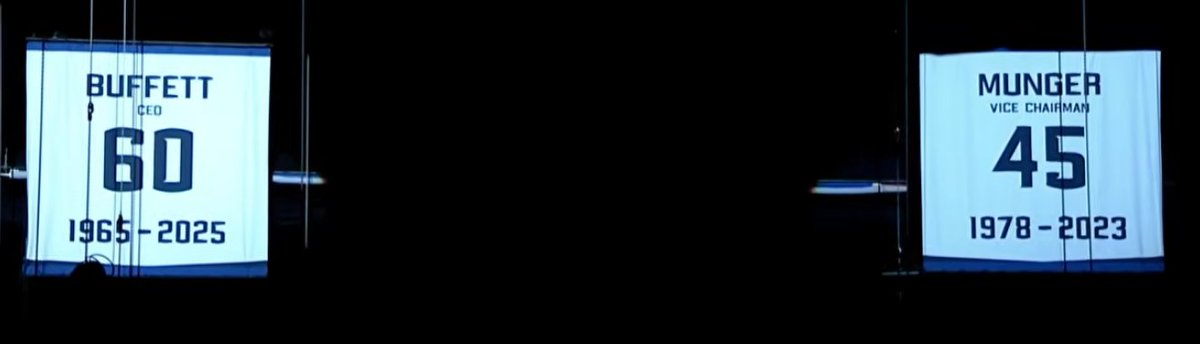
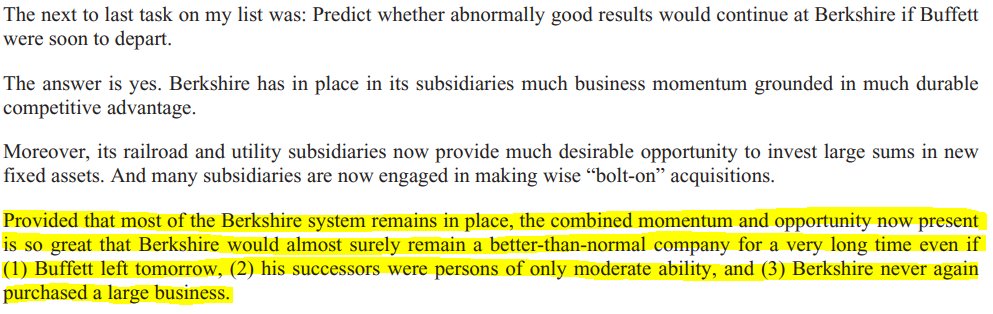
What a job Greg Abel has taken on...
His every move measured against what people merely think Buffett would have done/not done.
He needs to be judged over time, ofc course he does, but every decision he makes can't be judged after 2 minutes.
Almost can't believe these numbers, it's absolutely crazy growth. The results Google has produced since I became a shareholder has far exceeded my expectations.
Also search growing a staggering 19%.
Very impressive quarter from Visa. $V
Notable that Visa is now basically as big in VAS as Mastercard and growing a surprising 9% faster (27% vs 18%).
As I've said multiple times, a bigger core network = bigger upsell opportunities. I belive they have better prospects than MA.
Estimating the intrinsic value of Berkshire Hathaway is a three part equation;
1. investments (including cash), 2. earning-power of subsidiaries and 3. a qualitative assessment of future capital allocation succes.
The first part is very easy to find. As of the last report Berkshire held roughly 300 billion in marketable securities and 375 billion in cash (T-bills). 675 billion.
Net worth, or book value, is also a reasonable yard stick although for Berkshire, but of course much smaller than intrinsic value because of the underlying earnings power not shown in the balance sheet.
Looking at networth, around 720 billion as of the 2025 annual report, there are two liabilities that are actually big assets for Berkshire. Deferred tax on capital gains and all of their insurance float.
The float in particular is a revolving door of funds which as Buffett has pointed out many times is both long enduring and often cost-free (they have in most years actually been paid to hold the money because they underwrite at a profit.)
A such “liability” is worth much less than shown on the balance sheet.
Lets not try to get too complicated here and use 700 billion as book value. With a market cap of 1 trillion, we have to figure out if the earning power of Berkshire is worth roughly 300 billion.
Using conservative estimates leaving aside ALL interest income on T-bills, cutting underwriting profit in half, slightly down regulating earnings from both BNSF and BHE and basically saying that all CapEx Berkshire spends beyond D&A will go to waste makes the owner earnings in a range of 24-26 billion.
Without it growing at much more than inflation it will still yield decent results. IMO Berkshire’s subsidiaries are worth far more than this, but we want a nice margin of safety.
Speaking of margin of safety we need the third and final pillar of intrinsic value.
The estimate of future capital allocation succes. This is where I think they margin of safety really is.
The above estimates I used included no growth from big acquisitions or buys of marketable securities.
Is their size a challenge, hell yes but I find it hard to believe that periods of fear is behind us. Extreme fear.
Berkshire has it hard with a booming private equity sector and wide spread speculation, but their time will come.
The upside for Berkshire in terms of opportunities coming their way is quite big imo. If they find just 1 true elephant in this decade it will be a decent succes.
I am a shareholder and think the current price is decently attractive. I will buy more if they price falls further.
THIS IS NOT FINACIAL ADVICE OF ANY KIND, just my personal opinion. It should never be taken as advice, I am no professional.
@investwithwes1 “Wonderful business at a fair price” is the easiest fallacy to fall victim to. Buying an often great business at any price because it’s “wonderful” so the price is actually not important…
Still yielding far less than a government bond
If SpaceX really IPO's at $1.5 trillion I would just love my close partner at Google (Sundar) to sell our 7.5% stake. Just a small $100+ billion dollars straight in the bank.
$900 million to $100+ billion in roughly 10 years isn't so bad.
Trying to predict interest rates is a fools game.
At the same time, the importance of rates on the entire investment proces is very understated.
I Got Gemini to do a very simple cross-comparison of the S&P 500 p/e and FED funds rate from 1955-2026.
*Note: the huge 2008 peak in P/E came, partly, as a result of huge write-downs impacting earnings (the denominator) which makes it look even more dramatic than it was.
It's quite clear though; interest rates are gravity. It pulls down the ceiling for what a person should be willing to pay for a risky business.
It's not very often mentioned how important interest rates are for valuations, and how misleading a relative comparison of multiples from different times can be because of different interest rates.
It really is shooting one self in the foot to look at historical multiples of a company and then deciding what a "cheap" multiple is.
0% interest rates allows valuations to ballon, as the alternative to buying businesses is producing nothing. Accepting a 1.3% yield from a business is theoretcially better than the 0% interest.
But is it worth it taking a 1.3% yield from owning an inherently risky asset (a business)? It probably isn't, unless you with absolute certainty knew interest rates would never ever rise again.
(earnings could also grow incredibly fast to justify a low yield, but that is usually also very unpredictable)
If rates are suddenly 5% then 1.3% is not that great is it?
A 25x multiple (4% yield) was extremely cheap in 2021 with 0% interest (if it stayed that way), but that same 25x multiple isn't nearly as attractive today, even though the business might be roughly the same.
When you value a company, it is only attractive when it yields (much) more than the risk-free alternative, over time.
The (unfortunately) very popular 10-year average multiple tells you close to nothing without taking into account the interest rate.