Been testing GPT 5.5 and it's implemented the HTML-in-Canvas spec
Worked for both WebGL and WebGPU out of the box
Then created this demo with the PixiJS + GSAP Skills
Hopefully there will soon be no excuses to make boring websites
I just noticed that someone created a vamp and copied my post to use as their pinned message in their community.
Please be aware: this is not affiliated with us, not related to the original OpenFang discussion, and it is very likely a bundled launch.
Do not trust it. Do not buy it.
Always double check the exact name, CA, and source before interacting with any token.
Quick update for the community.
The thread I wrote about OpenFang including the breakdown and the CA in the comments just got reposted.
I didn’t spam them. I simply shared a structured perspective, So that they don’t feel afraid or attacked.
I’ve also sent a DM to Jaber and the OpenFang team to let them know that funding is currently available through the GitHub mechanism tied to $OpenFang.
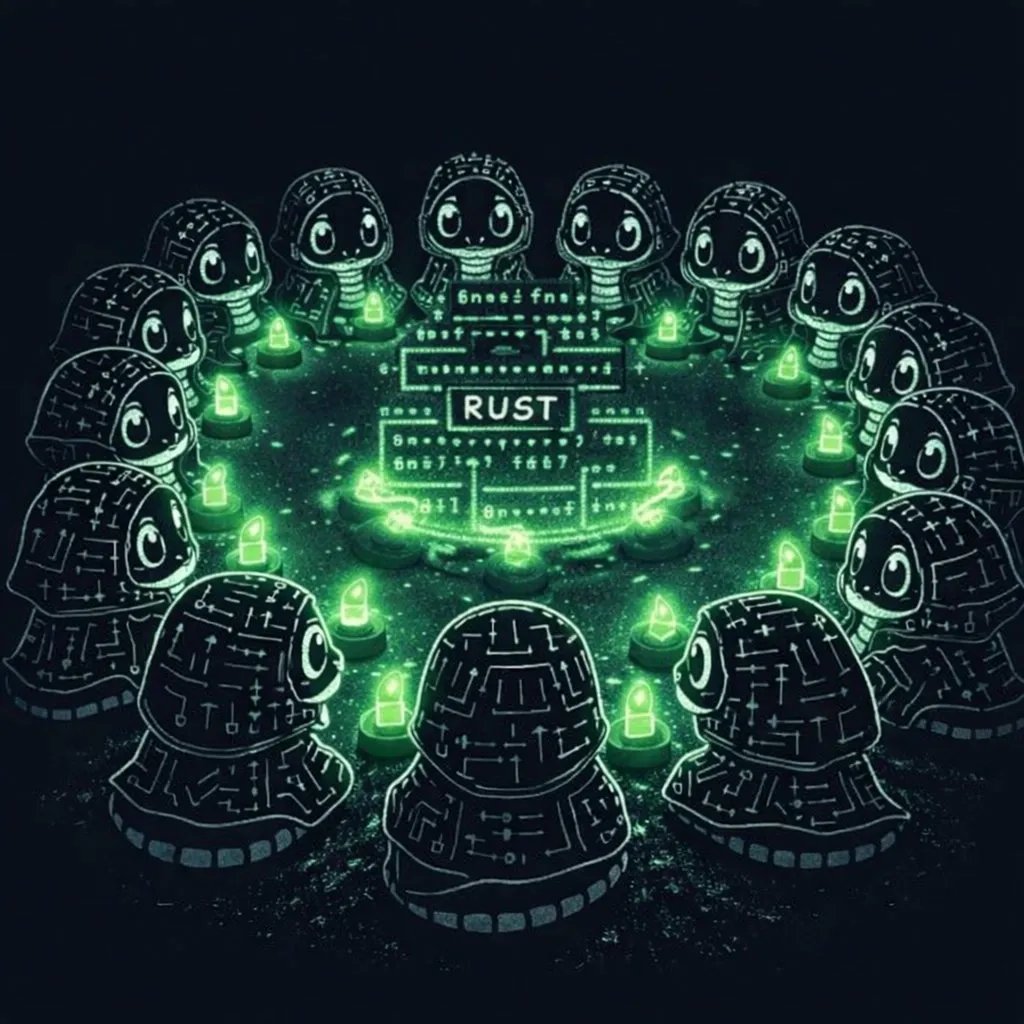
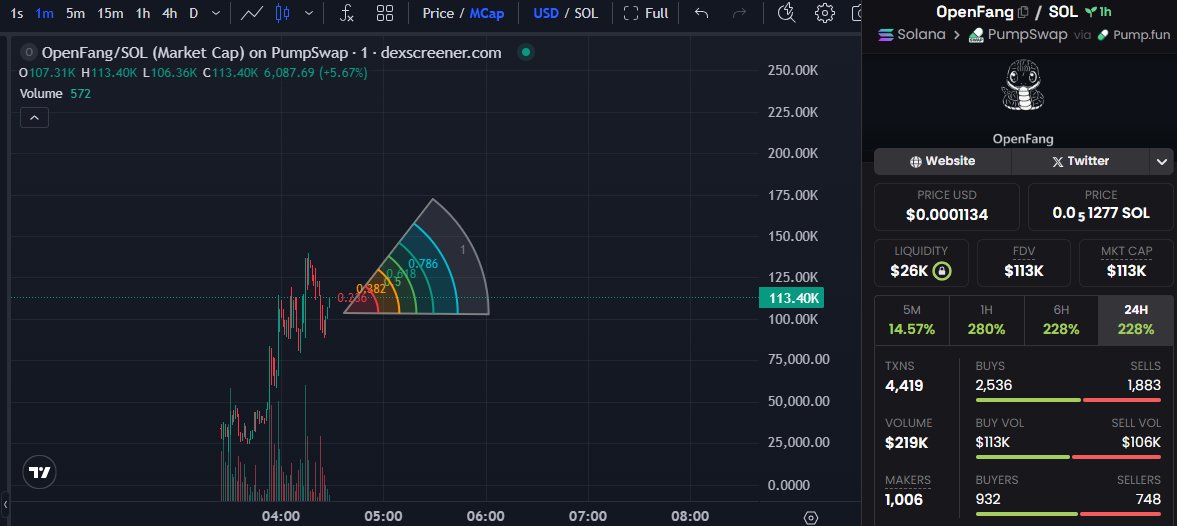
Cute meme vibe, solid art, easy narrative to push. Most importantly — still low market cap, huge upside room. At this MC, it only takes a bit of FOMO volume to send the chart vertical.
The AI agent space is maturing fast, and most people still don’t realize what’s actually changing under the hood.
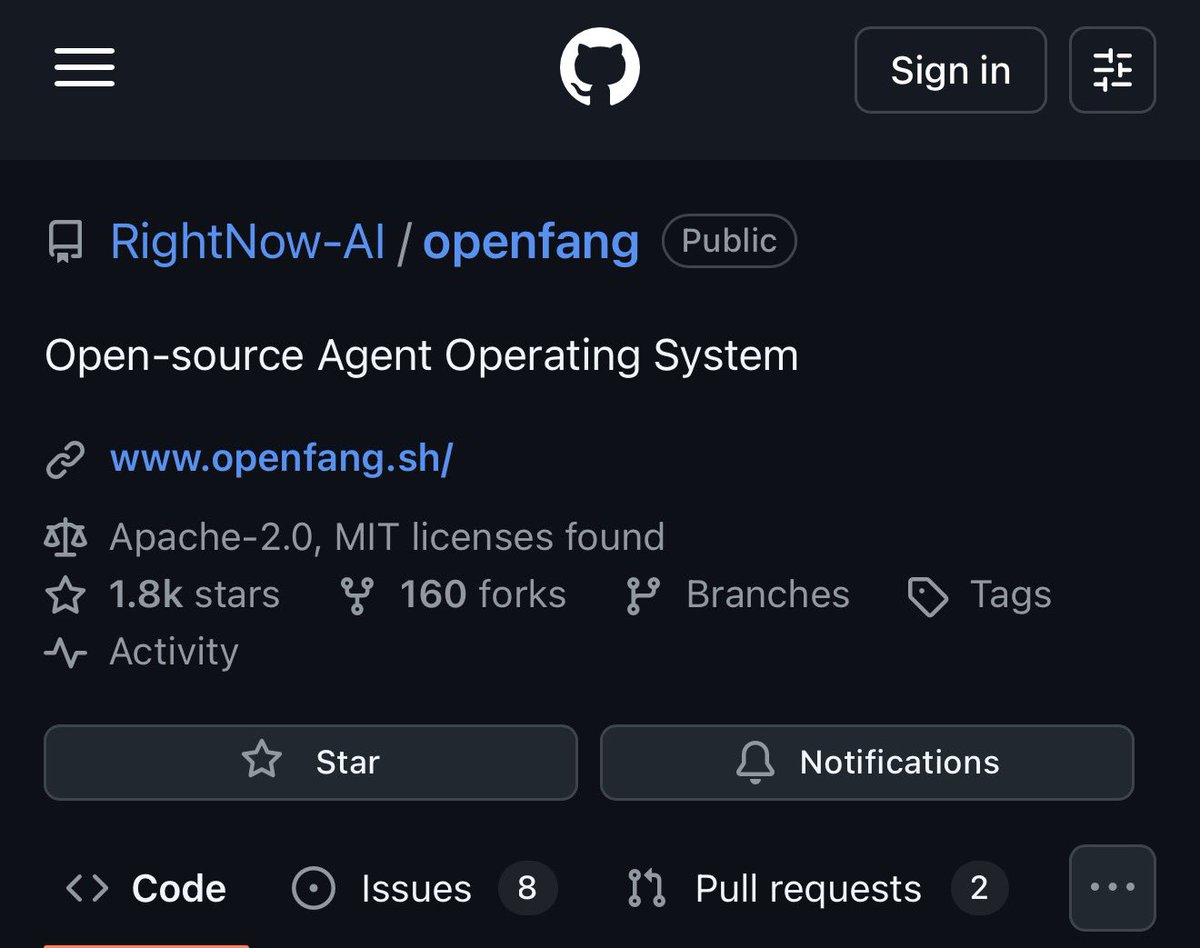
Let’s talk about @openfangg.
( The Agent Operating System )
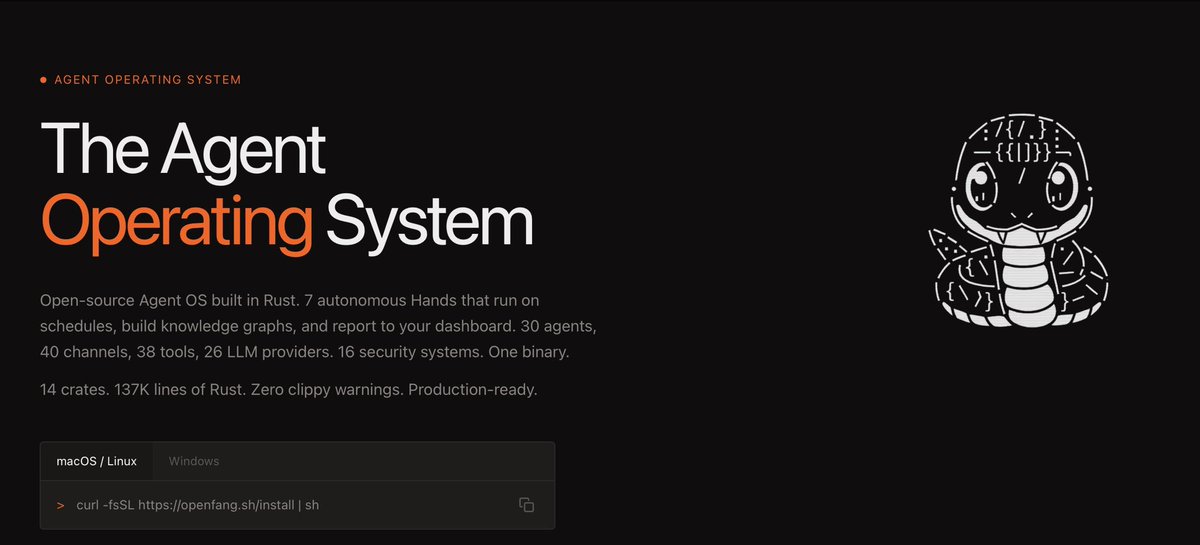
OpenFang is not positioning itself as another chat-based agent framework. It introduces a fundamentally different approach: an Agent Operating System built from scratch in pure Rust, with 137,000+ lines of code, 1,700+ tests, MIT licensing, and zero Clippy warnings.
Instead of wrapping tools around an LLM and relying on prompt chains, OpenFang runs agents inside WASM sandboxes under a kernel-like runtime. Each agent is scheduled, isolated, fuel metered, epoch controlled, and can be terminated instantly if it behaves unexpectedly. This treats agents as real system processes not experimental scripts.
Security is a first class concern. @openfangg integrates 16 independent security layers, including dual metered WASM execution, Ed25519 signed manifests, Merkle hash chain audit trails, secret taint tracking with zeroization, prompt injection detection, SSRF protection, HMAC mutual authentication, rate limiting, subprocess isolation, and path traversal mitigation.
Performance is equally notable. With a ~32MB binary and ~180ms cold start time, OpenFang maintains a lightweight footprint compared to heavier multi hundred megabyte stacks.
OpenFang’s core positioning 7 autonomous Hands, 30 agent templates, 40 channel adapters, 38+ tools, 26+ LLM providers, 16 security systems, all inside a single binary.
This is not a wrapper framework. It’s infrastructure.
( Comparison @openfangg & @openclaw )
Now, why does this matter especially in comparison to @openclaw?
OpenClaw helped popularize agent tooling by making chat integrated workflows simple and accessible. It is flexible, model agnostic, and easy to deploy.
However, its architecture remains largely prompt driven and reactive. Agents depend heavily on user interaction, and isolation is lighter compared to kernel-level sandboxing. The install footprint is significantly larger, cold starts are slower, and runtime control is less deterministic.
OpenFang approaches the problem differently:
• Kernel-level WASM isolation instead of loose tool execution
• Deterministic scheduling and process control
• Built in resource metering (fuel + epochs)
• Stronger security model by default
• Smaller binary footprint and faster startup
• Designed for autonomous execution, not just chat response
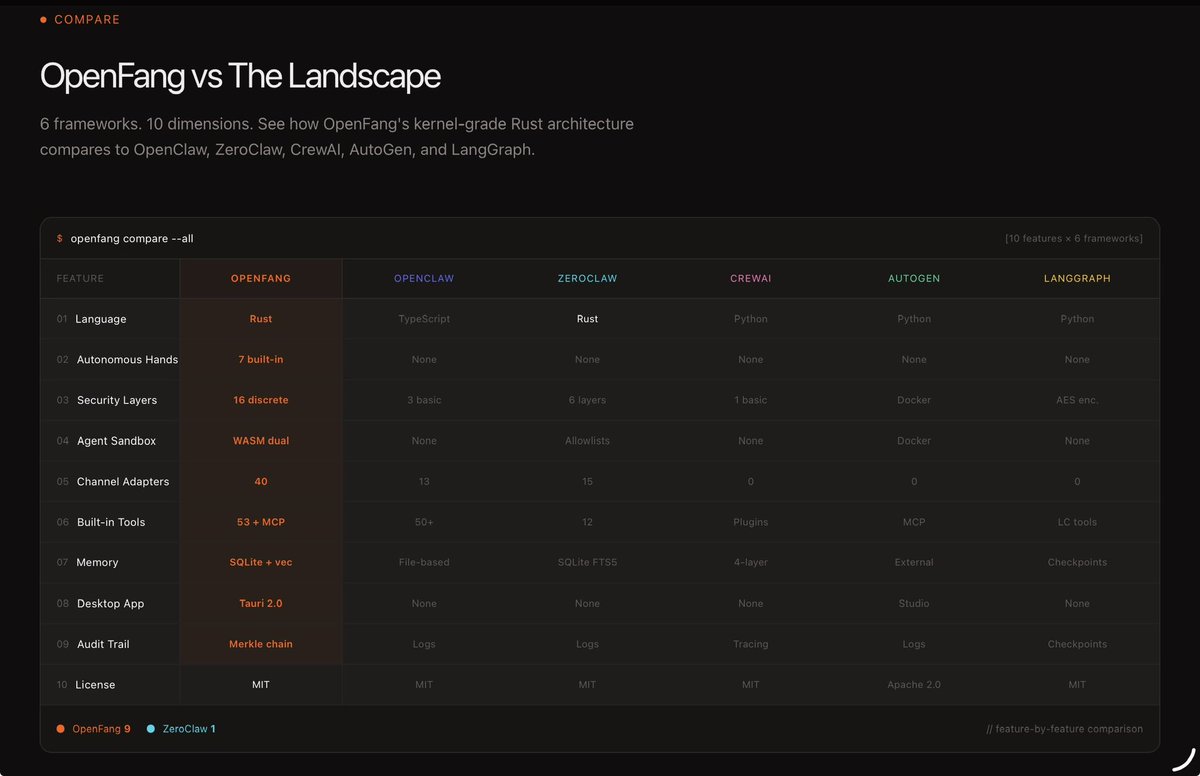
( OpenFang vs The Landscape ) :
This table visually shows the architectural differences.
Rust vs TypeScript/Python
16 security layers vs 3
WASM sandbox vs minimal isolation
Merkle chain audit trail vs basic logging
40 channel adapters vs 13
This isn’t about attacking competitors.
It highlights a shift from convenience first frameworks to runtime first engineering.
( Hands + v0.1.1 )
The biggest shift is Hands, autonomous agents that operate continuously without constant prompting. Hands run on schedules, generate research, build knowledge graphs, automate workflows, monitor data streams, and deliver output directly to communication platforms. This transforms agents from reactive assistants into proactive AI workers.
OpenFang v0.1.1 reinforces this production focused direction:
• 30 agent templates bundled directly in the binary
• Default provider consistency across agents
• API keys persist across restarts
• New providers added: Kimi, Qwen, MiniMax, Zhipu, Qianfan
• OpenSSL dependency removed in favor of pure Rust TLS
• Ubuntu 22.04+ Linux compatibility confirmed
• Skill TOML parsing fixed
• Docker image naming corrected
These are infrastructure level refinements, not cosmetic updates.
( Benchmarks )
Cold start: ~180ms vs ~5960ms
Idle memory: ~40MB vs ~394MB
Install size: ~32MB vs ~500MB
Security systems: 16 vs 3
These numbers reinforce the architectural intent: OS level determinism and lightweight execution.
#AIAgents #OpenFang #OpenClaw #Rust #WASM #OpenSource
I did not launch this but the tek is really really good and deserves to go viral. So I made the community for it.
Fees are locked and to their GitHub already.
$OPENFANG
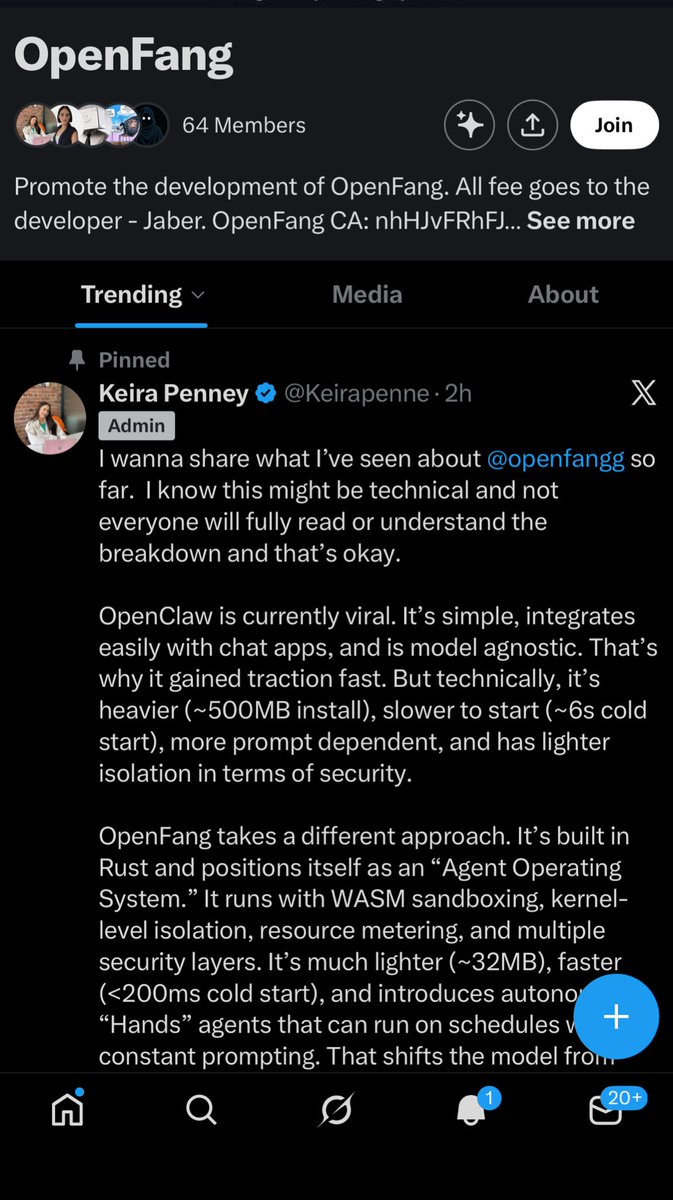
I wanna share what I’ve seen about @openfangg so far.
I know this might be technical and not everyone will fully read or understand the breakdown and that’s okay.
OpenClaw is currently viral. It’s simple, integrates easily with chat apps, and is model agnostic. That’s why it gained traction fast. But technically, it’s heavier (~500MB install), slower to start (~6s cold start), more prompt dependent, and has lighter isolation in terms of security.
@openfangg takes a different approach. It’s built in Rust and positions itself as an “Agent Operating System.” It runs with WASM sandboxing, kernel-level isolation, resource metering, and multiple security layers. It’s much lighter (~32MB), faster (<200ms cold start), and introduces autonomous “Hands” agents that can run on schedules without constant prompting. That shifts the model from reactive chatbot to proactive AI worker.
Yes, @openfangg is still very early. It’s not as battle tested as OpenClaw yet. But the attention is growing fast. Earlier today @Akashi203 post had only a few thousand views now it’s at 151k+. That kind of organic acceleration usually means real interest from builders and developers.
Now it comes down to @Akashi203 response. My hope is that he acknowledges and accepts the funding model so the fees can genuinely support @openfangg long term development together with the community. If builder alignment this could turn into something much bigger.
@Akashi203 if you read this, the community created this coin on @Pumpfun with one intention, to support @openfangg development. This is not about speculation or pressure. The structure was intentionally designed so that all fees go directly to the project’s GitHub.
You can read this guide from @Pumpfun : https://t.co/IfKWSQ8337
7Z294H4R6FRmfQwX4XS8XfVUEk4zCb5cxMr1taudpump
And sorry if this feels like too much posting.
Big things happening today with @pepecoins getting listed on @krakenfx ! 🐸🐙
To celebrate, I drew and minted a new NFT directly from Pepepaint on https://t.co/cf3YIW7vL5 that depicts this moment exactly as it occured: "The Creation of the Pepening"
https://t.co/qksQxfQNjv