High Performance Psychologist (PSI) & Trading Psychology Consultant. Helping experienced and professional traders execute with precision under pressure.
The 5 Stages of Trading Psychology Mastery
New masterclass for experienced traders who are stuck in a cycle of violating their plan.
Discover every stage a trader goes through to reach consistent execution under pressure - and what holds you back from progressing at each one.
Register free 👉 https://t.co/kaMOdyaoha
Just watched the Titans of Tomorrow podcast episode with Jeff Holden from @smbcapital — seriously valuable conversation with a lot of practical takeaways for traders who want to adopt a professional approach.
A few points stood out to me that I wanted to offer a reflection on from the perspective of a high-performance psychologist working with traders:
👉 Structure first. Psychology second.
I completely agree with this take. Without a solid base of skill in trading and a highly refined playbook informing what you need to do in the market to make money, all the resilience and emotional composure in the world won't make a difference. I'd argue that psychology becomes more of a performance lever, the higher the level you're operating at as a trader.
While structure is the priority, psychology can also indirectly support refining structure. In my experience working with professional traders, sometimes trying to resolve an issue on the psychology side can shine a spotlight on something that needs to be addressed from the strategy/ structural side of things that the trader wasn't previously aware of. And when that happens, the fix is structural, not psychological.
When a trader is prepared to work on both, and has the understanding and measurement tools to differentiate between what's a psychology issue and what's a strategy/ structural issue, they hit the sweet spot for performance optimisation.
👉 On the example of a trader exiting half their position early to manage their psychology...
This underscores a really important trading psychology principle. The aim is not to create a trading system that accommodates psychological pressure points (e.g., defining a plan that accounts for a high level of anxiety at keeping a full position on in a winning trade). The aim of optimising psychology is to enable the trader to execute the plan that is structurally best to follow from a pure trading perspective.
In this example, if a trader is managing their psychology (emotions like fear or anxiety) by following a plan that pre-emptively accounts for psychological discomfort (exiting half the position on a giant trend trade almost right away), I'd frame that as solving the wrong problem. The issue isn't partial exits per se, it's when the exit is driven by discomfort rather than by the trade's logic. The plan should be set by the trading logic, and then the trader should cultivate the mental and emotional skill to execute on that plan. Not the other way around.
👉 Not relying on psychometric questionnaires for hiring traders.
Agree with this too. Psychometrics are very helpful tools for generating discussion and reflection, but I personally choose not to use them in my own practice with traders and other high performers. I believe you can learn a lot more about a person and their beliefs/ capabilities/ blind spots by listening intently to their perspective of how things are and asking the right questions.
Psychometrics definitely have their place, but solely relying on them to the exclusion of deeply listening to the person in front of you and applying your own experience and intuition to assess the fit is too reductive to risk a hiring decision on, in my opinion.
👉 The goal of trading psychology (at least at an individual performance level) is not strictly about helping a trader to adhere to their edge because there are times when discretionary trading is warranted within a pre-defined system.
This is the one point where I'd offer a slightly different framing, though I suspect the difference comes down to definitions. To me, performance psychology is about working on the mental and emotional factors that enable a person to execute the behaviours that constitute peak performance. It's not about simply having a positive mindset, it's about conditioning predictable, pre-defined behaviours. And I'd argue that recognising when your edge is no longer in play and taking action is one of those behaviours.
A deeply understood playbook defines not just the setup, but the conditions under which the setup is invalid. So when a trader steps aside or adjusts because the edge isn't there, they're not abandoning the system, they're executing a deeper layer of it.
If an NFL athlete needs to switch to a different play to respond more appropriately to whatever is occurring on the field, they are still in essence "adhering to the plan". In other words, "adhering to the plan" (properly defined) already includes deviations that are sanctioned by the plan itself.
Intuition and creativity have a really important part to play in skilled trading, but when the plan itself defines where discretion is sanctioned, every deviation becomes reviewable. A trader can look back at any trade and objectively discern whether they took appropriate action.
Overall it was a fantastic and thought-provoking discussion. Check it out here if you haven't caught the episode yet: https://t.co/7CXJPVwQjH
The 5 Stages of Trading Psychology Mastery
New masterclass for experienced traders who are stuck in a cycle of violating their plan.
Discover every stage a trader goes through to reach consistent execution under pressure - and what holds you back from progressing at each one.
Register free 👉 https://t.co/kaMOdyaoha
@traderprad@steenbab@kimanncurtin The self awareness is already half the work done 😄 Figure out what your subconscious has to say about that and you’ll have cracked it. You’d be in great hands with @steenbab or @kimanncurtin and my Go Deep to Level Up program is open year round too. DM me! 🧠
I had a really enjoyable chat with Becky Gaskell on the Market Mamas podcast recently. The episode just dropped on YouTube.
Check it out here 👉: The Identity Shift Every Profitable Trader Must Make | Trader Psychology
https://t.co/e6pypHP8RK
Traders usually treat plan violations as a discipline problem.
But human psychology dictates that rule-breaking is almost inevitable under pressure without training or intervention.
What if instead of waiting for the P&L to be impacted before you address inconsistent execution — you treated it like a risk to be proactively managed?
This is what I'm covering in my new YouTube video:
🎥 https://t.co/2sa1ySNGEU
Last night’s NinjaTrader Ecosystem webinar didn’t happen — I had to cancel with six hours’ notice due to illness. Sorry to anyone who had registered.
I’m recording the full webinar next week and posting it to YouTube so anyone who registered won’t miss out on the content.
I’ll share the link the moment it’s live. Thanks for bearing with me.
Hey Experienced Traders,
I'm planning out my next few YouTube videos and I wanted to understand what type of content is the most helpful/ interesting to you?
What do you want to see? Comment with your number:
1️⃣ "How to" videos with practical action points to improve trading
2️⃣ Explaining the psychology behind specific trading challenges
3️⃣The trader as a whole person — money mindset, life pressure etc.
4️⃣ Psychology of elite performance - applied to trading
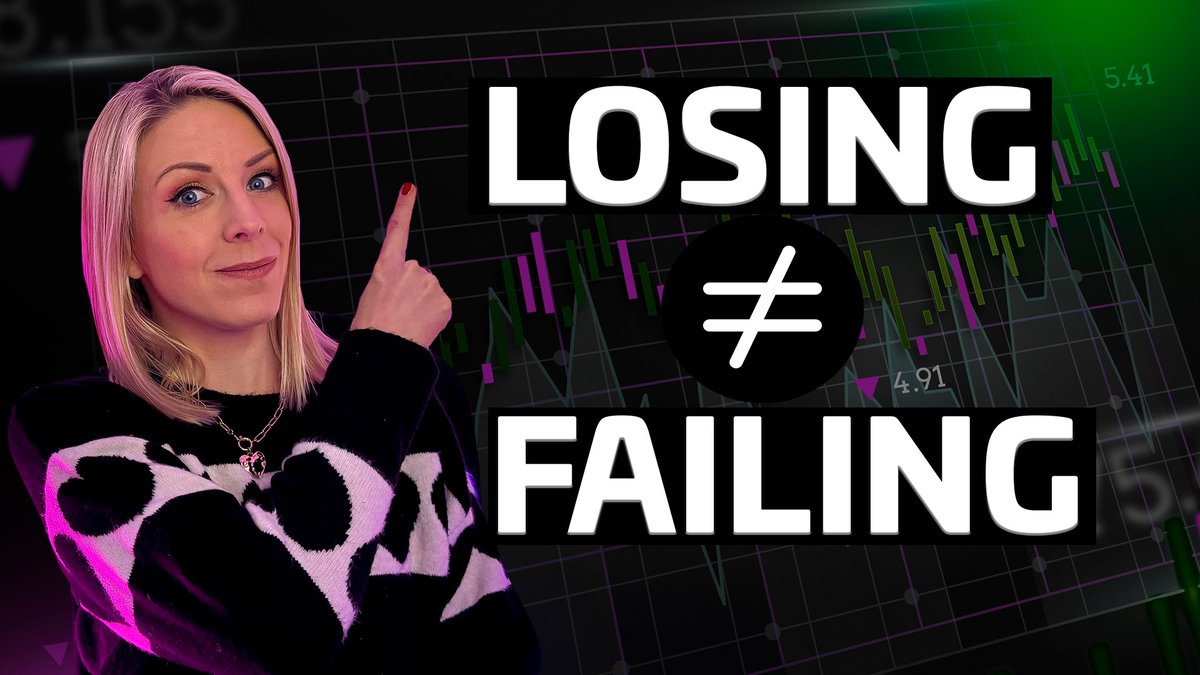
Losing is not the same as failing.
But it's what you do after the loss that determines the true impact on your account.
Do you recover and execute according to your plan on the next trade — containing the damage to a single event?
Or does the loss trigger a spiral of indiscipline and emotion-driven trading?
Here's a concrete 3-part process to re-set to neutral quickly after any trading loss:
🎥https://t.co/wKVrjTFRfF
Rewiring your beliefs, thoughts, emotional responses and habits is not a fluffy, introspective activity. It's the architecture of elite performance.
This is what professional athletes do before they step into the arena with millions watching.
This is what Navy SEALs do before they walk into a situation with no margin for error.
This is what successful traders do to engineer consistent execution under pressure.
I truly believe that if you want to be an effective coach, you can’t just educate. That’s not enough. People don’t grow in environments where they’re only being taught, they grow in environments where they feel seen, understood, and supported.
Yes, I’ll teach you market structure. Yes, I’ll give you key levels and zones. Yes, I’ll educate you, guide you, and help you improve your execution. But more importantly, I’ll care about how you’re doing, pay attention to the subtleties, and be willing to give my time and energy to support you as a person, not just as a trader.
Ted Lasso said: “Success is not about the wins and losses. It’s about making these young players better people, first and foremost.” To do that, you have to care.
https://t.co/zDg3HDMTqQ
One of the hardest parts of trading is knowing exactly what you need to do - then not following through on it consistently.
There is a massive frustration in being so close to success, and realising that the obstacle in the way is yourself.
If this resonated, follow me — I write about the psychology side of trading that most people ignore.
And repost if you know a trader who needs to hear this. ♻️
This is why "the inner work" is unavoidable if you want to excel in trading.
Your psychology is influencing your trading — whether you choose to pay attention to it or not.
Interesting take. Agreed that process is the foundation. In my experience though, even experienced and professional traders who have defined every variable in advance can still violate the plan the moment pressure hits. The process has to go deeper than decision architecture — it needs to address the reasons why execution breaks down at the psychological level. That's where trading psychology shifts from being reactive damage control to an actual risk management system.