MiCA olayını kısaca yorumlamak isterim,
Binance - MiCA haberinin en önemli kısmı, başvurunun geri çekilmesi değil; bunun neden yapıldığı. Gelin detaylandıralım ⤵️
İlk bakışta olumsuz görünebilir ancak detaylara bakınca bunun reddedilen bir başvurudan ziyade, beklenenden uzun süren bürokratik sürecin ardından izlenen stratejinin değiştirilmesi olduğu görülüyor. Avrupa hedefi ortadan kalkmış değil, yalnızca lisansa ulaşmak için tercih edilen ülke değişiyor.
Açıkçası ben bunu olumsuz okumuyorum.
Kripto artık birkaç geliştiricinin kurduğu küçük bir sektör değil. Milyarlarca dolarlık hacimlerin döndüğü, bankaların, fonların ve kurumsal yatırımcıların girdiği bir ekosistem haline geldi. Böyle bir yapının regülasyonlarla daha fazla temas etmesi kaçınılmazdı.
Üstelik teknoloji dünyasında bunun birçok örneğini gördük. Uber, Airbnb ve benzeri küresel şirketler de faaliyet gösterdikleri ülkelerde benzer süreçlerden geçti. Önemli olan ilk başvurunun hangi ülkeden yapıldığı değil, şirketin regüle bir yapıyla uzun vadede faaliyet göstermeye devam etmesi.
Binance CEO'su @heyibinance çok doğru ve yerinde bir açıklama yaptı. Avrupa’dan çekilmek yerine farklı AB ulusal düzenleyicilerle MiCA lisansını tamamlamaya kararlı olduklarını söyledi. Bana göre bu, geri adım atmaktan çok süreci daha verimli yönetme kararı.
Türkiye tarafında ise kullanıcıların endişe etmesini gerektiren bir durum olduğunu düşünmüyorum. Binance TR, Avrupa’daki MiCA sürecinden bağımsız olarak Türkiye’nin kendi düzenleyici çerçevesi içinde faaliyetlerini sürdürüyor.
Ben yıllardır şuna inanıyorum; kripto piyasasında en büyük hatalar çoğu zaman haberlerden değil, manşetlerden besleniyor. Başlıklar birkaç dakikalık fiyat hareketi yaratabilir ama uzun vadede önemli olan, şirketlerin regülasyonlara uyum sağlama iradesidir.
Reading the @summertokensol whitepaper gave me a better understanding of the project.
Some of the details mentioned include:
• Fair presale
• No insiders
• USDT rewards
• 980k supply
• $0.7 first phase
• $1 launch price
I'll be following the presale and launch to see how everything develops.
As Always NFA/DYOR
Everyone wants to know where Bitcoin goes next.
But sometimes the chart isn't the most important story.
Glassnode data shows that 10.83 million BTC are currently sitting at an unrealized loss, the highest level recorded in this cycle.
What's interesting is that this isn't only about recent buyers anymore. A growing share of long-term holders are also underwater, yet they continue to hold a historically large portion of Bitcoin's supply.
That doesn't tell us what happens next.
It simply highlights that market sentiment and investor conviction don't always move together.
When conditions become uncomfortable, on-chain data often reveals more about investor behavior than price alone.
Big News.
Korea's biggest fintech giant @toss__official is bringing its 30M users into the AI data economy with @psdnai, in its first ever AI/web3 partnership.
We'll begin working to integrate our contributor app Numo as a mini-app inside Toss, so anyone can provide real-world data to train AI and get paid for it ↓
Bitcoin funding rates have moved back into positive territory after an extended period of mixed positioning.
The shift suggests long exposure is gradually returning even as traders continue watching whether momentum can be sustained.
Introducing Native Anchored VWAP indicator⚓️
Now, you can view D, W, M, Q, and Y VWAPs all at the exact same time.
Also includes intraday VWAPs, you can track the exact average price of Tokyo, Sydney, London, and NY.
Zero shifting, deeply anchored.
Bir itirafta bulunayım.
Piyasada en çok para kaybettiğim dönem...
En kötü analiz yaptığım dönem değildi.
En kötü yaşadığım dönemdi.
Düzensiz uyku.
Sürekli ekran.
Kahveyle geçen günler.
"Biraz daha bakayım" derken geçen geceler...
O zamanlar fark etmiyordum ama yorgunluk sadece bedeni değil, kararları da etkiliyor.
Sonra küçük şeyleri değiştirmeye başladım.
Daha düzenli uyku.
Kısa yürüyüşler.
Ekrandan bilinçli uzaklaşmak.
Ve ilginç olan şu:
Analizlerim değişmeden önce karar kalitem değişti.
Kripto piyasası 7/24 açık.
Ama biz 7/24 verimli çalışmak zorunda değiliz.
Bazen yapılacak en iyi işlem...
Hiç işlem yapmayıp biraz dinlenmek olabiliyor.
Bugün hâlâ kendime bunu hatırlatıyorum.
Çünkü iyi bir trader olmadan önce iyi durumda bir insan olmak gerekiyor.
Sizce piyasada performansı en çok etkileyen şey ne?
Uyku mu?
Beslenme mi?
Yoksa stres yönetimi mi?
A lot has happened around Cassator lately.
• New website is now live after months of development. ➔ https://t.co/ofRJmfVbFa
• Discussions with a US-based strategic investor are ongoing, focused not only on funding but also long-term growth, partnerships, and ecosystem expansion.
• New Gold, Silver and Platinum RWA assets have been added, with more themed assets on the way.
• Major product upgrades are in progress, including updated mobile apps, a new web version, and stronger backend infrastructure.
• Sl8 ecosystem continues to expand with staking additions and an upcoming 6-level referral model. < https://t.co/kceS60o4zl & https://t.co/cXvbAg0SC2 >
What stands out to me is that the focus isn’t on a single announcement. It’s the combination of product development, RWA expansion, infrastructure improvements, and growing institutional interest all moving forward at the same time.
Worth keeping an eye on.
⚠️ Informational purposes only. Not financial advice.
Binance Wallet has launched a rewards campaign for users interacting with USD1.
A total of 16 million WLFI tokens has been allocated for participants using USD1 across selected DeFi protocols.
The campaign runs from June 19 to July 18.
To qualify, users need to actively use USD1 rather than simply hold it. Activities such as earning yield, providing liquidity, and engaging with supported protocols are among the eligible actions.
Supported platforms include PancakeSwap, Lorenzo Protocol, and Lista DAO within the BNB Chain ecosystem.
The campaign is another step toward expanding USD1 usage across DeFi and increasing activity within the BNB Chain ecosystem.
As Always NFA/DYOR
$292M left Kelp in essentially one motion.
Forget the exploit for a second and ask the dumber question: should any single path move 18% of a token’s supply with nothing checking it on the way out?
Velocity limits are boring. This feels so different
@newton_xyz
The Market Is Sending a Message. Are You Listening? 👀
Bitcoin Spot ETFs recorded another $90.65M in net outflows a headline that may seem bearish at first glance.
But beneath the surface, the story looks very different.
Despite recent outflows, Bitcoin ETF holdings still stand at an impressive $78.32B, a clear sign that institutional capital remains firmly engaged.
This is no longer a market fueled by hype alone.
It’s a market shaped by strategy, patience, and conviction.
The most rewarding opportunities rarely appear when confidence is at its highest. They emerge when uncertainty dominates the conversation and the crowd struggles to see beyond the noise.
The real question isn’t why money is leaving.
It’s where smart money is positioning itself for the next chapter.
Markets move in cycles. Conviction separates those who react from those who prepare.
Stay informed. Stay patient.
The next move often begins before the crowd notices it. 🚀
Quite a few updates coming from @cassator lately.
The new website is finally live, more metals-backed RWA assets have been added for staking and the team is reportedly in discussions with a potential strategic investor from the US.
Interesting to see both the product side and infrastructure side moving forward at the same time.
Will be watching how these developments evolve over the coming months.
Check now: https://t.co/OUCRcyYrAk
Short-term Bitcoin holder inflows to Binance recently spiked to one of their highest levels of the year.
Historically, similar moves have often appeared during periods of increased market volatility.
A metric many traders are watching closely as Bitcoin remains under pressure.
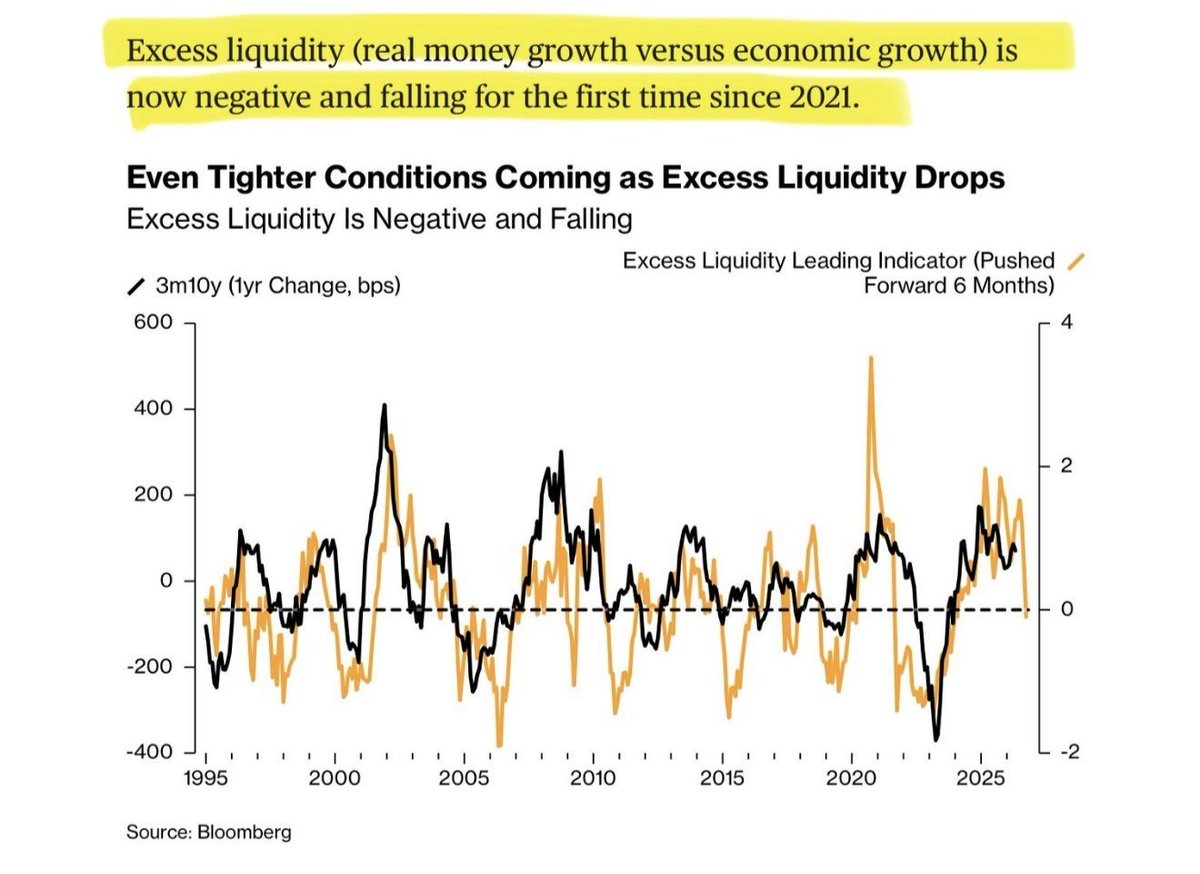
Everyone is focused on rate cuts, but liquidity is telling a different story.
For the first time since 2021, excess liquidity has turned negative.
That matters because excess liquidity is often what finds its way into stocks. When it disappears, risk assets lose one of their biggest tailwinds.
The market has been tightening for months, long before the Fed acknowledged it.
Borrowing costs are rising, the yield curve is flattening and global central banks are moving back toward tighter conditions.
At the same time, stocks remain expensive, while new share issuance is now outpacing buybacks for the first time since 2021.
Yet retail investors keep buying.
US equity ETFs just saw one of their largest weekly inflows on record.
The setup is simple:
The liquidity that normally supports higher asset prices is fading, while retail participation continues to surge.
That disconnect is worth paying attention to.
In BTC, everyone is asking where price goes next, but when you zoom out, the structure is already visible.
This is a range and right now we are sitting almost in the middle of it.
At the beginning of the year, Bitcoin printed a high near 93,846. The sharp February sell-off then dragged price all the way down into the 60,000–60,500 green demand zone.
What happened next?
Price spent the following months building a base inside that green demand zone, absorbing liquidity and forming a clear accumulation structure through April.
Then came May.
Bitcoin rallied strongly from demand and pushed into the 80,000–82,000 red supply zone, where sellers stepped in aggressively.
The red supply zone acted as a distribution area, where larger participants sold into strength and pushed price back down.
In June, the same story played out again.
Price returned to the green demand zone around 60,000–60,500, swept liquidity below the lows, found buyers and bounced back toward the first resistance level at 66,500.
Right now, Bitcoin is trading around 64,030.
Which means we are once again stuck in the middle of the range.
For me, the map is straightforward.
🟢 Below:
60,000–60,500 remains the key demand zone.
A confirmed daily close below that area would invalidate the current structure, trigger a wave of stop-losses and open up significantly more downside.
🔵 Above:
66,500 is the first resistance.
70,432 is the second resistance and an important level because it previously acted as support before turning into resistance.
Above that sits the 74,000 area.
🔴 Then comes the real obstacle:
the 80,000–82,000 red supply zone.
That zone has rejected price twice already.
If Bitcoin reaches it for a third test, either buyers reclaim it with conviction and establish acceptance above supply, or the market likely rotates back toward the green demand zone once again.
Everything between those levels is mostly noise.
The highest probability trades usually come from the edges of the range, not the middle.
That is why I am waiting for one of these major levels to break before getting aggressive.
Most retail traders lose money by opening positions in the center of a range where risk is highest and direction is least clear.
DeFi isn’t short on opportunities anymore.
The problem is deciding which ones actually make sense for you.
That’s where tools like @Ask_ORO come in, helping users map strategies based on what they already hold instead of starting from scratch.
What I noticed is that the goal isn't necessarily to help users chase the highest yield.
It’s to make decisions easier in a space that keeps getting more complex.
That shift matters more than it looks.
As Always NFA/DYOR
DeFi doesn’t have a shortage of opportunities.
It has a shortage of simplicity.
With hundreds of protocols, vaults, and strategies competing for attention, finding the right fit often takes more effort than accessing the opportunity itself.
That’s what I found interesting about @Ask_ORO.
Rather than pushing users toward a specific destination, it helps organize choices around the assets they already hold and the level of risk they’re comfortable taking.
In a market where options keep multiplying, reducing complexity may be just as important as generating yield.
Details below 👇
As always NFA / DYOR