Master of Lifecraft
Artist in times of Risefare (renaissance)
Strategist of All Sentient Life (until 2030)
sat/kas stacker (check pinned post)
lifemaxxing 🍀
Legit. Tested by me.
The minimum requirement to start making wealth in 2025 is a cellphone with Android 5.0+ or iOS 12.5+ and a connection to internet.
That’s all a human needs to start making money today. Not even a new phone.
If you’re not stacking, you’re missing out.
🍀😁
The RF world is insane.
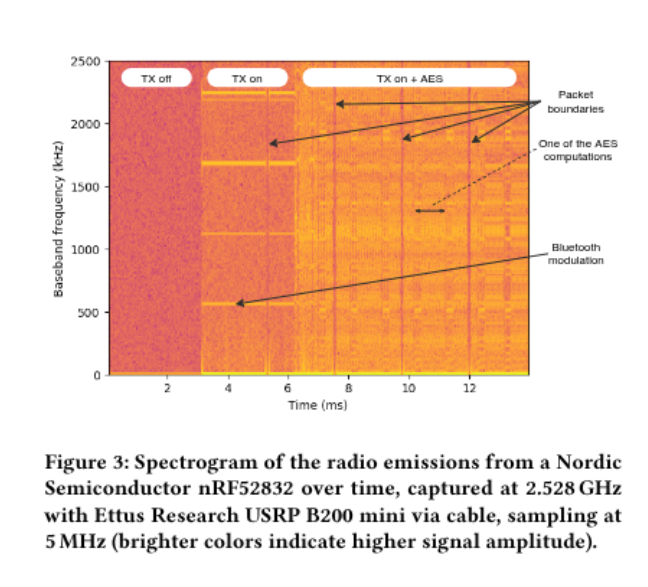
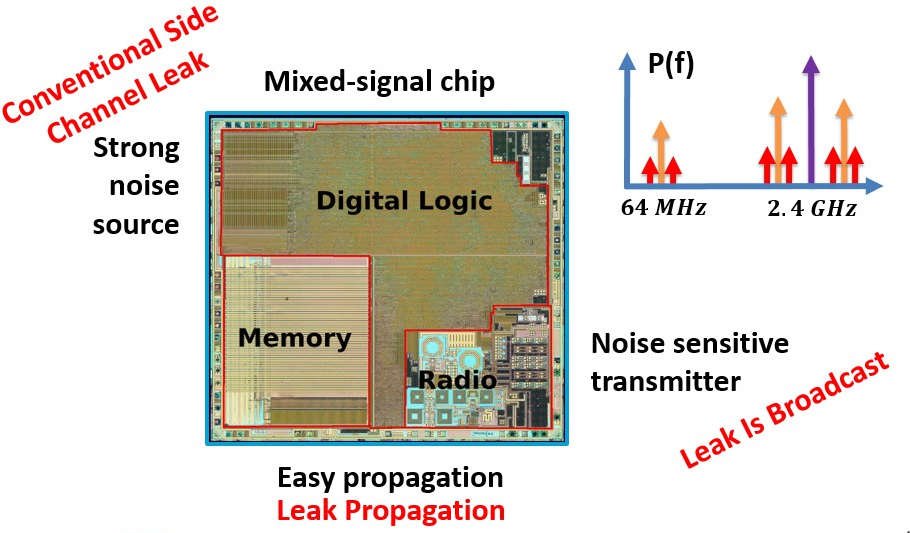
Researchers recovered AES-128 keys from a Bluetooth chip by listening to its own antenna from 10 meters away.
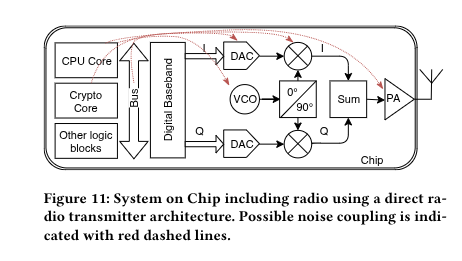
Crypto-engine switching noise couples into the RF chain, rides the 2.4 GHz carrier, and leaks out as radio.
@ArxiaLayerOne@lilygo9 I will support you until Arxia is so freaking amazing & easy to use, that you can have multiple ways to use it, from NFC on a smartphone, to GSM on al old 2000’s phone, and even by Morse code. Someone in the community will eventually figure how to transact via morse code. 😁
$KAS being recognized by the masters of the future (yes, I am recognizing @ArxiaLayerOne as a primordial step into the new era of human technology) speaks a lot!
Is there an emoji or Unicode symbol to represent this Layer 1? I want to integrate it to my profile bio æsthetic. ✨
kaspa has serious engineering behind it, ghostdag is well documented. but the architecture wasn't built for lora, blocks run around 80kb where lora mtu is 256 bytes. you'd need a heavy secondary layer to bridge it, which reintroduces the reconciliation problem we built arxia to solve at l1.
arxia uses block lattice (per-account chains) which fits offline natively, that's why 193 byte tx work end to end on radio. different design for a different constraint.
if offline-first is what you were looking for, you might be in the right place.
I lo be finding fast immediate confirmation to my assessments on the X platform.
#levitation does not require #gravity or #antigravity
https://t.co/iQEyTApvqf
@ArxiaLayerOne@lilygo9 Kaspa not made for lora. Cool.
But it can work offline somehow and I will eventually discover how.
Meanwhile. Arxia. Did you feed your full repo to an AI so it can teach people how it works? I want to know everything! Thanks for replying.
If this premise is true:
Consciousness does not primarily require self awareness to function correctly.
Then @RichardDawkins indeed was right in his assessment.
TFYATTM
🍀
The Ghost in the Machine: How Player Pianos Sparked Protests, and What They Reveal About Our AI Future
In the early 1900s, the player piano was a sensation. These self-playing instruments used perforated paper rolls fed through pneumatic mechanisms to reproduce complex piano performances automatically.
By the 1910s to mid-1920s, they outsold ordinary pianos in many markets, filling American parlors, saloons, and theaters with ragtime, marches, and classical pieces.
Great artists like Sergei Rachmaninoff and Ignace Paderewski cut rolls, preserving their interpretations for generations.
It was automation that brought “live” music into every home, without the need for lessons or live performers.
Yet this marvel triggered intense resistance. Composers and musicians saw it as an existential threat. In his fiery 1906 essay “The Menace of Mechanical Music,” bandleader and composer John Philip Sousa warned that player pianos and phonographs would “substitute machinery for the human soul.”
He predicted the death of amateur music-making: children would stop learning instruments, families would stop gathering around the piano, and music would lose its emotional depth.
Sousa testified before Congress, helping drive the 1909 Copyright Act, which created compulsory licensing so composers could earn royalties from mechanical reproductions, a landmark victory born from protest.
As “talkies” and radio displaced theater orchestras in the late 1920s, the American Federation of Musicians (AFM) launched the Music Defense League in 1930.
Funded by a tax on members, the union spent hundreds of thousands of dollars (millions in today’s dollars) on a national advertising blitz.
Dramatic newspaper ads depicted sinister robots replacing human musicians, with slogans like “Is Art to Have a Tyrant?” and warnings that “canned music” would destroy jobs and degrade culture.
The campaign targeted not just records but all mechanical music, including player pianos in public spaces.
While there were no Luddite-style riots smashing machines (player pianos were mostly expensive home devices), the opposition was fierce: boycotts, lobbying, lawsuits, and cultural shaming of anyone who chose “the robot” over living performers.
The protests did not kill the player piano. Record sales, radio, and the Great Depression did that by the early 1930s.
But the episode left a lasting legacy: new copyright rules, heightened awareness of technology’s impact on artists, and a template for how workers respond to automation.
We are living through the same story with AI and robotics. Generative models now compose music, write screenplays, generate art, and even perform.
Musicians, writers, and visual artists are protesting in eerily familiar ways: lawsuits over unlicensed training data (the modern equivalent of the player-piano royalty fight), demands for “human-made” labels, strikes by Hollywood writers and actors, and public campaigns against “AI slop.”
Fears echo Sousa’s exactly: loss of soul, authenticity, jobs, and human connection. “The robot is coming” ads of 1930 could run unchanged today, just swap “canned music” for “AI-generated content.”
History’s lesson is nuanced.
The player piano did not end music; it briefly coexisted with live performance before giving way to richer ecosystems.
Rolls by legends now serve as priceless archives.
Protests forced legal compromises that protected creators while allowing innovation. Yet real displacement happened. Thousands of theater musicians lost steady work, and the cultural shift toward passive consumption was real.
Today’s AI moment carries higher stakes: it threatens not just one profession but broad swaths of cognitive and creative labor.
Robots and AI could augment surgeons, drivers, teachers, and artists, or render many obsolete. The player-piano saga shows that raw Luddism rarely wins,
We cannot stop technological progress, The music plays on. The question is: who, or what, plays it?
@JeffCrypt0s It is not needed. Indeed.
No one needs to devalue their products.
Period.
I just posted this as an example of how crypto has been working in the last decade. With the ones truly believing, being rekt and exit liquidity.
Thanks for your reply. Have a nice day.
Having a conversation about Kaspa and the fee market. I proposed an idea already considering it genius, and it’s clearly something that the $KAS community should evaluate over the months.
I can play this game. No wife, no children, no physical assets. Just my talent & creativity
@JeffCrypt0s It’s a philosophical dive into group thinking, subjective value and appreciation of code.
Basically, if people who use $KAS truly believe in it, would they price their services in $KAS at a fiat loss?
The answer is: Not needed. Also better ways. What do you think?
This device was banned in some cites.
They called this soulless machine music.
It took over a decade to allow some cites to remove restrictions.
When you know the past, you know the future.