Introducing GPT-5.5
A new class of intelligence for real work and powering agents, built to understand complex goals, use tools, check its work, and carry more tasks through to completion. It marks a new way of getting computer work done.
Now available in ChatGPT and Codex.
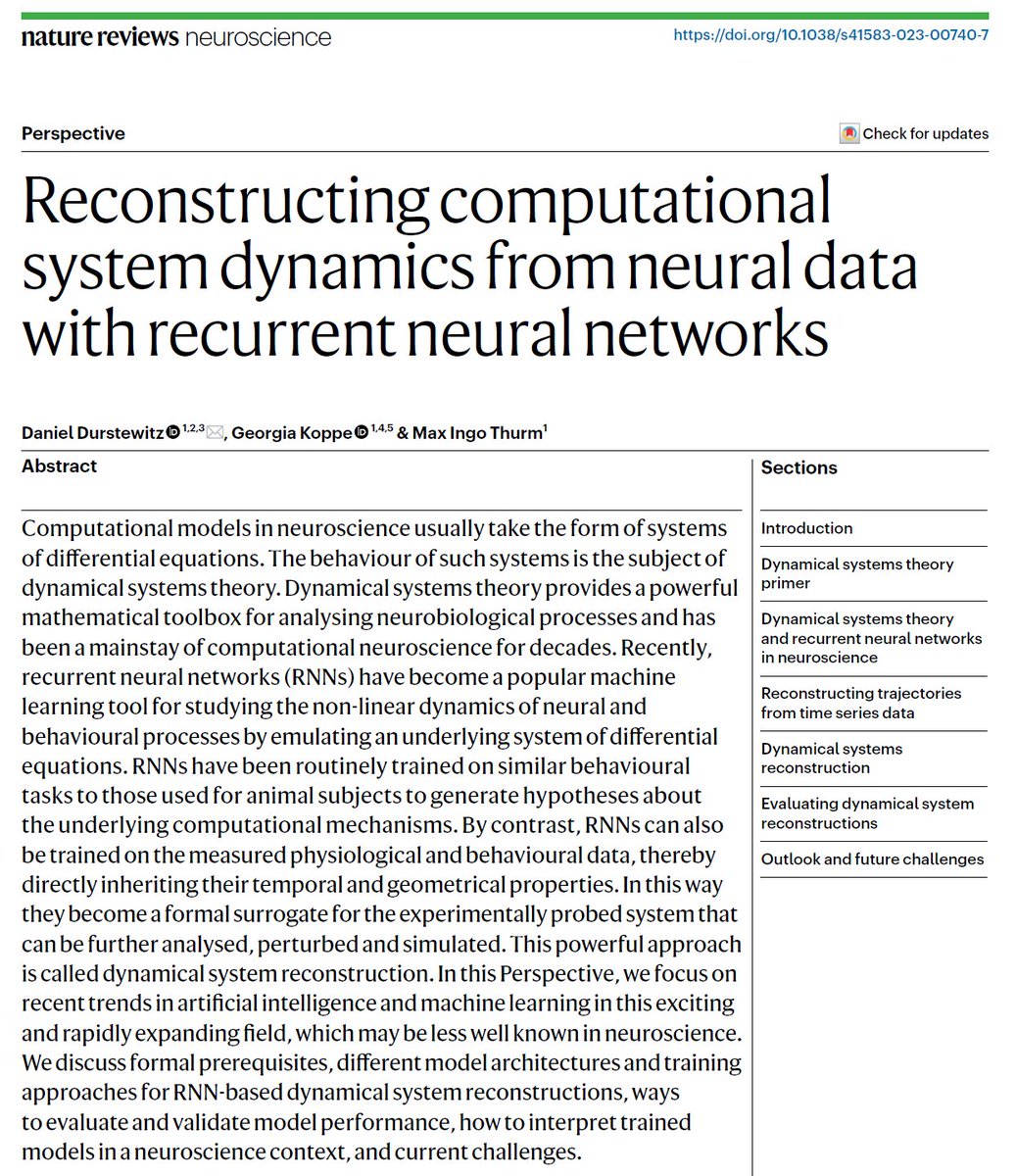
𝗕𝗿𝗮𝗶𝗻 𝗱𝘆𝗻𝗮𝗺𝗶𝗰𝘀 𝗮𝗻𝗱 𝗿𝗲𝗰𝘂𝗿𝗿𝗲𝗻𝘁 𝗻𝗲𝘂𝗿𝗮𝗹 𝗻𝗲𝘁𝘄𝗼𝗿𝗸𝘀
Went back to this paper which I highly recommend, including very rich supplementary section with valuable info.
https://t.co/T24Dfv3fR6
Introducing Claude Opus 4.7, our most capable Opus model yet.
It handles long-running tasks with more rigor, follows instructions more precisely, and verifies its own outputs before reporting back.
You can hand off your hardest work with less supervision.
Introducing Project Glasswing: an urgent initiative to help secure the world’s most critical software.
It’s powered by our newest frontier model, Claude Mythos Preview, which can find software vulnerabilities better than all but the most skilled humans.
https://t.co/NQ7IfEtYk7
We’re wrapping up data collection this week! If you have data to contribute, see the link below.
Our goal is to train AI models to automatically score all creativity tasks in the dataset. We will share the models open access.
In this completed Stage 2 Registered Report, Lin et al. examine whether people can learn to value effort in its own right. @hauselin@mit@mitsloan@uofregina@uoft
https://t.co/LfWcZM1U3g
Just released our Python EEG Handbook! It's designed as a very easy-to-follow learning guide for anyone looking to get started with EEG data processing using Python.
Save a copy of the PDF 📁 and share it around! 🔄 #EEG#Python#OpenScience https://t.co/PfSTpVLQfh
'Development of visual object recognition', a new Review by Vladislav Ayzenberg (@vayzenberg90) & Marlene Behrmann (@behrman81779370)
Web: https://t.co/sBR5buvaa6
PDF: https://t.co/STXaetcoDE
Why do humans cry with tears?
In a paper that was just published in @PLOSBiology. We found that a chemosignal in human tears blocks aggression.
https://t.co/Es4hdSCYRp
With simultaneous EEG-fMRI, we probed human replay in both fine time and space! Amazing work led by Qi Huang @HuangQi9932 et al., along with Ray and Tim @behrenstimb
I hope to recruit a new graduate student for the fall of 2024 to work with me in Drexel University’s doctoral program in Applied Cognitive and Brain Sciences (ACBS) on the cognitive neuroscience of creativity and intelligence. Please spread the word.
Talk alert! We are excited to have @mark_ho_ as the next speaker on Oct, 4th, 9:00 a.m (EST). Mark Ho will talk about his publication @Nature, in which the authors investigated the simplified representation in human planning:
https://t.co/XbOdpMgfTk
See the Zoom link below.
Tweet 1/9: 📢 Postdoc positions in Neuroeconomics available at Dr. Lusha Zhu's lab, Peking University! Dive into the exciting world of human decision-making mechanisms. 🧠🔍 #neuroeconomics#PostdocJobs
One of the appealing features of representational similarity analysis (RSA) is its simplicity and ease of implementation: Just measure representational dissimilarities and correlate representational dissimilarity matrices (RDMs), right? ...
Here is my Letter to TiCS responding to the recent paper by @Roger_Beaty and @yoed_kenett on creativity and semantic memory. They are fine fellows, but their approach was known to be wrong decades ago... https://t.co/q3TLc3Gl7R