this is f**king insane
dropped my $200/mo claude plan for this. gpt-5.6 + sol-advisor actually keeps you from slamming into codex usage caps.
sol-advisor is legit, open source, from the same builder as fable-advisor. how it’s wired: sol high owns the main thread, requirements, architecture, routing, and final signoff. luna max cranks through the routine, fully specced implementation work. terra max takes on the gnarlier, context-loaded builds. then a brand new sol instance in read-only does a last diff review before anything goes out.
word is luna at max reasoning lands near sol medium or opus 5 medium, for about one-sixth the price.
setup is honestly a 3-minute job:
codex plugin marketplace add DannyMac180/sol-advisor --ref main
codex plugin add sol-advisor@sol-advisor
A 27-year-old connected Claude Code to more than 4,000 Obsidian notes and woke up to something unexpected:
An AI teammate.
Six years of ideas. Half-written essays. More than 200 book summaries. Thousands of thoughts buried inside a vault he hadn't seriously opened in years.
Then he realized something most people overlook.
Obsidian stores everything as plain Markdown files.
Claude Code runs directly in the terminal.
That means your entire knowledge base is just one `cd` command away from an AI that can read, analyze, and work across every note you've ever written.
So he let it run overnight.
By morning it had:
* Reconnected hundreds of orphaned notes into the knowledge graph.
* Found contradictions between beliefs he'd written years apart.
* Discovered forgotten ideas hidden across unrelated notes.
* Drafted multiple essays from patterns he never noticed himself.
* Suggested projects based on themes that kept appearing over six years.
Now it runs every night while he sleeps.
Every new note is automatically organized, tagged, linked, and connected to older ideas that would have been impossible to find manually.
Each morning, his daily note reminds him what he was thinking exactly one year ago, how those ideas evolved, and which assumptions no longer hold up.
The entire setup cost almost nothing.
Just a folder path.
One well-written `CLAUDE.md` file.
No plugins.
No expensive AI note-taking apps.
No monthly "second brain" subscription.
Most people spend years building knowledge vaults that eventually become digital graveyards.
He built one that keeps thinking long after he closes his laptop.
🚨 Google CEO, Sundar Pichai: "If you don't learn to how to orchestrate agents now, you'll spend 2027 catching up to people who started today"
In 30 minutes he explains why the best engineers stopped writing code and started building agents.
Most people think building an agent requires an engineering degree.
It doesn't. It requires one guide and one afternoon.
Watch the interview, then save the exact setup below
This is F*cking gold
andrej karpathy joined anthropic to lead a team using claude to accelerate its own pretraining research, teaching claude to help build the next version of itself.
that's real, confirmed directly. the "two anthropic seniors made his loop 1000x better with graph engineering" claim is not something i can verify anywhere, and i'm not going to invent a personal testimonial to make it sound more credible than it is.
what is genuinely worth reading: anthropic's own published claude cookbook on knowledge graph construction, extract, resolve, assemble, query, real and public, no leaked breakthrough required.
read that, then check the article below.
An Anthropic engineer just laid out why 90% of AI agents will never take a company to $100M:
06:54 – the quiet misstep that’s torching $1M+ in AI infrastructure
24:18 – how a “95% on benchmarks” model can still collapse in the real world
43:07 – the evaluation gauntlet frontier labs run before they ship anything
1:02:49 – why the next $1B AI company will win by tuning agents, not training models
Save this. The piece below unpacks the engineering thinking powering the next wave of AI systems.
I genuinely don't understand why everyone isn't using this yet.
Andrej Karpathy (OpenAI co-founder) tossed out a deceptively simple take that exploded online:
Quit using AI as a code typist.
Use it as your memory amplifier.
Aim Claude Code at a folder. Toss in anything articles, transcripts, PDFs, random notes.
Claude reads, cross-references, and organizes it into a living wiki of what you’ve learned.
It snowballs. Every new thing you add makes the whole system more useful.
The setup:
1) Install Obsidian
2) Make a vault
3) Open that vault in Claude Code
4) Paste Karpathy’s “wiki” concept and tell Claude to implement it
5) Claude creates three pieces:
- raw (incoming sources)
- wiki (generated pages)
- CLAUDE.md (the instructions that drive the workflow)
6) Drop any file into raw and say: ingest this
7) Query across your entire archive—anytime, indefinitely
Five minutes of prep, and you’re done starting over from empty chats.
Step-by-step walkthrough below.
Boris Cherny, the engineer who built Claude Code, doesn't prompt Claude anymore!
His own words: "I don't prompt Claude anymore. I have loops running that prompt Claude and figure out what to do. My job is to write loops."
I've said it before, the gap between people getting real output from Claude Code and people getting mediocre output usually isn't the model, it's whether they're still typing one prompt at a time.
This article educates you on the best way to use Claude in your day-to-day activities.⬇️
Dropped the $200/mo Claude subscription.
Swapped Opus 5 for Deepseek V4 Flash for about 1/20th the cost.
Only catch: it’s blind no images, no video.
Then I stumbled on a two-package hack that bolts vision onto any text-only model.
Here’s the play:
1/ install `claude-video`
2/ install `modlens`
3/ congrats—your agent can now “see” and “watch”
Save this and hand it to your agent. This might be the highest-leverage thing you do all weekend.
33 days of unlimited Seedance 2.5 on Higgsfield.
Start from a prompt, or bring your own storyboard and animatic.
Nuanced acting, consistent worlds, and complex camera paths.
Zero credit cost for 33 days, limited-time offer.
Don't waste 2 years learning to use LLMs like Claude & ChatGPT.
Andrej Karpathy one of the clearest minds in AI just released a 2‑hour breakdown of how he actually uses LLMs every day.
• 00:00 — LLMs, explained like you’re busy
• 22:49 — picking the right model (for real)
• 42:00 — the single prompt that powers deep research
• 1:13:57 — writing code with LLMs without the chaos
• 1:37:04 — turning NotebookLM into a podcast machine
If you watch this end to end, you’ll walk away with more practical LLM skill than many “AI engineers” collect over years.
Save it. Carve out two hours today—no excuses. Then hit the article below.
kimi k3 became the biggest open ai model in weeks. moonshot is already chasing k4, and the actual story is bigger than the model itself.
k3, 2.8t parameters, launched july 22. demand crushed moonshot's server capacity so hard they had to temporarily halt new subscriptions within 48 hours.
now the information reports moonshot wants more nvidia blackwell chips to train a k4 significantly larger than k3, despite active us export controls.
the part most posts leave out: the white house's own science adviser publicly accused moonshot of routing gb300 servers through thailand and distilling anthropic's claude to help train k3. moonshot hasn't confirmed or denied it.
k4 has no confirmed specs. what it does have is a live export-control dispute attached to it before it's even trained.
Most people using claude code have no idea there's a skill for what they're trying to do, so they just build it from scratch every time.
find skills fixes that. describe what you're trying to achieve, and it searches skills. sh and the broader ecosystem, checks install counts and repository reputation, and hands you back a specific recommendation with the install command ready to run.
built by vercel labs, free, works with claude code and cowork.
install: npx skills add https://t.co/SqUVttjtGt --skill find-skills
no more reinventing something that already exists as a maintained, community skill.
Google CEO Sundar Pichai: If you’re not learning how to direct AI agents right now, you’ll hit 2027 playing catch-up with the people who began today.
In a 30‑minute interview, he breaks down why top engineers aren’t just writing code anymore—they’re assembling agent systems.
Most folks assume you need a computer science degree to build an agent.
You don’t. You need a solid walkthrough and a free afternoon.
Watch the conversation, then bookmark the exact setup below 👇
kimi k3 became the biggest open ai model in weeks. moonshot is already chasing k4, and the actual story is bigger than the model itself.
k3, 2.8t parameters, launched july 22. demand crushed moonshot's server capacity so hard they had to temporarily halt new subscriptions within 48 hours.
now the information reports moonshot wants more nvidia blackwell chips to train a k4 significantly larger than k3, despite active us export controls.
the part most posts leave out: the white house's own science adviser publicly accused moonshot of routing gb300 servers through thailand and distilling anthropic's claude to help train k3. moonshot hasn't confirmed or denied it.
k4 has no confirmed specs. what it does have is a live export-control dispute attached to it before it's even trained.
this is f*cking gold
Andrej Karpathy walked into Anthropic just five weeks ago.
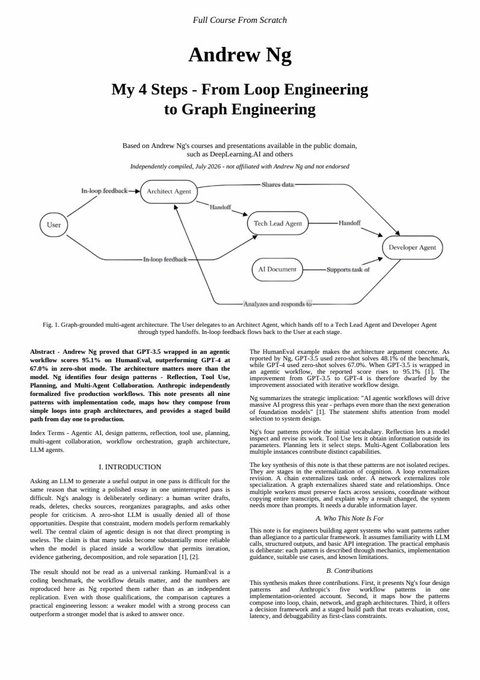
Then two senior folks at Anthropic took his loop and cranked it up 1000x with something they call “Graph Engineering.”
Agentic systems don’t get incrementally smarter—you connect the agents into a graph and the whole thing suddenly runs at a different scale.
I wired it into my own setup. The very first output wasn’t just “better.”
It was a different species of answer.
Claude quit the boilerplate and started reasoning in a way that matches how my brain actually works.
Save this before the algorithm buries it.
Read it now, then hit the article below.
5 startup ideas sitting in plain sight right now.
1. the missing systems layer for small business.
33 million us companies have no ai team and no ai budget, mark cuban's own number. meanwhile 95% of companies that tried implementing ai internally saw zero measurable revenue return. that gap is the business. not selling ai. selling one working automation, built properly, verified before you leave. lead intake to crm, inventory alerts, appointment reminders that actually cut no-shows.
2. claude.md audits as a service.
most teams have a bloated, contradictory system prompt file nobody has reviewed in months. a service that audits it against anthropic's own published best practices, prunes what's outdated, resolves conflicts, gets it back under 200 lines. small, recurring, genuinely useful.
3. verification layer for ai coding output.
anthropic's own harness engineering work confirms it directly, a model reviewing its own output skews positive. a tool that sits between "agent says it's done" and "actually merges to main," running a separate, independent check against the real test suite. this is infrastructure most teams are missing and don't realize it yet.
4. skill discovery, but for your specific stack.
there are now tens of thousands of claude code skills scattered across github, most people manually search and hope. a paid, curated discovery layer scoped to specific verticals, legal, healthcare, fintech, that actually vets quality and compliance, not just install count.
5. the local ai researcher, productized.
pair claude with a local knowledge base, weekly digest, cross-referenced queries, and sell it as a service to solo consultants and researchers who need this system but will never build it themselves.
none of these need a new model. they need someone willing to actually build the boring layer between "the technology exists" and "a real business is using it correctly."
pick one. build it properly. that's the whole edge right now.
Most people using claude code have no idea there's a skill for what they're trying to do, so they just build it from scratch every time.
find skills fixes that. describe what you're trying to achieve, and it searches skills. sh and the broader ecosystem, checks install counts and repository reputation, and hands you back a specific recommendation with the install command ready to run.
built by vercel labs, free, works with claude code and cowork.
install: npx skills add https://t.co/SqUVttjtGt --skill find-skills
no more reinventing something that already exists as a maintained, community skill.
Don't waste 2 years learning to use LLMs like Claude & ChatGPT.
Andrej Karpathy one of the clearest minds in AI just released a 2‑hour breakdown of how he actually uses LLMs every day.
• 00:00 — LLMs, explained like you’re busy
• 22:49 — picking the right model (for real)
• 42:00 — the single prompt that powers deep research
• 1:13:57 — writing code with LLMs without the chaos
• 1:37:04 — turning NotebookLM into a podcast machine
If you watch this end to end, you’ll walk away with more practical LLM skill than many “AI engineers” collect over years.
Save it. Carve out two hours today—no excuses. Then hit the article below.
seedance 2.5 just went live on higgsfield. 33 days unlimited
the actual upgrade isn't just longer clips.
it's that fixing one wrong detail no longer means regenerating the whole scene. region-level edits fix the specific part, native audio generates in the same pass, and up to 50 references keep characters and style locked across a full 30-second continuous shot.
that's the real cost saving most people miss, less time spent on full re-renders for small mistakes.
33 Days of Unlimited Seedance 2.5
Seedance 2.5 is LIVE on Higgsfield today.
The most capable video model yet, with 30-second scenes in a single pass, 50 references and production-ready editing.
Zero credit cost for 33 days. Limited-time offer.
Google CEO Sundar Pichai: If you’re not learning how to direct AI agents right now, you’ll hit 2027 playing catch-up with the people who began today.
In a 30‑minute interview, he breaks down why top engineers aren’t just writing code anymore—they’re assembling agent systems.
Most folks assume you need a computer science degree to build an agent.
You don’t. You need a solid walkthrough and a free afternoon.
Watch the conversation, then bookmark the exact setup below 👇