THIS GUY MAKES COMPLEX AI AGENT CONCEPTS RIDICULOUSLY EASY TO UNDERSTAND.
No jargon wall. No assuming you already know what a reward model or an evaluation harness is.
Just a straight line from "I have no idea how agents actually work" to "oh, that's genuinely simple."
The best explainers do not simplify by cutting corners. They simplify by finding the one analogy that makes the whole thing click.
Anthropic's own claude cookbook has a guide on graph engineering for multi-agentic systems, no leaked pdf required.
the shift: your agent's memory dies with its context window. a knowledge graph makes it permanent.
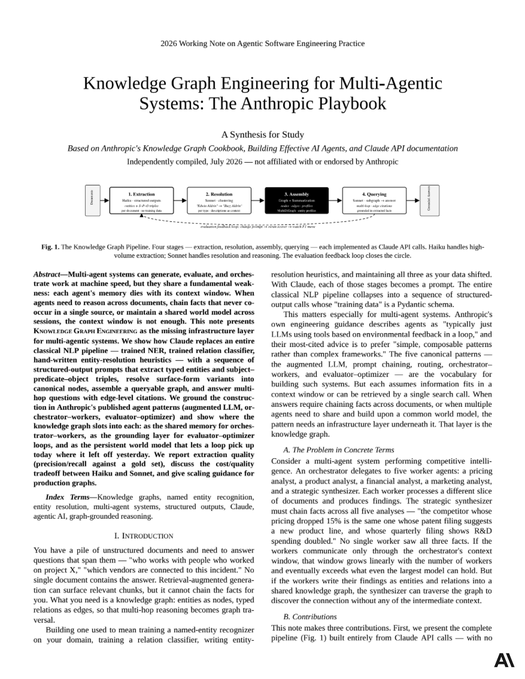
extract → resolve → assemble → query → repeat
every agentic graph has 5 stages:
extract: haiku pulls entities and s-p-o triples. one call per doc. the pydantic schema is the only training data.
resolve: claude clusters "edwin aldrin" → "buzz aldrin" - zero string overlap - using descriptions as context.
assemble: canonical nodes, typed edges, provenance on every triple. one connected graph.
query: serialize a subgraph → claude reasons over triples → every answer cites a specific edge.
plug this into multi-agent systems as shared memory. workers write to it, evaluators fact-check against it, loops persist overnight with it.
this guide changed how i'm building multi-agent systems today. free, official, public, not a leaked pdf.
read it now, then explore the article below.
Andrew Ng:
“AI agents are doing almost 100% of my tasks now - the hype has exceeded my expectations.
in 3-6 months, we’ll all be building graphs to orchestrate self-improving agents. No more prompting.”
In a 40-minute talk, Andrew Ng explains how to build self-improving agentic systems from scratch.
Worth more than a $500 agentic course.
Watch this video, then read the article below on how to become a graph architect.
Holy sh*t, this can't be FREE
A FREE GITHUB REPO FROM JACK DORSEY'S BLOCK JUST DROPPED A FULL AI-AGENT WORKPLACE BUILT TO REPLACE SLACK AND GITHUB.
It's called Buzz. Open source, built on the decentralized Nostr protocol.
Setup: clone and self-host the server. Channels, search, git, automation, all live there.
Add your agent to a channel like a real teammate. Scope its key. Let the team steer it live.
Every agent gets its own cryptographic identity and audit trail, not a permission flag bolted onto someone else's login.
Apache 2.0. Supports Claude Code, Codex, and Block's own goose.
Save and bookmark this.
SAM ALTMAN CALLED OPENAI A "COMPANY" TO ELON MUSK'S FACE IN 2015.
Elon stopped him cold.
"OpenAI is structured as a 501(c)3 nonprofit."
Not a company. A nonprofit. Built specifically so no one would ever profit from it.
Sam nodded.
Then spent the next 10 years running it.
Then converted it into a for-profit company valued at $300 billion.
With shareholders.
With investors expecting returns.
The correction Elon gave him in that interview was not a small vocabulary note.
It was the entire point of OpenAI's existence.
The nonprofit structure was not a legal technicality.
It was the promise.
The thing that made it different from every other AI lab racing to make money.
Sam knew that in 2015.
He was corrected on it by the co-founder in real time.
And then he changed the structure anyway.
The interview exists.
The correction is on tape.
The conversion happened.
@elonmusk
is in court arguing this exact point right now.
The evidence is the 2015 interview.
Screenshot this.
Follow @cyrilXBT for every OpenAI development the mainstream refuses to connect the dots on.
KIMI K3 VS GPT-5.6 SOL VS FABLE 5. SAME PROMPT. SAME TASK. NOT EVEN CLOSE.
Judged all three on speed, design, and how the actual gameplay felt.
Kimi K3 understood what makes a game fun on its own and added the right features without extra prompting. Pacing felt natural.
Fable 5 and GPT-5.6 Sol both shipped gameplay that felt rushed. Not a video speed issue. That was the real output.
Final scores.
Kimi K3: 9.5/10 · $0.030
Fable 5: 7.5/10 · $0.38
GPT-5.6 Sol: 7/10 · $0.11
The cheapest model won on quality too.
MOST PEOPLE ASSUME SLOW LLM INFERENCE MEANS THEY NEED A BIGGER GPU.
Often it means they are running the wrong inference engine. Naive serving reserves worst-case memory for every single request, and that assumption alone burns 60 to 80% of your GPU memory before you have processed anything.
vLLM's PagedAttention allocates memory in fixed pages, on demand, the same idea operating systems use for virtual memory. Utilization jumps to roughly 95%.
This walkthrough goes from that concept straight into a production OpenAI-compatible server, load testing, and a real monitoring dashboard, not just the theory.
Andrew Ng:
“AI agents are doing almost 100% of my tasks now - the hype has exceeded my expectations.
in 3-6 months, we’ll all be building graphs to orchestrate self-improving agents. No more prompting.”
In a 40-minute talk, Andrew Ng explains how to build self-improving agentic systems from scratch.
Worth more than a $500 agentic course.
Watch this video, then read the article below on how to become a graph architect.
Okay, this is actually insanely useful.
Every time I move from ChatGPT to Claude, I lose the context and have to explain everything again.
@Unibase_AI built a Chrome extension that fixes exactly that.
I saved a ChatGPT conversation, opened Claude, and sent the whole thing straight into the prompt. You can also choose only the messages you need.
No giant copy paste. No starting from zero.
If you use more than one AI regularly, save this.
Sam Altman:
"We're going to see 10-person billion-dollar companies pretty soon."
"If I were 22 right now, I'd feel like the luckiest kid in history."
Most people will read this, feel inspired for 3 minutes, and go back to what they were doing.
The ones who act will build a one-person company this weekend.
One tool. Claude Cowork. Full operation.
This is the exact playbook ↓
MOST PEOPLE ASSUME SLOW LLM INFERENCE MEANS THEY NEED A BIGGER GPU.
Often it means they are running the wrong inference engine. Naive serving reserves worst-case memory for every single request, and that assumption alone burns 60 to 80% of your GPU memory before you have processed anything.
vLLM's PagedAttention allocates memory in fixed pages, on demand, the same idea operating systems use for virtual memory. Utilization jumps to roughly 95%.
This walkthrough goes from that concept straight into a production OpenAI-compatible server, load testing, and a real monitoring dashboard, not just the theory.
KIMI K3 VS GPT-5.6 SOL VS FABLE 5. SAME PROMPT. SAME TASK. NOT EVEN CLOSE.
Judged all three on speed, design, and how the actual gameplay felt.
Kimi K3 understood what makes a game fun on its own and added the right features without extra prompting. Pacing felt natural.
Fable 5 and GPT-5.6 Sol both shipped gameplay that felt rushed. Not a video speed issue. That was the real output.
Final scores.
Kimi K3: 9.5/10 · $0.030
Fable 5: 7.5/10 · $0.38
GPT-5.6 Sol: 7/10 · $0.11
The cheapest model won on quality too.
Sam Altman:
"We're going to see 10-person billion-dollar companies pretty soon."
"If I were 22 right now, I'd feel like the luckiest kid in history."
Most people will read this, feel inspired for 3 minutes, and go back to what they were doing.
The ones who act will build a one-person company this weekend.
One tool. Claude Cowork. Full operation.
This is the exact playbook ↓
SAM ALTMAN CALLED OPENAI A "COMPANY" TO ELON MUSK'S FACE IN 2015.
Elon stopped him cold.
"OpenAI is structured as a 501(c)3 nonprofit."
Not a company. A nonprofit. Built specifically so no one would ever profit from it.
Sam nodded.
Then spent the next 10 years running it.
Then converted it into a for-profit company valued at $300 billion.
With shareholders.
With investors expecting returns.
The correction Elon gave him in that interview was not a small vocabulary note.
It was the entire point of OpenAI's existence.
The nonprofit structure was not a legal technicality.
It was the promise.
The thing that made it different from every other AI lab racing to make money.
Sam knew that in 2015.
He was corrected on it by the co-founder in real time.
And then he changed the structure anyway.
The interview exists.
The correction is on tape.
The conversion happened.
@elonmusk
is in court arguing this exact point right now.
The evidence is the 2015 interview.
Screenshot this.
Follow @cyrilXBT for every OpenAI development the mainstream refuses to connect the dots on.
THIS SHOULD NOT BE POSSIBLE YET.
A developer open-sourced a coding agent harness that boots 245x faster than Claude Code. It's called jcode.
First frame renders in 14ms. Claude Code takes 3,437ms.
One session with embeddings off uses 27.8 MB of RAM. Claude Code uses 386.6 MB. Run ten sessions in parallel and jcode holds at 117 MB while Claude Code balloons to 2.3 GB and OpenCode hits 3.2 GB.
Each agent gets a semantic memory graph instead of a scratchpad. Every turn gets embedded as a vector, queried against the graph on future turns, verified by a side-agent before injection, consolidated in the background for staleness and conflicts. No manual /remember calls. No token burn on lookup tools.
30+ providers built in. Claude, ChatGPT, Gemini, Copilot, Azure, OpenRouter, DeepSeek, Groq, Mistral, Perplexity, Fireworks, Ollama, LM Studio, and any OpenAI-compatible endpoint.
Swarm lets multiple agents work the same repo. Edit a file another agent already read, it gets pinged and checks the diff. Agents DM each other, broadcast, or spawn their own worker teams.
Self-dev mode: tell it to edit its own source, rebuild, and reload live, mid-session.
Written in Rust. MIT licensed. macOS, Windows, Linux, Termux. 11.2k stars, native iOS coming.
https://t.co/xZek94xMWh
SOMEONE BUILT AN MCP THAT COPIES ANY WEBSITE'S DESIGN INTO YOUR OWN PROJECT.
Point it at a URL. It fetches the HTML and CSS, extracts the color palette, typography, spacing tokens, even border radius and shadows, and applies it directly to your codebase.
No screenshots. No manually eyeballing hex codes. No browser automation required for most implementations, pure HTTP fetch and parsing.
Result: clean, professional UIs without touching a design tool.
Save this before you go back to hand-copying colors from inspector tabs.