"Will AI cause Armageddon?" is the wrong question.
The discussion about the threats that AI might pose has taken on an apocalyptic tone: will it extinguish life on Earth? Will it destroy humanity? It won’t, but it poses some far more real dangers to us all—right now, not in some imagined future. In the next couple of years, we are likely to face a new wave of rampant, pervasive cyberattacks and cybercrime.
As the recent series of attacks by AI agents show, we no longer need to speculate about whether AI can conduct cyberattacks. It can. The important question now is what happens when attacks that once required skilled human beings can be conducted by machines, at machine speed and machine scale.
For most of cybersecurity’s history, we have built defenses around an unstated assumption: the attacker is human. A person—or a team—has to inspect a system, find a weakness, exploit it, see what happens and decide what to do next. That takes time. Detection therefore buys time. Defenders spot an intrusion and respond before the attacker gets much further.
Frontier AI attacks that assumption.
An agent does not need to sleep. It can inspect code, probe a network, hit a barrier, devise another approach and try again. Make a thousand copies and they can work against a thousand targets at once. Allow agents to share what they learn and hacking begins to change from a human-scale activity into a machine-scale one.
At Rubrik, we are seeing part of this transformation firsthand. Through our participation in Anthropic’s Project Glasswing, one lesson became clear. AI is not necessarily creating new vulnerabilities. It is collapsing the cost and time required to discover them.
That changes the economics of cybersecurity.
Modern software may contain thousands of small imperfections. Most lead nowhere. A few, combined in the right sequence, open a path through a supposedly secure system. Historically, finding those chains required talented people, lots of time and some luck. Frontier models can increasingly do the searching themselves, discovering paths through complex systems that humans might never find.
This is what makes complacency about the new threat so dangerous.
In 1998 a group of hackers appeared before Congress and warned that the rapidly expanding internet contained vulnerabilities capable of producing enormous disruption. There was no single cyber Armageddon. Instead North Korea crippled Sony Pictures. WannaCry raced through more than 200,000 computers in roughly 150 countries, disrupting hospitals and factories. NotPetya began as a Russian attack on Ukraine and caused about $10 billion in damage worldwide. Ransomware shut down Colonial Pipeline and disrupted fuel supplies across the American east coast.
It would be strange to look at that history and conclude that the warnings were overblown. The catastrophe did not arrive as one spectacular event. Cyber insecurity became a permanent condition.
Now imagine that condition at machine speed.
That is why “Will AI cause Armageddon?” is the wrong question. A hospital whose systems are encrypted, a bank that loses control of its identities, or a company that cannot recover its data doesn’t care much whether civilization remains intact. The question is whether AI can make attacks faster, cheaper, more sophisticated and vastly easier to replicate.
We are beginning to get the answer.
Cyber-defense therefore has to change as well. For years the industry has concentrated on prevention and detection: keep the attacker out and, failing that, spot him quickly. Both remain essential. But when attacks operate at machine speed, detection may no longer buy enough time. Intrusion, exploitation and damage can begin to collapse toward the same instant.
Companies must assume that some attacks will succeed. They need to be able to recover just as fast.
The answer is not less AI. It is more AI on the defensive side: continuously hunting vulnerabilities, watching identities and data, detecting abnormal behavior, patching weaknesses and helping restore compromised systems. Machine-speed attacks require machine-speed defense.
There has always been an asymmetry in cybersecurity. An attacker has to be right once. A defender has to be right every time. AI makes that imbalance more dangerous because attackers do not need permission, compliance reviews or perfect systems. They need only find one opening—and now they can search for it continuously, cheaply and at an enormous scale.
Criminal groups and hostile governments will use this technology. They would be foolish not to.
The first generation of cybersecurity was built to stop human beings sitting at keyboards. That world has ended. The next attack may be launched by thousands of agents, moving at a speed no human team can match.
If the hackers are becoming machines, our defenses must become machines too.
This came way sooner than what we saw with Japanese car manufacturers or outsourcing of factories to China. This time around, it’s not just about “my job,” but “my energy bill” and “my water bill.”
While it’s a political issue now, the architectural pieces matter just as much: precision, efficiency, and safety; cpu AND gpu; humans AND AI workers.
@mcuban The deep neural network is inherently a probabilistic data structure. Also, the frontier models have no memory about your business. Precision will come only when we use deterministic data structures like old-style databases, and use LLMs to generate code to look them up.
Andrew Ng just revealed why the AI companies throwing the most compute at the problem are going to lose.
The winner of the intelligence race won’t use the most compute.
They’ll waste the least.
Ng: “Most of your high-dimensional data lies on a lower-dimensional subspace. It’s just a fact of life.”
Here’s what that means in practice.
You have a 10,000-dimensional dataset.
Every dimension dragged through every calculation.
Every training cycle hauling dead weight the model will never use.
Ng: “You’re carrying around these 10,000-dimensional examples throughout your whole training process.”
That bloat isn’t just inefficient.
It’s a tax on every computation you run.
Memory bandwidth. Network bandwidth. Computational speed.
All of it eaten by dimensions that contribute nothing to intelligence.
They contribute noise.
The insight that separates the architects from the arms race: that 10,000-dimensional dataset is almost entirely captured by a much smaller subspace.
The signal lives in a fraction of the space you’re paying to process.
Compress it. 10,000 dimensions down to 1,000.
Ng: “You can run your learning algorithm on a much lower-dimensional set of data and it may be much more efficient.”
Same hardware. Same budget. A fraction of the friction.
Brute force is the strategy of whoever has the deepest pockets.
Compression is the strategy of whoever actually understands the problem.
The companies that master this don’t just build faster models.
They build models that find more truth in less data than anything scaling blindly ever will.
Intelligence was never about processing everything.
It’s about knowing what to cut.
Small businesses are the backbone of American economy.
At the first 2026 @TheLBJSchool Business Forum, we examine the public policy choices that will determine whether AI fuels inclusive growth—or widens the gap.
Register—Open to public: https://t.co/aA0RNaM5AS
Does semantic collapse exist? Yes.
Is this guy either lying or incompetent? Also yes.
I’ve read the Stanford and Berkeley papers on embedding degradation at scale.
This graphic clearly hasn’t.
The chart assumes one thing:
a single vector search over a flat pile of documents.
That’s like saying dbs don’t scale because full table scans get slow!
Yes! That’s why indexes, hybrid search, and filters exist 😂
You’re arguing against the dumbest possible implementation and pretending that’s what everyone does. No we don’t
This isn’t analysis.
This is ragebait. Anyone with real experience now knows you have none
The security vulnerability we found in Perplexity’s Comet browser this summer is not an isolated issue.
Indirect prompt injections are a systemic problem facing Comet and other AI-powered browsers.
Today we’re publishing details on more security vulnerabilities we uncovered.
Moving and organizing data into vector DBs, SQL DBs, and graph DBs — and serving them via custom ‘compute’ skills — is what will give conversational surfaces depth in the enterprise. This is where Computer by @devrev shines. It’s (a) search, (b) analytics, and (c) workflows done right for an agentic enterprise. Read more about Computer Memory and AirSync here:
https://t.co/K40iH0Bzho
Meet Computer, your new AI teammate, and the next step in our journey toward Team Intelligence — which like most profound things in life — captures 3 design ethos of @devrev:
- Discovering knowledge already within the enterprise
- Your customer is also in your team
- The team’s biggest enemy is departments
Computer is “here,” where your team and your enterprise data are.
https://t.co/K40iH0Bzho
Meet Computer, by DevRev.
Your new AI teammate that makes work faster, smarter, and more human – and maybe even a bit more fun. It unites data, breaks down silos, and lifts every team with real collaboration.
Computer is born from our belief that AI should feel less like managing another tool and more like gaining a trusted teammate.
Discover what makes Computer special in our CEO Dheeraj's launch message: https://t.co/bloIRvebna
@dheeraj
And legacy SaaS thinks of LAMP stack as the end-all and be-all of all data and compute. There’s so much more to data in the world of AI and agents: graph DBs, inverted indexes, vector DBs, DWs, time-series engines, pub-sub busses, … imagine creating millions of such indexes, DBs, et al.
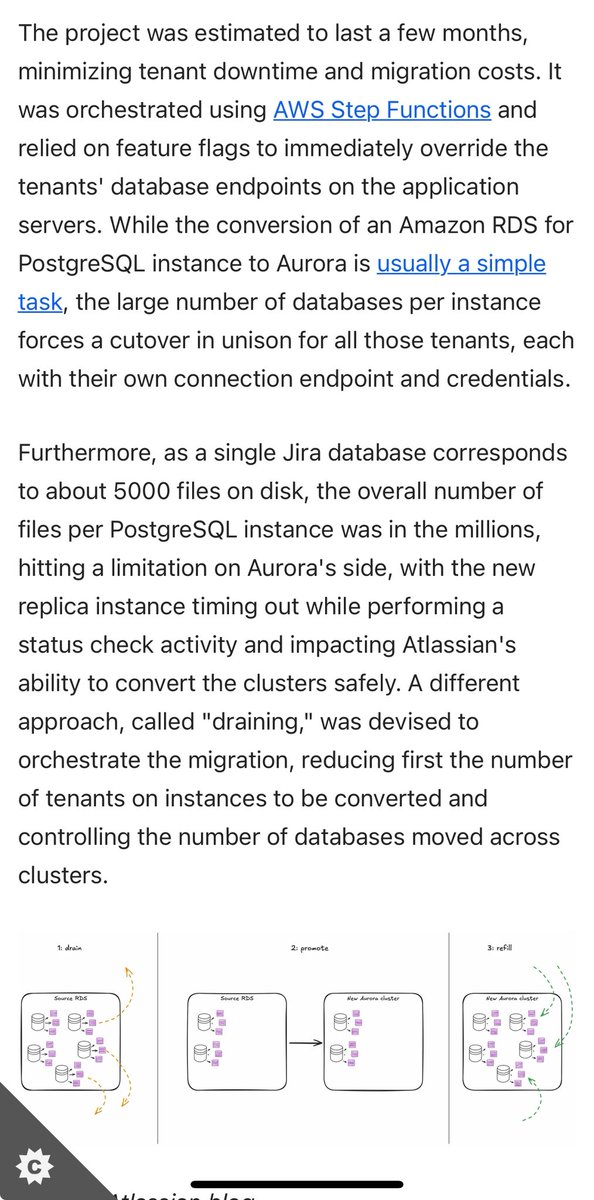
For all this talk of isolation, this is soft multi-tenancy, and is the worst of both worlds strategy to build a cloud. Databases in PG are logically isolated, which gives a warm-fuzzy feeling of isolation. 🧵