🌍 YAI formally filed Requests for Information on the procurement of radiotherapy and cancer treatment machines reportedly funded through ring-fenced sugar tax revenues.
We are seeking answers:
▪️ How many machines were acquired?
▪️ How much was paid?
▪️ Which company supplied them?
▪️ Was a tender process followed?
Public funds require public accountability.
@daddyhope
#Transparency #Accountability #AccessToInformation #Zimbabwe #YAI
I’ve just finished watching this BBC report, and it really broke my heart. I wish our African leaders would sit down and resolve these issues diplomatically. I also wish our leaders would take the time to fully understand what is actually happening on the ground before reacting.
I do not think it is fair to suggest that the South African government has remained silent or failed to condemn the actions of the small number of individuals who have harassed or intimidated people. There is often much more happening behind the scenes than what appears in media reports.
I therefore appeal to African governments to engage through their embassies, diplomatic channels, and direct communication with Pretoria. We must be careful not to make decisions based purely on emotions or media headlines in ways that could undermine African unity.
I live in South Africa, and my experience is that news coverage can sometimes create the impression that a situation is far bigger or more widespread than it actually is.
That is why, some months ago, I cautioned the South African media against giving excessive airtime to fringe groups whose actions tarnish the image of South Africa both continentally and internationally.
As journalists, we have a responsibility to report the news accurately, but we must also be careful not to amplify individuals who are deliberately performing for the cameras or seeking publicity through inflammatory statements and actions.
My plea is simple, let African leaders engage one another calmly, honestly, and diplomatically. Africa’s challenges will not be solved through megaphone diplomacy or emotional reactions.
They will be solved through dialogue, mutual respect, and a shared commitment to preserving the unity of our continent.
There are people who are benefiting from what is going on, and I have no doubt that some of them will sleep very well tonight after watching this report.
Let us be honest, South Africa has an immigration crisis, and pretending otherwise helps no one. It is a real issue that cannot simply be swept under the carpet. However, we must also be honest about a second reality, there are elements within South African society that are exploiting this immigration crisis, as well as the country’s economic challenges and unemployment, for political and populist purposes.
What should be a serious discussion about immigration policy, border management, economic growth, and job creation is, in some instances, being turned into a vehicle for political mobilisation and the pursuit of narrow agendas.
That is why I appeal to African governments to look beyond the headlines and seek to understand what is happening in the background. There are forces taking advantage of a genuine problem and manipulating public frustration for their own ends.
As Africans, we have a responsibility to approach these issues with honesty and maturity. The first step is to acknowledge that South Africa has an immigration challenge. The second is to recognise that some political and social actors are exploiting that challenge for reasons that have little to do with finding real solutions.
If we fail to understand both realities at the same time, we risk misdiagnosing the problem and deepening divisions at a time when Africa needs unity, dialogue, and practical solutions.
My dear brother, if you want to have a discussion, I am happy to have one.
Cap 3 is a political project that emerged from a political party conference. If it was genuinely intended to solve the national problems you are referring to, then that political party should have sold the idea to the nation instead of attempting to push it through without properly engaging the public and giving citizens an opportunity to have their say.
I have very good friends in ZANUPF, and I regularly engage people across the political spectrum, including government ministers. ZANUPF is a Zimbabwean party, and I am Zimbabwean too. If the objective was to reduce toxicity in our politics, then the idea should have been openly debated and sold to the people on its merits.
Instead, citizens who asked legitimate questions were often told that these amendments did not require a referendum, when many people can read the Constitution for themselves.
There are many people within ZANUPF who privately agree with some of these concerns but cannot express them publicly because it is not politically convenient to do so.
The broader problem is that many initiatives coming from ZANUPF become heavily politicised from the outset. Those who disagree are often treated as enemies rather than citizens with legitimate concerns.
Yet the essence of politics is to win hearts and minds, not to compel people to agree with you. Once people feel they are being forced, they stop listening altogether.
Secondly, this is not even being presented as a universally accepted ZANUPF position. It has become associated with one faction around the President, while another faction aligned with the Vice President appears to hold a different view. Even within the ruling party, there are visible divisions on the issue.
On the question of objectivity, even good ideas can fail when they are badly packaged and poorly communicated. A classic example is the 2000 constitutional draft. The opposition successfully mobilised against it and it was rejected.
Yet, with the benefit of hindsight, many people now acknowledge that it contained provisions that were better than many of the proposals that came afterwards. The problem was that it became heavily politicised and was viewed as a Mugabe project rather than a national project.
In the same way, these amendments have increasingly become viewed as a Mnangagwa project because of the manner in which they have been pursued.
Politics is both an art and a science. Messaging matters. You engage people, listen to their concerns, make concessions where necessary, and build consensus. That is how durable political solutions are created.
What many people find difficult to accept is the insistence that no referendum is required when the Constitution appears clear on matters relating to presidential terms and the benefit of incumbents.
Whether one supports or opposes the proposed changes is secondary. The first question should always be, what does the Constitution say?
We cannot claim to respect constitutionalism while ignoring provisions we find inconvenient. If, as you say, I must be objective, then I believe I am being objective. But objectivity must also be accompanied by honesty.
At the end of the day, it is not about personalities, factions, or political camps. What matters is that things are done properly, lawfully, and in a manner that commands public confidence. That is what strengthens a nation and its democracy.
A couple of years ago, I proposed a moratorium on elections. I made the argument, and it was very well received. It was received well because it was not seen as a party-political agenda or a party-political factional agenda being driven dishonestly.
I made the case for why we needed an electoral moratorium to heal our politics, and it was something that many people referenced. It went even deeper than some of the arguments being made today. But because of how it was packaged, explained, and why it was being proposed, people received it well.
So if you want to win me over, my brother, you need to engage me in a way that is not partisan, but national.
We should not become victims of blind loyalty, because that is how dictators are made.
Robert Mugabe was wildly popular in 1980, filling stadiums and public grounds across Zimbabwe with hundreds of thousands of supporters. Yet it was that same blind loyalty that helped create the monster who went on to preside over the massacre of thousands of citizens in Matabeleland and the Midlands.
It was that same blind loyalty that contributed to the destruction of a once-strong economy, plunging millions into poverty and hardship. It was that same blind loyalty that turned Zimbabweans into trillionaires through hyperinflation and made our country a global laughingstock.
That is why we must engage in politics with clear minds, not with cult-like devotion to individuals. Every politician, regardless of party, status, or popularity, must be subjected to scrutiny and criticism.
There are no sacred cows in politics. If you seek public office, you must be prepared to answer tough questions and face public examination.
If people disagree with a critique, they should engage with the substance of the argument rather than resort to insults, intimidation, or personality worship.
We must never allow ourselves to be held hostage by noisy sycophants and bootlickers. If we surrender our independent thinking to political cheerleaders, we will have failed ourselves and our quest for democracy.
No genuine democrat or progressive fears scrutiny. On the contrary, accountability, transparency, and robust debate are the lifeblood of any healthy democracy. Those who detest scrutiny are often the very people who should be scrutinised the most.
@daddyhope Trying to turn Chamisa’s blind loyalists into critical thinkers is a futile effort, Hopewell. Their unwavering devotion makes him infinitely valuable to ZANU PF.
He has become the most effective weapon ZANU PF has ever used against the people of Zimbabwe. 🥲
My dear brother, you are an example of why many people now laugh at the myth that Zimbabweans are highly educated. You are also an example of why our country has not recorded an O-Level pass rate above 33% for much of the past four decades.
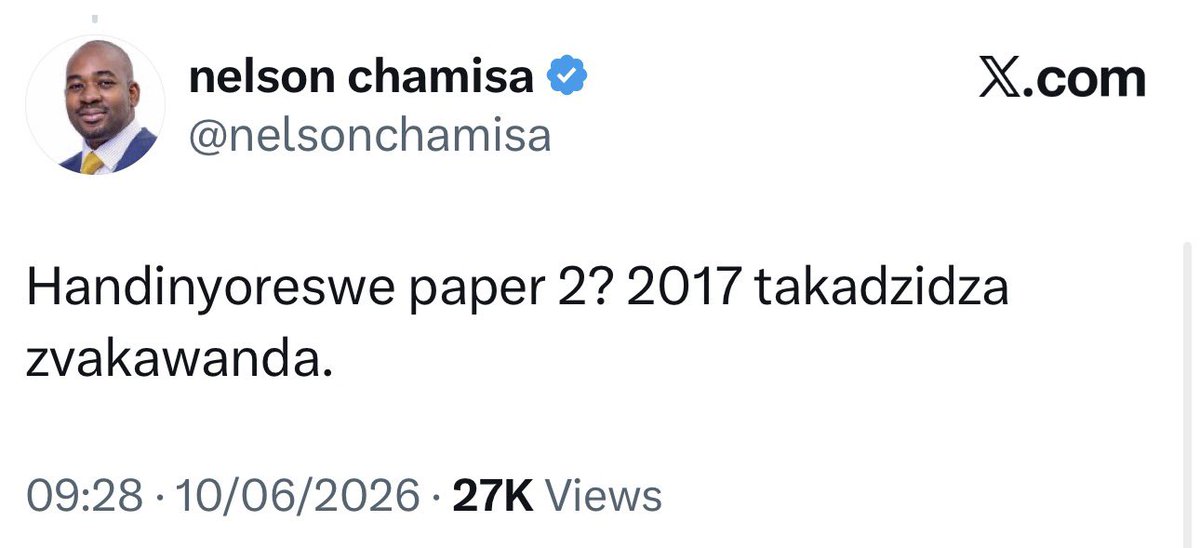
Nelson Chamisa was asked why he did not join Comrade Bombshell Geza, who was advocating for people to take to the streets and for the military to intervene to stop Camp 3. Chamisa responded that he would not “write Paper 2” and that he had learned lessons from 2017.
What does that mean? “Paper 2” means doing the same thing again. The reference to 2017 is a reference to supporting the removal of a president through military intervention and backing that process as the opposition. That is exactly what happened in 2017. Both Morgan Tsvangirai and Nelson Chamisa supported the military intervention that removed former President Robert Mugabe from power.
Chamisa is now saying that he does not want to “write Paper 2” because he learned lessons from what happened in 2017. So what exactly is it that you do not understand from the tweet? Do you want to be spoon-fed comprehension like a Grade 0 child?
It is embarrassing when adults come onto public platforms and advertise their ignorance. I know you may support Nelson Chamisa and may be disappointed by what he said, but do not attack journalists for reporting what was actually said. The job of a journalist is to report the facts, not to rewrite them to suit anyone’s political preferences.
Former Zimbabwean opposition leader Nelson Chamisa has come out in the open and made it absolutely clear that he would not support another military coup in Zimbabwe. By implication, he would not support any military coup against President Emmerson Mnangagwa.
In a tweet, Chamisa said he would not be made to “write Paper 2” again, a euphemism widely understood to mean that he would not repeat the role the opposition played during the events of November 2017, when the military intervened and removed former President Robert Mugabe from power.
ZANUPF talks as if it is doing Zimbabweans a favour by offering a referendum. It is not a favour; it is a constitutional requirement. Only the dull, the daft, and the politically opportunistic would suggest otherwise.
The Constitution is clear that the changes ZANUPF wants to make require the approval of the people through a referendum. Furthermore, any attempt to extend the benefits of those changes to the incumbent President would require compliance with the constitutional provisions governing such amendments through a referendum.
Short of that, any law enacted in violation of the Constitution would be open to challenge and could trigger serious political, legal, underhand, and constitutional consequences.
In a constitutional democracy, no party is above the supreme law of the land, and attempts to circumvent constitutional requirements will create uncertainty, instability, and unintended consequences.
The day Africans stop following personalities and start following policies; stop supporting leaders because of where they come from, their ethnicity, or their tribe, and instead judge them on the basis of their ideas, competence, integrity, and results, that is the day Africa will begin to rise.
That is the day the continent will start to break free from the cycle of poor governance, corruption, and underdevelopment. Real progress happens when citizens demand substance over slogans, performance over personality cults, and accountability over blind loyalty.
This is a challenge that cuts across the entire continent. The future of Africa will not be determined by who leads, but by the standards Africans demand from those who seek to lead.
You are missing the point entirely.
The issue is not just Susan Matsunga as an individual. The issue is the process that produced her. If a selection system can place someone in Parliament who abandons the interests of her constituents and ends up defending ZANUPF, then that process deserves scrutiny.
Of course, the same process may have produced some capable MPs. That is not evidence that the process was transparent, democratic, or beyond criticism. A flawed system can occasionally produce good outcomes, just as a broken clock is right twice a day.
Four years ago, I argued that candidate selection should be open, transparent, and subjected to public scrutiny through interviews and accountability mechanisms. I was attacked for saying so. Today, some of the very people who insulted me are shocked by the conduct of individuals who emerged from that same opaque process.
If we are serious about building a credible opposition, we must be willing to examine not only the actions of individual MPs but also the systems, decisions, and leadership choices that put them there in the first place. That is called accountability, not “dragging in” anyone.
Susan Matsunga entered Parliament as an opposition Member of Parliament for Budiriro, a constituency where three Zimbabweans were recently found drowned in a sewer.
Yet instead of focusing on the real issues affecting her constituents, she chose to defend and advance the interests of the ruling party and President Emmerson Mnangagwa in exchange for political trinkets. She is a perfect example of what is wrong with Zimbabwean politics.
Four years ago, I was heavily criticised and insulted on this platform by some personality politics die hards when I questioned the process used by the opposition to select candidates for Parliament. One of the reasons I eventually fell out with the opposition leader was because I challenged the lack of transparency in how candidates were chosen.
I argued that there should be public interviews so that Zimbabweans, both at home and abroad, could hear for themselves the quality of thought, ideas and leadership abilities of those seeking to represent them before they were selected or elected. I questioned how different the opposition was to ZANUPF if it refuses this level of transparency.
I deliberately use the words “selected” and “elected” interchangeably because, in many cases, opposition candidates are selected long before voters are given an opportunity to elect them. If need be, rigging is done to make sure that the candidate the leader wants gets in, this is commonly known in the opposition circles.
Anyone who has spent time around opposition politics knows that many aspiring MPs get onto the ticket not on merit but more on ingratiating oneself with the leader and his side kicks. That makes the process fundamentally flawed.
My challenge in 2022 and again in 2023 was simple, if the opposition claims to be different from ZANUPF, why should advancement depend on loyalty to an individual rather than commitment and loyalty to ideas and principles? There were persistent stories that some aspiring candidates had to curry favour with influential figures in order to secure positions on party tickets.
Susan Matsunga is an example of what happens when politics revolves around personalities rather than principles. Many will remember how she bootlicked the opposition leader on social media and attacked anyone who raised genuine concerns. I raised concerns about that at the time, and I will look for the posts.
What we are witnessing now is not an isolated incident. It is a symptom of a deeper and structural problem. When people rise through the ranks by flattering leaders rather than demonstrating competence, principles and independent thinking, they eventually transfer that loyalty elsewhere whenever it serves their interests, as she is doing now.
What she said during the Constitutional Amendment Bill No. 3 debate yesterday reflects exactly that. President Emmerson Mnangagwa did not simply ask MPs to support a bill that could benefit him. He offered something that could benefit them as well, an extension of their own terms in parliament. For those like Susan whose politics is driven by personal gain rather than principle, the temptation becomes obvious.
Bootlicking is not loyalty to a particular progressive idea. It is a political culture based on personality cults. Those who build careers through flattery will eventually flatter whoever appears capable of advancing their personal interests. Yesterday it was the opposition leadership. Today it is Mnangagwa. Tomorrow it will be someone else.
Zimbabwe’s political challenge is bigger than one person or one party. We have allowed personality cults to dominate our politics at the expense of ideas. We support individuals rather than principles, and as a result we repeatedly produce leaders and representatives who place personal interests above the interests of the people they claim to serve.
If our politics were rooted in ideas, accountability and merit, there would be less bootlicking and more conviction. Representatives would feel bound by the principles on which they were elected rather than by opportunities for personal advancement. Today you see grown men and women shamelessly bootlicking leaders instead of ideas.
Susan Matsunga entered Parliament on an opposition ticket, but many of her constituents who oppose Constitutional Amendment Bill No. 3 will struggle to see their views reflected in her position. In the end, that is the real issue, whether elected representatives remain accountable to the people who sent them there.
Some people will not understand this argument today. Others may take years to do so. As the saying goes, puppies in the same litter do not open their eyes on the same day. Some open them sooner, some later, and when it comes to human beings, some never open them at all.
But history must be recorded. These things need to be said when they need to be said, so that future generations know there were people who challenged the culture of personality politics and warned about its consequences long before the damage became obvious to everyone else.
And to my fellow citizens, especially journalists, it is far better to be unpopular for saying the right things than to be celebrated for saying the wrong ones.
History has a way of separating principle from convenience. Those who stand for what is right, even when it is unpopular and misunderstood, are often vindicated with time. The crowd is not always right, and popularity is not always a measure of truth.
Eventually, history will judge those who stood with the interests of the people, even when the people themselves did not fully understand the message at the time. The duty of a journalist is not to tell people what they want to hear, but to tell them what they need to hear, guided by facts, principle and conscience.
Susan Matsunga is not the disease; she is the symptom. The real disease is a political culture that rewards bootlicking over ideas, loyalty to individuals over principles, and personality cults over democracy.
@Sir_Sh0k0@agencygumbo@molokele Did you read to understand or you just rushed to respond. Learn to comprehend when you read something and not embarrass yourself on public platforms.
Agency Gumbo represents the kind of opposition Member of Parliament that every democracy needs. We are all Zimbabweans, but people hold different political views, ideologies and visions for the country. Those citizens deserve representatives who can clearly, intelligently and fearlessly articulate their positions in Parliament.
His contribution during yesterday’s debate on the controversial Constitutional Amendment Bill No. 3 demonstrated exactly what an effective opposition MP should do, scrutinise legislation, challenge those in power, and give voice to the concerns of the citizens he represents.
Agency Gumbo showed the importance of having opposition legislators who are informed, articulate and prepared to defend the constitutional principles and democratic values they believe in.
A healthy democracy is not built on conformity. It is strengthened when different viewpoints are robustly debated, tested and heard.
Gumbo’s contribution to the Constitutional Amendment Bill No. 3 debate was a reminder of the vital role that a strong and credible opposition representative plays in any democratic society.
Omar Artan didn’t just make the #FIFAWorldCup, he made history as the first Somali referee to get there, and as #Africa’s best. That milestone stands no matter what. So sorry to see this, Omar. You reached the summit of your profession and inspired a generation back home just by getting there, and being kept off the pitch you earned doesn’t change that. This won’t be the end of your story on the world stage. The world stands with you as one family, wishing you resilience now and many more major finals to come. Solidarity. #Somalia
It is already shaping up to be the worst @FIFAWorldCup in modern times, so nothing surprises us anymore. It has become a total joke, overshadowed by, exclusion, racism, empty seats, and decisions that have undermined the very spirit of a tournament that is supposed to unite the world through football.
When hundreds of thousands of tickets are ending up on the resale market and fans are being shut out, it is clear that something has gone badly wrong. This is not the celebration of global football that @FIFAcom promised the world.
You are a shameless racist regime. You have taken the world’s most beloved sporting event and turned it into what is shaping up to be the worst World Cup of the modern era, marked by exclusion, controversy, and embarrassingly empty stadiums.
A World Cup is supposed to bring people together, not divide them. It is supposed to celebrate the global game, not discriminate against those who participate in it. What a disgrace, and what a shame for a tournament that should have united the world through football.
🇺🇸⚽ The United States is excited to welcome fans from around the world for the FIFA World Cup 2026™. Coinciding with America’s 250th birthday, President Trump is committed to making this the greatest sporting event in world history.
Thank you, my brother. I truly appreciate your kind words and support.
Today it is Omar Artan, tomorrow it could be another African professional, journalist, coach, student, or businessperson facing the same injustice and racist humiliation.
Africa can only command respect when Africans are prepared to stand up for one another, regardless of nationality, language, ethnicity or religion.
Divisions have led to charlatan opportunists destroying that much needed Pan-African unity that Bon Marley sang about, William Edward Burghardt Du Bois wrote about and Kwame Nkrumah preached about.
Thank you to all the like Ian Wright who have publicly spoke out, and all Africans who understand that an injustice against one African is an injustice against us all. Much love and respect, my brother. 🙏🏿❤️🌍
@daddyhope I’ve been following your unwavering support for Referee Omar Artan and your strong stand against racism and discrimination. Your courage, integrity, and commitment to justice are truly inspiring. On behalf of Somalis and many Africans, thank you for standing up for what is right. We deeply appreciate you, brother. 🙏❤️🌍
Sadly, my dear sister @Sophie_Mokoena, Africa will not speak with one voice because too many opportunists are more concerned about securing a seat at the top table in Washington than standing up for the interests of their own continent. They are afraid of upsetting the apple cart, so they remain silent when courage and principle are needed most.
Do not expect African business leaders, political leaders, or even the self-proclaimed Gucci Pan-Africanists and civil society to speak out. Many of them choose convenience over conviction and personal advancement over solidarity.
As long as their interests are protected, they will remain quiet, even when Africa is being undermined and humiliated. That is the tragedy of our continent, too many people talk about Pan-Africanism when it is fashionable, but disappear when it demands courage, principle, a voice, and sacrifice. I call them Fashion Pan-Africanists!