Looking for a monthly roundup of what's happening in the world of data policy?
Subscribe to the Data Foundation newsletter for expert analysis, new reports, podcast episodes, event updates, and insights on topics like AI, financial transparency, climate and environmental data, and evidence-based policymaking.
Join our monthly mailing list and stay connected: https://t.co/ddWnDGpxwE
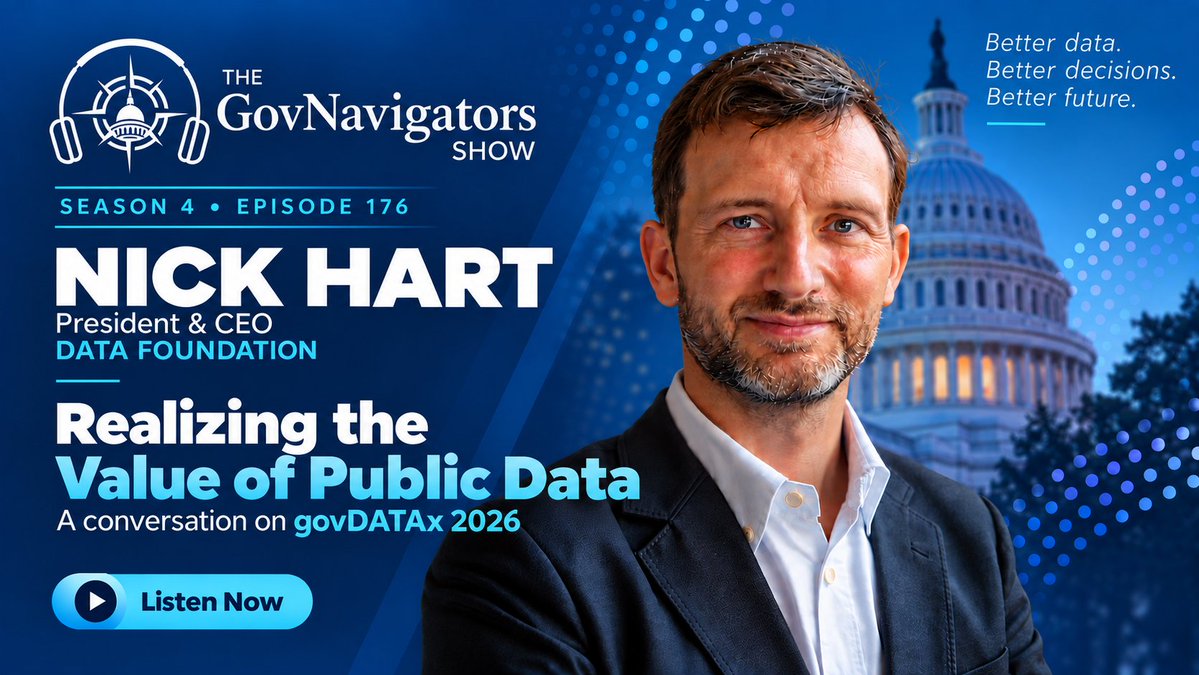
Joined @GovNavigators this week to debrief #govDATAx and talk federal data: the progress agencies are making, balancing representation with privacy, and why good public data is key to fighting fraud. (Yes, Jaws came up.) Thanks to @Allocore for sponsoring.
https://t.co/4M5eVAQEid
🔎 Be sure to register for a webinar next week (Sept. 24) from Lauren Damme, PhD, Senior Fellow at the Data Foundation, about the role of social scientists and policy researchers in evaluating AI-driven tools, systems and services. The webinar draws from her forthcoming paper, "Tested but Not Evaluated: Bringing Social Science Rigor to AI Evaluation."
📅 September 24, 2026
⌚ 12:00 P.M. Eastern Time
🔗 Register now: https://t.co/d59W70XVXe
🏆 Congrats to the 2026 Datum Award recipients, six federal leaders recognized for advancing data policy & evidence-informed government:
🔹Sharon Boivin & Heather Madray (NSF)
🔹Ross Williford (HHS)
🔹Tony LaVoi (NOAA)
🔹Tiffany Boiman (DOL)
🔹Chou-Lin Chen (NHTSA/DOT)
At the end of September, federal agencies will be required to publish a comprehensive inventory of their data assets on their websites, ensuring that those entries meet a new metadata schema as well as open formatting requirements.
The Sept. 30 deadline will be a milestone for the data quality and accessibility improvements envisioned in a 2019 law known as the OPEN Government Data Act, capping a list of actions the Office of Management and Budget outlined for that implementation in the final days of the Biden administration. https://t.co/SvH1Is542B
🔎 Be sure to register for a webinar next week (Sept. 24) from Lauren Damme, PhD, Senior Fellow at the Data Foundation, about the role of social scientists and policy researchers in evaluating AI-driven tools, systems and services. The webinar draws from her forthcoming paper, "Tested but Not Evaluated: Bringing Social Science Rigor to AI Evaluation."
📅 September 24, 2026
⌚ 12:00 P.M. Eastern Time
🔗 Register now: https://t.co/d59W70XVXe
Be sure to check out our keynote speakers:
- Christian Hoehner, Policy Director, Majority, Committee on Oversight and Government Reform, U.S. House of Representatives (at ~9:40 a.m.)
- Joyce Meyer, Under Secretary of Commerce for Economic Affairs, U.S. Department of Commerce (~3:45 p.m.)
Happening today: The Data Foundation's govDATAx convening on realizing the value of public data. There's still time to register.
Check out the full agenda: https://t.co/M63QHXzS0b
Register: https://t.co/rydNDJkj2v
To help the field build shared standards, the Data Foundation launched the Methane Plume Remote Sensing Measurements Technical Working Group (MP TWG) — fostering consistency, understanding error sources, and building real validation strategies.
Read the full study 👇
https://t.co/ez95dgH7Se
Satellites can now spot methane leaks that used to be invisible — at oil & gas sites, landfills, coal mines. But as this tech goes from research to real-world use, one question matters most: can different teams agree on what they're measuring? 🧵
Why it matters: satellites are one part of a bigger observing system — complementing aircraft (best for very low emission rates) and global flux mappers (best for large ones). Getting the pieces to work together is key to data-driven climate action.
Announcing the Semantic Commons for Climate, Nature, & Economy (CNE) — a new initiative from Data Foundation, the Lincoln Institute of Land Policy, and Basque Centre for Climate Change to fix a core problem in climate and nature data: nobody agrees on what the terms mean. 🧵