🚨 Check out this new article “Between a rock and a hard place: A geosocial approach to water insecurity in Kabul”
Read about the findings and implications: https://t.co/DnwZpnRGAu
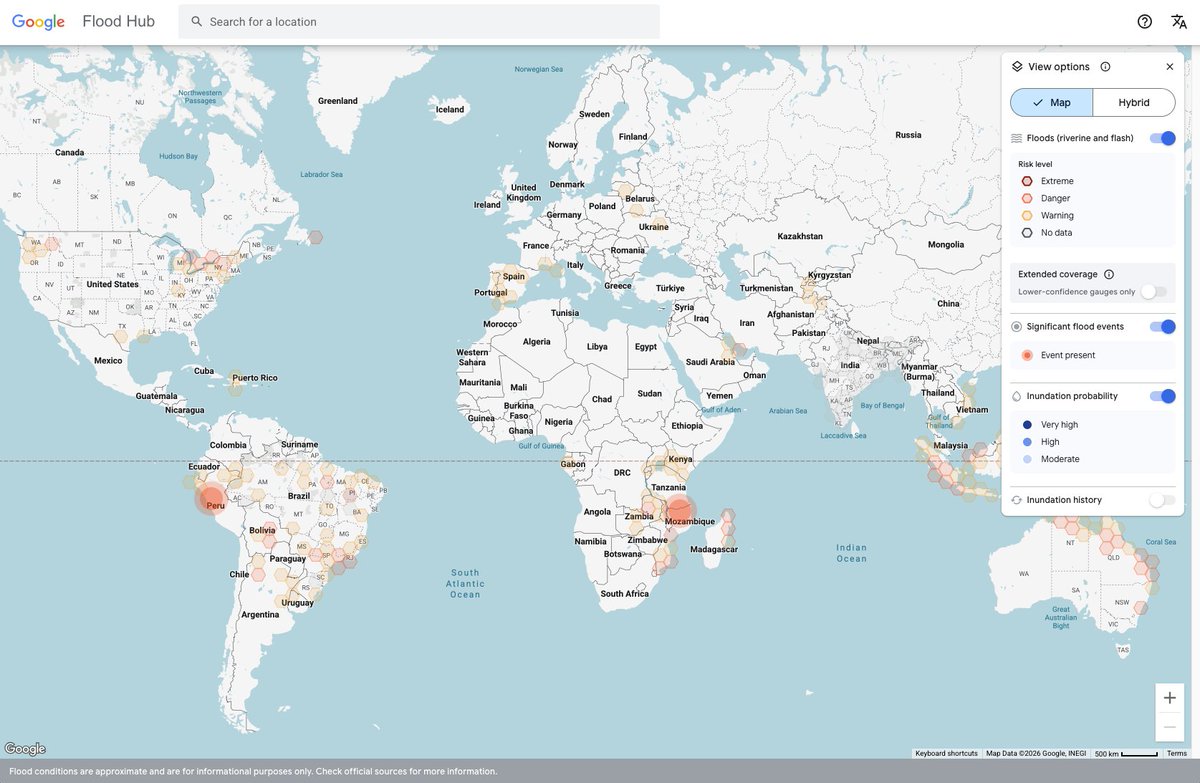
We trained a new flood forecasting model designed to predict flash floods in urban areas up to 24 hours in advance.
To help address a flash floods data gap, we created Groundsource: a new AI methodology using Gemini to identify 2.6M+ historical events across 150+ countries.
We’re open-sourcing this dataset to advance global research, and urban flash flood forecasts are live now in Flood Hub to help communities stay safe.
🚜💧 Water challenges cost agriculture billions: Argentina faces $2.1B in losses due to water issues, Cape Town lost 20,000 farm jobs, and Lebanon could lose $250M yearly from shifting weather patterns. https://t.co/LcMLo7o0DK
📢 Don't miss this new paper:
Exploring the determinants of household water treatment in Kabul: A COM-B model perspective in a low-income context
Read the full article here:
https://t.co/sitkLoT9gt
🚨 Check out this new article “Between a rock and a hard place: A geosocial approach to water insecurity in Kabul”
Read about the findings and implications: https://t.co/DnwZpnRGAu
💧Groundwater extraction in Northern India accounts for roughly 25% of all groundwater extraction worldwide.
A recent study in Haryana offers lessons on how to address depletion.
Find out more: https://t.co/HY0dL1wh1h
Water access issues are worsening. My fieldwork in Kabul (pre-AUG 21) revealed similar issues, companies collect money for promised water networks but either abscond with the funds or delay delivery. More on water challenges: https://t.co/DnwZpnRGAu
@LNajafizada
This research is a result of my interdisciplinary PhD work. A central argument of the paper is the need for a geosocial approach to measuring water (in)security.
Read more: https://t.co/DnwZpnSeq2
🚨 Check out this new article “Between a rock and a hard place: A geosocial approach to water insecurity in Kabul”
Read about the findings and implications: https://t.co/DnwZpnRGAu
Secondly, considering the high evaporation rates in this semi-arid region, initiatives on groundwater recharge (e.g., rainwater harvesting, MAR) are much needed for sustainable water access.
Source details: https://t.co/AWser2Lfzq
(2/2)
Recent rainfall has increased the water level at Salma Dam, bringing hope to farmers. There is very much hope that work on the downstream development starts soon to ensure efficient water use.
(1/2)
Uganda's innovative approach to water services for refugees & locals is a game-changer! Shifting from traditional aid to sustainable development, they've partnered with @WorldBank & UNHCR @Refugees to set a global example: https://t.co/z5vYQevq8F
Large-scale global flood forecasting has been out of reach for a long time. In our Nature paper published today we show how breakthroughs in AI can close the gap & provide reliable flood predictions even in regions that previously lacked data. Learn more: https://t.co/A35HyTczZr
Each winter, Gulmarg, one of Asia’s largest and highest ski resort towns, attracts thousands of skiers, drawn by perfect powder, cheap hotels and breathtaking views of the Himalayas.
But this year, there’s something missing: snow.
https://t.co/HsPOMQzXJC
I asked a friend who visited Nayeb Rafi village -- the epicentre of Herat earthquake -- on what the survivors needed most. He said he couldn't find any villager who had survived, apart from a few shepherds who were not in their village during the earthquake. 2k plus lives lost.
"We cannot address global #water challenges without social sciences" - Honoured to have been invited to write this piece in the launching issue of the new Nature Water journal @NaturePortfolio@NatureWaterJnl@wateratleeds @SRILeeds https://t.co/phUK5FiJ2g