We’re going live! 🎙️
Join us on Wednesday, July 8, for our June 2026 Recap & AMA.
We’ll cover the latest $DFDV developments and answer your questions.
Drop us a question & set a reminder! 👇
https://t.co/A7zI0hzZf3
We’re going live! 🎙️
Join us on Wednesday, July 8, for our June 2026 Recap & AMA.
We’ll cover the latest $DFDV developments and answer your questions.
Drop us a question & set a reminder! 👇
https://t.co/A7zI0hzZf3
Today, DFDV announces the strategic transition of $DONT leadership to @drfaria89, CEO of Nasdaq-listed @stack0G, and a dedicated ecosystem team.
DFDV pioneered the launch of the world’s first publicly traded company-created memecoin in January 2026.
Now, @DisclaimerCoin enters its next phase with an independent team focused full-time on community growth, partnerships, liquidity expansion, integrations, and new utility.
DFDV will continue to permanently hold ~31.6% of the total $DONT supply on its balance sheet, consistent with our original launch commitment.
More details here. 👇
https://t.co/9KVgvaxwln
1/ $SOL sentiment is turning.
The bottom looks to be in to many.
And the accumulation has officially begun.
But what if there was a better way to increase $SOL exposure than simply buying spot? Here's why some are turning to $DFDV. 👇
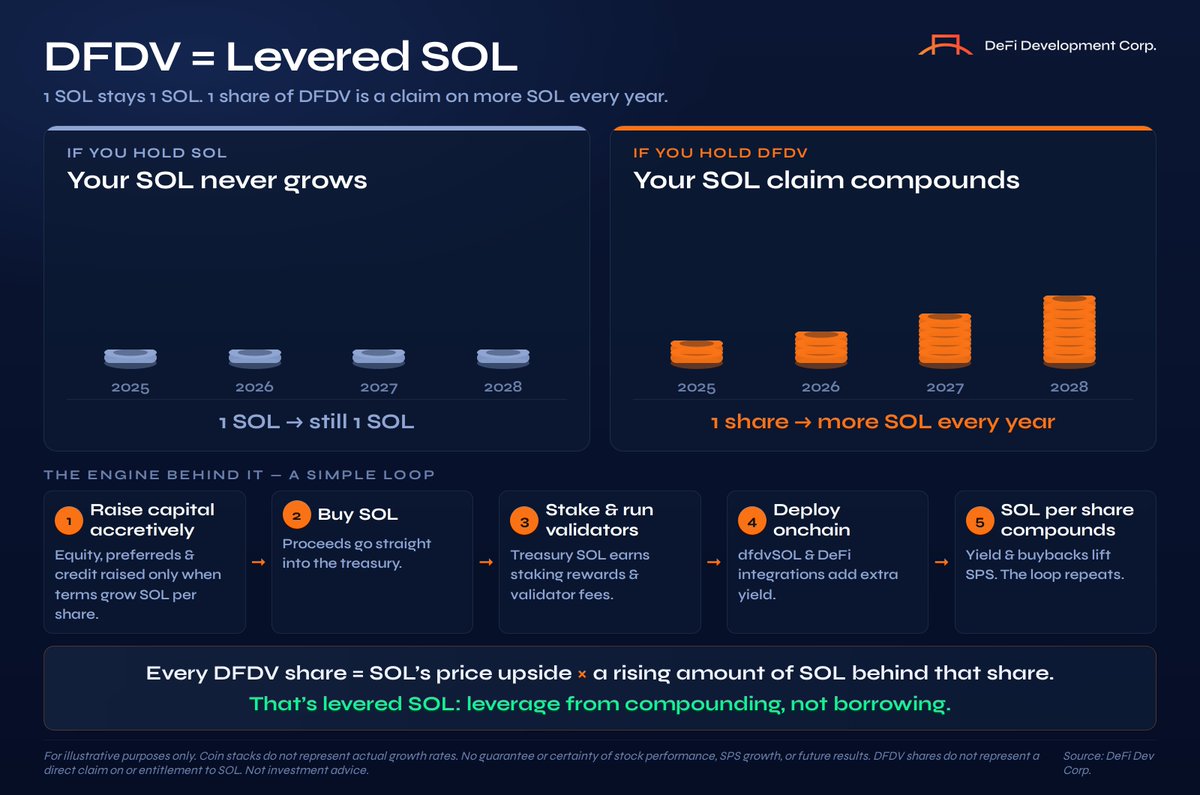
Let's start with the basic problem: 1 $SOL is always 1 $SOL.
Buy it, hold it, and your upside is the price. Nothing more. Unstaked, it just sits there while the network grows around it. But a share of $DFDV works differently.
Each share represents a claim on a treasury of $SOL that we are constantly working to grow. The metric that matters is $SOL Per Share (SPS): how much $SOL sits behind each share of the company. Our entire strategy is built around pushing that number up.
How? A 5-step engine that runs on repeat:
🔸 Step 1: Raise capital accretively. Equity, preferreds, and credit, but only when the terms grow $SOL per share instead of diluting it.
🔸 Step 2: Buy $SOL. Proceeds go straight into the treasury.
🔸 Step 3: Stake it and run validators. Treasury $SOL earns staking rewards, and our own validator infrastructure earns fees on top.
🔸 Step 4: Deploy onchain. dfdvSOL and DeFi integrations put the treasury to work for additional yield.
🔸 Step 5: SPS compounds. Yield and buybacks lift $SOL Per Share. Then the loop repeats.
The result: your exposure isn't just $SOL's price. It's $SOL's price multiplied by a growing amount of $SOL behind every share.
That's why we call it levered $SOL.
The leverage doesn't come from margin, borrowing against the position, or funding rates. It comes from compounding.
No liquidation price. No margin calls. Just a treasury designed to accumulate more $SOL per share, year after year.
1/ $SOL issues ~60,000 new tokens a day, but only burns ~650.
But three proposed changes are about to flip that math on its head. 🤯
Price has started to rebound, but the real story with $SOL right now is happening at the protocol level. New supply is entering circulation at nearly 100x the rate it's being removed. For years, that dynamic has been a headwind for the token.
Three proposed Solana Improvement Documents (SIMDs) take direct aim at that imbalance. Each one pulls a different lever:
🔸 SIMD-550: Less new supply.
Solana's inflation is already on a declining schedule, heading toward a 1.5% terminal rate. SIMD-550 would double the pace of that decline, cutting the disinflation rate from 15% to 30% per year. Translation: SOL reaches its terminal, low-inflation state years sooner, and far fewer new tokens hit the market along the way.
🔸 SIMD-123: Less liquid supply.
This one opens the door to institutional staking through validator-managed pools. ETFs, custodians, and corporate treasuries that couldn't easily stake before now can. The effect is simple: more SOL gets locked into staking and out of the freely tradable float. Less liquid supply, less sell pressure.
🔸 SIMD-553: More demand captured.
Right now, a large share of Solana's network activity is underpriced. SIMD-553 introduces compute-based resource pricing, charging for the actual resources a transaction consumes, and burns those fees. At current activity levels, that could take daily burns from ~650 SOL to 7,500 to 9,000. A 12 to 14x increase in the amount of SOL destroyed every day.
Now stack them together. Less new supply, less liquid supply, and more burns.
Each change is meaningful on its own. Together, they bend the entire supply-demand curve in the same direction. Net new SOL issuance trends toward zero and, in an upside scenario, potentially negative.
This is what it looks like when a network stops just growing and starts converting that growth into scarcity. Adoption drives activity, activity drives fees, fees drive burns, and burns reduce supply. A flywheel where usage and token value finally point the same way.
Price reflects sentiment, tokenomics reflects structure, and the structure beneath $SOL is quietly strengthening. 👀
$SOL's best month EVER.
3.77B transactions in June 2026.
That's more than any month in history, 10x the nearest competitor, and ~79% of all activity across major chains.
Price is down, but the fundamentals have never been better. 🚀
"Healthier Choices Management Corp. (HCMC) today announced its inaugural investment in 1 billion tokens of solana:FbmmdcCYHL7WETG89xtWmNFMzQAaQ8Zs9NXVbimibonk DisclaimerCoin, the pioneering meme coin launched by @defidevcorp (“DFDV”)."
We tried to tell them solana:FbmmdcCYHL7WETG89xtWmNFMzQAaQ8Zs9NXVbimibonk do it. 🙄
https://t.co/fdBwBrAUPs
Japan is moving onchain to $SOL. 🇯🇵
@AlliedCrpt announced today plans to stake SOL through $DFDV’s validator infrastructure and utilize solana:sctmB7GPi5L2Q5G9tUSzXvhZ4YiDMEGcRov9KfArQpx through Allied Verse.
This marks yet another step toward capital markets converging on Solana. 🙌