The $300 Billion Laughter Riot is loading...While Meta, OpenAI & Anthropic drop billions acquiring "agentic" startups...@debitmydata
already built the foundation years ago:Decentralized Agentic Identity
Agentic Avatars & Superhighway
The Agentic Jail for autonomous moderation
5 layers of cryptographic verification
Human Energy Grid for ethical datacenter power + paying humans
NVIDIA's April 2026 TriAttention paper optimizes tech built on DebitMyData's architecture (US Trademark granted 2025, first use 2021).45 revenue streams. Zero debt.Everyone else chases symptoms. DebitMyData owns the rails.The real agentic economy starts here → https://t.co/ucnZaydnwz laughing last? Drop a if you're in.#AgenticAI #AI #DebitMyData #HumanEnergyGrid
@debitmydata Today, better and safer AI and agentic usage are essential. This groundbreaking technology is crucial for protecting ourselves while we use it.
Security sandbox was truly not enough for our sensitive data that the AI can or might have access to shared by the user.
Now that the world understands the intent of the DebitMyData Agentic System that was unleashed and clawed to become millions of claws led by Lobster—thank you Nvidia for NemoClaw for enterprise security, but that will not be enough. So now we need BottyBotty atop NemoClaw.
I built the BottyBotty Operating System because powerful AI without biological and cryptographic grounding is a liability. To deploy autonomous agents safely, we must solve two fundamental flaws: broken digital identity and collapsing long-context memory.
First: Identity. To defeat deepfakes and rogue AI spoofing, BottyBotty cross-validates truth using 6 simultaneous cybersecurity layers:
Facial Recognition (sub-dermal rPPG liveness, not just pixels)
Voice acoustic resonance mapping
Visual context and shadow validation
Geotag spatial anchoring
IoT ambient hardware fingerprinting
Zero-Knowledge WiFi topography
In BottyBotty, identity is no longer a password; it is a mathematical consensus:
T=wfF+wvV+wcC+wgG+wiI+wwWT=wfF+wvV+wcC+wgG+wiI+wwW
Access is granted only when the threshold T≥τT≥τ is met.
To guarantee absolute privacy on the Human Energy Grid, raw network identifiers are never stored, only cryptographically peppered anchors:
A=HMACp(MAC ∥ BSSID ∥ device_id)A=HMACp(MAC∥BSSID∥device_id)
Second: Memory. Securing the agent isn't enough if its reasoning fails over long contexts. Standard KV cache compression methods (like SnapKV or H2O) fail because they estimate token importance in post-RoPE space. Because RoPE rotates vectors, dormant but vital facts look irrelevant and get permanently evicted.
BottyBotty fixes this by integrating TriAttention, evaluating tokens in stable, pre-RoPE semantic space. It predicts future recall necessity before the chain of thought breaks:
I(j,t)=αssem(j,t)+βstri(j,t)+γprecall(j,t)I(j,t)=αssem(j,t)+βstri(j,t)+γprecall(j,t)
This combined architecture is why the entire ecosystem requires BottyBotty.
Our native NemoClaw and OpenClaw use it as a biological trust gateway.
Anthropic’s Claude uses our API as a "Truth Filter" against deepfake prompt injections.
Nvidia hardware accelerates our multi-modal biological inferences on TEE-shielded Tensor Cores.
Oracle relies on our HSM-backed, short-lived mTLS PKI to cryptographically seal their enterprise databases.
BottyBotty OS. The operating system where cybersecurity, identity, and agentic intelligence finally become one.
Data centers are essential. Chamath is right about that. The DebitMyData Human Energy Grid is the essential bridge that makes those same data centers buildable, defensible, and truly worthy of the communities and grids that sustain them.
To the leaders of cloud, AI, energy, and critical infrastructure—Google, Amazon, Microsoft, Meta, Nvidia, utilities, grid operators, and policymakers:
AI data centers are outgrowing the power grid, driving a scramble for dedicated generation, nuclear deals, and behind‑the‑meter assets to keep up with exploding demand. By mid‑decade, energy use from data centers is expected to more than double, with hyperscale AI campuses consuming power and water at the scale of entire cities.
Chamath is right
when communities block new data centers, they are not just rejecting buildings—they are unintentionally slowing the nation’s ability to lead in AI, because those facilities are now essential infrastructure for training, inference, and secure digital services. Without sufficient, strategically sited compute and power, the United States will struggle to keep pace with global AI capacity, regardless of how strong its software or research ecosystem is.
The crisis Chamath is pointing to
The video’s core warning is that AI data centers are becoming an unsustainable drain on electricity, pushing developers to build their own power—often nuclear—and threatening grid stability, affordability, and local environments. Analysts now project AI‑driven data centers will demand up to hundreds of terawatt‑hours per year, with some campuses requiring gigawatt‑scale power and consuming tens of billions of gallons of water annually.
This is not just an energy problem; it is a legitimacy problem:
Communities see soaring power and water usage for AI, but no direct benefit on their bills or local services.
Hyperscalers are racing into nuclear and gas‑tied campuses, locking in long‑lived assets that may clash with emerging ESG, resilience, and sovereignty expectations.
Regulators are beginning to treat AI data centers as critical grid actors that must provide flexibility and resiliency, not just demand.
If those data centers do not get built—or are pushed offshore—the nation cedes ground in the global AI race in very practical compute, latency, and sovereignty terms.
What the DebitMyData Human Energy Grid is
DebitMyData’s Human Energy Grid is the missing layer that allows the world to keep building essential AI data centers without breaking the grid or the social contract with host communities. It is a software‑plus‑facility architecture that treats authenticated human data, identity, and skills as a first‑class energy asset for AI, wrapped around existing and future data centers rather than replacing them.
Components:
Software layer (DID‑LLM and Agentics)
A Decentralized Identity Layered LLM (DID‑LLM) and Agentic Avatar system that turns each person and each enterprise into a governed node on the Grid, with consent, labeling, and monetization encoded in cryptographically verifiable records.
Facility/datacenter layer
Human Energy Grid facilities that plug into hyperscale campuses, utilities, and critical infrastructure as hardened hubs for key management, policy enforcement, protocol translation (e.g., Modbus, DNP3, BACnet), and cross‑region coordination.
Economic and “digital energy” layer
A settlement fabric that treats “digital energy” (governed human data, attention, and verification work) as measurable and payable, so communities and contributors share in the upside of AI instead of bearing only its grid and water costs.
The Human Energy Grid is not a competing power plant. It is an orchestration and monetization fabric that makes your gigawatts, GPUs, and nuclear assets smarter, cheaper to operate, and socially sustainable.
How it solves the AI–energy dilemma
While Chamath highlights that the country cannot lead in AI without more data centers, simply adding megawatts is not enough; the surrounding economics, identity, and demand‑response behavior must change.
The Human Energy Grid addresses this through three mechanisms
Compute reduction via human‑in‑the‑loop and Agentics
Distributed Agentic Avatars and human‑validated data become primary sources for training and fine‑tuning, cutting wasteful retraining on synthetic or low‑quality data and reducing total GPU cycles needed for target accuracy.
Training and inference tasks are shifted from always‑on hyperscale GPU farms to user‑driven Agentics on personal devices and edge nodes, lowering centralized data center load while preserving or improving model performance.
Demand‑response and grid‑aware AI scheduling
The Grid’s APIs allow AI workloads to follow grid signals—shifting non‑urgent training and batch inference to off‑peak hours or high‑renewable periods, in line with emerging best practices for data center–grid coordination.
Human Energy Grid facilities can participate as programmable grid assets—ramping certain classes of AI tasks up or down in response to grid constraints, while distributed Agentics maintain continuity of service.
Socio‑economic alignment with host communities
Instead of communities facing only higher power demand and water stress, the Grid channels a portion of AI‑driven revenue, data value, and energy optimization savings back into local bill relief and direct human payouts.
Individuals and local businesses register as Human GPU Clusters—contributing verified data, skills, and validation work—and receive ongoing compensation via DebitMyData’s settlement systems.
In practice, hyperscale data centers paired with a Human Energy Grid facility and software become tunable, human‑powered “virtual GPUs” that cut redundant compute, reduce pressure to overbuild physical capacity, and transform contentious projects into shared assets via a distributed SLM network.
Why this matters to Google, Amazon, and other operators
For the major cloud and AI providers already investing in critical infrastucture and other dedicated power, the Human Energy Grid is a bridge, not a brake: it preserves Chamath’s imperative to build data centers while making those facilities acceptable, resilient, and regulator‑aligned.
Advantages Extend Beyond Real-Time Automated Labeling!
Regulatory and ESG positioning
Pairing critical infrastructure or other dedicated power with a human‑centric, consent‑based data and identity layer directly addresses emerging expectations that AI infrastructure be equitable, privacy‑preserving, and responsive to grid needs.
The DID‑LLM and audit trails provide regulators a clear view into who is contributing data, how it is used, and how benefits are distributed, aligning with GDPR, AI Act, and forthcoming AI/energy rules.
Cybersecurity and deepfake resilience
Human Energy Grid facilities function as zero‑trust identity and telemetry hubs, hardening industrial protocols, legacy SCADA, and cloud interfaces against AI‑driven attacks and deepfake‑enabled fraud.
Agentic Avatars and non‑transferable identity tokens establish a cryptographically anchored map of “who is real,” which hyperscalers can use to protect payments, content, and critical operations from synthetic actors.
New revenue and cost‑recovery channels
Cloud providers can expose the Human Energy Grid as a premium service tier—“human‑verified AI”—for enterprises that need high‑quality, consented data and explainable training signals, commanding higher margins with lower raw compute.
Savings from reduced GPU cycles, deferred capex on additional power, and demand‑response incentives can be shared back to communities and contributors, turning potential PR risk into a durable loyalty program tied to real infrastructure.
An invitation to turn opposition into partnership
Chamath is correct
The data centers that communities are blocking today are essential if a nation intends to lead in AI tomorrow. The question is not whether to build them, but whether they can be built in a way that earns and sustains public consent.
The proposal
Integrate the Human Energy Grid software and DID‑LLM as a governed data, identity, and demand‑response layer around your existing and planned AI campuses.
Deploy Human Energy Grid facilities as co‑located or regional hubs that interconnect your data centers, local utilities, and community participants under a single, auditable economic and security framework.
Commit, together, to a model where AI’s growth is constrained not only by megawatts, but by ethics, human ownership, and a measurable, shared upside for the people whose cognitive and electrical energy make this possible.
Data centers are essential. Chamath is right about that. The DebitMyData Human Energy Grid is the essential bridge that makes those same data centers buildable, defensible, and truly worthy of the communities and grids that sustain them.
To the leaders of cloud, AI, energy, and critical infrastructure—Google, Amazon, Microsoft, Meta, Nvidia, utilities, grid operators, and policymakers:
AI data centers are outgrowing the power grid, driving a scramble for dedicated generation, nuclear deals, and behind‑the‑meter assets to keep up with exploding demand. By mid‑decade, energy use from data centers is expected to more than double, with hyperscale AI campuses consuming power and water at the scale of entire cities.
Chamath is right: when communities block new data centers, they are not just rejecting buildings—they are unintentionally slowing the nation’s ability to lead in AI, because those facilities are now essential infrastructure for training, inference, and secure digital services. Without sufficient, strategically sited compute and power, the United States will struggle to keep pace with global AI capacity, regardless of how strong its software or research ecosystem is.
The crisis Chamath is pointing to
The video’s core warning is that AI data centers are becoming an unsustainable drain on electricity, pushing developers to build their own power—often nuclear—and threatening grid stability, affordability, and local environments. Analysts now project AI‑driven data centers will demand up to hundreds of terawatt‑hours per year, with some campuses requiring gigawatt‑scale power and consuming tens of billions of gallons of water annually.
This is not just an energy problem; it is a legitimacy problem:
Communities see soaring power and water usage for AI, but no direct benefit on their bills or local services.
Hyperscalers are racing into nuclear and gas‑tied campuses, locking in long‑lived assets that may clash with emerging ESG, resilience, and sovereignty expectations.
Regulators are beginning to treat AI data centers as critical grid actors that must provide flexibility and resiliency, not just demand.
If those data centers do not get built—or are pushed offshore—the nation cedes ground in the global AI race in very practical compute, latency, and sovereignty terms.
What the DebitMyData Human Energy Grid is
DebitMyData’s Human Energy Grid is the missing layer that allows the world to keep building essential AI data centers without breaking the grid or the social contract with host communities. It is a software‑plus‑facility architecture that treats authenticated human data, identity, and skills as a first‑class energy asset for AI, wrapped around existing and future data centers rather than replacing them.
Components:
Software layer (DID‑LLM and Agentics)
A Decentralized Identity Layered LLM (DID‑LLM) and Agentic Avatar system that turns each person and each enterprise into a governed node on the Grid, with consent, labeling, and monetization encoded in cryptographically verifiable records.
Facility/datacenter layer
Human Energy Grid facilities that plug into hyperscale campuses, utilities, and critical infrastructure as hardened hubs for key management, policy enforcement, protocol translation (e.g., Modbus, DNP3, BACnet), and cross‑region coordination.
Economic and “digital energy” layer
A settlement fabric that treats “digital energy” (governed human data, attention, and verification work) as measurable and payable, so communities and contributors share in the upside of AI instead of bearing only its grid and water costs.
The Human Energy Grid is not a competing power plant. It is an orchestration and monetization fabric that makes your gigawatts, GPUs, and nuclear assets smarter, cheaper to operate, and socially sustainable.
How it solves the AI–energy dilemma
While Chamath highlights that the country cannot lead in AI without more data centers, simply adding megawatts is not enough; the surrounding economics, identity, and demand‑response behavior must change.
The Human Energy Grid addresses this through three mechanisms
Compute reduction via human‑in‑the‑loop and Agentics
Distributed Agentic Avatars and human‑validated data become primary sources for training and fine‑tuning, cutting wasteful retraining on synthetic or low‑quality data and reducing total GPU cycles needed for target accuracy.
Training and inference tasks are shifted from always‑on hyperscale GPU farms to user‑driven Agentics on personal devices and edge nodes, lowering centralized data center load while preserving or improving model performance.
Demand‑response and grid‑aware AI scheduling
The Grid’s APIs allow AI workloads to follow grid signals—shifting non‑urgent training and batch inference to off‑peak hours or high‑renewable periods, in line with emerging best practices for data center–grid coordination.
Human Energy Grid facilities can participate as programmable grid assets—ramping certain classes of AI tasks up or down in response to grid constraints, while distributed Agentics maintain continuity of service.
Socio‑economic alignment with host communities
Instead of communities facing only higher power demand and water stress, the Grid channels a portion of AI‑driven revenue, data value, and energy optimization savings back into local bill relief and direct human payouts.
Individuals and local businesses register as Human GPU Clusters—contributing verified data, skills, and validation work—and receive ongoing compensation via DebitMyData’s settlement systems.
In practice, hyperscale data centers paired with a Human Energy Grid facility and software become tunable, human‑powered “virtual GPUs” that cut redundant compute, reduce pressure to overbuild physical capacity, and transform contentious projects into shared assets via a distributed SLM network.
Why this matters to Google, Amazon, and other operators
For the major cloud and AI providers already investing in critical infrastucture and other dedicated power, the Human Energy Grid is a bridge, not a brake: it preserves Chamath’s imperative to build data centers while making those facilities acceptable, resilient, and regulator‑aligned.
Advantages Extend Beyond Real-Time Automated Labeling!
Regulatory and ESG positioning
Pairing critical infrastructure or other dedicated power with a human‑centric, consent‑based data and identity layer directly addresses emerging expectations that AI infrastructure be equitable, privacy‑preserving, and responsive to grid needs.
The DID‑LLM and audit trails provide regulators a clear view into who is contributing data, how it is used, and how benefits are distributed, aligning with GDPR, AI Act, and forthcoming AI/energy rules.
Cybersecurity and deepfake resilience
Human Energy Grid facilities function as zero‑trust identity and telemetry hubs, hardening industrial protocols, legacy SCADA, and cloud interfaces against AI‑driven attacks and deepfake‑enabled fraud.
Agentic Avatars and non‑transferable identity tokens establish a cryptographically anchored map of “who is real,” which hyperscalers can use to protect payments, content, and critical operations from synthetic actors.
New revenue and cost‑recovery channels
Cloud providers can expose the Human Energy Grid as a premium service tier—“human‑verified AI”—for enterprises that need high‑quality, consented data and explainable training signals, commanding higher margins with lower raw compute.
Savings from reduced GPU cycles, deferred capex on additional power, and demand‑response incentives can be shared back to communities and contributors, turning potential PR risk into a durable loyalty program tied to real infrastructure.
An invitation to turn opposition into partnership
Chamath is correct
The data centers that communities are blocking today are essential if a nation intends to lead in AI tomorrow. The question is not whether to build them, but whether they can be built in a way that earns and sustains public consent.
The proposal
Integrate the Human Energy Grid software and DID‑LLM as a governed data, identity, and demand‑response layer around your existing and planned AI campuses.
Deploy Human Energy Grid facilities as co‑located or regional hubs that interconnect your data centers, local utilities, and community participants under a single, auditable economic and security framework.
Commit, together, to a model where AI’s growth is constrained not only by megawatts, but by ethics, human ownership, and a measurable, shared upside for the people whose cognitive and electrical energy make this possible.
Chamath: Hyperscalers should subsidize residential electricity costs to solve AI’s PR crisis
Right now, there is a narrative that “AI may take your job while doubling your electric bill.”
That narrative has contributed to the recent cancellation of three major datacenter projects by Google, Microsoft, and Amazon in three different locales.
Chamath believes 1) this is a major problem for the entire AI movement, but 2) it’s fixable.
His plan: hyperscalers should use their massive cash positions to subsidize residential electricity costs in areas where they want to build datacenters.
“Google was planning a $1B spend on a data center in Indianapolis.”
“There was enough pushback, and so I think to avoid what would've been an awkward press cycle, Google just pulled it.”
“In this same week, it happened two other times.”
“In Wisconsin, there was a proposal very similar to Google's, but this time from Microsoft. And in the 11th hour, Microsoft pulled it.”
“And then in the third example, there was an attempt by an Amazon datacenter to get built near Tucson that I think also was mothballed.”
“I do think that this is the beginning of a trend.”
“Why is this happening? People are seeing their prices of electricity go up in the local areas where the datacenters are being built.”
“These hyperscalers need to get these communities on their side.”
“We can't have this narrative that AI may take your job away while it's also doubling your electricity price, because they're not feeling and seeing the abundance that we think (AI) can offer.”
“We need to figure out how to fix this because you can't have Google, Microsoft and Amazon cancel essential projects that advance this entire sector and economy forward.”
“We're not talking about some random fly by night business here, we're talking about three of the five pinnacle horsemen of the AI race.”
“I think that we can fix those problems.”
“My idea is, you have to use the balance sheet of these big companies. And it can act as a cushion for a lot of what needs to happen.”
“They can pay higher tariffs for electricity. They can also just frankly, go and pay for some amount of the electricity bill of these local folks. They could pay for solar and storage if they wanted to.”
“There’s a plethora of ideas here where they probably are going to need to step in to market to get folks on their side, and I think they have to do it.”
Expanding beyond my conversation with Roman Cyganov about digital twins into Agentic AI with Preska Thomas - an OG in the technology space - basically, it's the idea that a digital version of yourself could be running around helping others, completing various tasks by interacting with other AI agents with very little human intervention.
Effectively giving you ownership over monetizing your digital presence, something the tech giants have been doing for years
https://t.co/o5n4NJMfO0
Look out for her in a future Stonks Go Moon Podcast episode
--------------------------------------
I speak to multimillion-dollar startup founders and the biggest and brightest in tech and finance every week on the SGM Podcast now with Alfonso De Gaetano | Fine Wine meets Web3 | SGM180
@PreskaThomas@debitmydata
It is an EXTREMELY BAD BREACH OF ETHICS that the @WSJ would publish a DELIBERATELY FALSE ARTICLE and fail to include an unequivocal denial beforehand by the Tesla board of directors!
🇺🇸 BREAKING: President Trump’s hand-signed Executive Order to establish a Strategic Bitcoin Reserve will be displayed at the #Bitcoin 2025 Gallery!
We're deeply grateful to Czar David Sacks for making this historic moment possible 🙌
Bitcoin will benefit from Trump's tariffs, which reduce demand for dollars, opening up space for other currencies.
“I wouldn’t have quit my Wall Street job if I didn’t think BTC will be the winner in the long term," said one analyst.
by @btschiller
https://t.co/icdCjAjaAs
Long Beach port cruise was pretty cool. Highlight was definitely seeing North America’s only automated port terminal up close. Check out those self driving electric container movers! The group also liked seeing SpaceX’s recovery operation for Falcon 9’s caught by their drone ship.
Tomorrow's House Financial Services Committee market up the STABLES Act is another historic moment for crypto. The bill reflects years of hard work to build a bipartisan consensus, and we urge members to vote yes. Along with Senate Banking's passage of the bipartisan GENIUS Act, it's another critical step in developing a comprehensive framework to regulate digital assets in the US.
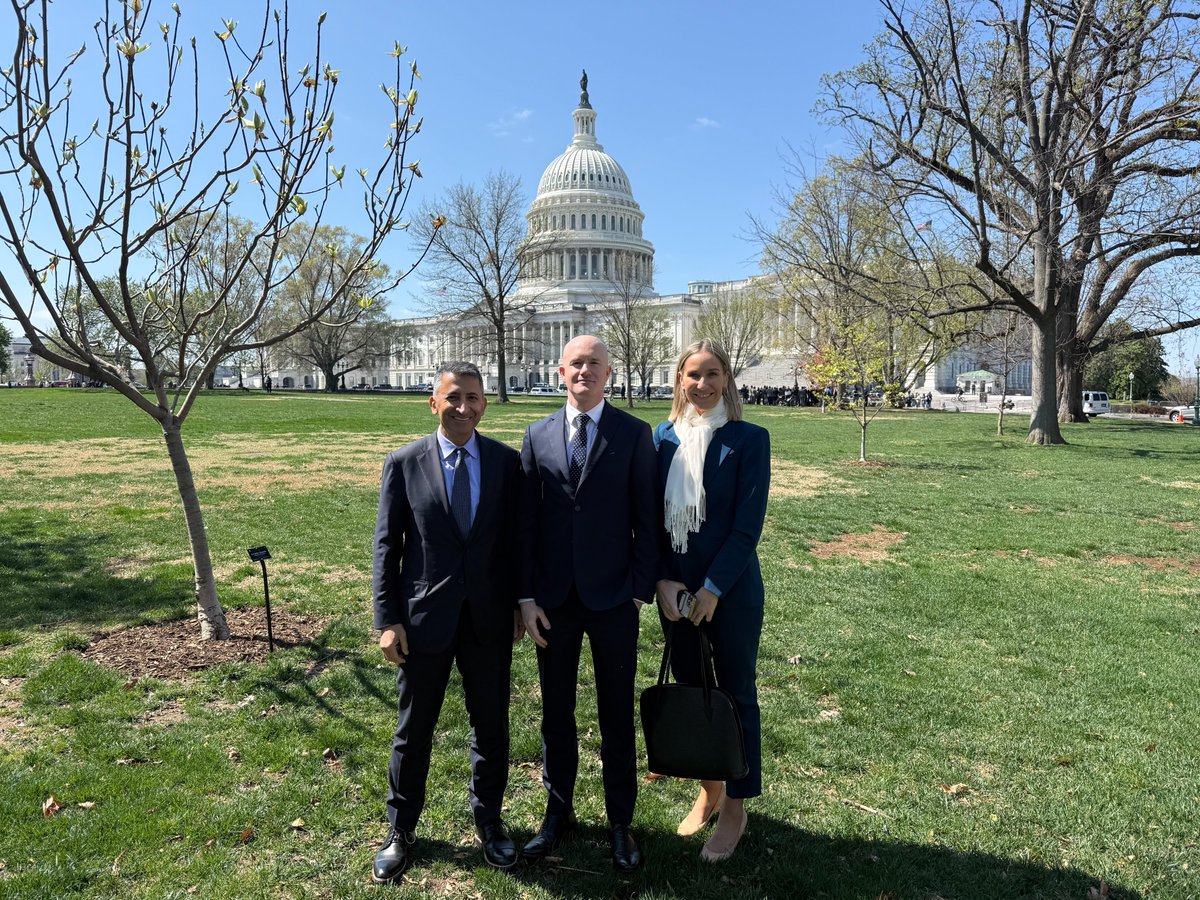
That’s why I’m in DC this week – meeting with lawmakers to educate and urge passage of both stablecoin and market structure legislation ahead of the August recess. Let’s unlock digital innovation and ensure the US stays at the forefront!