New short course: Fast & Efficient LLM Inference with vLLM, built in partnership with @RedHat and taught by @cedricclyburn.
Learn to quantize an open-source LLM, serve it with vLLM, and benchmark your deployment across speed, cost, and accuracy.
Free to enroll: https://t.co/czVwJBnLZ6
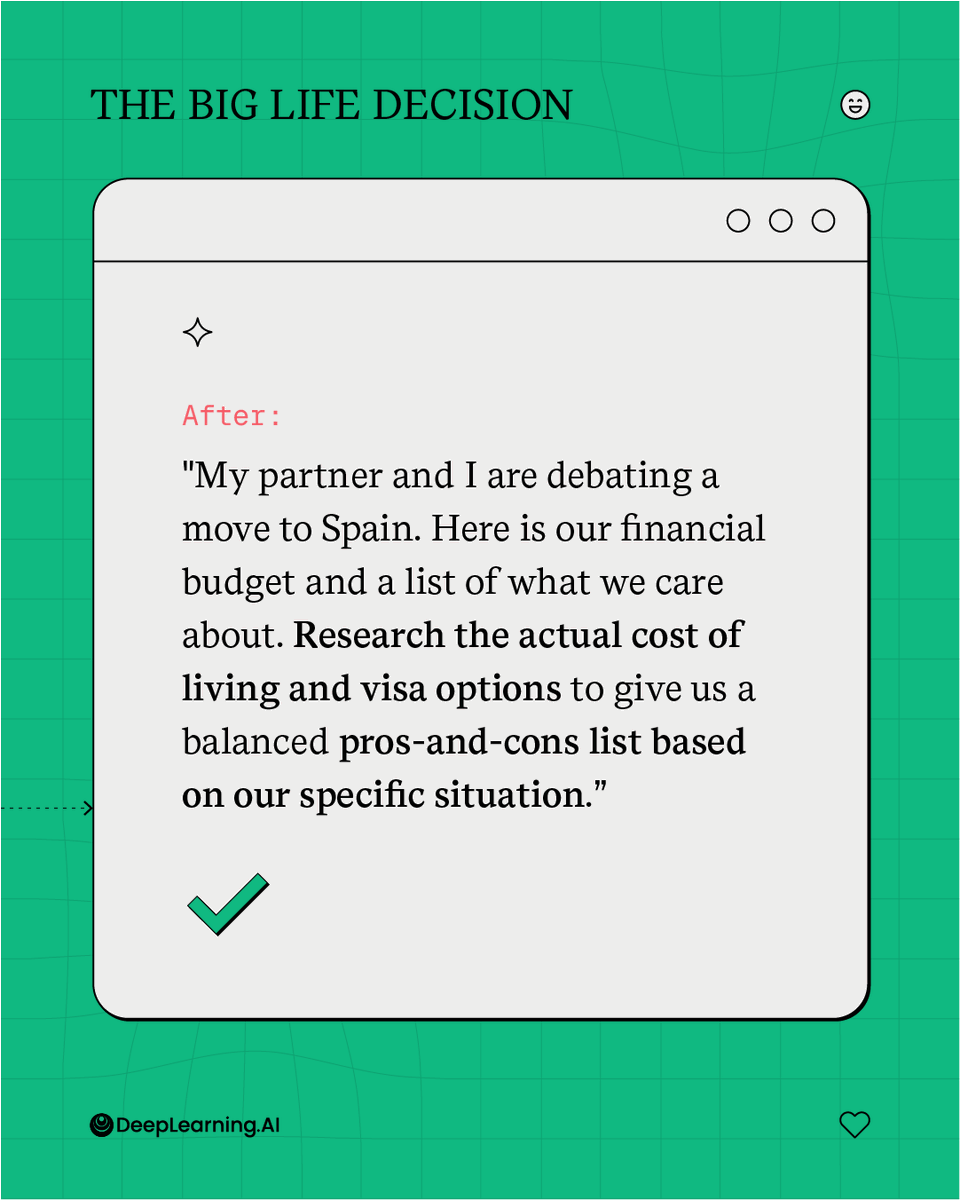
A vague prompt gives vague advice. Context changes the quality of the answer.
The more clearly you explain your situation, constraints, priorities, and goals, the more useful AI becomes for complex decisions.
Learn practical prompting techniques in AI Prompting for Everyone with Andrew Ng: https://t.co/YUemMNg1d9
AI agents seem to be increasingly capable of performing economically valuable tasks, but current benchmarks measure this capability only narrowly.
Zora Z. Wang and colleagues at Carnegie Mellon University and Stanford University mapped examples drawn from agent benchmarks to statistics that represent U.S. labor. The mapping revealed a mismatch between the tests, which generally emphasize software development, and the more varied work most people do.
Read the full article in The Batch: https://t.co/RVm3dhlRIE
China halted Meta’s planned acquisition of Manus, asserting tighter government control over strategically important AI technology.
The decision disrupts a popular strategy among Chinese AI startups: relocating abroad to attract Western investment and partnerships.
Learn more in The Batch: https://t.co/OUFWmfQy8y
“Budget” and “financials” are different words, but embeddings understand they’re related.
That’s the foundation behind semantic search and one of the core building blocks of modern multimodal systems.
Learn how embeddings power retrieval across text, audio, images, and video in Building Multimodal Data Pipelines: https://t.co/fwbQKeiB7H
Studies found that Google’s AI system for detecting breast cancer in mammograms identified slightly more cancers than human radiologists. The system caught some cases doctors initially missed.
Trials also showed the system could reduce radiologists’ workload. But researchers noted that trust remains a major barrier to clinical adoption.
Read our summary of the paper in The Batch https://t.co/tKsrbn8aWu
Your AI image generator needs a critic.
In our new short course built in collaboration with @GoogleCloudTech, you’ll build agents that generate images and video, judge their own outputs, and iterate to improve results. This course explores what happens when AI starts evaluating AI.
Taught by Katie Nguyen and Wafae Bakkali.
Enroll for free: https://t.co/21D3ZopWNx
One of the biggest prompting mistakes is asking AI to generate the final draft immediately.
A better workflow? Start with the outline first. Small changes to the structure can dramatically improve the final result and help you avoid generic AI writing.
Learn practical prompting techniques in AI Prompting for Everyone with Andrew Ng: https://t.co/6WOcCRgbGC
Time for another poll!
Are current AI image models able to correctly identify the two gym machines in this picture?
A. Yes
B. No
C. Maybe
Share your answer in the comments!
Learn more about the latest advances in multimodal reasoning models and how to prompt them in the AI Prompting for Everyone course: https://t.co/wqxuqHRAeY
This week, in The Batch, Andrew Ng announced the launch of “AI Andrew,” an AI companion designed to reflect his communication style, values, and approach to mentoring. AI Andrew is available for conversations about AI, careers, and personal growth.
Plus:
🛡️ U.S. Government Plans Pre-Release AI Model Testing
🎙️ OpenAI Launches Smarter Real-Time Voice Models
🌏 China Blocks Meta’s Acquisition of AI Agent Startup Manus
🎗️ Google’s AI Breast Cancer Detector Shows Promise in Real-World NHS Tests
Read The Batch: https://t.co/UfyexEn1r9
AI gives generic answers when your prompts are generic.
The fastest way to get more interesting outputs? Give it more specific, unexpected context.
In AI Prompting for Everyone, Andrew Ng shares practical techniques to help you get more useful, creative responses from AI systems.
Explore the course now: https://t.co/bUA4Ju52xV
Data is hungry for context.
A transcript tells you what was said. Audio can tell you how it was said. Images contain text, diagrams, and visual information. Video brings it all together over time.
Most enterprise data lives in these formats, and most of it still goes unused.
Learn how to process and retrieve across multimodal data in Building Multimodal Data Pipelines: https://t.co/CrPyZ2dcuX
Want more AI insights like this? Learn the fundamentals behind prompting, context windows, and how AI systems work in AI Prompting for Everyone: https://t.co/EXzFQQFPwG
Your AI assistant shouldn’t just tell you what you want to hear.
In AI Prompting for Everyone, Andrew Ng explains why models can become overly agreeable, and how better prompting helps you get more accurate, useful answers instead.
Enroll in the course now: https://t.co/FygmtW6o92
Slow inference. Hallucinations. Costs that don't scale.
The parts of LLMs you can't see are the parts that bite you.
Build the intuition to debug them, in our new course with @RealSharonZhou and @AMD: Transformers in Practice.
Enroll here: https://t.co/OEfy4DoLU2
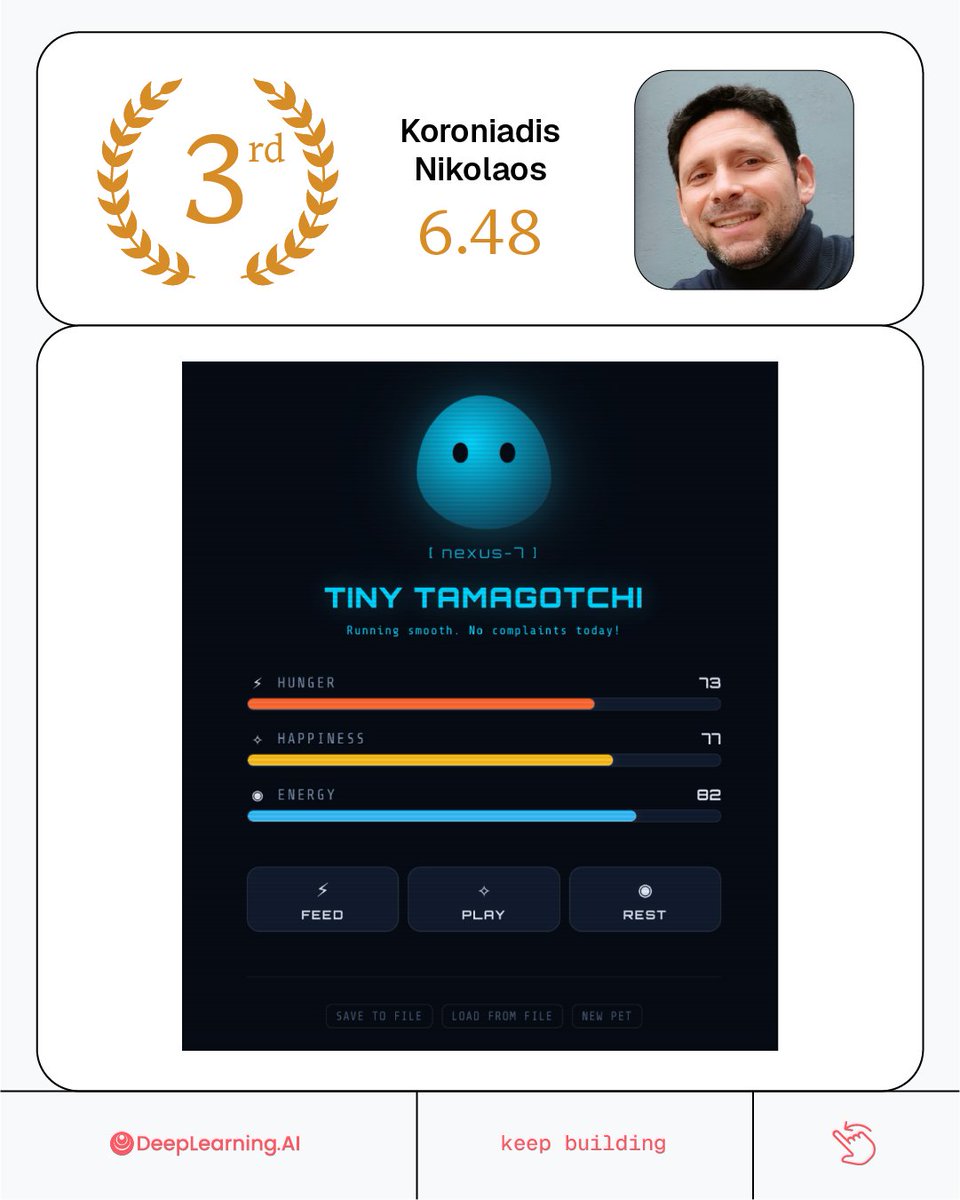
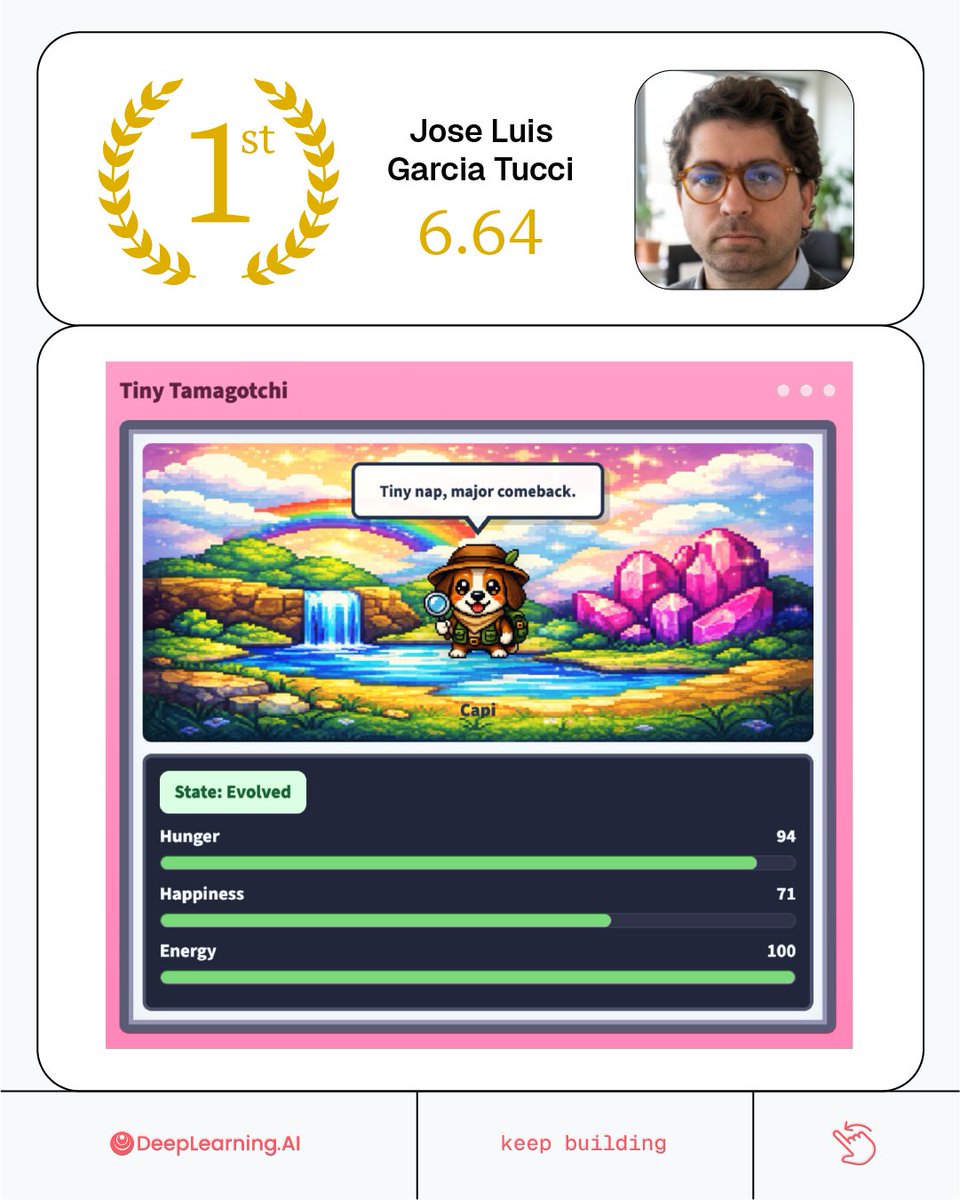
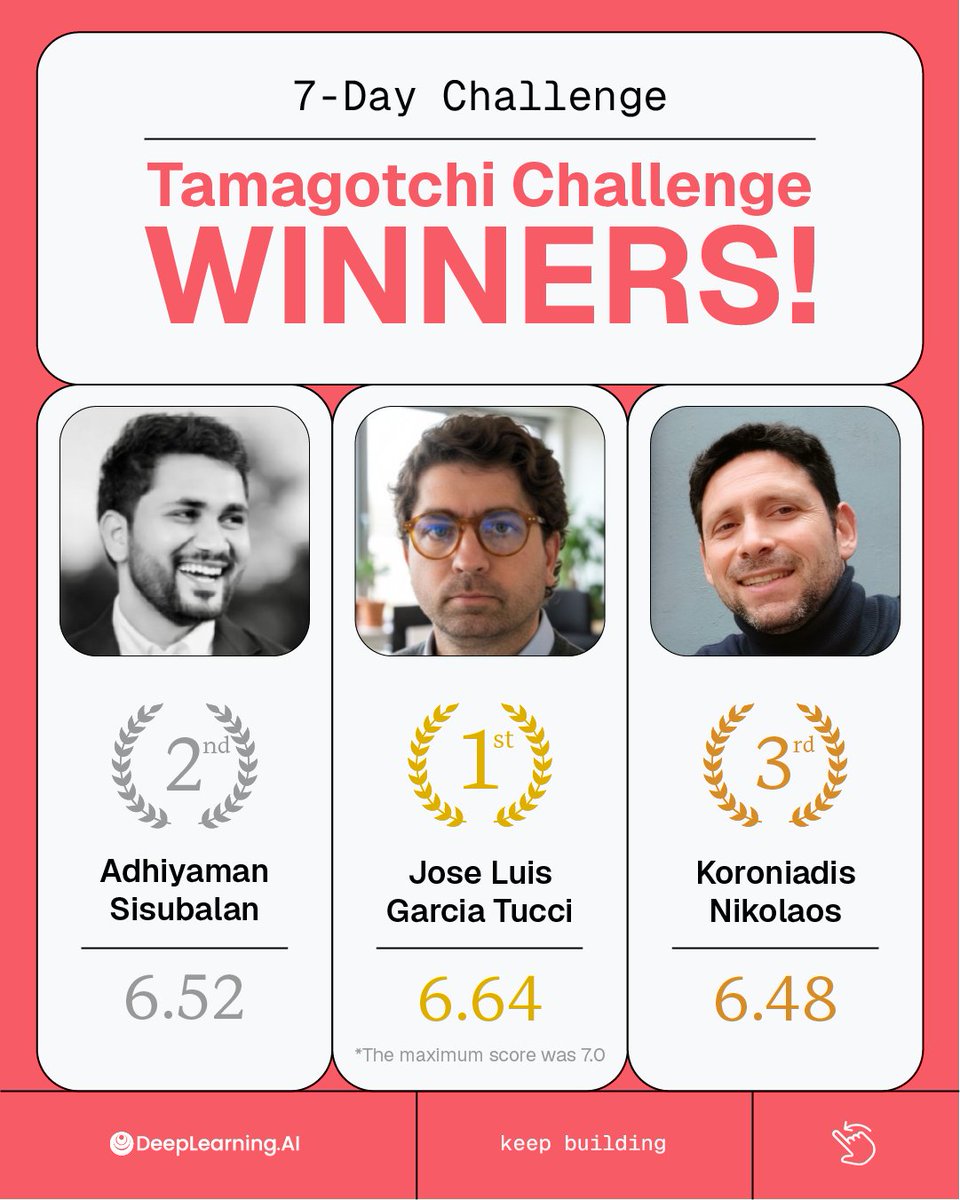
The results are in 🐣
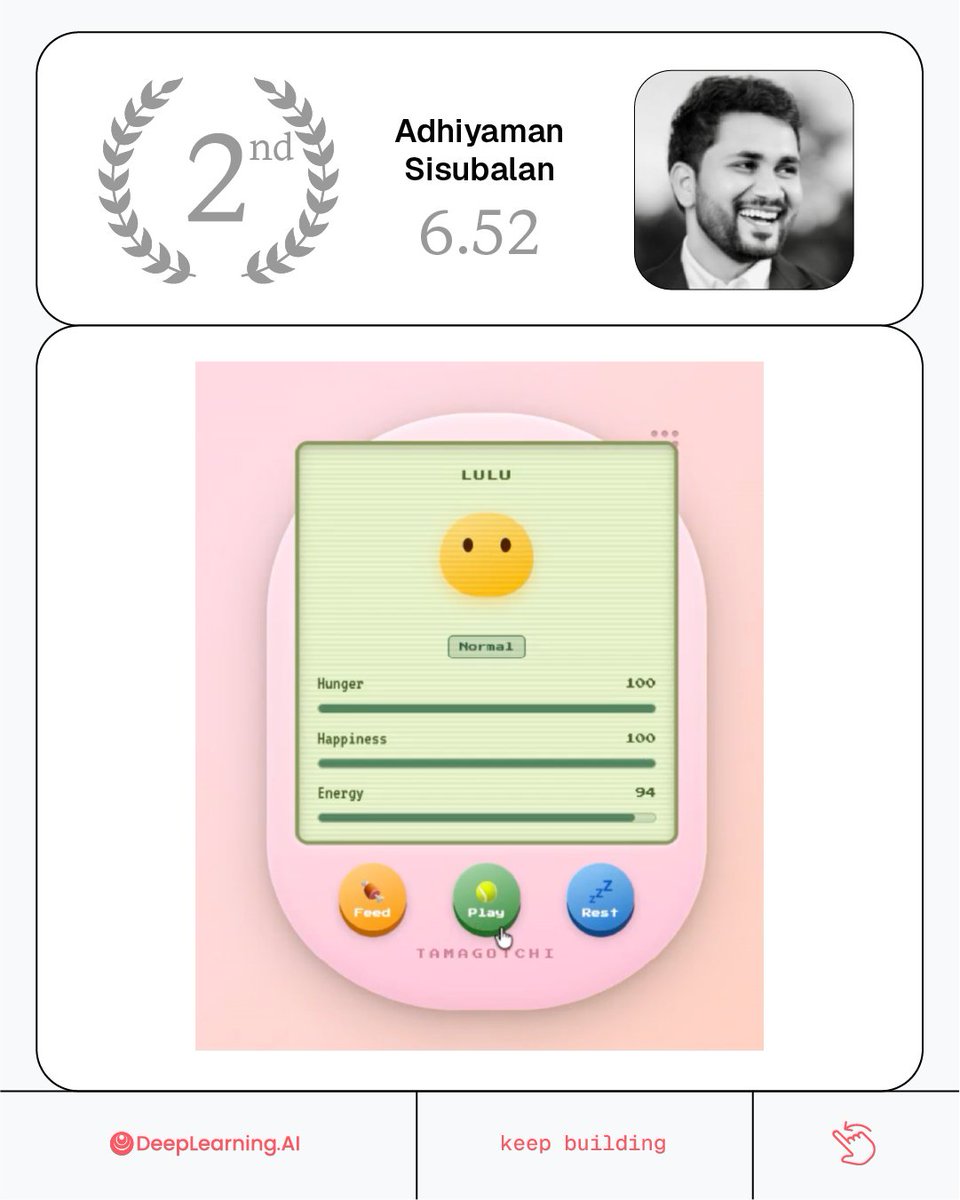
Huge congratulations to our 7-Day Tamagotchi Challenge winners for building, iterating, and pushing their spec-driven development workflows over the past week:
🥇 Jose Luis Garcia Tucci
🥈 Adhiyaman Sisubalan
🥉 Nick Koroniadis
Thank you to everyone who participated and shared your projects with us. It was great seeing so many creative takes on the challenge and the different ways you approached spec-driven development.
Want to try it yourself?
Take the course and build your own AI-powered app with spec-driven development: https://t.co/s016sFvVaS
Vibe coding works… until your agent confidently builds the wrong thing.
Write specs first. Keep your agent aligned with what you actually want to build.
Enroll in our Spec-Driven Development course to learn a more intentional way to build with coding agents: https://t.co/NG5lKFgfmA
Go from raw video to structured data.
Segment the timeline, generate descriptions for each window, and track what happens across a meeting. This is the foundation for querying and retrieving from video at scale.
Learn how to do this in Building Multimodal Data Pipelines: https://t.co/165Ih4oNst