It also found that stearic acid flipped from negatively to positively associated with most of those same outcomes, so if this study is used as evidence against seed oils, it should be used as evidence against meat and dairy too, yeah? (Imo it’s not evidence for either being bad, but that would be the logically consistent interpretation.)
One more critique on the UC Davis avocado oil study, specifically for the mayonnaise it tested.
Most of the mayo brands (Chosen Foods, Primal Kitchen, Sir Kensington's, BetterBody Foods) looked inconsistent with authentic avocado oil, while only two brands (Grove/AvoYeah, Graza) looked legit.
There's a confounder here though, because mayonnaise contains egg-yolk fat along with oil fat, and the yolk fat couldn't be separated from the avocado oil during analysis.
For the study, the researchers actually made their own mayonnaise in the lab to see whether emulsification would impact the avocado oil composition. The recipe they used contained about 6% egg yolk (18% whole egg), which only slightly changed the overall fatty acid profile, which in turn indicates the yolk fat shouldn't impact the results of their mayo product analyses.
But commercial mayonnaise formulas can have highly variable amounts of egg yolk, possibly more than what their test mayo contained. And incidentally, the changes induced by egg yolk would look a lot like seed oil dilution -- decrease in cis-vaccenic acid, increase in stearic acid, decrease in palmitoleic acid.
In fact, the only mayonnaise samples that passed the authenticity test seemed to have lower recipe amounts of egg yolk (water as the first non-oil ingredient, whole eggs as the second). Some of the "inconsistent" samples had egg yolks as their first non-oil ingredient, indicating a higher recipe proportion.
This doesn't mean the suspicious mayos were all actually okay, or even that some of them were. But I do think it's worth noting that their mayo simulation test may have underestimated the fatty acid dilution occurring in more yolk-heavy recipes.
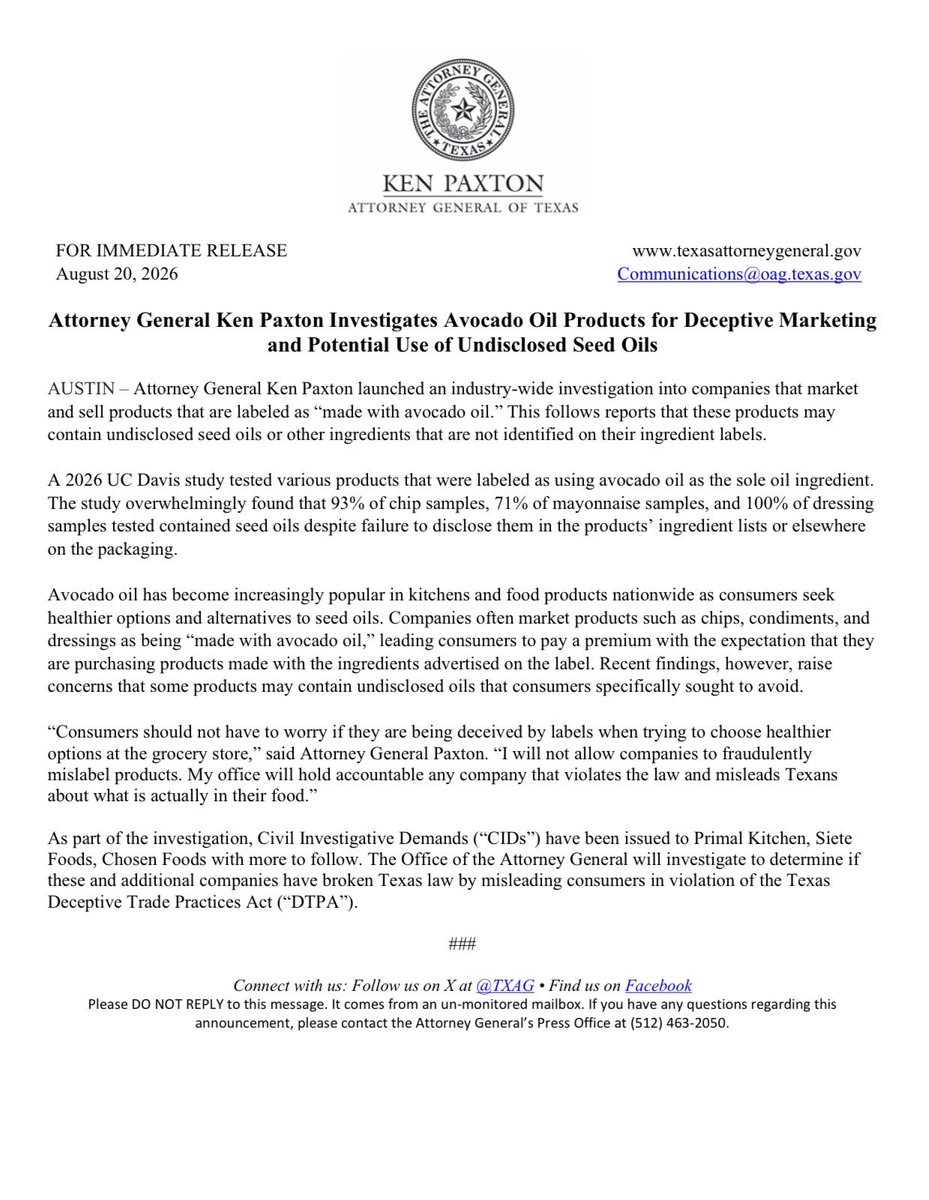
The more I look at that new avocado oil study, the more I think it could have overestimated "adulteration" for at least some of the products they tested. And that any actual fraud most likely happens at the level of the oil producers, NOT the food companies. This is a thread with some thoughts!
Going after food manufacturers won't solve the problem when it's the oil suppliers themselves who are adulterating the oil.
The companies selling chips, mayo, salad dressings, etc. are NOT secretly purchasing seed oils and pouring them into their products and not telling you. This is a huge misconception, and wildly underestimates how difficult and risky it is to attempt fraud at that level, for multiple years, without getting caught, in a highly litigious country that heavily rewards whistleblowing, all while their brands and reputations are on the line.
If food companies were actually adding undisclosed oils themselves, the paper trail would be massive and someone inside would have exposed the story and made millions. There's a reason lawsuits keep getting attempted and dismissed due to lack of evidence. The fraud is not occurring there.
The avocado oils being purchased have already been cut further up in the supply chain. Most likely at the refineries or mixers in other countries, which are shielded by the many intermediaries their oils pass through on the way to their final destination.
Food companies are mostly relying on COAs and other purity documentation from the suppliers they buy from, as is the case with every other ingredient, and which *should* be enough to safeguard against adulteration. It's literally why those certification processes exist.
The avocado oil industry is just uniquely loopholed and poorly regulated right now, since it's a relatively new ingredient and still finding its sea legs.
But the loopholes being exploited are, again, mostly present at the places where huge amounts of oils are being processed and stored. NOT at the companies selling the products you eat.
Think about it: which scenario is more likely?
1) Sixteen different brands -- the number with "adulterated" products in the recent UC Davis study -- all independently deciding to scam their customers, in some cases only adding seed oils to certain batches of the same product (Lesser Evil, Tostitos), in other cases having their avocado oil deemed authentic in previous years but not now (Chosen Foods), in other cases selling a haphazard mix of adulterated and authentic products (Sprouts brand), somehow maintaining a fake paper trail that passes through numerous eyes and audits, while risking decimating their reputation from a single misstep that exposes them...
...all to save what's likely to be a relatively small amount of money overall?
or
2) A single major oil producer cutting their oil and passing along COAs that were performed prior, in turn contaminating dozens or even hundreds of downstream brands who think they're buying legitimate oil?
The risk vs. incentive is so wildly lopsided here.
Oil producers committing fraud get most of the economic benefit, while pushing the "brand reputation" risk downstream onto companies that have no obvious way of chemically verifying every tanker or lot unless they specifically build in an avocado-oil-authentication program, which they may not think is necessary because that's what the COAs and other documentation are supposed to take care of.
When the COAs aren't doing their job, the safety net falls apart. Food companies aren't equipped to battle widespread infections in the supply chain, especially ones where the origin is hidden.
But those companies do tend to become the punching bag when something goes wrong, because they're often the only visible face in the situation. It's hard to direct outrage at something you can't see, much easier to do so at something you can.
So, before we witch-hunt food manufacturers for deceptive marketing, I think we should consider that they may also be victims of fraud, and the whole situation is really made possible by how terribly regulated the avocado oil industry is. The places that need cleanup are generally not even in America, certainly not with logos we recognize and customer contact forms we can fill out. We could put every "adulterating" company out of business and the overarching system failure will still be there.
All that said, I think the odds of food companies knowingly adding seed oils to their products is close to zero. The fraud is almost definitely happening way upstream in the supply chain, and it's likely a lot of these food companies themselves are getting scammed. And I think this is really easy to show with both logic and things that exist on the internet.
This thread is already way too long, so I'll put that stuff in a new one!
The more I look at that new avocado oil study, the more I think it could have overestimated "adulteration" for at least some of the products they tested. And that any actual fraud most likely happens at the level of the oil producers, NOT the food companies. This is a thread with some thoughts!
Now, the bad news. Even though natural variation pops out an occasional aberrant 'cado, the majority of them do still fall within Codex ranges. I had to scour the internet to find outlier numbers, and even then, most were still less extreme than many of the samples tested in the UC Davis study. So, the most likely explanation for (at least some of) the wayward products is that they were indeed cut with another oil.
For example, lots of tested products had cis-vaccenic acid levels sitting around 1.2 - 1.3%, which is still lower than the lowest of the low authentic avocados that have been documented (a tad under 3%), which themselves are cultivars not commonly used for oil production. I couldn't find evidence that any processing methods would substantially alter its levels, especially not more-than-halving it. So, this is very hard to explain by natural means.
And most of the out-of-range numbers are out of range in really distinct patterns, rather than random distributions. If it was really just a matter of natural variation exceeding the current authenticity standards, we'd expect to see numbers out of range in both directions (too high *and* too low) instead of all clustered around the same abnormal values, which coincidentally happen to resemble seed oil numbers.
The only possibility is that all these companies are sourcing avocado oil from the same specific source, and that source hasn't had its oil analyzed in any research papers yet. I suppose it's technically possible. But we're in Occam's Razor territory here, and the blade sliceth strongly in the direction of "adulteration." Most major companies are getting oil from multiple global locations, which should dilute the random outlier batch.
So, the counterexamples in this thread only show that they're possible, not that they're common, and certainly not likely to explain all *89%* of products having statistically unusual values.
BUT! I really think it's worth leaving the door open for some false-adulteration-positives to be in this study. If for no other reason than the Codex ranges *do* exclude some authentic avocado oils, and we don't know which products that might apply to here. And in general, Codex ranges are optimized for detecting adulteration, not for making sure nobody's falsely accused (the UC Davis researchers even state this in their various papers). And whatever's happening in the avocado oil market at any given moment is going to be many steps ahead of the published analyses, for obvious reasons related to the chronology of time.