The 2026 Australian Federal Budget was released last night. International affairs, including defence, development, diplomacy, intelligence, and international policing, make up $76.18b, or roughly 9.54% of Australia's total 2026-2027 budget.
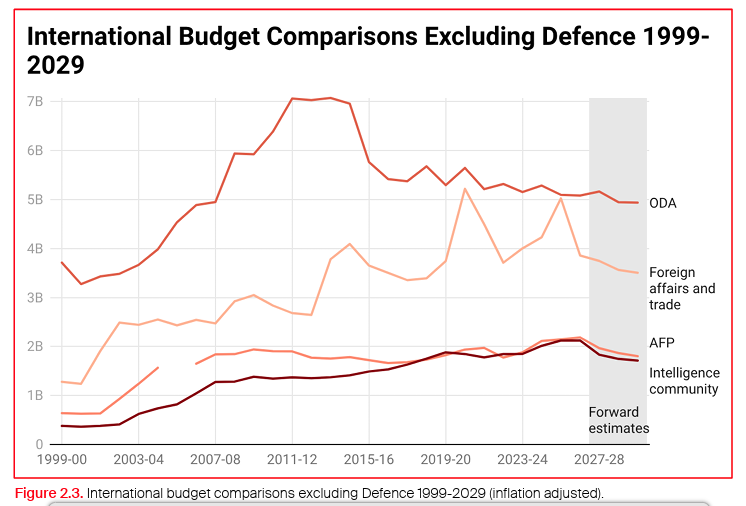
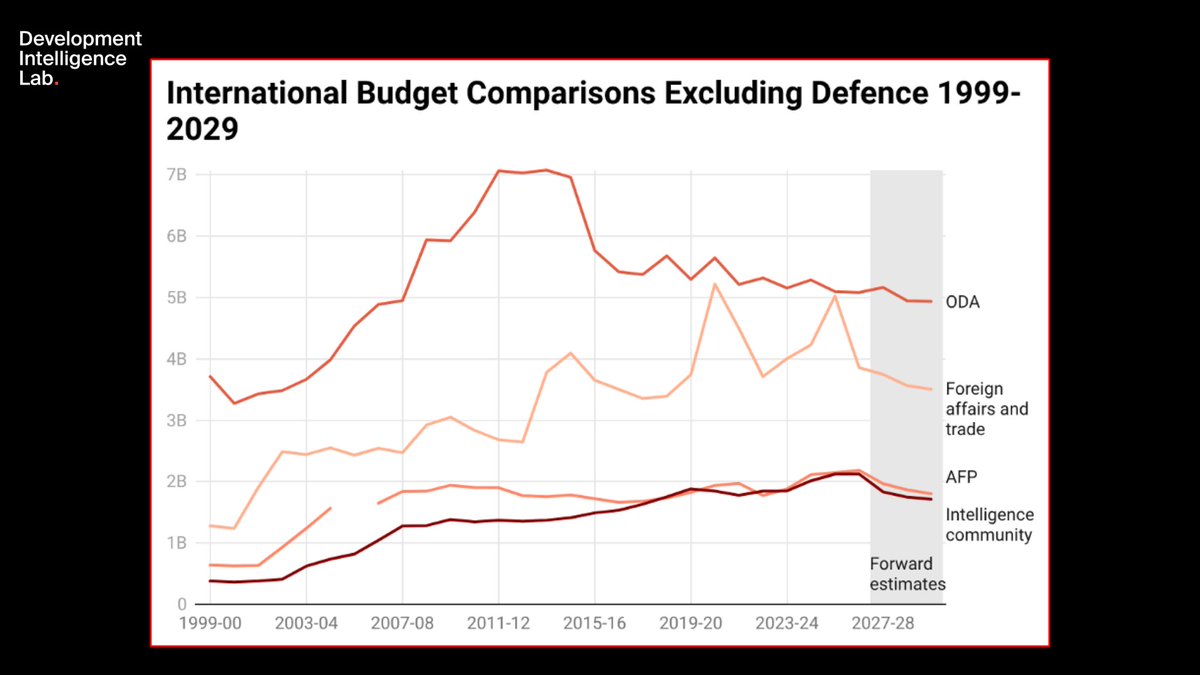
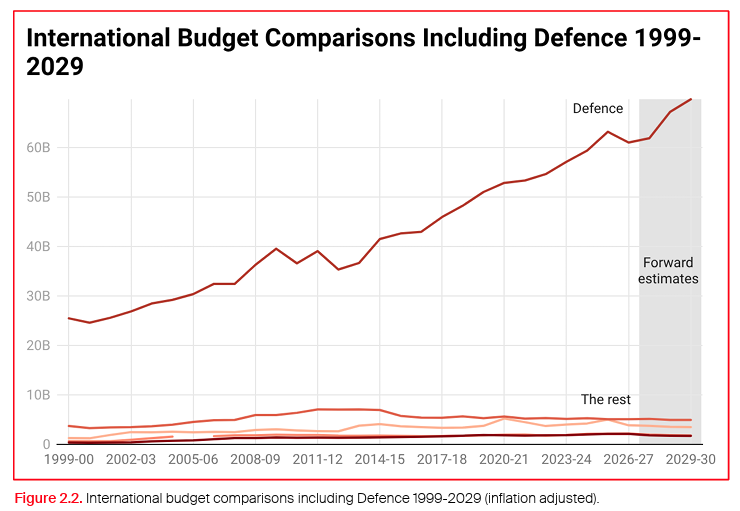
We have summarised the budget data on international affairs from 1999-2029 – adjusted for inflation – in the graphs below. And put together a year-on-year comparison between this year’s budget and last year’s, both in nominal and inflation-adjusted terms.
Check them out.👇
🔴 Our full analysis of the international affairs budget drops soon. Sign up to our email list to be the first to get it: https://t.co/mymdpExrtw
🔴 In the meantime, you can access 25+ years of federal budget data and examine key changes in Australian international budgets on our online interactive database, BudgetLines: https://t.co/9LjrfNolsc
The Intel’s editor, Victoria Cooper, sets the scene for this fortnight’s question and why it deserves to be asked:
“In these turbulent times, some are beginning to wonder whether these planning models are still fit for purpose— or whether they simply offer the comforting illusion of control in a world determined to behave otherwise.”
Explore the debate 👉 https://t.co/aLGgkYyumm
This fortnight’s Intel featured insights from Milica Begovic, Terence Wood, and Yasuhiko Matsuda, responding to the question:
🔴 Is long-term planning still a viable strategy or just a comfort blanket?
Multiple perspectives. Different angles.
Explore the points of agreement, tension, and difference here 👉 https://t.co/aLGgkYxWwO
At the Lab, we know that good development policy starts with understanding the region we live in.
This is why, today, the Lab was pleased to deliver a development briefing to Members of Parliament, on the invitation of Helen Haines, MP.
Our CEO, Bridi Rice, and Project Officer, Laetitia Chow, joined Helen and other MPs including Zali Steggal, Monique Ryan, Kate Chaney, and Allegra Spender at Parliament to talk development and conflict dynamics across the Indo-Pacific.
One of the things we're proudest of at the Lab is acting as an evidence-based brains trust and creating space for decision-makers to engage directly with the latest research, data, field experience and emerging trends shaping our region.
Modern Australian development is a dynamic element of statecraft – it's about stability, resilience, influence, economic opportunity and Australia's relationships with our neighbours.
Thank you to the MPs who joined the discussion and brought such incisive and thoughtful questions to the room.
And if you work in or around politics and would like to learn more about development, aid and regional dynamics in a format that is tailored to your needs, we'd love to hear from you!
Contact us to discuss future briefings, workshops and masterclasses here: https://t.co/L1t8EFdxwy
This fortnight on the Intel we ask:
🔴 Is long-term planning still a viable strategy or just a comfort blanket?
Our expert contributors pitch in:
⚫ UNDP’s, Millie Begovic
⚫ Development Policy Lab’s, Terence Wood
⚫ The Asia Foundation’s, Yasuhiko Matsuda
Explore their three competing views, here 👉 https://t.co/aLGgkYxWwO
Don’t miss an edition, sign up to our list to get the Intel straight to your inbox 👉 https://t.co/mymdpEwTDY
This fortnight on the Intel we ask:
🔴 What are the key signals from the ASEAN Summit for development in the region?
Our expert contributors pitch in:
⚫ Deutsche Gesellschaft für Internationale Zusammenarbeit (GIZ) GmbH’s Shameer Khanal
⚫ University of Melbourne Asia Institute’s Melissa Conley Tyler
⚫ Fundasaun Mahein’s Nélson Belo & DFAT Ireland’s Niall Almond
Explore their three competing views, here 👉 https://t.co/iERXC94Dsx
Don’t miss an edition, sign up to our list to get the Intel straight to your inbox 👉 https://t.co/mymdpExrtw
Great new paper from @devintellab!
Excited to see Bridi Rice, Geordie Fung & team using #UbiquitybyFilterLabs alongside traditional surveys to map local sentiment across countries of interest.
What a pleasure to partner with them & support their work!
https://t.co/hbCnFsCANe
Useful graphs here from @devintellab and @bridirice / @WillLeben2 showing Australian government spending on defence, ODA, diplomacy and intelligence over the years
“Development cooperation is no longer the soft edge of foreign policy. It is now uniquely suited to advancing Foreign Minister Penny Wong’s four priorities: region, relationships, rules and resilience.”
This is what our Strategic Advisor, @mickenzie21, writes in his new article for the @LowyInstitute’s The Interpreter.
Following the Federal Budget announcement this week, Michael argues that there is “growing recognition that Australia’s future is inextricably linked to sustainable development in the Indo-Pacific.”
And the ‘4Rs’ which have been overshadowed in the past, can refocus development cooperation at the forefront of Australian statecraft.
🔴 Read the full article ‘The 4Rs: A new(ish) narrative for Australia’s development cooperation,’ here: https://t.co/Jzd6GaVMil
The 2026-27 Australian Federal Budget was released last night. What’s the long term, big picture story?
⚫ Amidst rising global threats and aid cuts, this year, Australia’s international affairs budget makes up $76.18b, or 9.54% of the total Commonwealth budget.
⚫ Defence dominates the budget at approximately 82% of the total $76.18b spend on international affairs this budget year. There is set to be real growth over the forward estimates.
⚫ Aid has seen the weakest growth over the last 27 years. There is set to be a real decline over the forward estimates.
⚫ Over the last 27 years, funding for Australian diplomacy has been the most volatile. This budget reports a spike of approximately $1b in DFAT’s core operating budget for 2025-26. This spike warrants further analysis. There is set to be a real decline over the forward estimates.
⚫ Intelligence community budgets have seen the greatest growth the last 27 years; Australia now budgets more than five-and-a-half times as much on intelligence agencies as it did in 1999. There is, however, set to be a real decline over the forward estimates.
⚫ International policing has grown a little more than foreign affairs and trade over the 27 year period. There is set to be a real decline over the forward estimates.
🔴 Deep dive into the full findings on the 2026-27 federal budget here: https://t.co/EOoTNIRlQ5
🔴 Or directly compare the numbers on BudgetLines, our online interactive database collating 25+ years of budget data, and see for yourself what Australia’s spending reveals about its historical priorities: https://t.co/9LjrfNolsc
The 2026 Australian Federal Budget has just been released. International affairs, including defence, development, diplomacy, intelligence, and international policing, make up $76.18b, or roughly 9.54% of Australia's total 2026-2027 budget.
This is consistent with what Australia has spent on international affairs over the last quarter-century.
Here’s the 2026-2027 budget breakdown (nominal):
🔴 Total Federal Budget: $798b
🔴 Official Development Assistance (ODA): $5.21b
🔴 Defence: $62.6b
🔴 Diplomacy – Foreign Affairs and Trade: $3.96b
🔴 National Intelligence Community (NIC): $2.18b
���� International Policing (AFP): $2.24b
🔴 Total international affairs: $76.18b
Our full analysis of the international affairs budget drops tomorrow. Sign up to our email list to be the first to get it: https://t.co/mymdpExrtw
In the meantime, you can access 25+ years of federal budget data and examine key changes in Australian international budgets on our online interactive database, BudgetLines: https://t.co/9LjrfNolsc
Delighted to have co-hosted a dialogue with @devintellab to discuss with senior policy makers, AI experts and development practitioners how Australia’s development program can help our region harness AI for inclusive growth
This fortnight’s Intel featured insights from Imogen Harper, Dr Cameron Hill, and Mira Sulistiyanto, responding to the question:
🔴 DFAT’s development performance report is out— what should you know?
Multiple perspectives. Different angles.
Explore the points of agreement, tension, and difference here 👉 https://t.co/tVloH4L4M9
AI is interacting with international development in three distinct ways:
🔴 as a tool for efficiency,
🔴 as a contributor to effectiveness, and
🔴 as a force shaping long-term development trajectories.
It is natural for practitioners to move through these lenses sequentially over time. But given the urgency and consequences of the third lens, this would be a mistake.
Because by the time trajectory-level questions feel unavoidable, many of the most consequential choices around AI infrastructure, standards, partnerships, and power may already have been made.
So what can the development community do?
A starting point would be to build enough fluency in AI to participate credibly in the conversations where these decisions are made, and expanding our partnerships to include the technology companies that are building the models shaping the future.
Which is why, last year, the Lab launched its AI x Development work stream to bring AI knowledge closer to practitioners and continue fostering unusual collaborations and debate.
So far, we have hosted over 400 people across six discussion sessions and published two articles – with more publications, sessions, and ways to think about AI to come!
You can sign up to our mailing list to be notified when the next session is on, and every time a new article drops 👉 https://t.co/mymdpEwTDY
And don’t forget to catch up on the AI x Development articles by Geordie Fung, here:
⚫ Mindsets shaping the moment 👉 https://t.co/aWkNdZvVLA
⚫ Tools, programs or trajectories? 👉 https://t.co/7dnsgCi3Fm
This fortnight’s Intel featured insights from Serena Sasingian, Grace Stanhope, and Richard Moore, responding to the question:
🔴 Non-ODA support for development - What works, what doesn't?
Multiple perspectives. Different angles.
Explore the points of agreement, tension, and difference here 👉 https://t.co/mLAk6AJW4p
How will AI impact international development? This is the question on every practitioner’s mind.
Yet, conversations on the topic can feel circular, confusing or even overwhelming.
Our Director of Analysis and Advising, Geordie Fung, argues that this is due to a lack of shared language on AI in the development community.
To resolve this, his latest article ‘AI x Development: tools, programs or trajectories?’ puts forward three distinct lenses for understanding how AI interacts with development cooperation:
🔴 AI for efficiency – making the practice of development cooperation faster and cheaper. This shows up as productivity tools that slot easily into existing workflows, but that run the risk of equating speed with progress.
🔴 AI for effectiveness – improving the impact of development interventions. As AI is embedded within existing programs and increasingly becoming a focus in its own right, it raises questions around the politics of locally led development and dependency loops.
🔴 AI as a force shaping development trajectories - looking beyond tools and programs to ask how AI will determine patterns of poverty and prosperity, the distribution of economic opportunity, the nature of governance, and the dynamics of conflict and stability.
By deconflicting meanings and understanding these lenses, practitioners can build enough fluency in AI to ultimately set the agenda and “argue for development values in rooms where those values are not the default.”
Read the full article here 👉 https://t.co/7dnsgCi3Fm
Not long until Bridi Rice, CEO of think tank @devintellab, joins us on the 27th to share her insights into #disaster resilience in the #IndoPacific. We can't wait for her to bring her development and foreign policy experience to our show.
Register: https://t.co/n84knPYdCV
When someone says "AI will transform development" what are they actually talking about?
A chatbot that saves time on donor reports? An AI-powered health intervention? Or AI reshaping which countries prosper and which fall further behind?
Geordie Fung’s second article in the Lab's AI x Development series argues these are three different conversations. The interaction between AI and development cooperation can be understood through three lenses:
🔴 AI for efficiency - making development cooperation faster and cheaper
🔴 AI for effectiveness - improving the impact of development programs
🔴 AI as a force reshaping development trajectories - shaping poverty, prosperity, governance, and power at a country level
The question isn't whether the development community will have to grapple with AI. It's whether they'll do so before or after the most consequential choices have already been made.
🔴 Read the article: https://t.co/7dnsgCi3Fm
Last year, Foreign Minister Penny Wong affirmed Australia’s commitment to ‘remaining a reliable partner’ in the Indo-Pacific, despite the global reduction in development assistance.
While Wong did not elaborate on funding sources, non-ODA support (NODA) plays an increasingly significant role in delivering on this vision.
So what are the opportunities of NODA?
⚫ Pragmatic partnerships.
NODA opens pathways to enhance development impact in a constrained budgetary environment, enabling greater scale, flexibility and coherence across development interventions.
⚫ Building regional resilience.
As NODA integrates development and broader strategic objectives, it is well-suited to projects that build regional resilience, whether alone or in combination with ODA.
⚫ Prioritising those in need.
By utilising NODA for investments with a higher geostrategic or commercial return, Australia can preserve ODA funds to assist those most in need.
⚫ A tool of statecraft.
NODA provides a bridge between development cooperation and other tools of statecraft, including economic, diplomatic and defence engagement. It is no longer just a question of how development assistance advances national interests, but also how other tools of statecraft can deliver a development dividend.
🔴 Learn more about NODA in our latest brief ‘Non-ODA support and the future of development cooperation’ here 👉 https://t.co/nB9i46U4dI
This fortnight on the Intel we ask:
🔴 Middle East trigger shocks that reshape development challenges in the Indo-Pacific?
Our expert contributors pitch in:
⚫ Center for Indonesian Policy Studies’s @ASurianta
⚫ The Lab’s @anitramz
⚫ @USSC's @jaredmondschein
Explore their three competing views, here 👉 https://t.co/j9RRW0Kdvm
Don’t miss an edition, sign up to our list to get the Intel straight to your inbox 👉 https://t.co/mymdpExrtw