@mcuban The deep neural network is inherently a probabilistic data structure. Also, the frontier models have no memory about your business. Precision will come only when we use deterministic data structures like old-style databases, and use LLMs to generate code to look them up.
Andrew Ng just revealed why the AI companies throwing the most compute at the problem are going to lose.
The winner of the intelligence race won’t use the most compute.
They’ll waste the least.
Ng: “Most of your high-dimensional data lies on a lower-dimensional subspace. It’s just a fact of life.”
Here’s what that means in practice.
You have a 10,000-dimensional dataset.
Every dimension dragged through every calculation.
Every training cycle hauling dead weight the model will never use.
Ng: “You’re carrying around these 10,000-dimensional examples throughout your whole training process.”
That bloat isn’t just inefficient.
It’s a tax on every computation you run.
Memory bandwidth. Network bandwidth. Computational speed.
All of it eaten by dimensions that contribute nothing to intelligence.
They contribute noise.
The insight that separates the architects from the arms race: that 10,000-dimensional dataset is almost entirely captured by a much smaller subspace.
The signal lives in a fraction of the space you’re paying to process.
Compress it. 10,000 dimensions down to 1,000.
Ng: “You can run your learning algorithm on a much lower-dimensional set of data and it may be much more efficient.”
Same hardware. Same budget. A fraction of the friction.
Brute force is the strategy of whoever has the deepest pockets.
Compression is the strategy of whoever actually understands the problem.
The companies that master this don’t just build faster models.
They build models that find more truth in less data than anything scaling blindly ever will.
Intelligence was never about processing everything.
It’s about knowing what to cut.
Small businesses are the backbone of American economy.
At the first 2026 @TheLBJSchool Business Forum, we examine the public policy choices that will determine whether AI fuels inclusive growth—or widens the gap.
Register—Open to public: https://t.co/aA0RNaM5AS
Does semantic collapse exist? Yes.
Is this guy either lying or incompetent? Also yes.
I’ve read the Stanford and Berkeley papers on embedding degradation at scale.
This graphic clearly hasn’t.
The chart assumes one thing:
a single vector search over a flat pile of documents.
That’s like saying dbs don’t scale because full table scans get slow!
Yes! That’s why indexes, hybrid search, and filters exist 😂
You’re arguing against the dumbest possible implementation and pretending that’s what everyone does. No we don’t
This isn’t analysis.
This is ragebait. Anyone with real experience now knows you have none
The security vulnerability we found in Perplexity’s Comet browser this summer is not an isolated issue.
Indirect prompt injections are a systemic problem facing Comet and other AI-powered browsers.
Today we’re publishing details on more security vulnerabilities we uncovered.
Moving and organizing data into vector DBs, SQL DBs, and graph DBs — and serving them via custom ‘compute’ skills — is what will give conversational surfaces depth in the enterprise. This is where Computer by @devrev shines. It’s (a) search, (b) analytics, and (c) workflows done right for an agentic enterprise. Read more about Computer Memory and AirSync here:
https://t.co/K40iH0Bzho
Meet Computer, your new AI teammate, and the next step in our journey toward Team Intelligence — which like most profound things in life — captures 3 design ethos of @devrev:
- Discovering knowledge already within the enterprise
- Your customer is also in your team
- The team’s biggest enemy is departments
Computer is “here,” where your team and your enterprise data are.
https://t.co/K40iH0Bzho
Meet Computer, by DevRev.
Your new AI teammate that makes work faster, smarter, and more human – and maybe even a bit more fun. It unites data, breaks down silos, and lifts every team with real collaboration.
Computer is born from our belief that AI should feel less like managing another tool and more like gaining a trusted teammate.
Discover what makes Computer special in our CEO Dheeraj's launch message: https://t.co/bloIRvebna
@dheeraj
And legacy SaaS thinks of LAMP stack as the end-all and be-all of all data and compute. There’s so much more to data in the world of AI and agents: graph DBs, inverted indexes, vector DBs, DWs, time-series engines, pub-sub busses, … imagine creating millions of such indexes, DBs, et al.
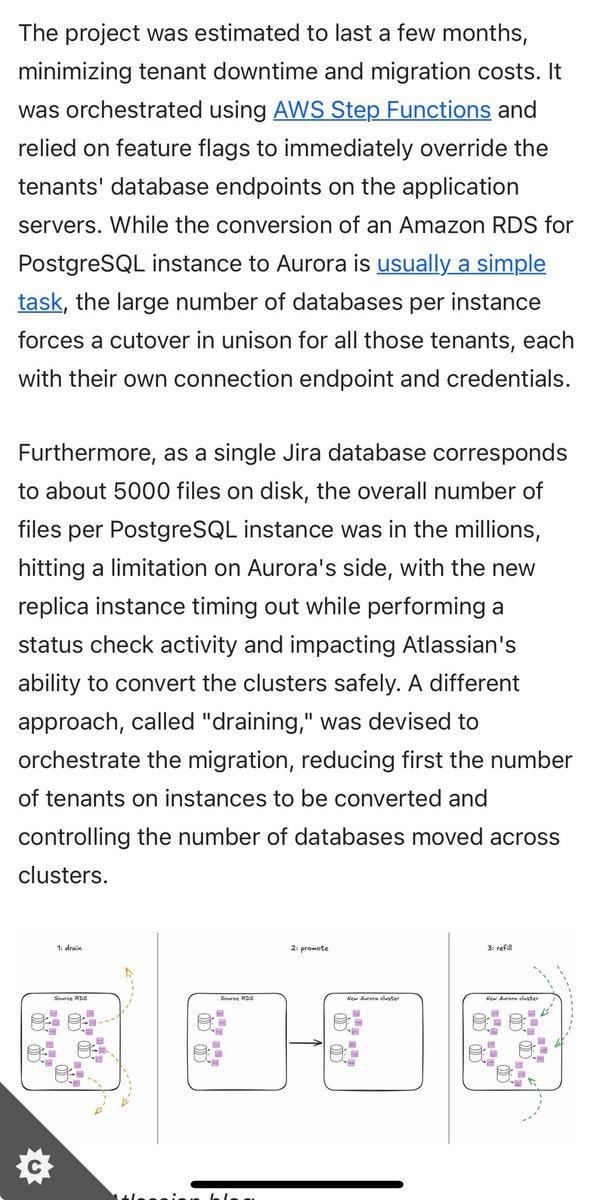
For all this talk of isolation, this is soft multi-tenancy, and is the worst of both worlds strategy to build a cloud. Databases in PG are logically isolated, which gives a warm-fuzzy feeling of isolation. 🧵
Yahoo! crawled the entire Internet too, as much as Google did. It’s the way Google stored the information — with inverted indexes, Linux, commodity servers, MapReduce jobs, GFS 2, BigTable, etc. — that mattered. They blew Y! out of business by refusing to use the big-honking Oracle-NetApp-Solaris complex. The power of commodity to democratize the web!
And of course, by bringing in the ‘surprise’ network effects — auto-complete, did-you-mean, and people-who-asked-this-also-asked-that “memory” — and bring delight to users by giving them more than they ever expected…