stop asking Claude one question and thinking you understand the topic. you don't.
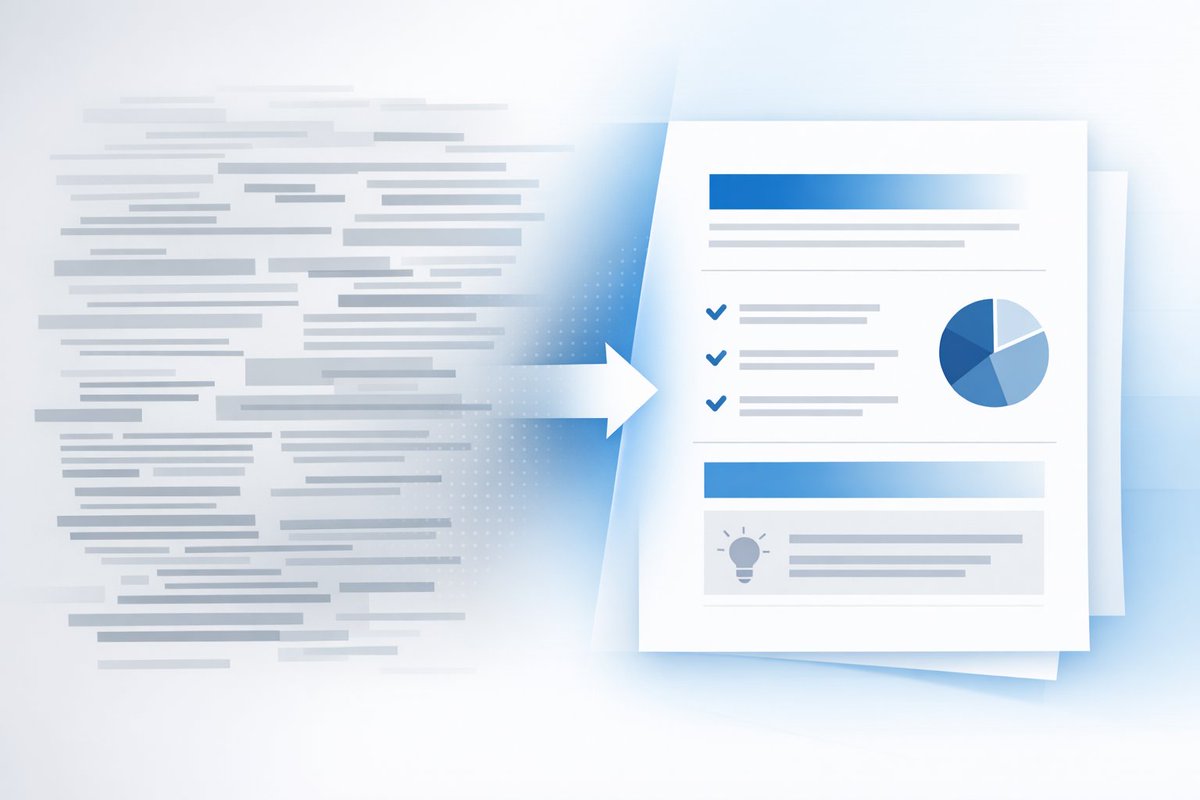
Stanford proved a better way. it's called STORM. peer reviewed. 25% more organized output. open source.
the trick: don't ask one question. ask five. from five different experts.
>the practitioner: what do they know that academics miss?
>the skeptic: what's the strongest counterargument?
>the economist: who profits from the current narrative?
>the historian: what pattern has played out before?
>the academic: what does the evidence actually say?
4 prompts. 5 minutes. no software. no GitHub. just paste into Claude.
single prompts give you what everyone already knows.
STORM gives you what nobody else found.
this article has all 4 prompts ready to copy. pick your hardest topic. paste prompt 1. you'll know more in 5 minutes than people who spent days reading.
🚨 BREAKING NEWS: I asked Claude to optimize my LinkedIn profile.
He didn’t just “optimize” it.
He transformed it into a profile that recruiters actually notice.
Here are the exact prompts I used:🧵
BREAKING: CLAUDE can now run your entire social media on autopilot mode like a $700/hour social media manager for free.
Here are 7 CLAUDE prompts that you should try:
Introducing 30 days of AI.
For the next 30 weekdays, I’m going to share one observation per day from the frontlines of AI.
I have the privilege of co-running an enterprise AI transformation firm, where I experience the edges of this technology, see the biggest challenges the biggest companies are facing, and have deep relationships with companies on the frontier (Anthropic, OpenAI, Lovable, Cursor, Perplexity, Vercel).
I get to live in the future for free, and I want to bring that future to those trying to disrupt themselves before they get disrupted.
There’s just two rules:
1) Each observation is actionable & understandable to the non-technical leader.
2) I can’t miss a day.
Post 1 coming soon.
I broke my own rule to never post about AI detection as it is fraught in many ways.
The problem is that if you use AI a lot, you know AI writing on sight, which makes the difficulty of objectively proving that AI use to others very frustrating
This 2-hour Stanford lecture breaks down how models like ChatGPT and Claude are actually built, clearer than what many people in top AI roles ever get exposed to.
Save this and set aside two hours today. It might end up being the most valuable thing you learn all week.
Prompt engineering is dead.
Anthropic recently released the real playbook for building AI agents that actually work.
It’s a 30+ page deep dive called The Complete Guide to Building Skills for Claude and it quietly shifts the conversation from “prompt engineering” to real execution design.
Here’s the big idea:
A Skill isn’t just a prompt.
It’s a structured system.
You package instructions inside a https://t.co/ayF9XmnQpU file, optionally add scripts, references, and assets, and teach Claude a repeatable workflow once instead of re-explaining it every chat.
But the real unlock is something they call progressive disclosure.
Instead of dumping everything into context:
• A lightweight YAML frontmatter tells Claude when to use the skill
• Full instructions load only when relevant
• Extra files are accessed only if needed
Less context bloat. More precision.
They also introduce a powerful analogy:
MCP gives Claude the kitchen.
Skills give it the recipe.
Without skills: users connect tools and don’t know what to do next.
With skills: workflows trigger automatically, best practices are embedded, API calls become consistent.
They outline 3 major patterns:
1) Document & asset creation
2) Workflow automation
3) MCP enhancement
And they emphasize something most builders ignore: testing.
Trigger accuracy.
Tool call efficiency.
Failure rate.
Token usage.
This isn’t about clever wording.
It’s about designing an execution layer on top of LLMs.
Skills work across https://t.co/pDY56kadwE, Claude Code, and the API. Build once, deploy everywhere.
The era of “just write a better prompt” is ending.
Anthropic just handed everyone a blueprint for turning chat into infrastructure.
Download the guide here: https://t.co/xEZ78RGkYu
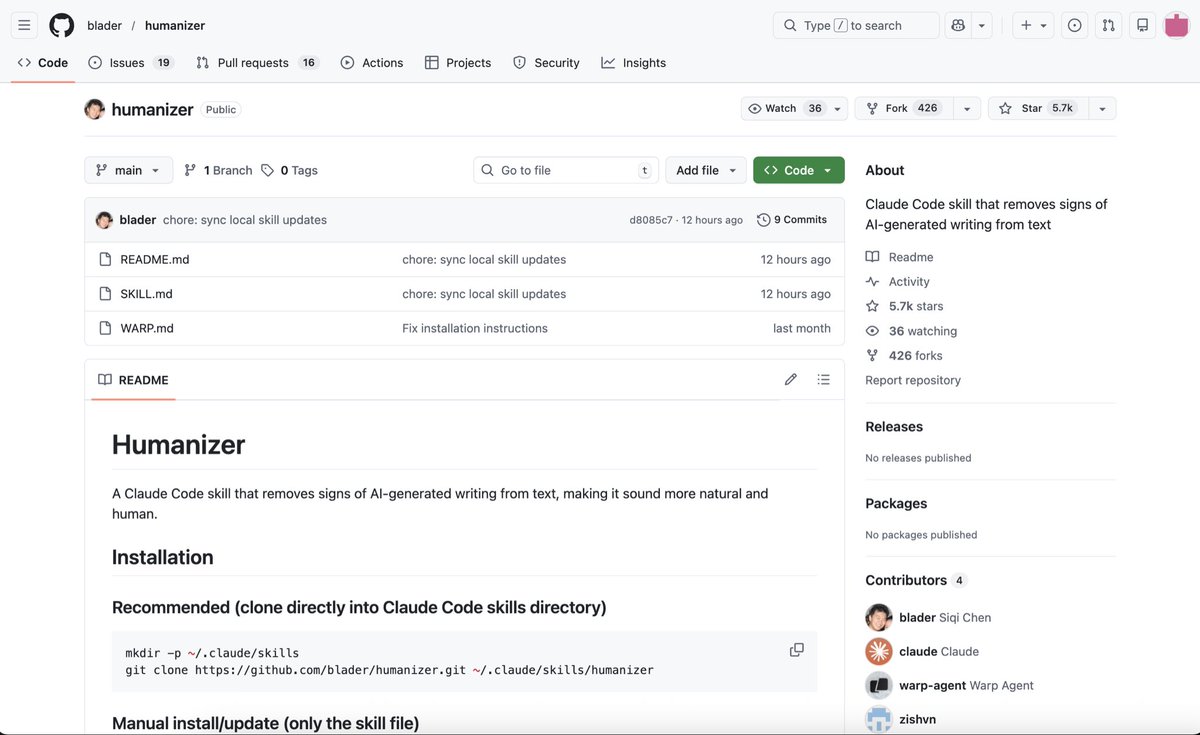
"This sounds like AI" is now easily fixable 🤯
There is a new Claude Code Skill that removes signs of AI-generated writing from text using 24 detection patterns.
Just type /humanizer and paste your text.
100% Open Source.
Cardiologist wins 3rd place at Anthropic's hackathon. Out of 13,000 applications. Built in 7 days by Michał Nedoszytko MD. Coded day and night - in the hospital, in the cloud, while flying from Brussels to San Francisco.
A few years ago, it would have been impossible for a doctor to build this alone in just a couple of days. AI changed that.
The project is called https://t.co/wAliajqjVF. It is an AI agentic care platform for patients. Including reverse AI scribe it is a companion that guides the patient from the moment they leave the doctor's office.
Powered by the massive context window of Opus 4.6, it allows patients to explore their full medical history, connected devices, Evidence Based resources and external data sources — all in one place.
Today, the barrier to entry has vanished; even a practicing physician can build an application from scratch.
You know what the biggest problem with pushing all-things-AI is? Wrong direction.
I want AI to do my laundry and dishes so that I can do art and writing, not for AI to do my art and writing so that I can do my laundry and dishes.
Today on International Day of Women & Girls in Science @WomenScienceDay I'm highlighting Prof Julie Williams CBE, a leading advocate for women in STEMM, and founder of the UK Dementia Research Institute (UK DRI) at Cardiff, one of the UK’s flagship dementia research hubs.
We’re #StrengtheningPiccadilly
👷🏻♀️From 14 to 22 February, there will be no trains from platforms 1 - 12 and an extremely limited service to platforms 13 and 14
Please plan your journey in advance @nationalrailenq
More details at https://t.co/W6tpGq5BPh
A sector first; our new collaboration with @Microsoft
65,000 colleagues and students will receive full Microsoft 365 @Copilot access and training, making @OfficialUoM the world’s first university to deploy equitable access across its entire community.
https://t.co/Hnk1ziKA5J
Generative AI for Academics by Mark Carrigan is one of the best #books I've read this year. Really thoughtful and critical exploration about the technology that is changing how we work and think. Recommended reading for anyone interested in #GenAI in #academia, #highereducation
FIRST LOOK AT TANGERINE, SALFORD’S NEW FOOD AND MUSIC HALL
Under the railway arches in Salford, there’s a new spot for drinks, dancing, great food and general spectacle.
Tangerine is a martini bar, live music venue, food hall (from burgers and ramen to pasta and even a Ukrainian bakery), cocktail club and roastery, cloaked in an orange hue and some distinctly anachronistic 70s vibes.
And all a brief hop from the bottom of Deansgate.
We headed down to check out what’s going on… it’s a lot.
If you want to give it a try while they're fine-tuning things, Tangerine friends, family and Instagram followers can get 50% off their food bill Monday to Friday from 4-7pm when you book a table before 14th November.
….
⏰ Mon 8am-10.30pm, Wed 8am-11pm, Thu 8pm-11.30am, Fri-Sat 8am-1am, Sun 8am-10pm
📍 Arch 60-61, 13-17 New Bailey St, Salford M3 5FS
💰 Prices vary