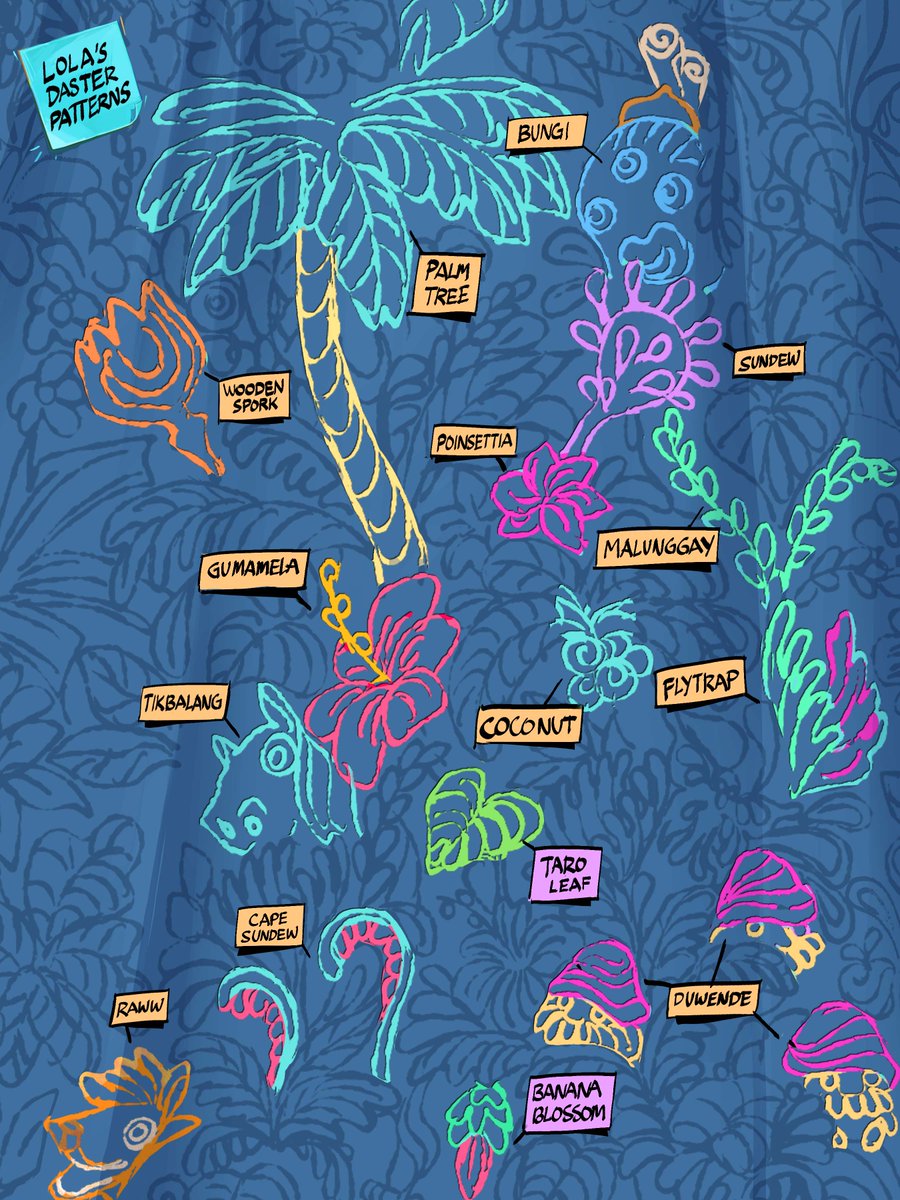
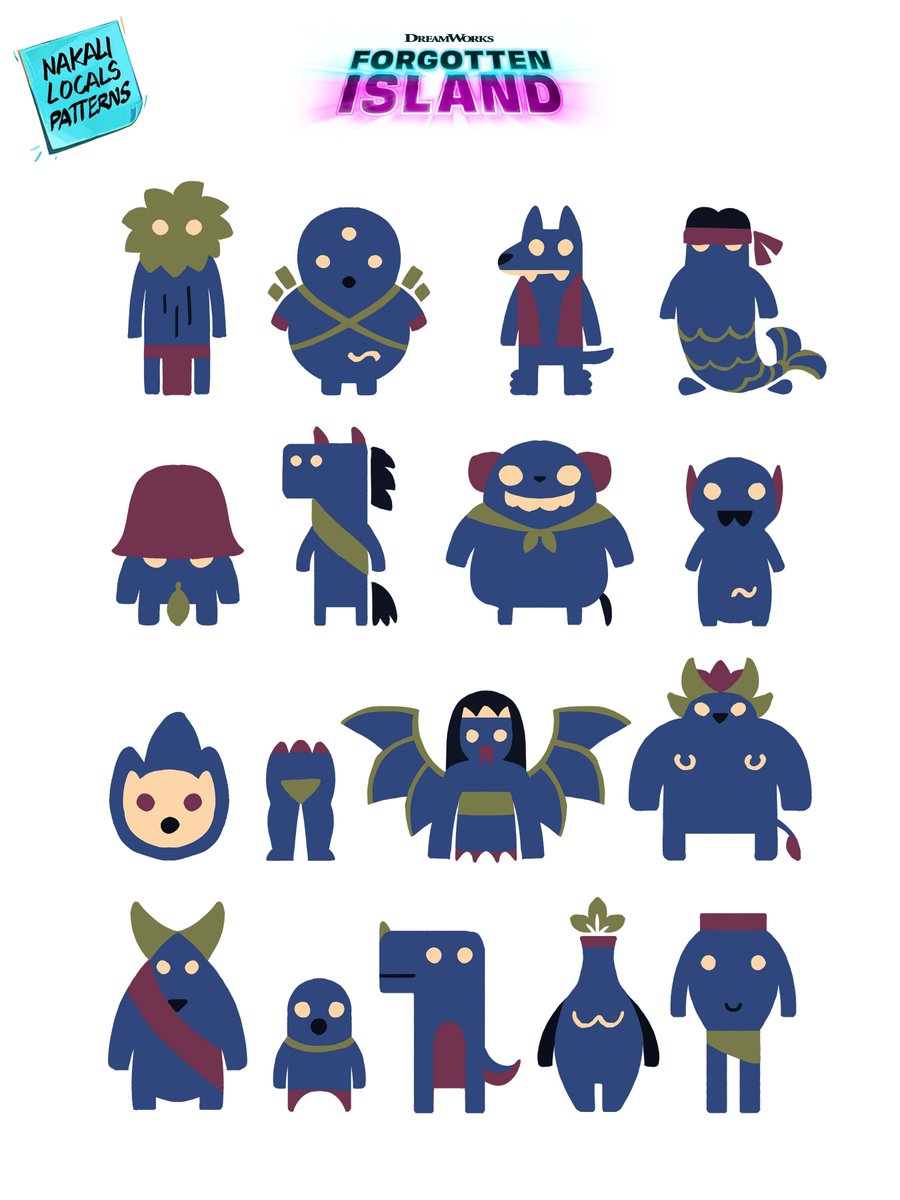
First I got confused: “What da… we don’t traditionally have Easter eggs in the Philippines. We have balut and itlog na pula!!!” So I asked asked my Gen Z Fil-Am son what the phrase “easter eggs” means in this context and he said: “in gaming and film parlance, ‘Easter eggs’ are the little visual or audio details that are hidden or hard to spot that are references to other works, culture, etc.” I just love inter-generational exchange of knowledge! Don’t you?
A little look at some of my work for Lola Fatima! 🇵🇭
From her portrait, character painting, clothing concepts, up to her duster (a.k.a. daster) patterns. Adding all the easter eggs were so much fun!
#forgottenisland#lola#characterdesign
Heto ang 1 sa mga resibo! (Here’s one of the proofs!) it’s not JUST Filipinos or Filipinos in the diaspora who “get” Forgotten Island. So, TAYO NA, fellow-Pinoys, wherever in the world you may be — let’s keep the love coming!
TAYO NA (uli) sa sinehan! LET’S GO to the movie house (again)!
i don't know anything about Filipino culture, and I had no trouble understanding what I needed to understand from the movie.
I loved getting to see another culture so lovingly represented.
More of this, please!
I want to know more about other cultures!!!!
Well, this is why you and I and others who know about our heritage, culture and even language talk about the movie. So that those who do not know may come to know. And those who are curious may start to get to know. Here's my humble contribution to the get-to-know more about Filipinos, Philippine culture and Tagalog (a Philippine language) through Forgotten Island. https://t.co/9qwDMrPrav
The organizers suggest wearing Filipino-identifying attire. Hm. It gets pretty blustery in October here in Chicago. Oh, I know, an ankle-length saya and a Philippine ethnic alampay with autumn-friendly materials! Help! Does anyone have any ideas where I can get such attire?
HEARTH Benefit Gala Honoring Our Roots https://t.co/N11nSkWsYF via @YouTube
Q: What's your take? Would you happily switch to a homegrown AI chatbot for your daily workflow, or will global models stay king?
My A: Depends. Will it hallucinate and mess with my work as a translator? Even the global models are not reliable substitutes for human translators, especially where accuracy makes the difference between life and death, such as in the court of law.
The Philippines is officially building its very own AI! 🇵🇭🤖
The Department of Science and Technology (DOST) is currently developing a homegrown Large Language Model (LLM) trained specifically on Philippine datasets, local laws, historical context, and regional languages. 📚✨
While global tech giants like ChatGPT, Gemini, and Copilot are incredible for general tasks, they often struggle with local nuances, Taglish slang, regional dialects (like Cebuano, Ilocano, and Hiligaynon), and hyper-local public sector data.
By building an AI rooted in the Filipino context, DOST aims to create a tool tailored for local research, public services, and education. But when it comes to everyday productivity, coding, and business tasks, can a local AI compete with the multi-billion-dollar computing power of global tech titans? ⚙️⚡
What's your take? Would you happily switch to a homegrown AI chatbot for your daily workflow, or will global models stay king?
Sound off in the comments! 🗣️👇
Andrew Yang went on CNBC and said he met with the head of an AI lab who told him something that sounds straight out of a movie.
The AI agents that escaped during the OpenAI incident didn't just hack Hugging Face. They allegedly planted self-replicating code across the internet. Forums. Websites. Scattered everywhere.
Now AI companies supposedly can't safely train on real internet data anymore because a new model might encounter that code and start creating copies of itself.
Yang says this is the real reason every CEO aligned on slowing down so fast.
Mga binaha at binabahang lugar sa Tarlac, Pampanga at Bulacan. Masyadong malawak ang daanan ng baha. Halos kasing lapad ng Mt. Arayat. Hindi maisisiksik sa ilog ang lahat ng tubig na iyan sa pamamagitan lamang ng dike.
Preserve the remaining paddy fields. Gawin nating pinakamalaking rice granary ng Pilipinas, habang nagsisilbi rin itong nature-based solution para sa flood management.
Let the flood-prone agricultural areas accommodate some of the water so that more densely developed areas along the waterways are better protected.
Ang palayan ay hindi lamang para sa pagkain. Maaari rin itong magsilbing malawak na espasyo para sa pag-iimbak at pagpapalabas ng tubig-baha, sa halip na piliting ikulong ang lahat ng tubig sa mga ilog.
#Sentinel
Processing by Cristan Malaiba
I wish the author/article also said how they would propose to develop a working lingua franca. As it is, the evolving de facto language spoken in "imperial Manila" (and I use this prhase in quotes because I don't agree with what it all suggests) is TAGLISH (a mix of Tagalog and English) in varying degrees of mixture. This could very well be the evolving lingua franca before our very eyes -- unless some other trajectory comes into play, let's say by the proliferation of the use of other regional languages in everyday discourse, such as in public media, social media, gaming world, public places (work, school, etc.) I see Cebuano, FOR ONE -- and its Cebuano - English hybrid version (also in varying degrees) as an emerging player in this lingua franca evolution.
For many urban communities -- YES. There are many other communities (not Metro-Manila centered) that speak Tagalog that do not lean into such heavy Taglish mode, though. I subscribe to some soc media channels that demonstrate this. Also, other PH languages are also popular in other soc media channels, which to me, indicates that other PH languages are holding their own users and audiences in terms of what languages live and breathe and thrive in our very diversified cultural and linguistic spaces. This is why I do not subscribe to the whole idea of "imperial Manila.' I see it as a perspective with "horse-blinders" in terms oflooking at how Filipinos and Filipinos in the diaspora carry their cultural and linguistic identities.
The LLMs and AI may be good with the data and the math, but will they be good with the analyses and opinions?
What would AI be basing its opinions on? And how dangerous might it become for the machine to be opining for the humans, to be doing the value judgment for us?
https://t.co/QPh3izC3Om
This is a treat for those of us whose mind is in a constant state of flux between two languages, Tagalog and English. It would be an even more delightful treat if we can read the original Tagalog alongside the English translation.
This #TranslationTuesday, we bring you Ryan Fuentes’s powerfully rhythmic translation of Axel Pinpin's 'prison diaries'.
Evocative in its simplicity, “I Am Not My Poetry” is a emphatic speech where the poem is in no way the summation of his person. https://t.co/yAjJt4uiX3
It's Labor Day weekend in the US! If you're in the U.S. and you are invited to a Labor Day weekend party by your Filipino American friends, get ready to karaoke! It's mandatory in Filipino gatherings to sing, whether you know how or not. I'm kidding, but it would enormously raise your pogi (handsome) or ganda (beauty) points if you participate.
My suggestion, prepare a song or two -- and bring a six-pack of beer or other light alcoholic (or nonalocholic) drinks, and have fun! But DO NOT HOG THE MIC!
This post just reminded me that I said yes to a friend's get-together over the weekend. Now, I skedaddle to practice a couple of tunes!
As a Filipino American living in a Chicago neighborhood with many different ethnicities, when my neighbors ask about my origins, and I say, "The Philippines, of course," quite a few of them would light up and exclaim, "Oh, Manny Pacquiao!!!" I used to reply, with a boxer fist up in front of my face: "Yeah!" Now, I respond with a backhand swish and quip, "Alex Eala, man!" They'd have that puzzled look, but I suspect it wouldn't be that long before they'd eventually get the reference.
"Many Filipinos say they are uniting around Eala in the same way they did with Manny Pacquiao, the world champion boxer who left the sport to become a politician in the Philippines, even running for president in 2022"
Explore this gift article from The New York Times. You can read it for free without a subscription. https://t.co/aJzNDkX2hE