With the rapid buildout of data centers, communities are facing growing health and environmental concerns. Join our webinar series to learn what’s at stake and how to respond.
Register here: https://t.co/CBjzKeYUAl
☀️ Plug-in solar is making clean energy more affordable and accessible. That means lower bills, less climate pollution, and healthier communities. https://t.co/ztLvyx3eZv
Pollution standards for heavy-duty vehicles aren't unnecessary—they're lifesaving. They help reduce harmful pollution that puts the health of our families at risk.
Tell EPA to keep these protections strong. Submit a comment by August 29: https://t.co/fbltBO5Zmh
@USEPA is holding a public hearing on a proposal to roll back clean trucks standards – a move EPA admits would increase air pollution. Lung Association staff & volunteers are testifying in opposition to this proposal, urging EPA to implement the original standards (1/5)
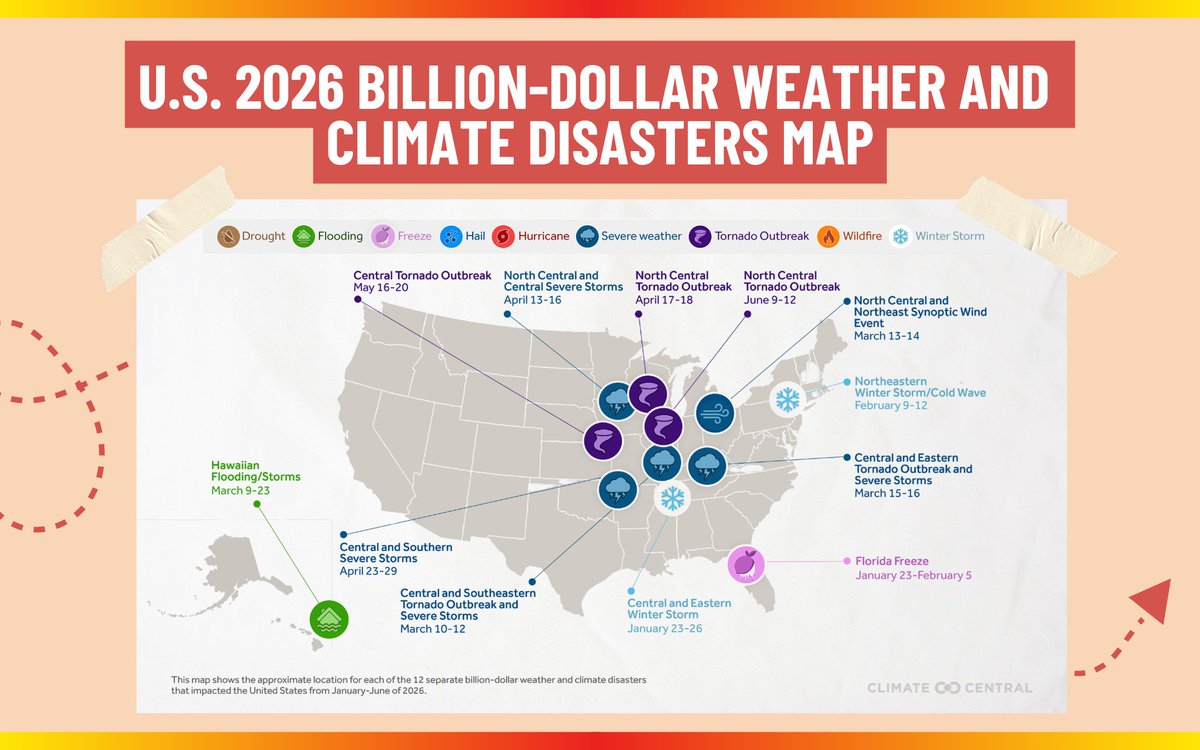
Through June 2026, the U.S. has experienced 12 billion-dollar weather and climate disasters, including:
⛈️8 severe storms
🍊1 record freeze event
❄️2 winter storms
🌊1 severe flooding event
Want to learn more? Explore the database: https://t.co/oaK8Q39jpJ
Millions are sweltering under this heat dome, and too many families are having to choose between AC and paying for food, rent, and medicine.
As climate change fuels more frequent extreme heat, we need an energy system that puts people first, not profits. https://t.co/fiy1DIwANg
What should health professionals know about data centers? Join our webinar series to learn about the risks, hear from experts and leave with practical tools for action.
Register: https://t.co/0FWhc6xGu7
🦟Mosquito season is getting longer, and the buzz is not so good.
#ClimateCentral analyzed "mosquito disease days" in 239 major U.S. cities from 1970–2025 — days with temperatures suitable for spreading West Nile virus — and found that 95% of these cities saw an increase.
People who are incarcerated are among those most vulnerable to the impacts of extreme weather, but their safety is often overlooked in disaster planning.
The latest #ExtremeWeatherExplained explores the risks and what solutions are needed.
Listen here: https://t.co/9O700HVC56
For decades, the oil and gas industry knew methane was a harmful climate pollutant, yet promoted natural gas as a "solution" anyway.
A new @climatecosts report exposes this deception and underscores the need for accountability. https://t.co/jSofLWafiP
How much is Canada responsible for the wildfire smoke reaching the U.S.?
Right now, nearly 900 wildfires are burning across Canada. Last week, Toronto's air quality was the worst of any major city in the world. But as the smoke spread south to the U.S., many politicians began blaming Canada for poor forest management.
It's true that local and regional forestry practices matter. Leafy deciduous trees hold moisture and can act as natural fire breaks; so clearing them for conifer monocultures can leave forests at higher risk to burn. But fire suppression, a big issue in the dry forests of the western U.S. where putting out frequent fires let fuel pile up, isn't a major factor here. Canada's remote boreal forests already burn naturally, in less frequent but higher-intensity fires.
The single biggest reason for the record-breaking *increases* in the area burned by wildfires that are causing all this smoke isn't land management. It's human-caused climate change.
As the world warms, winters are no longer cold enough to kill off tree-eating beetles. Their populations explode, leaving millions of acres of dead trees ready to burn. Warmer winters also mean less snowpack, so soil dries out earlier and the fire season runs longer. And climate change has more than doubled the frequency of hotter, drier fire weather across Canada and increased the frequency of the lightning strikes that spark most fires in northern Alberta and BC.
Every one of those four dials is being turned in the same direction by the same thing: the heat-trapping gas emissions from burning fossil fuels. And that's where the numbers start to tell a different picture.
The United States has emitted more carbon than any country in history: around 435 billion tonnes since the 1800s. That's close to a quarter of all the carbon humans have ever put into the air, 12 times Canada's total and still 50% more than China's 285 billion tonnes.
Look at it by company instead of by country, and 88 of the world's largest fossil fuel producers are responsible for the emissions that led to more than a third of the forest area burned across western North America since 1986. At the top of that list is Saudi Aramco, followed by US companies Chevron and ExxonMobil. The first Canadian company, Suncor, doesn't appear until number 76 ... but that could change, as Canada is building more pipelines!
Bottom line? If politicians want to clear the smoke from our skies, tell them the most effective place to start is by cutting the emissions that are driving these fires - no matter which side of the border we're on.
Sources, I'm a scientist so you know I have them: Doubled fire weather risk (World Weather Attribution, 2023). Fire suppression near communities (Parisien et al. 2020, Nature Communications). Climate-beetle-fire connections (e.g. Woo et al. 2024, Ecosphere). Climate-driven lightning increases in northwestern Canada (Burrows et al. 2024, Atmosphere-Ocean). Cumulative CO��� by country (Our World in Data). 88 producers behind 1/3+ of western N. American area burned (Dahl et al. 2023, Environmental Research Letters). Company ranking (Carbon Majors). And for an exhaustive review of how we know human emissions are driving climate change, see the next post in this thread.
https://t.co/Spedt9SMaI
Is it summer? Yes.
Should it be hot? Sure.
Should it be THIS hot? Not quite.
🔴A warmer atmosphere makes this kind of heat at least 3x more likely for:
• Mon: 52.2M Americans
• Tue: 95.4M
• Wed: 85.5M (and almost impossible w/out it for 65.2M!)
(📊@ClimateCentral)
The choices we make at the ballot box can #ProtectKidsHealth. Join CEHN & partners on 7/28 @ 4:30 pm ET for a webinar & learn how the 2026 elections can advance healthier futures for kids & families. https://t.co/iJSg9sWPw8 #Vote4Kids
Fossil fuels are already harming our communities, and this cruel summer of compounding climate impacts is proof.
But a healthier future is possible. It starts with a clean energy transition. https://t.co/f0Ace6mxKD
Wildfire smoke. Dangerous heat. Floods. These are not abstract impacts.
A new @theNASEM report shows attribution science is making climate change's role in these extremes clearer, helping communities prepare and hold big polluters accountable. https://t.co/mJghAlYfG1
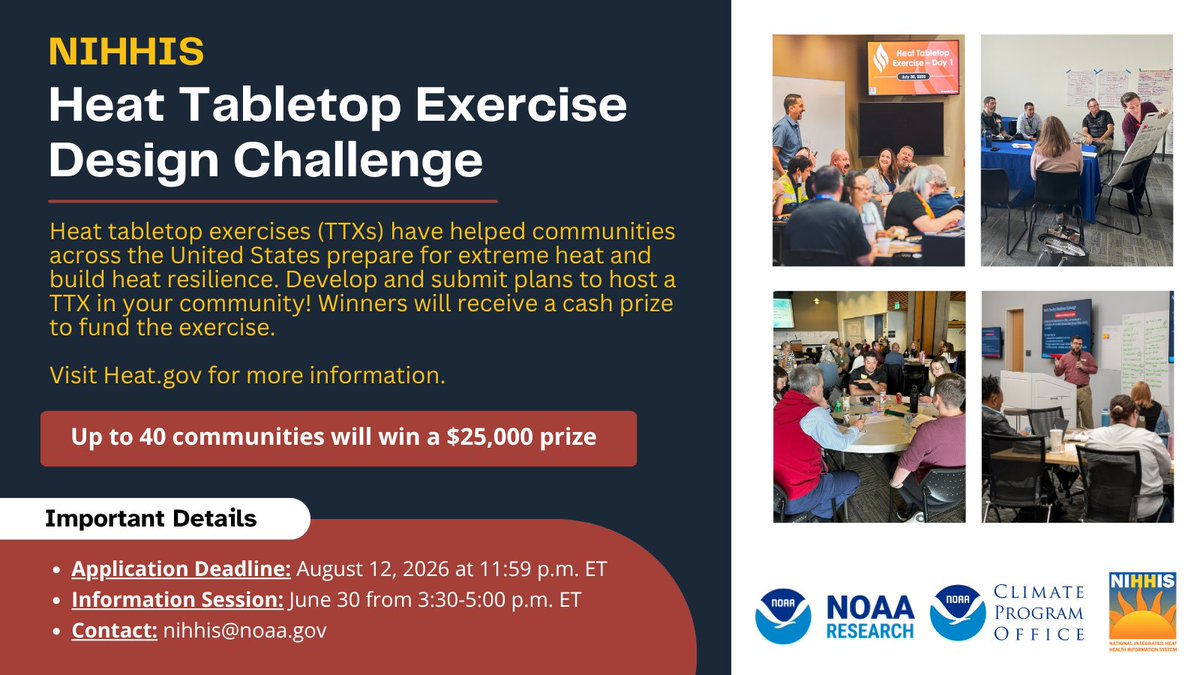
📢@NOAAResearch's Climate Program Office and NIHHIS invite communities to design tabletop exercises that support local heat action planning. Up to 40 communities will receive prizes of at least $25,000.
Enter by August 12 at 11:59 PM ET. More information: https://t.co/DfOvM1C0G4
The choices we make at the ballot box can #ProtectKidsHealth. Join @CEHN & partners on 7/28 @ 4:30 pm ET for a webinar & learn how the 2026 elections can advance healthier futures for kids & families. https://t.co/iJSg9sWhGA
#Vote4Kids
From my post last year, my 4 favorite sources of wildfire smoke forecasts:
1-3 day from NOAA:
https://t.co/bK4XjekAlP
https://t.co/4ka8PYOnkL
3-day from Environment Canada:
https://t.co/FyaPRCel0E
5-10-day from NASA:
https://t.co/J4qbMG2hQZ
https://t.co/fZfarCx2vg