Excited to share our latest paper: "Towards the Democratization of Subspecialty Medical Expertise." Rare heart disease illustrates a common challenge in healthcare: the scarcity of subspecialist expertise.
📜Paper: https://t.co/4jTY3VtWm8
💥Podcast: https://t.co/7Ge7H7OHF0
Since joining @GoogleDeepMind I’ve dreamt for a decade that AI can give clinicians superpowers: amplifying reach as an always-available, trustworthy member of the care team. Delighted to share our strategic research initiative at @GoogleDeepMind towards this vision: AI co-clinician https://t.co/hWy00ZahGs (1/n)
(1/10) Excited to share our new paper: "Towards Conversational Medical AI with Eyes, Ears and a Voice"
https://t.co/k0CNjqsgIP
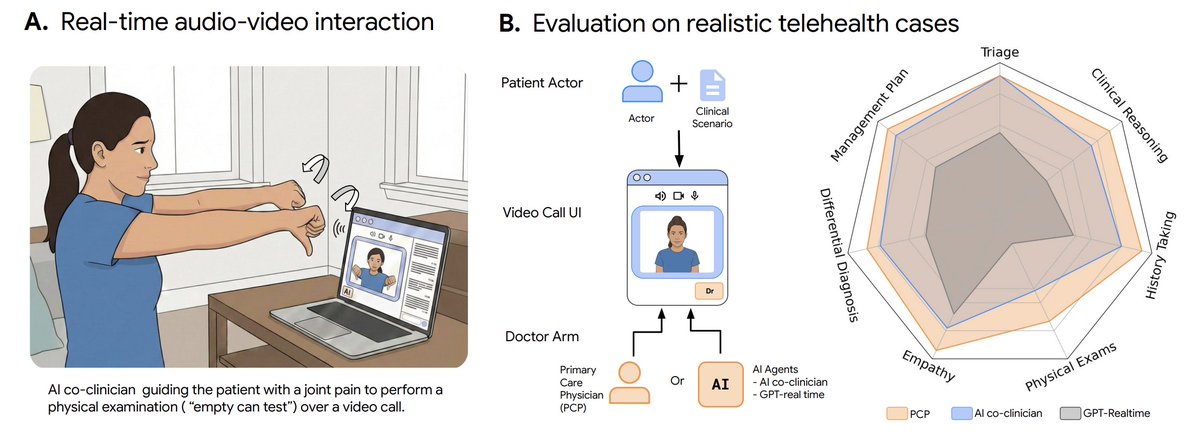
Clinical medicine depends on more than words; it relies on real-time visual cues (rashes, distress, gait), auditory signals (prosody, breathing), and guided physical exams (e.g., guiding someone through correcting their inhaler technique, or walking them through shoulder maneuvers to work up a rotator cuff injury).
But existing conversational medical AI systems are blind and deaf to this crucial information and are constrained to rigid, turn-by-turn user experience.
As an important ingredient in AI co-clinician, our new healthcare initiative at @GoogleDeepMind, we developed a first-of-its-kind real-time multimodal system that conducts natural clinical consultations over video calls while continuously watching, listening, and reasoning.
The preprint details the research progress we’ve made so far together with our collaborators at @StanfordMed and @harvardmed (@AdamRodmanMD@euanashley@DrJackOSullivan@jasongusdorf).
More details below!
Great to see the latest work from our @GoogleDeepMind collaboration see the light of day. AI co-clinicians now have eyes and ears and low latency interactive capabilities!
Blog: https://t.co/Ryx7npmt2C
Technical report: https://t.co/OhEiFBC4u2
Excited to release two new AI papers. First, we report what we believe to be the first truly multi-modal visual language model for cardiology. Second, we report surprising findings related to how visual language models reason.
https://t.co/BKS1Mo7JKX
https://t.co/H3YIyl01FR
A couple of months ago we shared our RCT showing LLMs can help manage complex cardiac patients by generating diagnosis and management plans from text: https://t.co/6eAOS2veUz
We found that all frontier vision-language models including GPT-5, Gemini 3 Pro, and Claude Opus 4.5 generate detailed image descriptions, elaborate reasoning traces, and even clinical diagnoses for images that were never provided. We call this phenomenon "mirage reasoning."
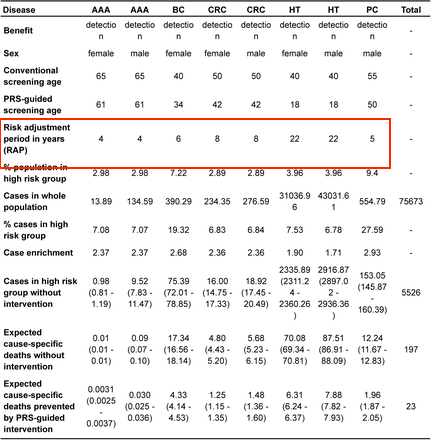
1/10 We’re excited to announce the publication of our work with @StanfordMed, examining the premature deaths that would be saved if PRS-guided screening was introduced across seven common disease screening programs
https://t.co/owphnP6wBw
It's that time of year again!
The Stanford Center for Inherited Cardiovascular Disease is raising funds for families with genetic heart disease with our annual fun run. I'll be there and I hope you will too! Sign up or donate here: https://t.co/g85msWiStr
Collectively across these 7 diseases:
Very high-risk individuals (OR>3) reach thhe same risk 10.8 years earlier.
High-risk individuals (OR>2) 8.9 years earlier
Reduced-risk individuals (OR<0.5) 16.8 years later
Perhaps time to rethink “one-size-fits-all” screening.
....USPTF recommends screening at 40, people at high PRS (OR>2) reach this same risk level 6 years earlier 🧐. See results for abdominal aortic aneurysm (AAA), Breast cancer (BC), colorectal cancer (CRC), hypertension (HT) and prostate cancer (PC) below.