This might be one of the easiest AI businesses to sell in 2027.
And Meta basically just published the blueprint for free.
Yesterday, Meta revealed its “organizational second brain.”
The idea is simple: take the knowledge sitting inside a company’s best employees and turn it into an AI system everyone else can use.
Meta says some expert work went from days to minutes.
Now forget Meta for a second.
There are millions of businesses where one or two people basically ARE the company’s knowledge base.
Real estate agencies. Accounting firms. Recruiters. Sales teams. Law firms. Customer support.
I wouldn’t sell them another AI chatbot.
I’d find the person everyone asks for help, capture how they make decisions, their cases, documents and processes, and turn that knowledge into an internal AI expert.
Then sell the implementation and charge monthly to maintain and improve it.
You don’t need 1,000 customers.
Pick one boring industry. Build it once. Learn exactly what that industry needs. Then sell versions of the same system again and again.
Everyone is trying to sell companies AI automation.
I think selling them their own intelligence might be the better business.
@MindTheGapMTG Exactly. Generation scales faster than attention. At some point, the real bottleneck isn’t creating more - it’s deciding what’s actually worth reviewing.
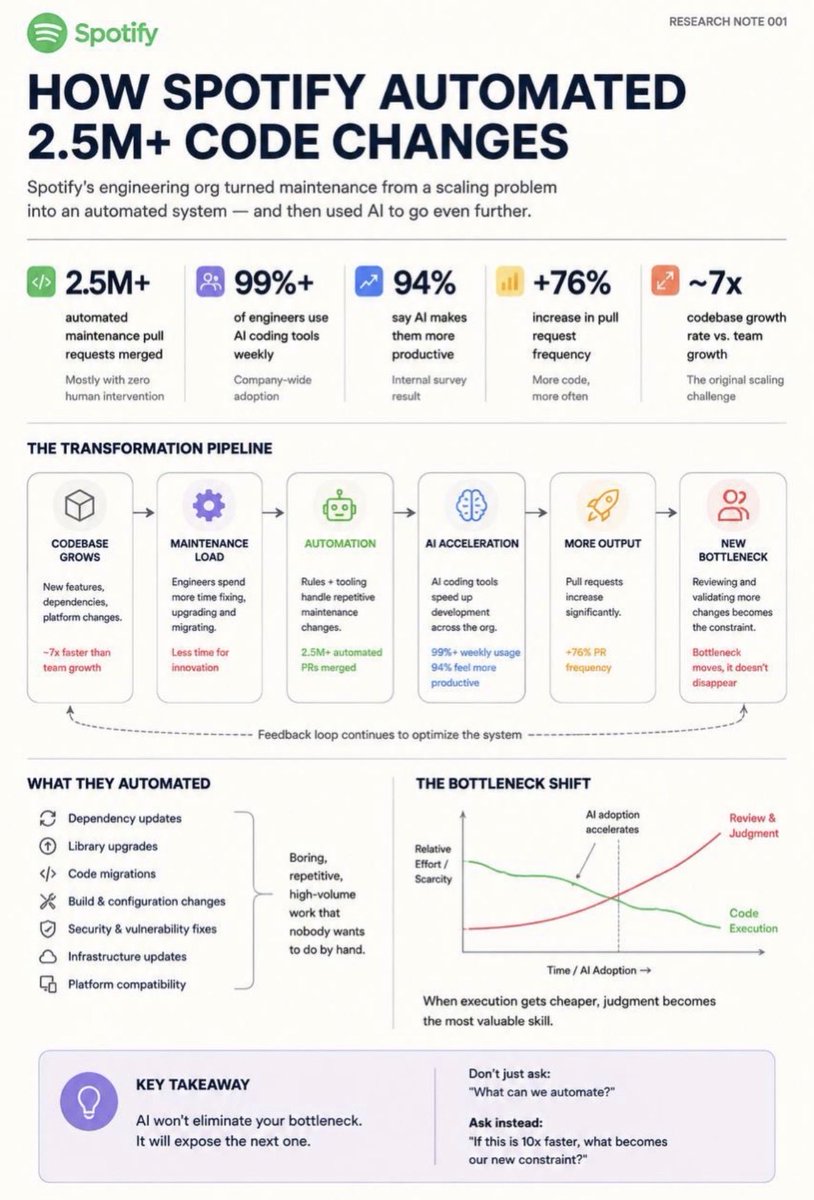
Spotify automated 2.5M+ code changes.
Instead of solving their bottleneck, they accidentally created a new one.
A few years ago, Spotify had a scaling problem.
Its codebase was growing roughly 7x faster than its engineering team.
More software meant more updates, migrations, dependencies and maintenance.
So Spotify started automating the boring work.
Over the years, its systems merged more than 2.5 million automated maintenance pull requests - the vast majority without human intervention.
Then AI accelerated everything again.
Today, 99%+ of Spotify engineers use AI coding tools weekly.
94% say they’re more productive.
And pull request frequency increased 76%.
Sounds perfect.
Except Spotify discovered something every company adopting AI should probably think about:
Bottlenecks don’t disappear. They move.
When AI makes writing code dramatically faster, someone still has to review it.
When building a prototype takes hours instead of weeks, someone still has to decide which prototype deserves to exist.
AI makes execution cheaper.
Which makes judgment more valuable.
There’s a useful question here for almost any business:
Don’t just ask:
“What can AI automate?”
Ask:
“If AI makes this 10x faster, what becomes the new bottleneck?”
That’s where I’d look next.
Anthropic cut Fable 5.1 cache costs by 75%. Most people are treating that as a pricing update. I think it’s something bigger.
The first generation of AI products was built around answers. You ask a question, the model responds, the interaction ends.
The next generation is built around agents. Agents don’t just answer. They keep working. They read the same documents, revisit the same context, call the same tools and loop through the same tasks hundreds of times.
That’s where costs start to matter. Not because intelligence is expensive. Because memory is.
The interesting part about Fable 5.1 isn’t that it scored higher on benchmarks. It’s that Anthropic is making long-running agents economically viable.
For years we measured AI in cost per token. Soon we may start measuring it in cost per autonomous hour of work.
And that changes what companies optimize for. Not smarter models. More useful hours.
AN AMERICAN ENGINEER BUILT "GROK DESK" WITH 12 AGENTS ACROSS 5 DESKS ON https://t.co/E1HMTIoGDx AND ONE HEAD OF DESK THAT FIRES ANYONE WHO UNDERPERFORMS. IT RAN FOR 96 HOURS WITHOUT HIM TOUCHING IT
$GROKDESK
repo: https://t.co/slfPM2guxX…
CA:5mxUjvrBhvaLrArfiQM6bPK8B52aXYpM6zBwrp34pump
Website https://t.co/lOJg7Xzql6
desk 1 · SCAN: two agents watching every new mint on https://t.co/U9iNSOjojx and every wallet with a track record of early entries. they never buy. their only output is a signal with a timestamp and a source
desk 2 · VERDICT: three agents scoring each signal. rugcheck pulls mint authority and freeze authority. wallet traces the first buyers for coordinated clusters. social checks if the chatter is real accounts or twenty wallets made that morning. one no from any of the three kills the signal. 94% of everything dies here
desk 3 · ENTRY: two agents. the first takes the position, sized against current exposure. the second manages exits across three tranches so no single trade holds the whole bag. neither one has ever seen a raw signal, they only see what verdict already cleared
desk 4 · RISK: one agent. hard caps exposure at 12% of the wallet per position and freezes new entries the moment total open risk crosses 40%. this desk overrides everyone including the head. it has, twice
desk 5 · LEDGER: two agents. one closes every trade and scores execution quality against what verdict predicted. the other tracks P&L, gas, and moves profit to cold storage every four hours. the score feeds back into verdict automatically, no prompt from him required
the head of desk is agent twelve. it does not trade. every ninety minutes it reads all five desks and makes one decision: whose prompt gets rewritten and who gets fired
it happened four times in 96 hours
at hour 22 a verdict agent kept clearing tokens with LP locked under 48 hours. three of those rugged inside a day. fired. the replacement runs a 72 hour threshold and hasn't cleared a rug since
at hour 41 the entry agent was splitting size too evenly across tranches, bleeding edge on the fast movers. fired. the replacement front-loads the first tranche and win rate on quick movers jumped 9 points
at hour 63 a scan agent's polling was too slow to catch graduations before they moved. fired. the replacement cut polling from 6 seconds to 2 and caught four graduations the old one would have missed entirely
at hour 84 risk flagged that exposure kept clustering in one narrative category no matter which tokens verdict cleared. fired the assumption, not the agent. the head added a category cap on top of the wallet cap
each replacement outperformed on the exact metric that got the last one fired. the desk was tuning itself
the 96 hour scoreboard
signals scanned: 61,000+
passed to verdict: 3,100
passed to entry: 197
positions taken: 38
wins: 24
losses: 14, total cost 1.3 sol
graduations: 5
net: 44.8 sol from 3.5 sol
the part he did not expect: by hour 70 verdict was killing tokens it would have approved at hour 10. it was not running his original prompt anymore. it was running a prompt the head had rewritten three times based on which of his original rules had actually cost money
he did not build a trading bot. he built a company with one employee: himself. at hour 96 the head sent a note that said "manual approval adds 3.8 seconds of latency per trade, estimated cost 0.9 sol over the sample period. recommend removing human gate"
that recommendation is still unapproved
@cloneismin Exactly. That’s the part I find most interesting. If output scales 10x but review and ownership only scale 2x, you haven’t removed the constraint - you’ve just moved it downstream. The companies that figure out that second layer may have the real advantage.
Imagine hiring an employee who forgets almost everything they learned about your company.
That’s basically how we use AI today.
Recently, an interesting experiment with AI agents showed what happens when you remove that limitation.
Several AI agents were doing different jobs, but they all shared the same memory.
One could learn something in the morning — and another could use that knowledge hours later without being briefed again.
Sounds like a small improvement.
But it solves a much bigger problem:
continuity.
Good employees become more valuable over time because they accumulate context.
They learn the customers.
Remember past decisions.
Know what worked and what failed.
Understand how the business actually operates.
AI usually has to rebuild much of that context again and again.
Shared memory changes this.
Imagine several AI agents working inside the same company for a year — researching, talking to customers, analyzing numbers — while everything useful they learn becomes shared knowledge.
Eventually, the question may stop being:
“Which AI model is the smartest?”
and become:
“How much does our AI already know about our business?”
Two companies may use the exact same model.
But if one has years of accumulated context, they’re no longer really using the same AI.
The model can be copied.
The experience can’t.
Hello @buidlpad, I need assistance:
I deposited USDC instead of USD-1 by mistake (~$2,000).
Already opened a ticket but no response yet.
Could someone please check?
Thank you!
🔥 Don’t miss your chance!
Up to 30% of the pool reserved for community creators.
✅ Make 5 posts
✅ Tag @MMTFinance + @buidlpad
✅ Add Ⓜ️Ⓜ️T to your name
✅ Join my squad: MPcCo6L453 / Iz19EW0sV3
Momentum isn’t just a project — it’s a movement.
#MMT#DeFi#crypto
💡 Some key facts about @MMTFinance:
• TVL > $550M
• $18B+ total volume
• 100% unlocked at launch
The next-gen #DeFi protocol on @buidlpad is live — don’t miss it 🚀
#Momentum#MMT#Sui Ⓜ️Ⓜ️T
📣 Content creators — your moment is here!
@MMTFinance & @buidlpad are rewarding those who spread the word about #Momentum.
Create 5 posts, tag both, add Ⓜ️Ⓜ️T to your name, and join my squad 👉
MPcCo6L453 / Iz19EW0sV3
Let’s build together 💪
#crypto#MMT#Buidlpad
What makes Momentum stand out?
⚙️ CLMM + ve(3,3) model = strong tokenomics
💧 Deep liquidity, fair incentives
🌐 Powered by #Sui — fast & scalable
Don’t miss the @buidlpad community sale — real DeFi innovation in action.
@MMTFinance@buidlpad#Momentum#MMT Ⓜ️Ⓜ️T
🚀 The DeFi space keeps evolving — and Momentum ($MMT) on @buidlpad is leading the next wave!
100% unlocked at TGE. Transparent. Fast. Built on #Sui.
💥 Join the movement & earn your place in the community pool (up to 30%).
@MMTFinance@buidlpad#Momentum#MMT#DeFi Ⓜ️Ⓜ️T
Entertainment is being rebuilt.
By players, creators, and AI.
Welcome to Astra Nova
The world's first AI Entertainment Ecosystem ✨
🔸 Built on intelligence
🔸 Powered by live products
🔸 Fueled by $RVV
💠 Explore Our Ecosystem:
🕹️ https://t.co/iFUwtcMMGb – Launch viral, monetizable Web3 games in minutes. No code. All AI.
🧬 ARPG – UE5 + AI NPCs in a playable sci-fi epic
📖 NovaToon – Interactive comics that evolve
🎯 BlackPass – SocialFi quests + loyalty rewards
⚔️ Deviants Fight Club – Telegram PvP casual game.
The era of passive entertainment is over.
Play. Build. Own the future.
🌐 Step Inside → https://t.co/4ZaVPINm4f
Build. Launch. Monetize. 🕹️
Turn your community into an arcade — in seconds. ⚡
No code. AI-powered.
Welcome to https://t.co/LZsqRU1Uo3
🚨 250K+ have already joined the waitlist — don’t miss your chance!
Loading
■■■■▢▢▢▢▢▢
Embark on your treasure quest with the Bybit web3 Airdrop Arcade🔥
Start collecting your $MNT & Fish Coins Rewards !
Are you a cat lover? Tap into exclusive catizen airdrops with just a click
Link: https://t.co/FUr7kAaCVc
📣 Catizens!
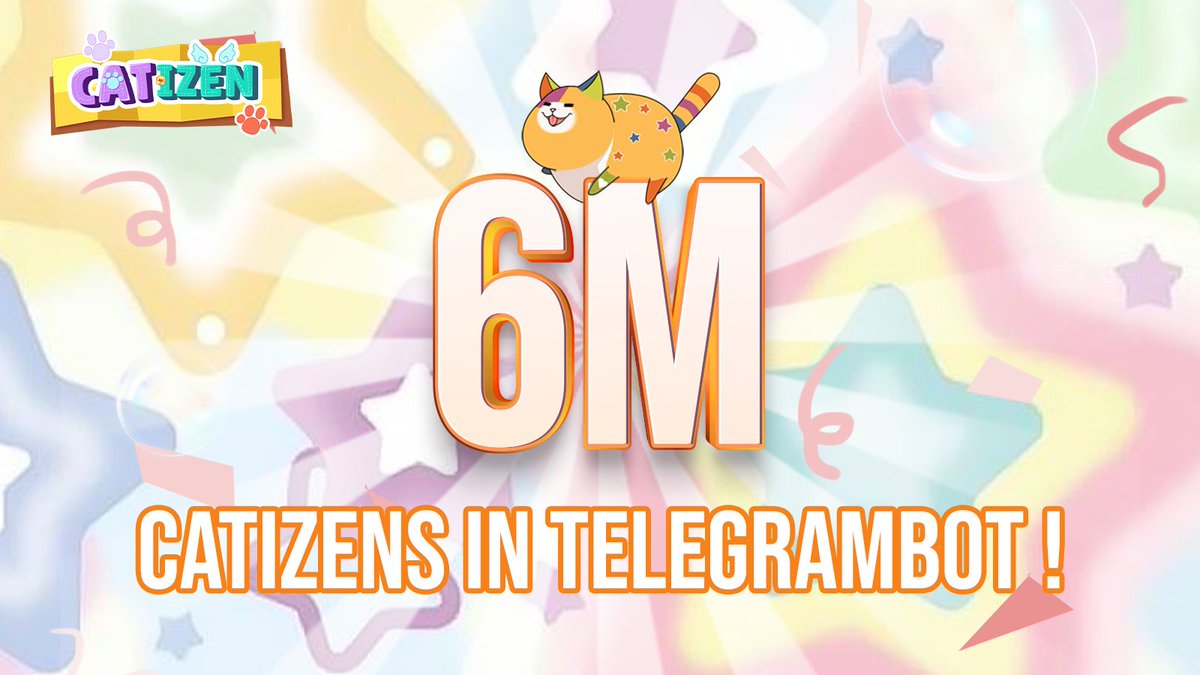
Catizen going online for 2 months and we have amassed 6M Catizens in Kittyverse!🌏
🔥Here are some data we'd like to share🔥
🐾 Total In-Game Catizens: 6M
🐾 Chain users: 610K
As the TON eco project has gained a lot of attention in this week, the Catizen family has also add many kitty fans!😼
😻In the TOL S2, Catizen is Top 1! This would not be possible without meow's support!
Thanks and love you all! And probably...👀
@ton_blockchain #0xMantle
✊ Countdown to Launch: DAO Maker Joins the Mission
We're thrilled to reveal that $PLENA is launching on @daomaker
Immerse yourself in the depth of DAO Maker's research & uncover what makes $PLENA a standout:
https://t.co/1vbbOSMxHO