A&E Dr, Hon Clin Prof football loving, nhs supporting dad to 5 brill kids.Once voted HSJ NHS wild card top 10 influencers - since failed to have any influence
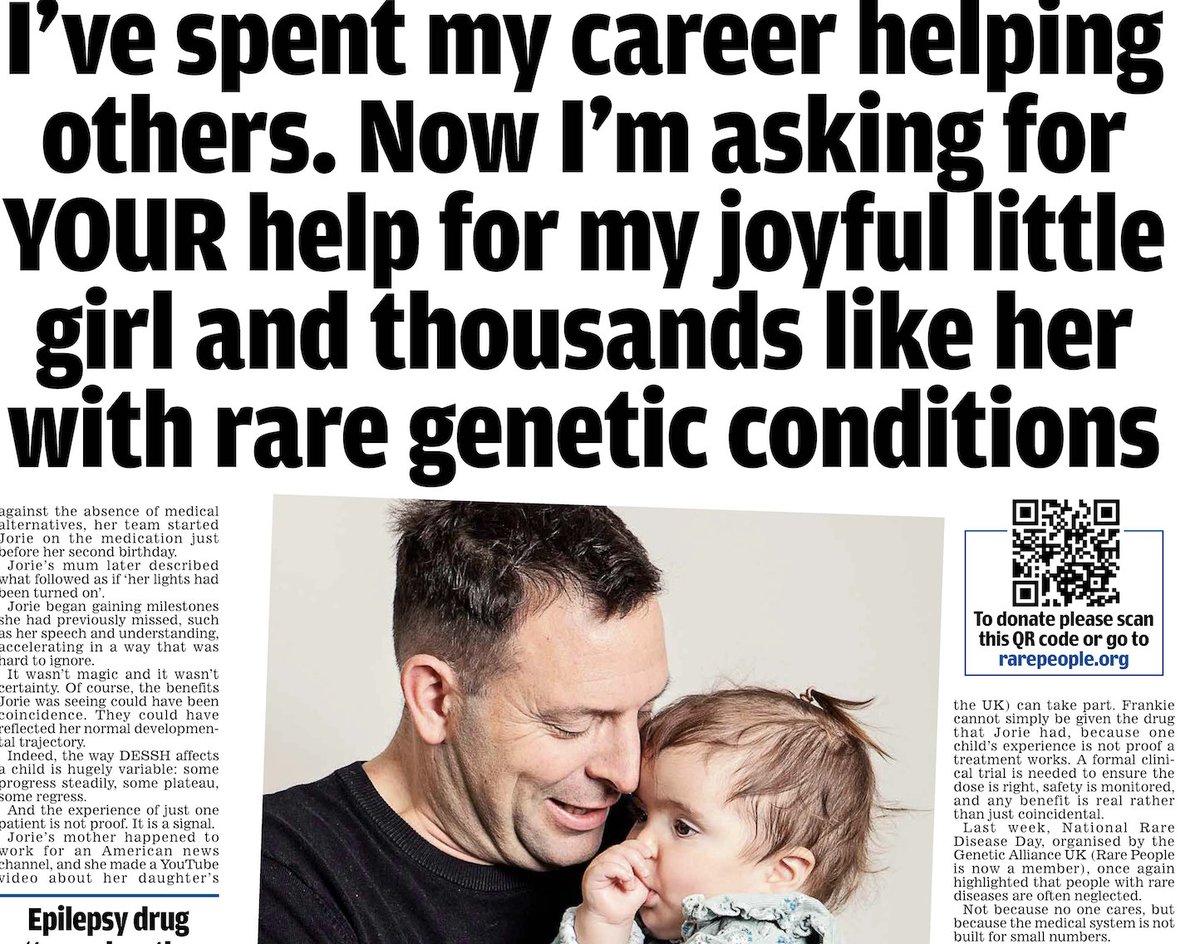
Can artificial intelligence help my daughter – and hundreds of thousands of other children with rare conditions? I truly hope it can. My article in this week’s Mail Health section explains how.
https://t.co/IaEsw1XhWz
It’s a long read (free to access), but the science is extraordinary and the hope it offers could be life-changing. Please do take the time to read it and share the story – and the work of the charity we have set up to turn science into hope: Rare People – The Research Charity.
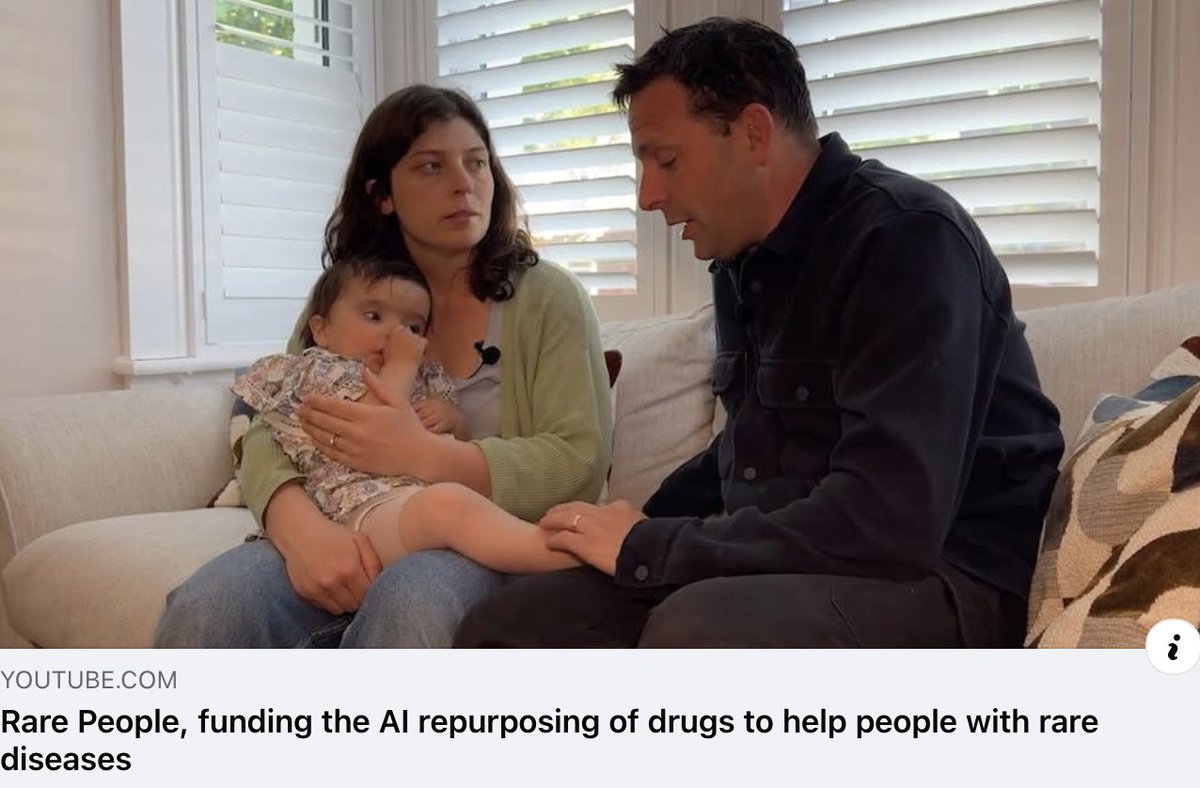
When our daughter was diagnosed with a rare genetic condition, we were told there was no treatment – only therapy and support. But over the past year I’ve discovered that medicine is changing beyond anything we could have imagined. With the help of AI and new ways of repurposing existing drugs, there is real hope that treatments for rare conditions could be found far more quickly than we once believed.
That’s why we founded Rare People – The Research Charity: to fund research that could make this hope a reality, but which currently receives little funding because there are no obvious pharmaceutical profits.
On Sunday we held our launch night, attended by more than 500 people. I’m incredibly grateful to everyone who helped make it happen. We heard from scientists from the United States, parents of children with rare conditions, and researchers hoping to lead the first UK trial.
We were also honoured to have the support of Brighton & Hove Albion, with Fabian Hürzeler speaking as a charity ambassador and Tony Bloom as one of our patrons.
So far we have raised £100,000 of the £250,000 needed to fund the first trial we will sponsor. After that, we hope to grow into a major research-funding charity giving hope to thousands of families.
If you would like to find out more, become a founding member, support us as a business partner, or take part in a sponsored event, please email [email protected] or visit:
https://t.co/D8dm55PMED
To donate please go to:
https://t.co/OYk11AquHD
Most medicine starts too late.
In my latest Daily Mail article, I explain longevity tests worth considering including ApoB, Lp(a)
Prevention matters.
Because the worst time to discover your risk is after the heart attack or stroke.
https://t.co/X8GP0SSFay
In this week's mail health I have examined a quiety emerging public health criss...iodine deficiency
Iodine deficiency used to be seen as something from the past. But as diets have changed - less cow’s milk, more plant-based alternatives, and low fish intake - it has quietly re-emerged in the UK.
And this matters far more than most people realise.
Iodine is needed to make thyroid hormones, which help control metabolism, growth and brain development. In pregnancy, a baby depends on these thyroid hormones for brain development. Too little iodine has been linked with lower verbal IQ and poorer reading scores in children.
Yet NHS Healthy Start pregnancy vitamins still do not contain iodine.
This is madness.
It means the women most likely to need support may assume they are taking everything they need for their baby - when they are not.
The problem is not just pregnancy. Many people have swapped cow’s milk for oat, almond or soya milk. There is nothing wrong with that choice, but while cow’s milk is a good source of iodine, many plant-based alternatives are not fortified. Over time, that can matter.
Long-standing iodine deficiency can make the thyroid work harder. This can lead to thyroid enlargement, nodules and, especially in older people, an overactive thyroid - increasing the risk of atrial fibrillation, heart failure, stroke, osteoporosis, muscle wasting and falls.
But the answer is not panic-buying iodine tablets or drinking seaweed “thyroid detox” drinks promoted online. Too much iodine can also be harmful. The thyroid is a Goldilocks organ - too little is a problem, too much is a problem.
This should not depend on whether someone is wealthy enough, informed enough or lucky enough to buy the right supplement.
My latest Mail Online column argues that Britain needs a proper iodine strategy - including NHS pregnancy vitamins that contain iodine, iodine-fortified plant milks, and a serious discussion about iodised salt.
We are spending billions on artificial intelligence while failing to protect natural intelligence with one of the cheapest public health measures available.
https://t.co/R2qvYve4PW
hank you to Angie and the brilliant team at Brighton's Latest TV for covering Rare People and for choosing us as a charity partner. @LatestTVBtn
Rare genetic diseases are often described as rare, but collectively we are many. And for too many families, a diagnosis is not the start of a treatment plan, it is the start of being told there is no plan at all. We want to fund proper research and clinical trials into rare neurodevelopmental genetic conditions, including the testing of promising existing drugs that may never be investigated because there is no commercial incentive to do so.
Latest TV gave us the time to explain this properly and we are incredibly grateful to Angie and her team for helping us get that message out.
Please get involved! share, donate, support, do a sponsored event , business partner with us, or simply help us tell the story.
Website: https://t.co/D8dm55PMED
Email: [email protected]
https://t.co/Q1YZXO065m
I’ve recently been part of the team which has published a paper in the British Journal of Hospital Medicine on human factors, deterioration and escalation of care.
It looks at why escalation sometimes fails, and what we can do to make it work more reliably in real clinical environments.
It is open access, free to read, and may be worth a read for anyone working in patient safety, acute care or clinical leadership.
I also run human factors courses at University Hospitals Sussex.
If you work at UHSussex and are interested in attending, please book via IRIS.
If you are external to the Trust, places can be booked via Eventbrite.
If you are interested in me running a course at your hospital, please contact me: [email protected]
https://t.co/pOOWotBGL9
In this week’s Daily Mail health section, free to read, I wrote about a headline from a recent paper that sounds genuinely alarming: fish oil/omega-3 supplements are linked with dementia?
But I'm going still be taking a daily tablet. Here's why; the study that triggered the concern was observational. That means it can show an association, but it cannot prove cause and effect. And that matters.
For years, coffee looked bad for us in some studies because coffee drinkers were more likely to smoke. It was not necessarily the caffeine killing them. It was the cigarettes.
The same has probably happened with claims that small amounts of alcohol are healthy. People who drink a little are often healthier, wealthier and more socially connected than people who do not drink at all. That does not mean alcohol is the thing making them healthy.
With this fish oils study there is a problem called reverse causality. People who are worried about their memory, have a family history of dementia, or feel they are starting to decline and more likely to be at higher risk of dementia and may be more likely to take omega-3 supplements. The supplement then gets blamed for the dementia risk, when in reality the risk may have been the reason they started taking it.
What we really need are randomised controlled trials. These are rare and difficult in nutrition, but they are much more reliable.
The best available evidence does not suggest fish oils are dangerous for the brain. If anything, the signal is that they may be slightly beneficial for some cognitive outcomes, and they also have potential benefits for triglycerides, inflammation, cardiovascular health and mood.
So my conclusion is simple.
If you eat oily fish regularly, you may not need supplements.
But if, like me, you hardly eat fish at all, I would still take omega-3.
Not because it is a miracle. It isn’t and it won’t undo a bad lifestyle. But the evidence at the moment shows, I believe, that the benefits outweigh the risks with minimal costs to buy the tablets
But if large, well-conducted randomised trials eventually show omega-3 supplements genuinely accelerate dementia or cause significant harm, I will stop taking them myself.
That is what medicine should be: not blind loyalty to a specific belief or supplement – and not panic about headlines – but following the evidence as it evolves.
https://t.co/PS9yXfuwE2
In this week’s (free to read) Daily Mail health section, I’ve written about why AI in medicine should not terrify us. It should excite us.
I understand why people are scared of AI. Every few days there is another headline warning us it will take our jobs, destroy creativity or ruin society.
But medicine is where AI could do something genuinely extraordinary. In the article I look at how AI is already helping detect strokes more quickly, how it can spot things on scans that might otherwise be missed, and how it has even been used to analyse huge numbers of Reddit posts about weight-loss jabs, picking up side effects that may not have been obvious through traditional systems.
The same principle could be used in rare conditions, by analysing social media interactions and conversations between families, to understand the typical features of diseases that are so rare they are often barely described in medical textbooks.
For my daughter Frankie, who has a very rare condition called DeSanto-Shinawi syndrome, that is so, so important. Because when a condition is that rare, parents often know things that the medical literature has not yet caught up with. AI could help gather those fragments of lived experience and turn them into knowledge that helps children like her.
And it could go further. AI may also help identify existing drugs that could be repurposed for rare conditions. Drugs that are already available, already understood, and might just have an effect on conditions that have never had enough research, funding or attention. That is one of the ideas behind Rare People - The Research Charity, which we set up to help fund proper research into rare conditions and turn promising ideas into clinical trials.
That is the point. AI is not just about robots and gimmicks. It is about finding patterns in huge amounts of messy, real-world information that no human being could possibly process alone.
Not replace doctors. Not replace nurses. Not replace the human bit of healthcare, which is often the most important bit.But help us.
Help spot subtle fractures on X-rays. Help detect tiny bleeds on CT scans. Help interpret complicated pathology slides. Help make sense of blood tests, symptoms, scans and risk in a way that is relevant to the patient sitting in front of us.
And, just as importantly, help us find the rare things. The diagnoses that are missed because no human being can hold every possibility in their head at once.
When the car was invented, people feared it would mean the end of horses. It didn’t. If anything, it liberated them from some of the worst work humans had forced them to do.
I think AI may do something similar in healthcare.
It should not be used for nonsense. It should not be a gimmick. It should be used where it actually helps patients.
Used properly, AI could mean faster diagnoses, safer care, fewer missed findings, better use of NHS resources and more time for the human conversations patients actually need.
We can be frightened of AI, or we can shape it.
In medicine, I think we need to embrace it - carefully, ethically and intelligently - because the opportunity to improve health is too big to ignore.
Free to read here:
https://t.co/73SvTLYcXG
Thank you to Public Sector Focus for covering Rare People - The Research Charity.
The article explains why rare conditions too often leave families carrying the burden alone, with little research, no clear treatment pathway and not enough urgency from the wider system. It also sets out why Rare People was created: to fund ethical, patient-focused research into rare neurodevelopmental genetic conditions, support AI-led drug repurposing, and help turn promising science into proper clinical trials.
For families like ours, and for children like Frankie, this really matters.
https://t.co/D8dm55PMED
Thank you to Public Sector Focus for covering Rare People - The Research Charity.
The article explains why rare conditions too often leave families carrying the burden alone, with little research, no clear treatment pathway and not enough urgency from the wider system. It also sets out why Rare People was created: to fund ethical, patient-focused research into rare neurodevelopmental genetic conditions, support AI-led drug repurposing, and help turn promising science into proper clinical trials.
For families like ours, and for children like Frankie, this really matters.
https://t.co/D8dm55PMED
In this week’s (free to read) Daily Mail health section, I’ve written about why AI in medicine should not terrify us. It should excite us.
I understand why people are scared of AI. Every few days there is another headline warning us it will take our jobs, destroy creativity or ruin society.
But medicine is where AI could do something genuinely extraordinary. In the article I look at how AI is already helping detect strokes more quickly, how it can spot things on scans that might otherwise be missed, and how it has even been used to analyse huge numbers of Reddit posts about weight-loss jabs, picking up side effects that may not have been obvious through traditional systems.
The same principle could be used in rare conditions, by analysing social media interactions and conversations between families, to understand the typical features of diseases that are so rare they are often barely described in medical textbooks.
For my daughter Frankie, who has a very rare condition called DeSanto-Shinawi syndrome, that is so, so important. Because when a condition is that rare, parents often know things that the medical literature has not yet caught up with. AI could help gather those fragments of lived experience and turn them into knowledge that helps children like her.
And it could go further. AI may also help identify existing drugs that could be repurposed for rare conditions. Drugs that are already available, already understood, and might just have an effect on conditions that have never had enough research, funding or attention. That is one of the ideas behind Rare People - The Research Charity, which we set up to help fund proper research into rare conditions and turn promising ideas into clinical trials.
That is the point. AI is not just about robots and gimmicks. It is about finding patterns in huge amounts of messy, real-world information that no human being could possibly process alone.
Not replace doctors. Not replace nurses. Not replace the human bit of healthcare, which is often the most important bit.But help us.
Help spot subtle fractures on X-rays. Help detect tiny bleeds on CT scans. Help interpret complicated pathology slides. Help make sense of blood tests, symptoms, scans and risk in a way that is relevant to the patient sitting in front of us.
And, just as importantly, help us find the rare things. The diagnoses that are missed because no human being can hold every possibility in their head at once.
When the car was invented, people feared it would mean the end of horses. It didn’t. If anything, it liberated them from some of the worst work humans had forced them to do.
I think AI may do something similar in healthcare.
It should not be used for nonsense. It should not be a gimmick. It should be used where it actually helps patients.
Used properly, AI could mean faster diagnoses, safer care, fewer missed findings, better use of NHS resources and more time for the human conversations patients actually need.
We can be frightened of AI, or we can shape it.
In medicine, I think we need to embrace it - carefully, ethically and intelligently - because the opportunity to improve health is too big to ignore.
Free to read here:
https://t.co/73SvTLYcXG
A warm welcome to @StockportNHS 🥰who join our HealthRota community!
Thank you to the team for choosing @healthrota to support medical workforce rostering and job planning. We’re looking forward to working with teams across @NHSStockportCCG , including colleagues at @SteppingHill
Three months ago we announced our new integration with @healthrota.
💬 If it’s made a difference to how you operate in your ED, we’d love to hear your story!
Get in touch via our website:
👉 https://t.co/SUtufHilhk
So grateful for ITV news covering the story of www.Rare People - the Research Charity.
https://t.co/QQ12SZLnrR has now raised over 130K and ready to fiund our first of many trials
For years, doctors dismissed multivitamins as pointless. I was taught they were little more than expensive urine. But the evidence has shifted, and I think we need to be honest about that.
A major study, followed by further analyses, suggests a daily multivitamin may help slow cognitive decline and even modestly slow biological ageing. Not reverse ageing. Not transform your health overnight. But slow the decline, and that matters.
The most likely reason is not magic. It is probably that small nutritional deficiencies, the sort we do not routinely measure or even recognise, may quietly affect cell repair, inflammation, brain health and ageing over many years.
That is why I have changed my mind. For something cheap, low risk and widely available, I now think taking a daily multivitamin is a sensible decision.
The bigger message is this: medicine has probably underestimated the importance of nutrition for far too long. We have focused on drugs, surgery and genetics, while often overlooking the possibility that small deficiencies building up over time may play a bigger part in how we age than we wanted to admit.
https://t.co/BLwwOYEfLG
Brighton Marathon Weekend will always have a special place in my heart having led the Medical team for so many years and being so passionate about mass participation running events.
But having stepped back from this role, I was excited to run this years marathon pushing Frankie the last few kilometres to raise money for the new charity, we set up Rare People - the Research Charity
But because of the resident Doctors strike I'm now unable to run as I'm helping covering the royal Sussex County Hospital A&E
For Those for those who already sponsored me, I hope you don't mind that I have just postponed the race for a year. If anyone else would like to sponsor a year in advance then please go to just giving Page!
But also a big thank you to the Brighton marathon Team to give me and Frankie the chance to run and me to push her
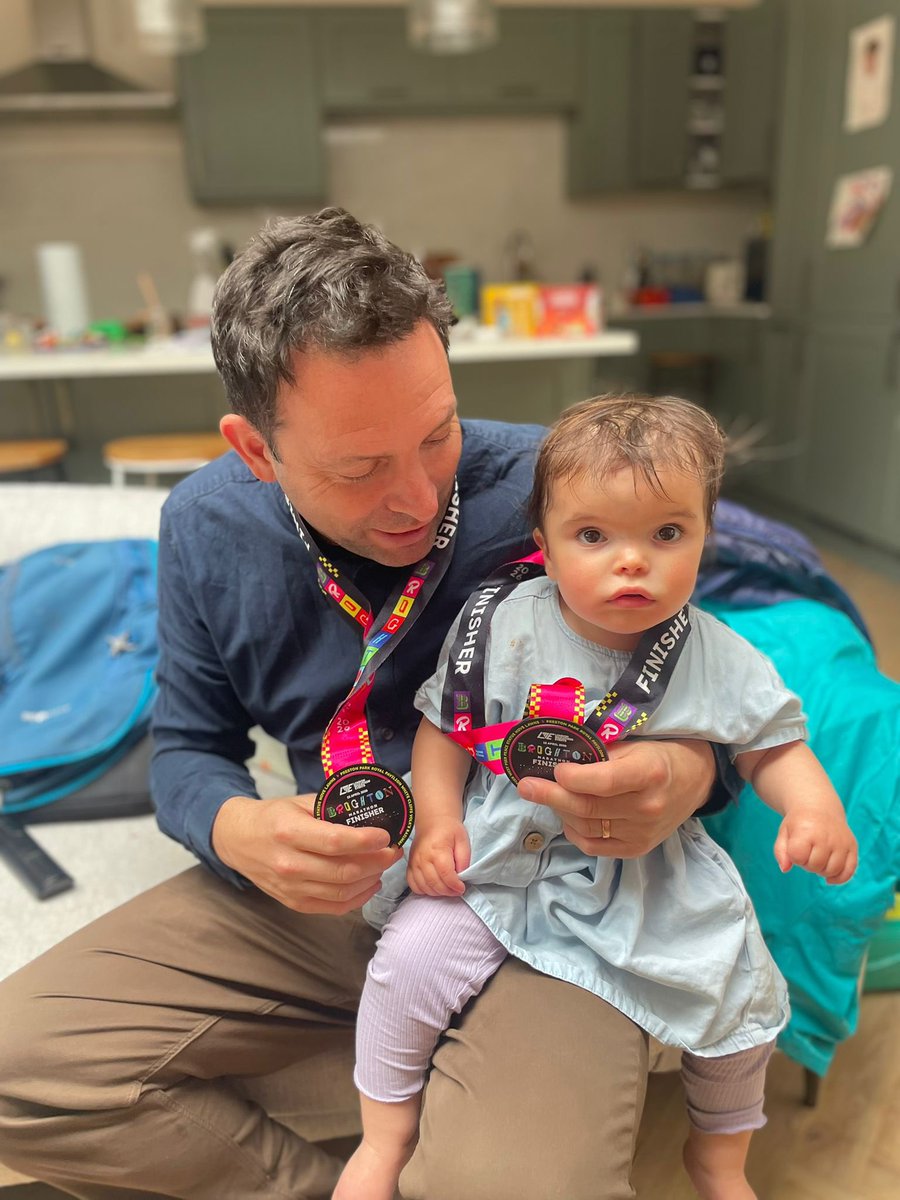
But as we can't this year, they have given us medals we would've got if we had run it (to be fair most shifts in A&E feel like a marathon and you deserve a medal for getting to the end anyway!)
Again thanks to Brighton marathon arranging this We will be running it next year though, but as a Family instead
Laura, tom, Katie and me pushing frankie for the last few kms........I just haven't told them yet till they read this posts
https://t.co/rxnZ0lgHKG
There are around 7,000 rare genetic conditions. For the vast majority, there are no treatments. Not because they are untreatable, but because traditional drug development simply isn’t viable - @DrRobgalloway writes for the MJA:
https://t.co/UGCQSyCZeV
The NHS is built on cost-effective care. Patients care about clinically effective care.
The NHS rations costs effective care based on cost – because it must do the most with what it has. But for the individual that does not always mean they get the best care if following NHS guidance.
Its rational for example for the NHS to not pay for Meningitis B vaccine for teenagers who missed it as babies because in this group its not cost effective.
But its also rational for individuals who can afford it to get it because its clinically effective and the benefits outweigh the risks
I’ve written about this in this week’s Daily Mail Good Health section, because it’s something we don’t explain nearly well enough.
A few years ago, near the end of a shift in A&E, I saw a teenager with a fever, headache and vomiting. On paper, it looked like a virus. But there was something about him that didn’t sit right. Not confused, not obviously unwell, just not quite himself. An hour later he developed a rash. Shortly after that he was critically ill with meningitis B.
He survived. But he lost his leg.
We already have a vaccine that could have prevented it. He hadn’t had it. Not because it doesn’t work, but because the NHS doesn’t offer it to his age group. It isn’t considered cost-effective.
That’s how the system works.
In the UK, decisions about what the NHS funds are largely made by NICE. First, they ask the obvious question: does a treatment work and is it safe? But then comes the harder one: is it worth it? To answer that, they use something called a QALY, which essentially puts a value on a year of healthy life. If a treatment costs more than about £30,000 for one year of good health, it often isn’t funded.
On one level, that’s entirely reasonable. The NHS doesn’t have unlimited money, and without these decisions the system wouldn’t function. But it becomes far more uncomfortable when you’re sitting in front of a patient.
Because as a doctor, I’m not thinking about population-level cost. I’m thinking about the person in front of me. Will this help them? Will it reduce their risk? Will it change their future?
That’s the gap we don’t talk about enough.
Most of the time, cost-effective and clinically effective overlap. But sometimes they don’t, and when they don’t, the consequences can be life-changing.
Meningitis B is rare in teenagers, which is why the vaccine isn’t routinely offered. But when it happens, it can be catastrophic, causing death, brain injury, or amputations. Treating a single severe case can cost hundreds of thousands of pounds. Suddenly the neat economics don’t feel quite so neat.
We see this same tension across medicine. Cancer drugs that clearly extend life but aren’t funded. Weight loss injections that work but are tightly restricted. Vaccines that prevent illness but are only offered to certain groups because that’s where they’re considered “worth it”.
Take shingles. The NHS offers the vaccine from 65 because that’s where it’s most cost-effective. But the vaccine works earlier, and shingles can be a miserable illness with long-term complications. There’s even emerging evidence it may reduce dementia risk. So I’ll be getting it at 50 and paying for it.
I’ve made similar decisions for my own family, including paying privately for vaccines. Not because the NHS is wrong, but because the calculation changes when it’s personal.
And something is shifting. More people are starting to understand this difference. Pharmacies are seeing growing demand for vaccines and treatments that aren’t routinely available on the NHS. People are taking health decisions into their own hands, trying to reduce their individual risk in ways the system simply can’t fund at scale.
None of this means the NHS is broken. It means it’s doing exactly what it was designed to do. Make difficult decisions with limited resources.
But we need to be honest about what those decisions mean.
When something is labelled “not cost-effective”, it doesn’t mean it doesn’t work. It means the system has decided it isn’t worth the price.
The real question is what you would do with that information.
If something reduces your risk of serious illness or death, but the NHS won’t fund it, would you pay for it yourself?
I’ve set out the vaccines I would consider paying for, and why, in this week’s Daily Mail but it goes further than this – for example various screening tests which are clinically effective but not cost effective.
Much of preventative health care ,including getting a vaccination, is like taking out an insurance policy. It often won’t be needed and the cost we are prepared to pay, reflects not just our ability to pat, but our own acceptance of risk.
If we can start asking ourselves about clinical effectiveness of healthcare and not just accept the NHS’s cost effectiveness decisions, then it will help each and every one of us make better decisions about our health.
https://t.co/hArtDWUFet
.@DrRobgalloway, Honorary Professor at BSMS & Consultant in A&E founded Rare People – The Research Charity. Inspired by his daughter Frankie who was diagnosed with DeSanto-Shinawi syndrome, it aims to fund clinical trials & research into rare diseases.
🔗https://t.co/hoDtFvLhXG