The data from O4c, the third part of the fourth observing run, is being analyzed and it will provide another opportunity either to detect a sub-solar-mass merger or to place even tighter constraints on these populations. Stay tuned!
Image credit: ESAHubble, N. Bartmann
In a paper published on ArXiv by the LIGO-Virgo-KAGRA Collaboration, researchers analyzed data from the second part of the fourth observing run (O4b) looking for mergers of objects less massive than our Sun, such as primordial black holes and dissipative dark matter black holes.
🔎🕳️ No signals coming from these events were found, and this allowed us to put the most stringent constraints to date on their rate, as well as the fraction of dark matter that can be explained by certain dark matter models.
I am committed to further developing EGO as the leading European laboratory for gravitational waves, working alongside the scientific community, funding agencies and international partners.”
Gianluca Gemme, a senior research scientist at @INFN_ Genova, is set to become the next director of the European Gravitational Observatory (EGO) from January 1st 2027. Gemme will succeed Massimo Carpinelli, a professor at @unimib and director of EGO since 2023.
“I would like to thank the EGO Council for the trust they have placed in me,” said the designated director Gianluca Gemme “I accept this role with a great sense of responsibility, at a decisive stage for Virgo’s future and, looking ahead, for the preparation of Einstein Telescope
and, of course, the network of the world’s largest telescopes, will succeed in revealing unexpected aspects of the most mysterious and extreme cosmic phenomena that we continue to investigate.”
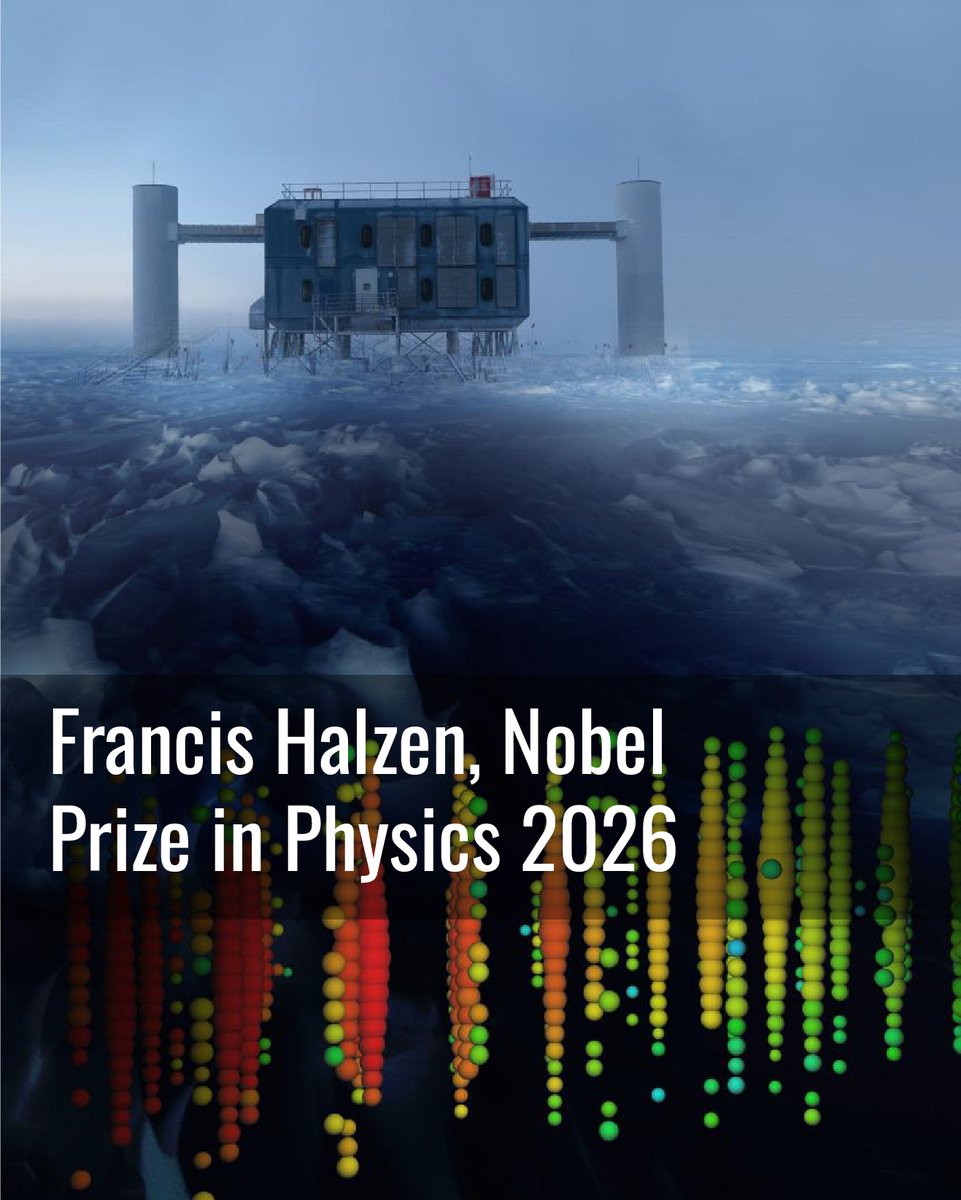
Congratulations to Francis Halzen, who was awarded the Nobel Prize in Physics for decisive contributions to @uw_icecube and the discovery of high-energy neutrinos of astrophysical origin 🧊
such as those of the LIGO and Virgo detectors, and the discovery of gravitational waves. We certainly expect that, in the near future, joint observations by gravitational wave detectors and neutrino observatories – such as IceCube in Antarctica and Km3Net in the Mediterranean –
Pictured from left to right: Harris Liu, Peter Couvares (LIGO Lab), Franco Carbognani (EGO/Virgo), Laura Cadonati (Georgia Institute of Technology/LIGO), Subir Sarkar (University of Oxford), Fukun Liu (Peking University)
EGO’s technical deputy director, Franco Carbognani, accepted the Frontiers of Science Award in Physics on behalf of the Virgo Collaboration, during the International Congress of Basic Science in Beijing, China.
Exactly nine years ago LIGO and Virgo detected a signal that would change astronomy forever: their first ever neutron star merger, GW170817 💥
Why was this observation so revolutionary? 🧐
Multi-messenger astronomy with gravitational waves was born! ✨
In addition to its scientific relevance, this event was also an impressive example of global collaboration: the paper describing the observations is coauthored by almost 4,000 scientists from over 900 institutions 🌍