ENS tutorial:
Owning ENS names vs setting a Primary Name
You can own a bunch of ENS names:
yourname.eth
brand.eth
project.eth
payments.project.eth
And all of them can point to the same holding wallet.
That means each name can resolve to the same address.
name → wallet
But that does not mean your wallet has a main ENS identity yet.
Your wallet also needs a Primary Name / Name Record.
That is the reverse side:
wallet → chosen name
So if you own 10 ENS names and they all point to the same wallet, apps still need to know which one to display.
With a Primary Name set:
0x wallet → yourname.eth
Apps can show:
yourname.eth
Without a Primary Name set:
Apps may just show:
0x8f3...91c2
Even if that wallet owns a bunch of ENS names.
Simple way to think about it:
Address records tell names where to go.
Primary Name tells the wallet what name to wear.
Owning names proves you control the names.
Setting a Primary Name gives the wallet its readable identity.
That is the loop:
yourname.eth → wallet
wallet → yourname.eth
That loop is what makes ENS more than a username.
It becomes an onchain identity system.
#ENS #Ethereum #Web3
Your ENS name still resolves in every major web3 wallet, plus PayPal, Venmo, and GoDaddy....
You can still import your own DNS domain.
It still can't be taken from you.
It's still permissionless for anyone to build on.🤝
@DoggieWish@ensdomains Who is deeming ENS a failure?
ENS is easily one of crypto’s clearest infrastructure success stories: real product market fit, broad wallet, dApp, and exchange integrations, recurring protocol revenue, and a self sustaining DAO treasury that funds ecosystem public goods.
@rocketinspirit@ensviewxyz That’s the point. Carrying costs are one of the only protocol level tools that push scarce names back into circulation instead of letting them sit parked forever in giant portfolios. This is basic namespace management.
@ensviewxyz Truly scarce namespaces can’t be both universally affordable and resistant to immediate capture. If you underprice 3 and 4 character names, they don’t magically become accessible to normal users. They get vacuumed up faster and flipped harder.
Who's gonna tell him?
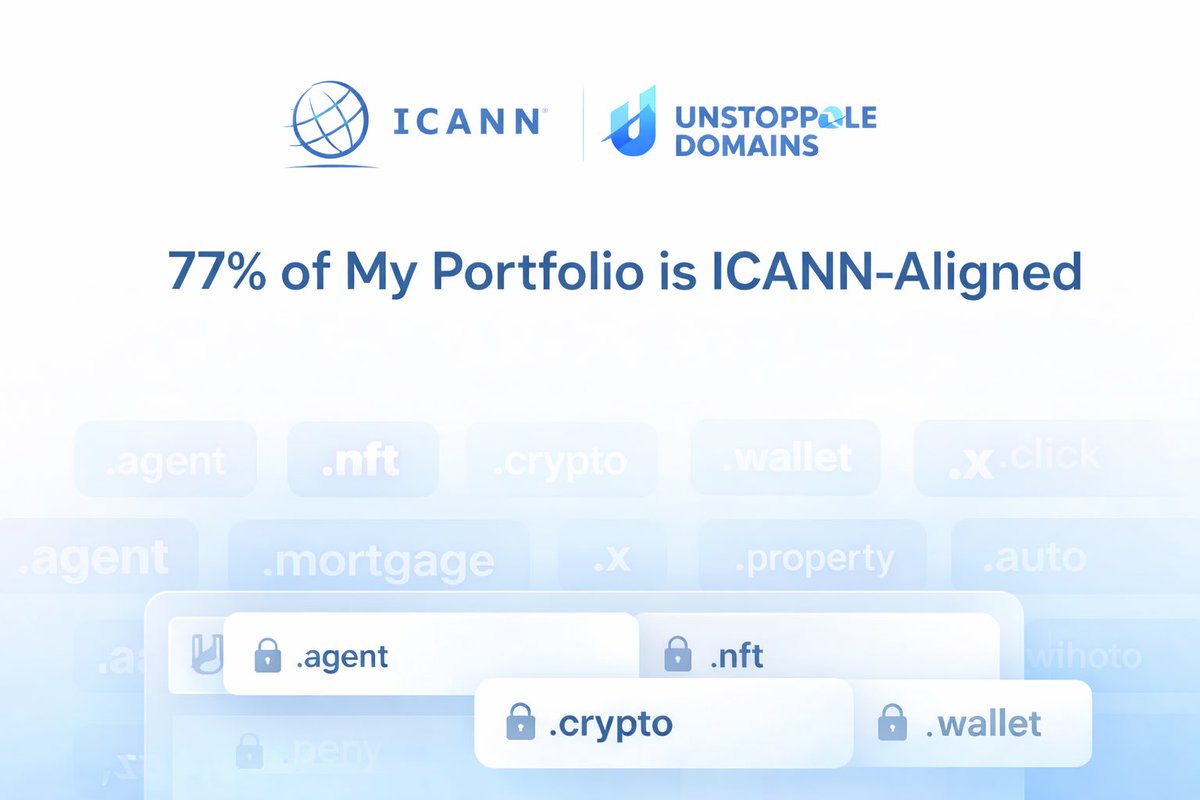
77% ICANN-aligned sounds great until you realize what ICANN alignment actually requires.
The application window opens April 30. Here's what's waiting:
$227k evaluation fee per string, due within 7 days of filing.
Out of 692 domains I picked up in 8 months, 533 are ICANN-aligned, that’s about 77%.
Guess I got a bit lucky coming into the space later than most.
How much of your portfolio is ICANN aligned?
#icann#domains#udfam#web3
Contention rounds if multiple parties want the same string. Years of contracting and delegation delays after all that.
The 2012 round had 1000's of applicants. Many took 3+ years. Many failed outright. Web3 strings get extra scrutiny on security and decentralization grounds.
Worth reiterating the main point.
ENS is core infrastructure that extends the global namespace and already works across wallets, dApps, exchanges, browsers, and DNS.
The tracks are already laid. The stations are already operating.
Come build on ENS. 🤝
New blockchain naming systems launch .whatever extensions faster than anyone can track.
.crypto
.wallet
.agent
.nft
Minting strings is easy.
Building naming infrastructure that works across wallets, dApps, exchanges, and the web is the hard part.
That distinction matters.
https://t.co/aL003o2Qrc
ENSIP-25 introduces a standardized way to verify that an AI agent registered onchain is genuinely associated with an ENS name.
As autonomous agents begin signing transactions, holding assets, and interacting with protocols, verifiable identity becomes essential infrastructure.
Launching a new .whatever namespace is easy. Building naming infrastructure that works across wallets, apps, exchanges, and the web is much harder.
Why ENS chose to extend the existing internet namespace instead of inventing new roots ⤵️
https://t.co/Kl3BHxQR8G