POV: Trying out the rare 1920s Alofs shotgun magazine! ⚡ This ingenious device was a game-changer, turning a simple single-shot shotgun into a fast-cycling repeater. It’s not just a shotgun; it’s a brilliant piece of mechanical history that shows how shooters used to upgrade their gear back in the day. ⚙️
What do you think of this mechanical add-on? Would you trust it in the field? Let me know in the comments! 👇
the creator deserves full credit for such awesome videos: https://t.co/dmxGAxBhL0
Gorsuch misses the harder point: America’s constitutional creed was not designed to float above culture. It was built by an individualist people and assumed citizens capable of living under common, impersonal rules. It did not anticipate a demographic shift toward a majority of permanent competing collectivist ethnos blocs treating politics as group bargaining.
America’s creed was built narrowly by and for a people in line with individual rights, impersonal rules, local self-government, property and restraint after losing political fights. The founders assumed a citizenry capable of thinking of itself primarily as individuals under common law, not as permanent multi-ethnic blocs each competing for group ethnos advantage.
Sure, the founders understood faction. But ordinary factions in a constitutional republic are not the same as permanent, self-enforcing multiple ethnos blocs treating the state as a prize system for in-group benefit.
A creed is a rule set, not a magic essence. It governs power only when enough people, especially ruling coalitions, treat its limits as binding even when inconvenient. The Declaration, Constitution, slogans, holidays, and institutional names can all remain while the real operating system changes underneath.
So, the question is whether the creed still limits what winners do.
Large-scale immigration and demographic change matter because they alter the political habits inside the system. If the historically individualist majority thins into a minority, and if many incoming populations retain stronger kinship, patronage, religious, ethnic, or group-centered political instincts, then the center of gravity shifts from individual rights toward organized bloc bargaining.
The issue here is political habit and coordination, and that is where game theory matters. In this system, organized ethnos blocs have built-in advantages over diffuse individualism. A thick in-group has dense social networks, identity discipline, internal enforcement, moral boundaries, and reputational pressure. It can coordinate turnout, money, messaging, institutional pressure, and social sanctions.
The organized ethnos blocs can bargain hard because they can coordinate hard.
A rights-based individualist population is weaker in that environment. It is fragmented, cross-pressured, harder to discipline, and harder to mobilize at scale. It may share broad preferences in the abstract, but cannot act as one player. So it gets outorganized and outplayed.
Public choice intensifies the shift. Each bloc seeks concentrated benefits for itself while spreading costs across everyone else. Over time, the state adapts. It distributes access, exemptions, carve-outs, regulatory favors, staffing, selective enforcement, and moral legitimacy through organized groups.
If you do not show up as a bloc, you do not get a seat.
That is the deeper danger. The individualist citizens either loses influence or reorganizes into a counter-bloc. But once everyone has to become a bloc to survive politically, the creedal premise has already eroded.
The founders did not design the constitutional order as a neutral arena for permanent ethnos competition over state resources. They designed it for a people capable of operating through impersonal rules and restrained citizenship.
When a durable coalition stops treating constitutional limits as legitimate, the system starts to bend. Courts become enemy veto points. Administration becomes spoils to staff and purge. Rights that block preferred outcomes become optional, selectively enforced, or reinterpreted into irrelevance. Opposition stops being a legitimate rival and becomes an illegitimate faction.
America can remain creedal on paper while ceasing to be creedal in reality. Elections can continue. The Declaration and Constitution can still be quoted.
But if organized group power becomes stronger than constitutional restraint, the operating system changes. The creed survives only if it binds the winners.
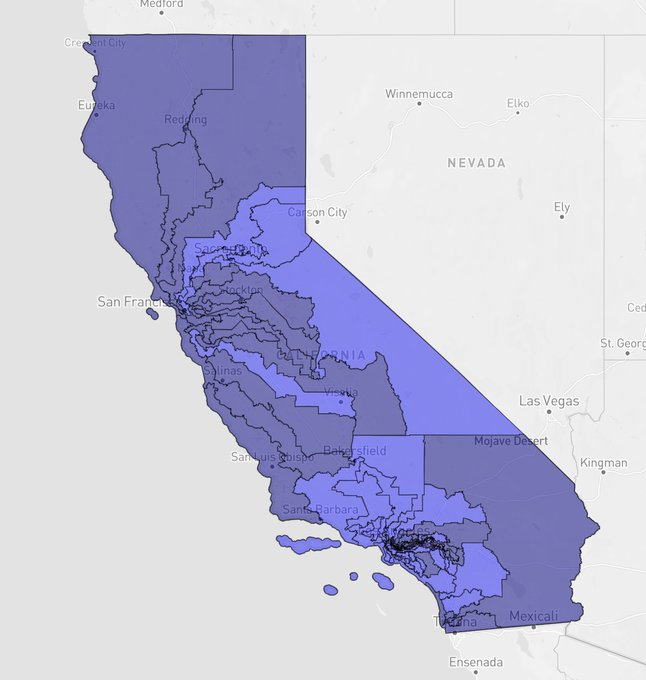
This image reminds me of Oswald Spengler's theory on late stage civilization.
According to him, the mega-city isn’t progress, it’s the end stage. Power, wealth, and people concentrate; roots fade.
These aren't the real districts in CA, but a recommendation from someone based on the hysteria from today. You get the idea though.
The theme is that cities spread out, like a virus. You see the way VA is trying to redistrict.
Mega cities are a sign of civilizational decadence. But they consume everything around them.
And eventually, they consume civilization itself.
Black shirt/red tie combo is so Sinister Dork coded it's unreal. The combo of choice for sapiosexuals, Church of Satan Redditors, pick up artists, bald magicians, BDSM beardos and other nocturnal creatures. You know you're dealing with a 'welcome to my twisted mind' type when this guy pulls up to the bar at a wedding and asks for absinthe. Vampire: The Masquerade ahh outfit. Bro runs a Youtube channel for pwning Christcucks. Bro read the Illuminatus trilogy and made it his whole personality. Bro's other shirt says "I see stupid people." Bro has seen Steam Powered Giraffe live.