📌 MARKET STRUCTURE 101 – HIGHS, LOWS, TRENDS, AND RANGES IN FOREX.
Confused about market structure? Want to learn how pros spot trends & reversals?
Let me break it down so you can start trading like a sniper. 🎯🧵👇
Drawdown is not a personal failure; it is the cost of doing business. Every business has overhead costs-rent, electricity, inventory losses. In trading, your overhead cost is a losing trade executed within your plan.
If you view every red trade as a proof that you're a bad trader, you will inevitably revenge trade to "get your money back." Shift your perspective: Protect your mental capital with the exact same intensity that you use to protect your financial capital.
Have a Profitable Week.
#psychology #trading #forex
Your journal isn't for tracking wins. It's for catching the version of you that breaks the plan.
Entry reason: Was the setup A+ or was it FOMO? Did you follow your risk rules? What would you do differently?
If you're only logging P&L, you're keeping a scoreboard, not a journal.
THE 5 REASONS 90% OF RETAIL TRADERS LOSE MONEY & HOW TO FIX IT.
Why do 90% of retail traders lose money?
It isn't because the market is "rigged" against them.
The real breakdown is structural, psychological, and operational.
Let's examine the five hard reasons most traders blow up their accounts and how you can position yourself on the right side of the distribution.
1. THE GET RICH QUICK MINDSET
Most retail traders enter the market under pressure to make life-changing money quickly.
They look at a $1,000 account and try to turn it into $100,000 within six months.
To achieve this, they use excessive leverage while ignoring the mathematical certainty of risk of ruin.
Professionals think in terms of percentage returns relative to maximum drawdown.
If you can't manage a $10,000 account with disciplined risk management, a $1,000,000 account would likely destroy you.
2. LACK OF A CLEAR TRADING EDGE
If you cannot explain your trading edge in three clear sentences, you probably don't have one.
Most traders have no defined trading system they just hop from one strategy to another trading based on vibes and luck.
A trading edge is a statistical tendency for price to behave in a specific way under specific market conditions, such as liquidity sweeps around higher timeframe institutional levels, candle closure formations.
Profitable traders picks one or two trading strategies and build a trading system around it.
3. MISUNDERSTANDING RISK AND PROBABILITY
Most amateur traders obsess over win rate.
They believe being right 80% of the time guarantees profitability.
Professional traders understand that win rate is only half the equation. The other half is the risk-to-reward ratio.
A trader with a 40% win rate can be highly profitable if the average winning trade is three times larger than the average losing trade.
On the other hand, a trader with a 90% win rate can still go bankrupt if the remaining losses are large enough.
Professional traders usually use a fixed percentage risk for every, because they understand the principles of probability.
4. THE EXECUTION GAP
You can have a perfectly backtested strategy, but if you hesitate to take losses or close winning trades too early out of fear, your real performance will never match your backtest.
The chart is only the execution canvas.
The real battle is your ability to accept uncertainty without taking every trade personally.
5. ZERO ANALYTICAL INFRASTRUCTURE
Most retail traders don't keep a detailed trading journal.
They don't categorize trades by setup, market condition, or emotional state.
As a result, they repeat the same mistakes week after week without realizing it.
If you don't measure it, you can't improve it.
Trading is a business.
Operate like a CEO, not a gambler.
THE 5 REASONS 90% OF RETAIL TRADERS LOSE MONEY & HOW TO FIX IT.
Why do 90% of retail traders lose money?
It isn't because the market is "rigged" against them.
The real breakdown is structural, psychological, and operational.
Let's examine the five hard reasons most traders blow up their accounts and how you can position yourself on the right side of the distribution.
1. THE GET RICH QUICK MINDSET
Most retail traders enter the market under pressure to make life-changing money quickly.
They look at a $1,000 account and try to turn it into $100,000 within six months.
To achieve this, they use excessive leverage while ignoring the mathematical certainty of risk of ruin.
Professionals think in terms of percentage returns relative to maximum drawdown.
If you can't manage a $10,000 account with disciplined risk management, a $1,000,000 account would likely destroy you.
2. LACK OF A CLEAR TRADING EDGE
If you cannot explain your trading edge in three clear sentences, you probably don't have one.
Most traders have no defined trading system they just hop from one strategy to another trading based on vibes and luck.
A trading edge is a statistical tendency for price to behave in a specific way under specific market conditions, such as liquidity sweeps around higher timeframe institutional levels, candle closure formations.
Profitable traders picks one or two trading strategies and build a trading system around it.
3. MISUNDERSTANDING RISK AND PROBABILITY
Most amateur traders obsess over win rate.
They believe being right 80% of the time guarantees profitability.
Professional traders understand that win rate is only half the equation. The other half is the risk-to-reward ratio.
A trader with a 40% win rate can be highly profitable if the average winning trade is three times larger than the average losing trade.
On the other hand, a trader with a 90% win rate can still go bankrupt if the remaining losses are large enough.
Professional traders usually use a fixed percentage risk for every, because they understand the principles of probability.
4. THE EXECUTION GAP
You can have a perfectly backtested strategy, but if you hesitate to take losses or close winning trades too early out of fear, your real performance will never match your backtest.
The chart is only the execution canvas.
The real battle is your ability to accept uncertainty without taking every trade personally.
5. ZERO ANALYTICAL INFRASTRUCTURE
Most retail traders don't keep a detailed trading journal.
They don't categorize trades by setup, market condition, or emotional state.
As a result, they repeat the same mistakes week after week without realizing it.
If you don't measure it, you can't improve it.
Trading is a business.
Operate like a CEO, not a gambler.
Market structure isn't complicated. It's just a record of who's winning.
Higher highs + higher lows = buyers in control.
Lower highs + lower lows = sellers in control.
Everything else is noise until structure breaks.
Stop overcomplicating your first read of a chart.
#priceaction #forextrading
So I think you've highlighted several characteristics that make retail CFD trading resemble gambling: the absence of ownership, the reliance on price movements, the use of leverage, and the fact that most participants lose money while brokers collect fees regardless.
Where I would probably differ slightly is in the final classification.
To me, retail CFD trading is best described as a highly speculative activity that can very easily become gambling in practice. Many participants treat it exactly like gambling, and many of the incentives within the industry encourage that behavior. But I am not sure the existence of a predefined methodology, risk management framework, and the possibility of developing a measurable edge allows it to fit neatly into the same category as activities that are primarily games of chance.
So I think the real disagreement between us may not be about how retail CFD markets work. We seem to agree on most of the mechanics. The disagreement may simply be about where we draw the line between speculation and gambling, and what definition of gambling we choose to use.
I think you've clarified your position much better here, and I also agree that I may have narrowed your original argument too much.
You're no longer arguing that forex trading is gambling simply because people are making predictions about future prices. You're arguing that retail CFD trading is fundamentally different from most economic transactions because there is no acquisition of the underlying asset, no transfer of ownership, and no obvious creation of value outside the redistribution of money between participants.
I think that is a much stronger argument.
The ownership point is particularly interesting. In most commercial activity, something exists independently of the transaction itself. A loaf of bread exists before it is sold. A company's shares represent ownership in an actual business. A commodity contract is linked to a physical good somewhere in the supply chain. Even if transactions are settled digitally, there is usually an underlying asset, product, service, or ownership claim that exists beyond the trade.
In retail CFD trading, that is generally not the case. The trader is not taking delivery of dollars, euros, gold, or any other asset. They are posting margin and entering into an agreement whose value depends on whether a price moves in a particular direction. I think that distinction is real and often overlooked by people who equate CFD trading with traditional investing.
I also understand your point about value creation. In a normal commercial exchange, both sides can walk away with something tangible. The customer gets bread; the baker gets revenue. The supplier gets paid; the retailer gets inventory. In retail CFD trading, the transaction is not producing a new good or service. The outcome is largely a redistribution of money based on who was right and who was wrong about future price movements.
Where I think the discussion becomes more nuanced is your final conclusion that this necessarily makes it gambling.
The reason I say that is because the definition of gambling itself becomes important.
If gambling means staking money on an uncertain outcome where gains come from losses incurred by others, then your argument is quite strong. Under that definition, retail CFD trading certainly shares many characteristics with gambling.
But if gambling means staking money on an outcome that is primarily determined by chance, then I think the comparison becomes less clear.
This is where I find myself drawing a distinction between the structure of the market and the behavior of the participants.
I completely agree that most retail traders lose money. The disclosures published by brokers make that clear. I also agree that leverage plays a major role in that outcome.
What I'm less convinced about is the idea that the majority losing automatically proves that the activity is gambling.
The more important question, in my view, is whether those losses occur because the outcome is fundamentally governed by luck or because most participants are inexperienced, undercapitalized, poorly trained, overleveraged, undisciplined, or operating without any demonstrable edge.
For example, if a trader is following a predefined system, managing risk, controlling position size, and executing the same process repeatedly over hundreds of trades, then the activity starts to look different from what most people mean when they use the word gambling. The outcome of any individual trade may be uncertain, but the participant is not relying purely on luck.
Ironically, I think your own explanation points to this distinction. You mention that many traders lose because they are inexperienced, overleveraged, late, or unlucky. The first three factors are not really chance factors; they are participant factors. They suggest that behavior, skill, discipline, and risk management matter, even if most people apply them poorly.
Great breakdown, but I think you slightly narrowed my argument too much.
I was not saying that merely predicting the future automatically makes something gambling. My point was that CFD forex trading is built around staking money on future price movements without acquiring the underlying currency or asset.
There are several things that led me to that conclusion: leverage, the absence of real ownership, and the structure of the market itself.
Even where nothing physically changes hands in a normal transaction, there is still a real product, asset, or money somewhere in the system. If I transfer money to you and you transfer it to someone else, no physical cash may move, but the money exists and can be withdrawn or used. If a trader buys commodities or shares through a broker, the underlying asset still exists somewhere—perhaps in a warehouse, vault, or company register—and ownership changes hands.
That is not what happens in CFD forex trading. You are not receiving dollars, pounds, euros, or any other currency. You are putting down margin and taking a position on whether the price will rise or fall. At the end, you receive or lose the difference.
But even that is not the biggest issue.
The central problem is that the whole model depends on a small minority making money while the majority lose because they are inexperienced, overleveraged, late, or simply unlucky. The platforms themselves disclose that most retail traders lose money. That is not an accidental side effect; it is built into the structure of the game.
A normal business can create value for both sides. A customer gets bread; the baker gets profit. A trader buys inventory; a supplier gets paid; both can benefit. But retail forex CFDs do not work like that. The gains of the few are largely funded by the losses of the many, while the broker collects spreads, commissions, and fees either way.
That is why I call it gambling. Not because it involves uncertainty, but because it is a leveraged wager on price movement in a system where the majority must lose for the minority and the platform to win.
I actually agree with some of your points.
A lot of people get into forex because social media sells the dream of quick money, and many retail traders are indeed just speculating on price movements through CFDs rather than exchanging actual currencies. It's also true that many people approach forex with a gambling mindset and end up losing money because they're overleveraged and chasing profits.
Where I disagree is with the conclusion that forex trading is therefore gambling.
If making predictions about future prices automatically makes something gambling, then a large part of the global financial system would fall into the same category. Banks, hedge funds, exporters, importers, and multinational companies all make decisions based on expected currency movements. Financial markets are built around managing and pricing future uncertainty.
The fact that no physical dollars change hands doesn't settle the argument either. Many legitimate financial instruments don't involve taking delivery of the underlying asset.
For me, the better distinction is between speculation and gambling. They can look similar on the surface, but they aren't necessarily the same thing. Someone risking their life savings on a highly leveraged trade based on a Telegram signal is behaving a lot like a gambler. Someone following a structured strategy, managing risk, and treating trading as a probabilistic exercise is doing something fundamentally different.
So I'd say the stronger argument is that many retail traders treat forex like gambling, not that forex trading itself is gambling.
I see a lot of northern youths going into forex, which is surprising because Forex is actually gambling.
Many people do not understand the difference between foreign exchange and Forex trading.
The man in Zone 4 who changes your naira to dollars is doing foreign exchange.
You give him naira. He gives you dollars. You leave with actual dollars in your hand or account.
That is an exchange.
But what many people are doing on Forex apps is something else entirely.
You do not receive dollars.
You do not receive euros.
You do not own gold, Bitcoin, a company, or anything tangible.
You open what is often called a Contract for Difference: CFD.
In simple English, you and the platform are making a wager on where a price will go.
You say dollar will rise against euro.
Or gold will fall.
Or Bitcoin will go up.
You put down a small amount of money, then the platform gives you “leverage” to control a much bigger amount.
If the price moves in the direction you predicted, you collect the difference.
If it moves against you, you lose the difference.
Nothing was exchanged.
No dollars changed hands.
No business was funded.
No asset was produced.
You simply put money on an uncertain future price and hoped your prediction would be right.
Candlesticks, Fibonacci, support and resistance, liquidity sweep, market structure, all of those may help somebody make a better prediction.
But they do not change what the arrangement is.
People study football statistics before betting too. Better analysis does not turn betting into investment.
The fact remains: you pay money, make a prediction about an uncertain outcome, and either win money or lose money based on whether that prediction comes true.
That is why I think we need to stop confusing actual foreign exchange with retail Forex trading.
One is exchanging currencies.
The other is, in many cases, simply gambling with charts.
Unpopular opinion: You can’t build long-term consistency by depending solely on signals. Trading is more than technical analysis.
But signals can be a good starting point, what matters is learning from them, not blindly following them.
Unpopular opinion: You can’t build long-term consistency by depending solely on signals. Trading is more than technical analysis.
But signals can be a good starting point, what matters is learning from them, not blindly following them.
Your first 5 figures can be within reach with what I’m bringing to you‼️🔥
I’m not sleeping on this opportunity, and I don’t want you to either.
From someone who has it documented and recorded not once, but twice, taking over 12,000+ people from evaluation to payout is quite remarkable. That’s exactly why you shouldn’t miss Episode 3 with @Fznation01
>He provides the trades.
> He provides the risk management.
>He guides you through the process until you clear Phase 1, Phase 2, and reach payout.
All you have to do is get your account ready.
If you have real capital, you can also position yourself instead of being left behind.
This is a one-time signal opportunity. After this year, you’ll have to wait until 2027.
The flyer below contains the requirements and more details about the entire process.
@B_trader__@atlasfunded Wait I don't understand why prop firms would deny you payout because someone else took similar trades with you.
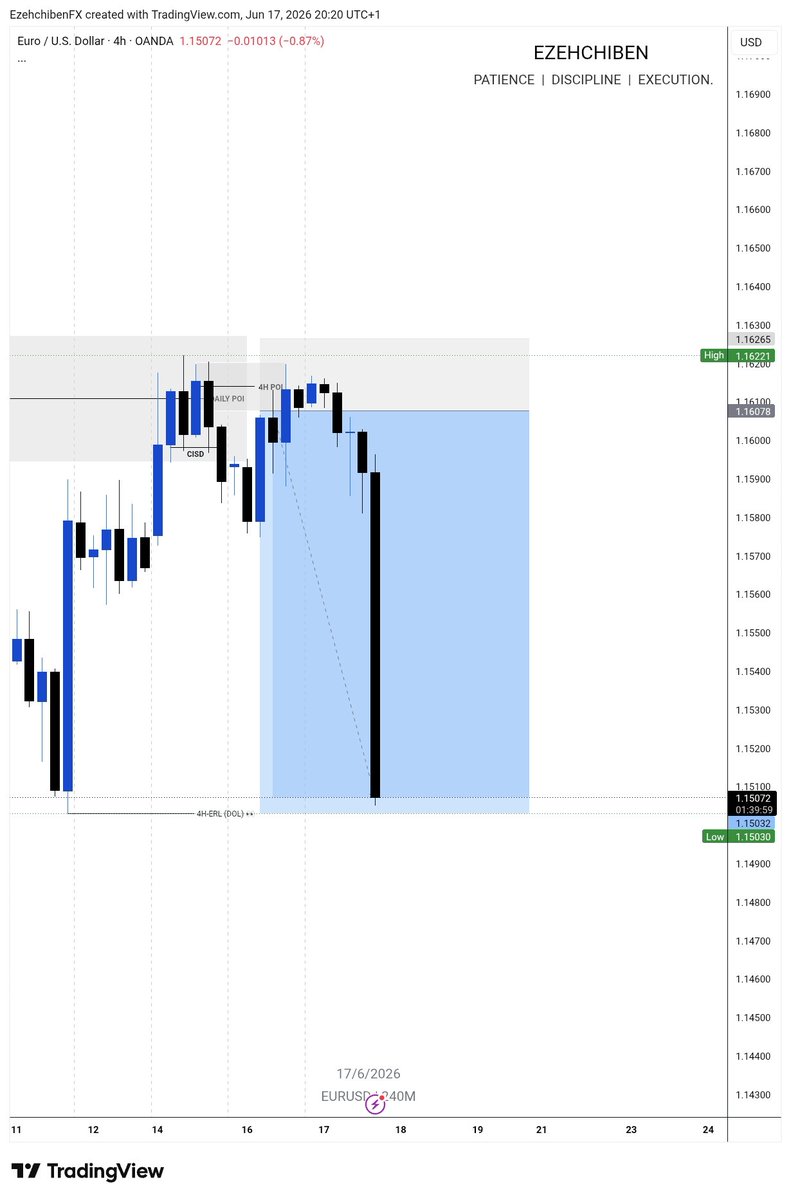
For example this sells on EU I can bet a lot of traders enter around that POI, and logically those lows were the DOL.
It makes absolutely no sense to me.
@shoshu_umar And the funny thing is that the day the North rises up Nigeria will be free, as someone who grew up there I know what they are capable of once they decide.