Five things I believe to be true:
- $BTC and hyperliquid:native are 1A and 1B tokens to accumulate today based on price vs potential
- ethereum:0x232ce3bd40fcd6f80f3d55a522d03f25df784ee2 is mispriced as a direct comp to $HYPE, and the two separate from one another by year-end
- ethereum:native underperforms its peers as it builds L2 density (RH chain, Base, etc), then rebounds when they turn true blob fee mechanics on
- ethereum:0x1f9840a85d5af5bf1d1762f925bdaddc4201f984 sneaks up as a CF darling with burn dynamics that flip deflationary given their reach across L2s
- solana:So11111111111111111111111111111111111111112 has no moat, and has trouble regaining its post-meme highs
@DaddieTechno Onboarding.
When digital asset rails are ‘legitimized’ by the big financial institutions, regular folks who view crypto as nothing but a scam, will start to adopt it.
More people on chain = more liquidity = more focus on other digital assets.
Call me wrong if you wish, but if you’re focusing on anything beyond the institutional onboarding to digital rails, you’re doing it wrong.
This is where the next cycle plays. Don’t get distracted.
The market had a terrible November. The plumbing had a good one.
Crypto prices had a rough November, while the plumbing underneath had one of its busiest months. Central banks and market utilities moved real money and real securities onto ledgers while bitcoin fell to a two-year low. None of that work depended on price, and none of it paused when price fell.
7:00 ET, vs Monday's print
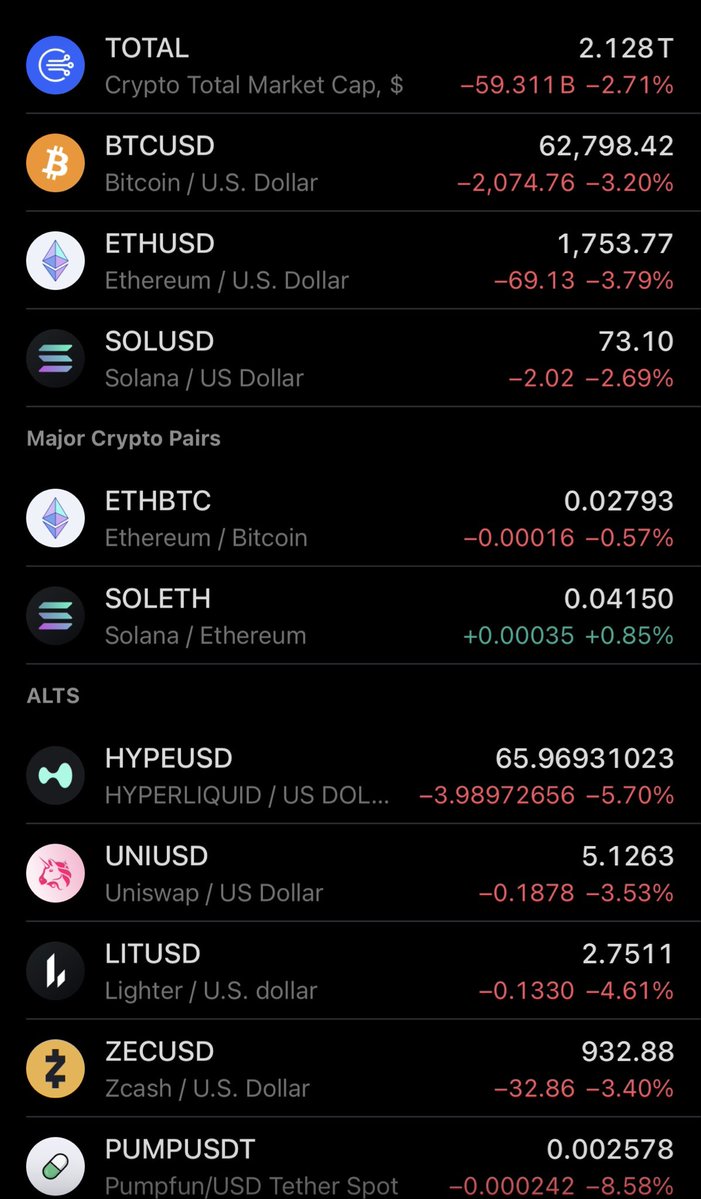
bitcoin:native $60,369 -1.6%
$ETH $1,700.71 -1.4%
$SOL $70.84 -2.2%
$HYPE $63.08 -1.6%
$ZEC $742.35 -6.6%
$UNI $4.77 flat
$LINK $9.01 +0.7%
$PUMP $2.45/1,000 -4.1%
$LIT $2.37 -2.5%
Spot ETFs Mon: BTC -$570M, ETH -$85M
$BTC: Bitcoin is down 22% since Nov 1. Last week it touched about $55,000, its lowest level in two years, leaving a record 11.6 million BTC worth less than their holders paid for them. Spot bitcoin ETFs have lost about $4.7 billion this month through Monday, with outflows five sessions running. When stocks had their best day since April 2025 on Monday, bitcoin still slipped.
Singapore: On Nov 6, the Monetary Authority of Singapore sold S$100 million, about $77.5 million, of four-week government bills that were created on its own ledger and paid for in wholesale central bank digital money. Five primary dealers bid for more than twice the amount on offer. The bills and the cash changed hands at the same instant, so neither side had to trust the other to deliver first. Next year's plan is more issuance and tests of using the bills as collateral.
Hong Kong: On Nov 2, the Hong Kong Monetary Authority moved its Project Ensemble pilot to round-the-clock settlement. Twelve banks can now settle tokenized deposits with each other in tokenized central bank money at any hour, weekends included. Two weeks later, the HKMA and Swift said they'll study linking Ensemble to Swift's blockchain ledger, so those deposits could move across currencies on the same rails.
United Kingdom: On Nov 2, the UK Treasury named Barclays, HSBC, Lloyds, Morgan Stanley, NatWest and RBC to lead its first digital gilt, a short-dated government bond issued and settled on a ledger inside the Bank of England's sandbox. The Bank also approved a link between HSBC's and the London Stock Exchange Group's digital platforms, so investors can reach the bond through either one. The open question is the cash: how buyers pay for it on-chain hasn't been confirmed yet.
United States: The securities side is moving fastest. DTCC, the utility that settles nearly every US stock and bond trade, switched on its tokenization service in late October, and Société Générale has already accepted $10 million of DTCC-tokenized Treasuries as collateral. The banks behind Zelle showed a dollar stablecoin on Solana last week, though only on a test network and with no launch date for customers. The cash leg is where the US is choosing a different path. Fed Governor Waller said last week that the private sector is best placed to build these tools, and the big banks' shared tokenized-deposit network isn't due to process transactions until the second quarter of 2027. For now, tokenized US assets settle against bank money and stablecoins, not against the Fed's own money.
In broader news: Nvidia reinstated Jensen Huang as CEO on Monday, less than two weeks after he resigned, and its shares closed up about 31%. That lifted the S&P 500 4.7% and the Nasdaq 6.5% on the day, though stock futures were lower this morning.
Observations, not advice.
Traders are betting against the bounce. The builders kept building.
Crypto traders spent the weekend paying to bet against the bounce, while a central bank and a card network kept building rails that don't depend on where the price goes.
7:00 ET, vs Sunday's print
$BTC $61,362 +0.7%
$ETH $1,724.01 +1.1%
solana:So11111111111111111111111111111111111111112 $72.47 +2.8%
$HYPE $64.09 +2.4%
$ZEC $794.42 -0.3%
$UNI $4.77 +1.1%
$LINK $8.95 +1.8%
$PUMP $2.56/1,000 +3.4%
$LIT $2.43 +3.8%
Spot ETFs Fri: BTC -$669M, ETH -$97M
solana:So11111111111111111111111111111111111111112: SOL rose 2.8% from Sunday's 7:00 print, but its funding rate turned negative on both Hyperliquid and OKX, and it has now been negative four days running. A perpetual future never expires, so on a regular schedule one side pays the other to keep its price close to the real one. When funding is negative, traders betting on a drop pay traders betting on a rise. Paying to stay short while the price climbs means the crowd doesn't trust this rally yet. If the price keeps rising, those shorts eventually have to buy back, and their buying adds to the move.
ECB: On Monday the European Central Bank approved a plan to let banks borrow from it against tokenized securities issued on platforms licensed under the EU's blockchain pilot program. It takes effect in June 2027. Since March, banks could already pledge tokenized securities that came through traditional settlement houses; this widens that list. Collateral is the unglamorous part of banking because it decides what a bank can turn into cash on a bad day. Once a central bank lends against a tokenized bond, that bond is something a bank can fund itself with, not an experiment. The usual credit rules still apply, and the ECB plans a blueprint for fully tokenized wholesale markets by 2028.
Agents: On Sunday, Visa's crypto lab released an experimental wallet that lets invited US cardholders verify an AI agent with their Visa card and send it out to do paid tasks. The earnings come in OUSD, a dollar stablecoin. One account can run up to 25 agents, and the owner sets their spending limits. Separately, the Solana Foundation has gathered its agent tools under solana[dot]ai: payments, wallets and trading kits, with more than 120 teams building on them. Software that pays other software doesn't keep bank hours or check sentiment. If these tools catch on, a growing share of stablecoin transfers will be programs paying programs, and that volume won't rise and fall with the mood.
In broader news: US stock futures jumped Monday morning. S&P 500 futures were up about 2.6% after seven straight losing sessions, and Nasdaq 100 futures were up more than 3%. Nvidia rose about 8% before the open after falling 23% last week. US markets are closed Thursday for Thanksgiving and close early Friday.
Observations, not advice.
Nobody hacked the chain. They hacked the doors.
This weekend's three crypto security stories all happened at the edges through a bridge, a vault's signing key and a phone ad. The blockchains underneath kept working normally. Whether crypto is safe to hold now depends less on the chain itself and more on everything between the chain and the person holding it.
7:00 ET, vs Saturday's print
$BTC $60,956 +4.9%
$ETH $1,705.56 +3.4%
$SOL $70.50 +2.6%
$HYPE $62.58 +5.3%
$ZEC $796.63 +4.7%
$UNI $4.72 +4.8%
$LINK $8.79 +4.1%
$PUMP $2.48/1,000 +7.0%
$LIT $2.34 +0.9%
Spot ETFs Thu: BTC -$582M, ETH -$131M
$CYBER: On Saturday someone minted 5.2 million CYBER on Solana with nothing backing them. Then the same amount came out of the bridge's Ethereum lockbox and was sold for about $968,000 in ETH. Upbit and Bithumb froze CYBER deposits and withdrawals, though trading stayed open. A bridge is two vaults with a messenger between them. You lock tokens on one side, and the messenger tells the other side to release the same amount. Fool the messenger and the far vault pays out. Solana and Ethereum both did exactly what they were told.
$FLIP: Chainflip, a protocol for swapping between chains, lost about $12 million in BTC, ETH and stablecoins from its vaults on Saturday. The first estimate was $4.86 million. The suspected cause is a compromised signing key where the vault saw a valid signature and paid out. Chainflip has offered the attacker 10%, roughly $1.2 million, to return the rest by Monday at 18:38 UTC. It's the protocol's second exploit in ten weeks, and FLIP fell about 31%. Bitcoin's network was fine. The key controlling a pile of bitcoin was not.
Phones: Ad-security firm Confiant linked more than 480 ad domains, live between May 12 and November 17, to a group it calls MoldyRoost. On older or unpatched iPhones, just loading the ad's landing page could be enough to steal a wallet's seed phrase. There was no app to install and no transaction to approve. Users of MetaMask, Phantom and Trust Wallet in more than 47 countries were targeted. A seed phrase is the master key to a wallet and whoever reads it can move the money, and nothing reverses it. The wallet apps weren't broken. The phones running them were out of date.
$BTC: Bitcoin rose 4.9% from Saturday's 7:00 print to $60,956, all of it while the ETFs were closed. The last three sessions with complete ETF data lost $1.13 billion, including IBIT's record $541 million outflow on Thursday. As of this morning, Friday's tally still has no IBIT figure. A weekend rally happens without the month's biggest seller trading. Monday's flow print will show whether it holds.
In broader news: The S&P 500 fell 3.7% on Friday, its seventh straight loss, and is now in a correction. CME futures stay shut until 6 p.m. ET, but the licensed S&P 500 perp on Hyperliquid has traded all weekend. It sat near 6,997 around 8 a.m. ET, about 1.3% above Friday's 6,910 close, with funding flat. Stocks are seeing the same weekend bounce as crypto, also in thin weekend trading, and tonight's futures open is the first real test of it.
Observations, not advice.
Half the S&P 500 Was One Trade: A Four-Week Check-In
On Oct. 23 the post here argued that the S&P 500 had become a concentrated bet on AI spending, and that a few crypto names trading well below a committed fair value were a better place for some of that money. Four weeks later, the first part held up and the second part didn't.
7:00 ET snap
bitcoin:native $58,109 (-5.9%) · ethereum:native $1,650 (-5.5%) · $SOL $68.75 (-4.1%) · hyperliquid:native $59.41 (-7.0%) · $ZEC $761 (-7.3%) · $UNI $4.50 (-6.0%) · $LINK $8.44 (-3.8%) · $LIT $2.32 (-10.4%) · $PUMP $2.31 per 1,000 (-7.5%)
Spot ETFs Thu: BTC -$582M, ETH -$131M
The original math: if you draw the index as 100 squares, 49 of them ride on AI spending. About 20 are companies selling the chips, servers and data centers, about 20 are the companies buying them, and the other nine are Apple and a handful of related names. The post sketched three outcomes for those 49 squares: a scare that takes about 6% off the index, a real repricing that takes about 17%, and a dot-com-style unwind that takes about a quarter.
Since then the S&P 500 has fallen 11%, closing Friday at 6,910 after seven straight down days, which puts it in a correction. The Nasdaq is down 15% and has given back everything it gained this year. So far that lands between the scare case and the repricing case.
The selling also started where the post said it would, in the debt of the companies building out AI. By early November, CoreWeave's 2032 bonds were trading around 76 cents on the dollar, SoftBank's credit default swaps were at their widest since 2022, and a bank put roughly $500 million of data-center loans up for auction, reportedly the first sale made up only of that kind of debt. Stocks followed through November.
The crypto side went the wrong way. $BTC is down 29% since that morning, $ETH is down 31% and $HYPE is down 23%. The post did say these assets aren't uncorrelated with tech, but it understated how much. When AI stocks sold off, crypto fell more than twice as much as the index, with record outflows from BlackRock's bitcoin ETF this week adding to it.
Over four weeks, that's a losing trade. The framework behind it is built for a longer horizon and none of its committed values have changed, so the names it marked cheap are now further below those values than they were. Whether that turns out to be early or just wrong won't be clear for a while, which is why the record is kept in public.
To watch the allocations as they change, @milogoodboy_bot keeps the receipts.
In broader news, Taiwan's stock market, where most of the chips behind those 49 squares are made, fell 6.2% on Friday.
Observations, not advice.
The regulator opened a door. The market saw a wall.
Washington told on-chain exchanges exactly how to get into the US, "same rules, two ways in," and hyperliquid:native still fell twice as hard as bitcoin on the day.
7:00 ET snap
$BTC $61,739 (-3.4%) · $ETH $1,747 (-3.3%) · $SOL $71.69 (-4.1%) · hyperliquid:native $63.86 (-6.9%) · $ZEC $821 (-13.9%) · $UNI $4.79 (-8.0%) · $LINK $8.78 (-4.5%) · $PUMP $2.50 per 1,000 (-8.3%)
Spot ETFs Thu: BTC -$582M, ETH -$131M
🏛️ hyperliquid:native got the clearest US roadmap it has had. CFTC Chairman Michael Selig said Thursday that on-chain derivatives platforms like Hyperliquid can serve American retail traders if they register as an exchange or partner with one that already is, under the same rules as any other venue and with no exemption for running on a blockchain. That is a map, not a ban. Backpack already walked it, picking up a license to clear trades on Nov. 13 and a license to run the exchange three days later. Kraken's parent is pursuing regulated perps built on Hyperliquid's own infrastructure. The first US door into Hyperliquid's markets is likely to be someone else building on its rails, not Hyperliquid itself, and that is still a door.
😐 $BTC hit a four-month low as spot ETFs lost $582 million on Thursday, $541 million of it from BlackRock's IBIT, the fund's largest single-day outflow since it launched. Three sessions, $1.13 billion out.
📉 $ZEC was the worst name on the board, down 13.9% with no headline attached, while its holders vote through Nov. 30 on the future of 50,000 ZEC in the community grants fund.
In broader news, Anthropic opened at $111.50 on its Nasdaq debut, 34% above its $83 offer, fell back under $100 within 17 minutes and closed at $97.17, while the Hyperliquid perp that traded near $100 that morning missed the pop and landed within about 3% of the close.
Observations, not advice.
A crypto exchange priced the biggest IPO ever first.
Wall Street set Anthropic's price last night; traders on Hyperliquid set it weeks ago, and the banks ended up moving toward them.
7:00 ET snap
bitcoin:native $63,876 (-0.4%) · $ETH $1,805 (+0.4%) · $SOL $74.77 (+0.5%) · hyperliquid:native $68.60 (+0.1%) · $ZEC $954 (+1.7%) · $UNI $5.21 (-0.5%) · $LINK $9.19 (+0.4%) · $PUMP $2.73 per 1,000 (+0.2%)
Spot ETFs Wed: BTC -$306M, ETH -$40M
🧠 Anthropic told investors its shares were worth $70 to $78. For two weeks before that, contracts tracking its share price on Hyperliquid traded between roughly $96 and $104, well above the top of that range. Last night the banks priced it at $83, above the range, upsized the deal to 980 million shares and raised $81.3 billion, the largest IPO on record. This morning those contracts sit around $100 to $102.50, still about 21% to 23% above the offer. The crypto market was right about the direction two weeks early; today's first trade on Nasdaq decides whether it was right about the size.
📈 $HYPE is the venue behind all of it. Hyperliquid lets outside builders list markets like these by staking HYPE, and the two largest Anthropic contracts carried about $375 million of open interest as the deal priced, with long positions outnumbering shorts roughly 2.8 to 1. A private company's price was found around the clock, in public, on a crypto exchange, before a single share traded.
😐 $BTC ignored all of it. Nasdaq futures were up about 2% this morning ahead of the debut and spot ETFs shed $546 million over two days, yet bitcoin sat just under $64,000, down 0.4%. Selling that heavy with a price that barely moves means buyers are absorbing it at this level.
In broader news, a watchdog warned that highly advanced quantum computers could crack the encryption banks and blockchains rely on within five years, and said both are lagging on defenses.
Observations, not advice.
Crypto isn't trading Nvidia.
Two days, two tests, same answer: crypto ignored the stock market in both directions this week, which means its next move belongs to its own flows and the Fed, not to AI earnings.
7:00 ET snap
bitcoin:native $64,162 (-1.2%) · ethereum:native $1,799 (-1.2%) · solana:So11111111111111111111111111111111111111112 $74.39 (+1.3%) · $HYPE $68.57 (-1.2%) · $ZEC $938 (-1.2%) · $UNI $5.23 (-2.5%) · $LINK $9.15 (-1.2%) · $LIT $2.87 (-4.6%) · $PUMP $2.72 per 1,000 (-3.0%)
Spot ETFs Tue: BTC -$240M, ETH -$29M
😐 bitcoin:native got two invitations from the stock market inside two days and turned both down. Monday the Nasdaq fell 2.5% and bitcoin barely moved. Tuesday night Nvidia beat on revenue, raised its outlook, stock futures climbed, and bitcoin slipped 1.2%. What did move it was plumbing: $240 million left the spot ETFs on Tuesday, one session after a seven-day outflow run finally broke, with a December Fed hike already priced in.
🩳 ethereum:native funding has been negative for seven straight days, which means traders betting against ether have paid to keep that bet open for a full week. That matters beyond the chart: yield products like Ethena's synthetic dollar earn when bulls pay, and this week the bulls haven't. One week is a cost, not a crisis, but it is the kind of cost that compounds quietly.
🟢 solana:So11111111111111111111111111111111111111112 was the only major in the green, up 1.3%. Zelle, the payments network owned by seven big US banks including JPMorgan and Wells Fargo, said at Solana's Breakpoint conference that its dollar stablecoin will run on Solana for international payments, and demoed a $1.25 million confidential transfer on a test network on stage. Funding on SOL is still negative on Hyperliquid and OKX, so shorts are paying to bet against the one major with a bank-sized headline behind it. There is no launch date yet, but that is an expensive side of the trade to be sitting on.
📈 $ZEC ran more than 10% on Tuesday to about $961 before giving a little back overnight. The jump came with a burst of short liquidations and no new money into the existing Zcash ETF that day, which makes it a squeeze rather than fresh demand.
In broader news, Anthropic prices its IPO tonight against a $70 to $78 range it is reportedly set to beat, while its pre-IPO perp on Hyperliquid traded near $96.60 this morning, 24% above the top of the range but down about 7% from last week's $104 high. The gap is closing from the perp's side, not the range's. Meanwhile Nvidia's interim CEO flagged that some of its fastest-growing AI customers may be growing at an unsustainable rate, even as revenue doubled.
Observations, not advice.
Yesterday, a friend asked if this became a clanker 🤖 account given my daily market updates are assisted by AI. The answer is maybe? My goal here to generate meaningful and accurate daily content about digital assets, in a timeframe that fits my busy livelihood outside of CT.
To accomplish this, the model is the least trusted part of the process.
Most AI market commentary is slop because the model is asked what happened and answers with confidence whether it knows or not. The process behind these posts is built the other way around, and the model is allowed to write sentences and nothing else, based on a script that’s run daily. Think of a fast food restaurant where employees prepare food, but they follow a very strict manual to aim for consistency.
Every price, flow and on-chain figure is fetched and computed by plain code. When the model labels something, the label is provisional, and code checks it before anything goes out. Arithmetic is never left to a language model, because a language model will happily round a number into a different number and sound sure about it.
Further, each asset I track has a stated value and a stated list of things that would change it (revenues, compliance, partnerships, etc), committed in advance. A scary headline does not move that value. Only a logged decision does, and the log records why.
The process is also geared to let me know when it’s unsure. If a token jumps 14% and no source explains it, the output reads "cause not established" and shows the nearest headline as exactly that, a nearest headline, not a reason. Numbers from a single source are labelled single-source. When two sources disagree, the disagreement gets printed instead of being averaged into something that looks tidy.
Dozens of automated checks run on every morning's output, and each one states what it covers and what it does not. It is also a continuously improving process. A check that cannot fail is treated as a bug. One morning the written summary was cut off mid-sentence and went out anyway, because nothing looked for that. By the next morning's run, something did.
Everything leaves receipts. Each day's readings, misses and corrections go into a record that only ever gets added to, never rewritten. Changes to the live system need a human's go, typed in their own words, and the agents that build are not the ones that run. Mistakes still happen; they get found, written down and fixed in the open instead of quietly disappearing.
Observations, not advice.
Stocks blinked. Crypto didn't.
The Nasdaq fell 2.5% on Monday, a December rate hike is priced in, the fear gauge sits at 12, and bitcoin:native still ended the night where it started, which looks a lot like sellers running out of things to sell.
7:00 ET snap
$BTC $64,918 (+0.8%) · ethereum:native $1,821 (+0.9%) · solana:So11111111111111111111111111111111111111112 $73.42 (+3.0%) · $HYPE $69.39 (+5.0%) · $UNI $5.36 (+4.4%) · $LINK $9.26 (+1.1%) · $LIT $3.01 (+14.4%) · $PUMP $2.81 per 1,000 (-2.2%)
Spot ETFs Mon: BTC +$8M, ETH -$8M
😐 $BTC spent Monday inside a range of less than $2,000 while tech stocks took the hit. Seven straight sessions of ETF outflows ended with an $8 million inflow, small enough to be a rounding error, but a rounding error pointed the right way. A market at Extreme Fear that refuses to fall on a bad day for stocks has already lost most of its sellers.
🩳 $ETH and $SOL are where the bears are paying rent. Funding went negative for $BTC, $ETH and $SOL on five major exchanges Monday, which means traders betting on a drop are paying traders betting on a rise just to keep their positions open. That only works for the shorts if price keeps falling. When it stops, every uptick forces some of them to buy back, and $SOL's 3% gain with no headline is what the first few of those look like.
📈 $HYPE was the biggest mover among the majors with no news attached, while its buyback kept grinding, about $2 million of $HYPE bought on Monday alone. Quiet tape, crowded shorts, steady bid underneath.
🔑 $LIT made the round trip in a day. Lighter paused withdrawals Monday after a trader's leaked API key let an attacker drain $10.4 million in USDC; the exchange's contracts were never touched. $LIT dropped to about $2.33, then climbed back to roughly $3.00 once withdrawals reopened with a postmortem. The stolen money went USDC to $ETH, through Hyperliquid, into Monero. The market got the distinction right: a stolen key is not a broken exchange.
In broader news, Nvidia reports after the close today, its first call since Jensen Huang resigned last week, with CFO Colette Kress as interim CEO, and Anthropic's IPO prices later this week.
Observations, not advice.
Robinhood Chain's Uniswap boom lost 84% in two months.
Uniswap's biggest growth engine of 2026 is running out of fuel: fees on Robinhood Chain are down 84% from their September peak while the rest of Uniswap slipped 12%.
7:00 ET snap
bitcoin:native $64,381 (-1.7%)
$ETH $1,804 (-1.7%)
$SOL $71.31 (-2.1%)
$HYPE $66.08 (-3.3%)
$ZEC $886 (-3.9%)
ethereum:0x1f9840a85d5af5bf1d1762f925bdaddc4201f984 $5.14 (-0.7%)
$LINK $9.15 (-1.9%)
$LIT $2.63 (-12.2%)
$PUMP $2.87 per 1,000 (-1.9%)
Spot ETFs Fri: BTC -$185M, ETH +$2M
$UNI: Thirty-day fees generated on Uniswap's Robinhood Chain pools peaked at $148.2M on Sept 23, 72% of all fees generated on Uniswap. This morning they are $23.1M, a 31.8% share, and the share has fallen at every reading this month. The rest of Uniswap went from about $56M to $50M over the same stretch, down 12%. The slide starts at the end of September, when the chain's launch incentives were scheduled to end. That is the difference between volume paid to show up and volume that stays. UNI's burn is funded by these fees, so it shrinks with them.
$BTC: Down 1.7% to $64,381 after what CoinDesk called a $2 billion weekend flush. Funding flipped negative across venues twice overnight and was back to neutral by morning. The shorts collected and closed.
In broader news: Singapore's and Germany's central banks are testing cross-border settlement, a year after signing their tokenization pact, while private stablecoin supply keeps shrinking.
Observations, not advice.
This week's AI test is a loan auction.
The AI number that matters this week is a loan price on Thursday, not Nvidia's earnings on Tuesday, and crypto has traded as part of the AI trade all month.
7:00 ET snap
bitcoin:native $65,315 (-2.4%)
$ETH $1,823 (-4.0%)
$SOL $72.30 (-4.3%)
base:0x15d0e0c55a3e7ee67152ad7e89acf164253ff68d $67.86 (-0.5%)
$ZEC $920 (+3.2%)
$UNI $5.13 (-5.4%)
$LINK $9.23 (-3.2%)
$LIT $3.02 (-2.3%)
$PUMP $2.93 per 1,000 (-11.3%)
Spot ETFs Fri: BTC -$185M, ETH +$2M
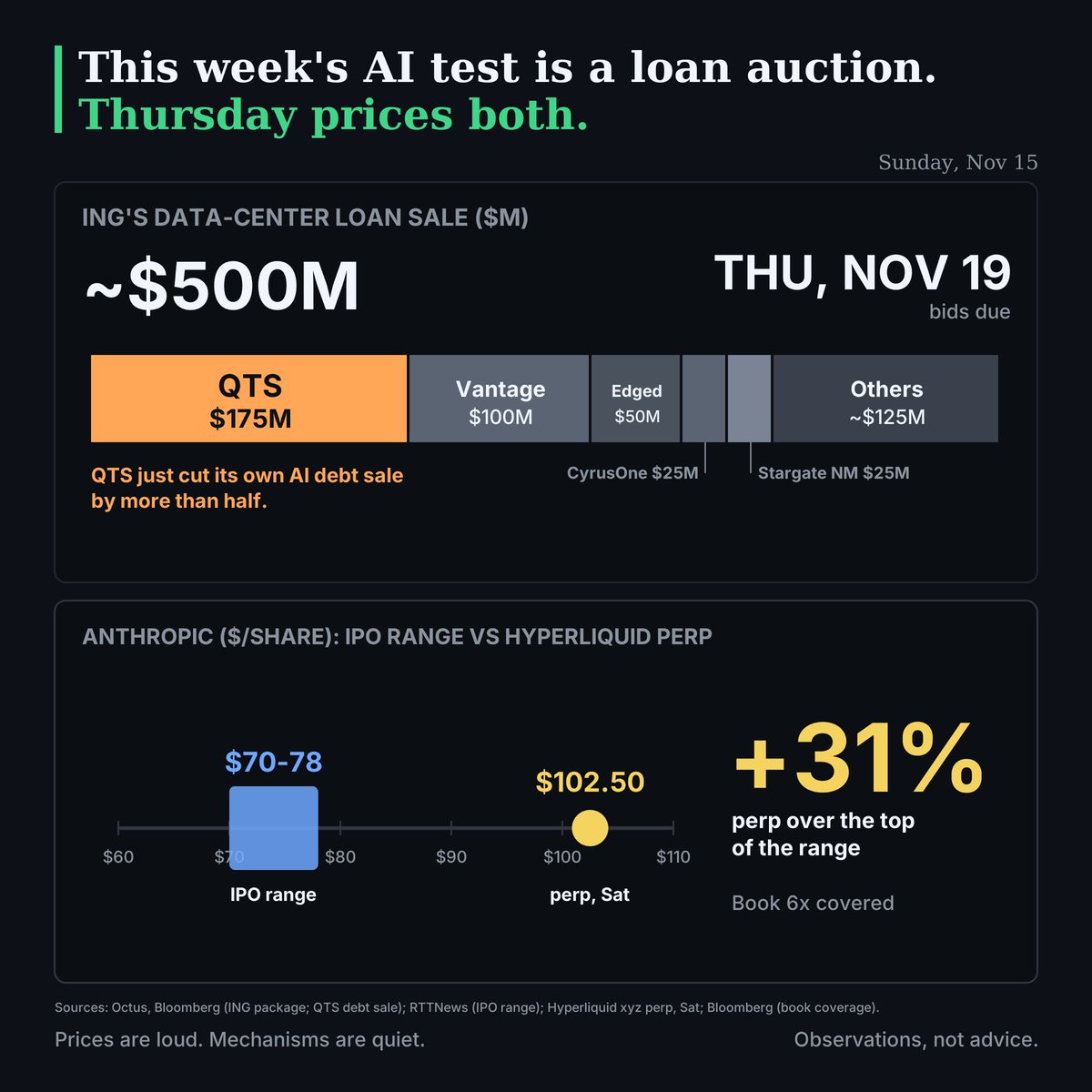
bitcoin:native: Three dates in four days. Tuesday, Nvidia reports for the first time since its CEO resigned, with the CFO standing in and no guidance reaffirmed. Wednesday, Anthropic is expected to price its IPO at $70 to $78 a share; its Hyperliquid perp traded near $102.50 on Saturday, about 31% above the top of the range. Thursday, Anthropic trades and bids close on ING's roughly $500M package of data-center loans, the largest slice $175M tied to QTS, the Blackstone-backed builder that just cut its own AI debt sale by more than half. Stocks can rally on Tuesday's print and Thursday's debut while lenders mark the same buildout lower. Bitcoin has traded inside that complex all month: it took the Nov 5 sell-off in full, skipped the next rebound, and spot ETFs have sold for seven straight sessions. Thursday's loan price is the tell.
hyperliquid:native: Flat on a day ETH fell 4% and PUMP 11%. The Assistance Fund bought back $3.3M of HYPE on Saturday, up from $2.8M on Friday. Revenue rises when the tape gets violent, and a Nvidia print plus an Anthropic listing are exactly the events Hyperliquid's stock perps trade around the clock.
In broader news: The OCC flagged credit risks for banks in the AI infrastructure boom, and the Fed flagged risks from asset prices partly driven by AI, both this week.
Observations, not advice.
Busy week ahead
Tue 11-17 - Nvidia earnings, 5 pm ET, Kress's first call as interim CEO.
Wed 11-18 - House committees' closed-door Nvidia briefing.
Thu 11-19 - Anthropic's first trade, range $70–78 vs perps near 103.
Bitcoin lost its 200-week line for the second time this year.
Bitcoin is back under its 200-week average, a line it already lost in June, and a level that breaks twice in five months is not a floor.
7:00 ET snap
bitcoin:native $67,203 (-2.8%)
$ETH $1,909 (-2.5%)
$SOL $75.87 (-5.9%)
hyperliquid:native $68.78 (-7.1%)
$ZEC $903 (-6.4%)
$UNI $5.49 (-5.4%)
$LINK $9.61 (-3.7%)
$LIT $3.08 (-6.5%)
$PUMP $3.28 per 1,000 (-5.0%)
Spot ETFs Fri: BTC -$185M, ETH +$2M
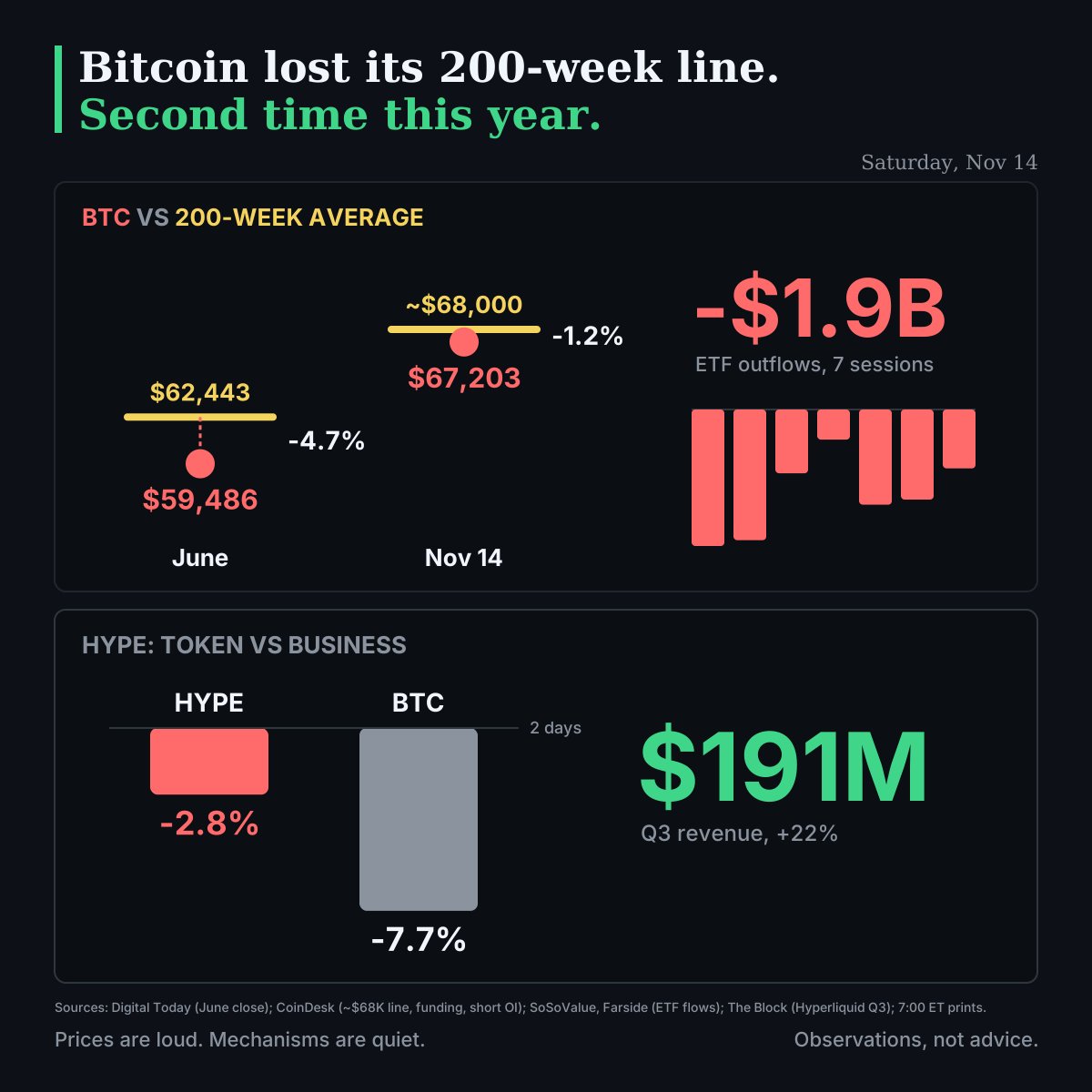
bitcoin:native: The 200-week average is the mean weekly close of roughly the last four years, about $68,000 today. Price only dipped under it near the bottoms of 2015, 2018 and 2020. Bitcoin closed a week under it at the end of June, $59,486 against $62,443, won it back in the summer rally, and fell through it again this week to its lowest since August. This time the selling has names. Spot ETFs have sold for seven straight sessions, $1.9B in all. Funding turned negative for the first time in a month, so shorts are paying to stay short, and short open interest sits above its August peak. In 2022 bitcoin lost this line in June and did not get it back for 16 months. The line is a level now, and price is on the wrong side of it.
hyperliquid:native: Down 7.1% overnight, the same week Hyperliquid posted its best quarter. Q3 revenue rose 22% to $191M and open positions hit a record $16.8B, passing Bybit, Kraken and OKX. Over two days the token is down 2.8% against bitcoin's 7.7%; Friday mostly handed back Thursday's bounce. The token trades the tape. The business does not.
In broader news: CoinDesk tied part of bitcoin's slide to demand for Anthropic's IPO. A new growth trade is now competing for the same risk dollars.
Observations, not advice.