External Member of the MPC @bankofengland; Senior Fellow, Brown University; Senior Fellow @chathamhouse; die hard @redsox fan; RT≠endorsement; opinions mine.
In fairness, a lot of growth has come from foreign money pouring into residential real estate…and construction is a higher productivity sector. But neither real estate nor tourism is scalable forever.
“Instead of the promised productivity increase via the bailout reforms, the Greek economy experienced the opposite: a sharp drop in labor productivity and a significant redistribution of employment toward low-productivity sectors.”
.@bankofengland's @economistmeg does not believe that pressure on central banks has abated, pointing to a backup in bond yields as a future concern.
"Central bank independence is absolutely vital for effective monetary policy," she tells @joshualipsky at our #IMFWBAM26 studio.
As debates on China's currency valuation ramp up in Europe, @bankofengland's @economistmeg told @joshualipsky at #IMFWBAM26 that an appreciation would increase import costs for the UK and impact inflation.
At our studio in Bangkok, @bankofengland's @economistmeg weighed in on what the IMF World Economic Outlook's upgrade to UK growth may mean for the British labor market and future interest rates.
.@bankofengland's @economistmeg explains why she voted to hike interest rates at our #IMFWBAM26 studio in Thailand: inflation and second-round effects.
"We've had successive supply shocks...and businesses and households are both much more attentive to inflation now," she says.
A TANTALIZING ANSWER TO THE BIGGEST MACRO QUESTION SINCE COVID
In today's newsletter, I argue that @timwillems85, Paolo Cavallino, and Paul Beaudry have published an important intervention in the ongoing debate about the post-Covid surge in interest rates.
The case for raising U.K. interest rates is growing https://t.co/ZswQ4tpx8R
My latest in @FT.
You can find more analysis behind it in my recent speech: https://t.co/sucMStcOi3
Here’s my latest speech on 2nd round effects, in which I:
👉Look at how energy shocks affect inflation
👉Analyse the shocks in 2011 & 2022 to gauge the extent of 2nd round effects now
👉Use scenarios to explore the appropriate monetary policy response
https://t.co/sucMStcOi3
There is still time to join us on 17 June at our Buxton campus for an inspiring CPD evening focused on SEND & inclusion in Early Years practice.🚀
All attendees will receive a Certificate on Attendance to help evidence their CPD!🚀
Book now👉️ https://t.co/wPlHORmUR3
Join us at The Cavendish Building for an insightful discussion with @economistmeg on the inflation risks linked to the recent global energy shock.
Explore insights, network with industry professionals and enjoy a complimentary buffet!
Book now: https://t.co/EyeUo9h0Oc
1/10
Important FT article by Mark Sobel, Brad Setser and Robin Brooks. They make the seemingly counterintuitive point that while incremental trade agreements, in which one side or the other agrees to buy a little more of this or a little less of...
https://t.co/lMczssQmyv
Join us at The Cavendish Building for an insightful discussion with @economistmeg on the inflation risks linked to the recent global energy shock.
Explore insights, network with industry professionals and enjoy a complimentary buffet!
Book now: https://t.co/6Zb4Hz4Tc6
Join us at The Cavendish Building for an insightful discussion with @economistmeg on the inflation risks linked to the recent global energy shock.
Explore insights, network with industry professionals and enjoy a complimentary buffet!
Book now: https://t.co/EyeUo9h0Oc
When global economies face one transitory shock after another, whether it's supply chain disruptions, the war in Ukraine or the war in Iran, are central banks equipped to deal with them?
@economistmeg joins @tracyalloway and @TheStalwart on the Odd Lots podcast to discuss the compounding effects of all these shocks and why, for now, she remains squarely focused on the risks of higher inflation https://t.co/qoGXjc1GMM
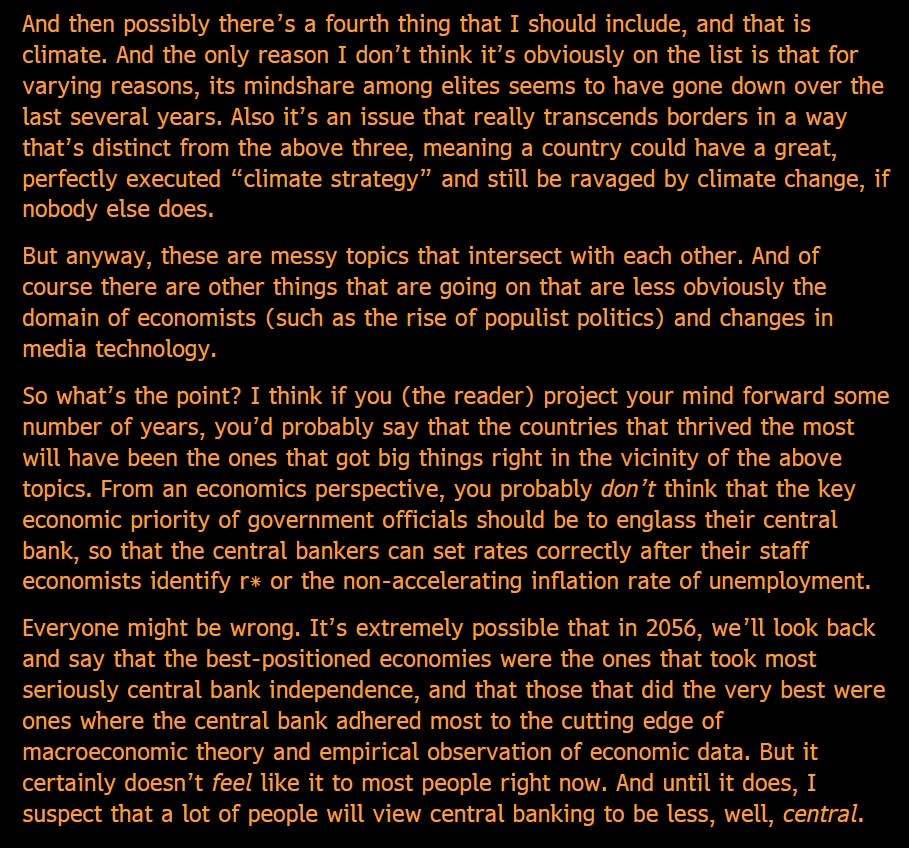
CENTRAL BANKING IN THE AGE OF THREE BIG MEGA-TRENDS:
In today's newsletter, I wrote about our conversation with @economistmeg and why central banking (I think) feels less central to the big economic challenges that every country on earth seems to be facing
When global economies face one transitory shock after another, whether it's supply chain disruptions, the war in Ukraine or the war in Iran, are central banks equipped to deal with them?
@economistmeg joins @tracyalloway and @TheStalwart on the Odd Lots podcast to discuss the compounding effects of all these shocks and why, for now, she remains squarely focused on the risks of higher inflation https://t.co/qoGXjc1GMM
NEW ODD LOTS
Monetary Policy in the Age of Supply Side Shocks
@tracyalloway and I talk to the great Megan Greene —- always @economistmeg to us — about how central banks are dealing with one inflationary episode after another https://t.co/y1tj2H3kJm
Many thanks to @tracyalloway and @TheStalwart for having me on Odd Lots to talk about UK monetary policy strategy in the face of yet another negative supply shock. Was great to see you guys again!
NEW ODD LOTS
Monetary Policy in the Age of Supply Side Shocks
@tracyalloway and I talk to the great Megan Greene —- always @economistmeg to us — about how central banks are dealing with one inflationary episode after another https://t.co/y1tj2H3kJm