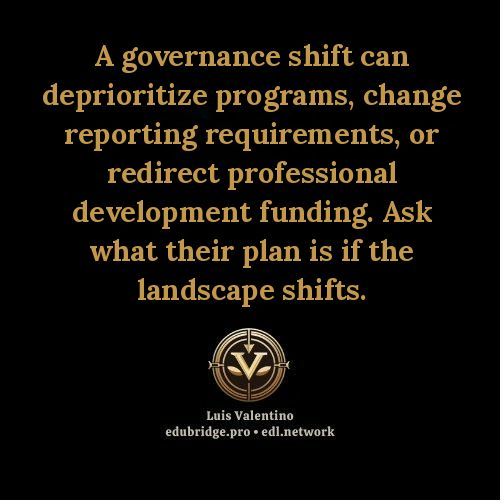
Vendor contracts don't account for what happens when the policy environment moves. This week's issue at https://t.co/tJbVNfT7SI does. California's restructuring transfers operational control of the Department of Education from an elected superintendent to a governor-appointed...
That sentence should change how you read every vendor proposal you receive. This week's issue at https://t.co/tJbVNfT7SI gives district leaders a four-question framework for evaluating vendor claims when the governance structure above them is in flux.
When governance shifts above you and vendors start repositioning, the pressure to make quick decisions will feel real. Resist it. Read this week's issue at https://t.co/tJbVNfT7SI.
When resources forced us to ask which partnerships actually served our instructional goals, the answers required evidence we didn't always have. This week's issue at https://t.co/tJbVNfT7SI names the gap and gives you a way to close it.
Endorsements are not evidence. This week's issue at https://t.co/tJbVNfT7SI gives district leaders a framework for telling the difference. As CAO I had to stand in front of my superintendent, the deputy, and the executive cabinet and justify every contract we kept.
Our vision and goals had not changed. What changed was the available resources.
When resources contract, the temptation is to treat it as a leadership crisis. It is not. It is a clarity moment. Read this week's issue at https://t.co/tJbVNfT7SI.
The vendors who will still be in your district five years from now are the ones whose value survives any transition. Read this week's issue at https://t.co/tJbVNfT7SI.
California's governance restructuring is the entry point. The real question is one every district leader faces: when the power structure above you shift. How do you evaluate the vendors still in the room?https://t.co/F9tPZoQpTN
Thirty-five years in education taught me that the leaders who hold genuine influence, not just compliance, not just politeness, understand that they are always being observed. Read the full article this week at https://t.co/tqBhpSkEmz . Not surveilled. Observed.
Districts remember. Teachers remember. Principals remember. That institutional memory is the reason trust is so hard to rebuild once it erodes. This week I wrote about how it gets built in the first place: https://t.co/tqBhpSkEmz.
“If we lose the midterms, these Democrats will turn every committee of Congress into an investigative body, and they'll go after the president's family, the cabinet, his donors, friends, half of you in this room will be targeted…”
You’re god damn right.
The sequence is non-negotiable. Attention first. Then connection. Then trust. Read this week's full issue at https://t.co/tqBhpSkEmz . Most leaders understand this intuitively when they think about relationships outside their organization.
Influence in schools does not flow through the org chart. It flows through networks. Full article at https://t.co/tqBhpSkEmz . James Spillane's research on distributed leadership makes this plain: teachers and principals who carry weight in a room do so before anyone speaks...
An informed public, a strengthened democracy. https://t.co/Tfycuo3k2a
American Oversight is a nonpartisan, nonprofit watchdog that advances truth, accountability, and democracy by enforcing the public’s right to government records.
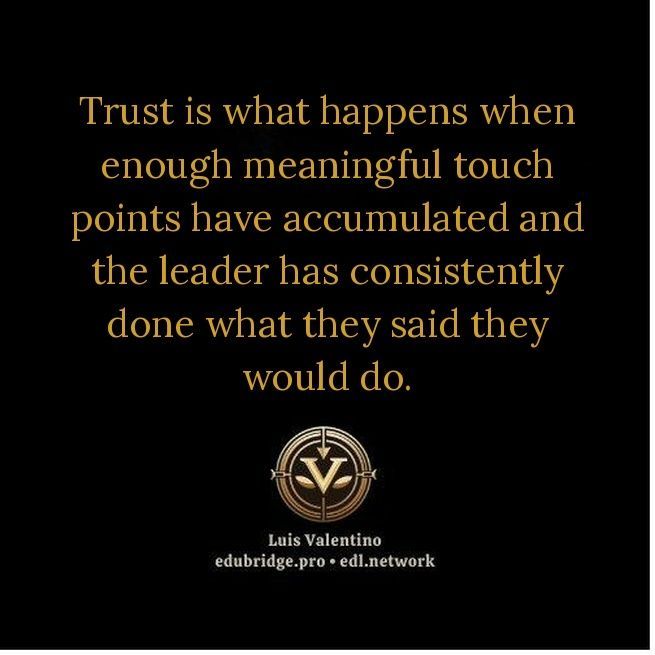
Trust is not a feeling. It is a record. This week's EDL issue unpacks the research behind how trust actually forms in school organizations: https://t.co/tqBhpSkEmz
There is a difference between being visible and being connected. Read the full article this week at https://t.co/tqBhpSkEmz . Most leaders attend the events, send the updates, and show their face at the right moments. That earns attention. Connection is something else.