Rene M Kern Prof of Prac at Wharton. Allianz Advisor. Gramercy Chair. Chair of UnderArmour Board. Former Pimco CEO/co-CIO and President of Queens' Col Cambridge
Good morning.
A big "thank you" to the one million of you for making this milestone possible.
I deeply appreciate your engagement, insights, and time.
My main goal here has always been to share what I find to be interesting economic and financial issues...with the occasional sports reference thrown in!
Most of my posts aren't aimed at asserting definitive conclusions, but rather to highlight the issues, data, and readings that can help us figure things out together.
Thank you very much for being part of this journey.
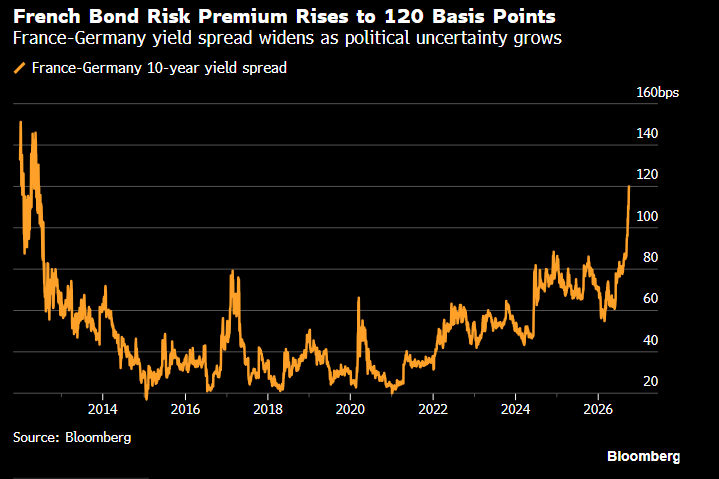
Meanwhile in Europe, while attention is understand centered on the 10-year France–Germany spread widening way past 100 bps in the last few weeks, what's happening at the short end is as interesting if not more so:
The 2-year spread between the two core eurozone sovereigns (Bloomberg chart) has surged to 62 bps—a stark signal of how rapidly markets have been repricing French sovereign risk.
#economy #bonds #germany #france #markets
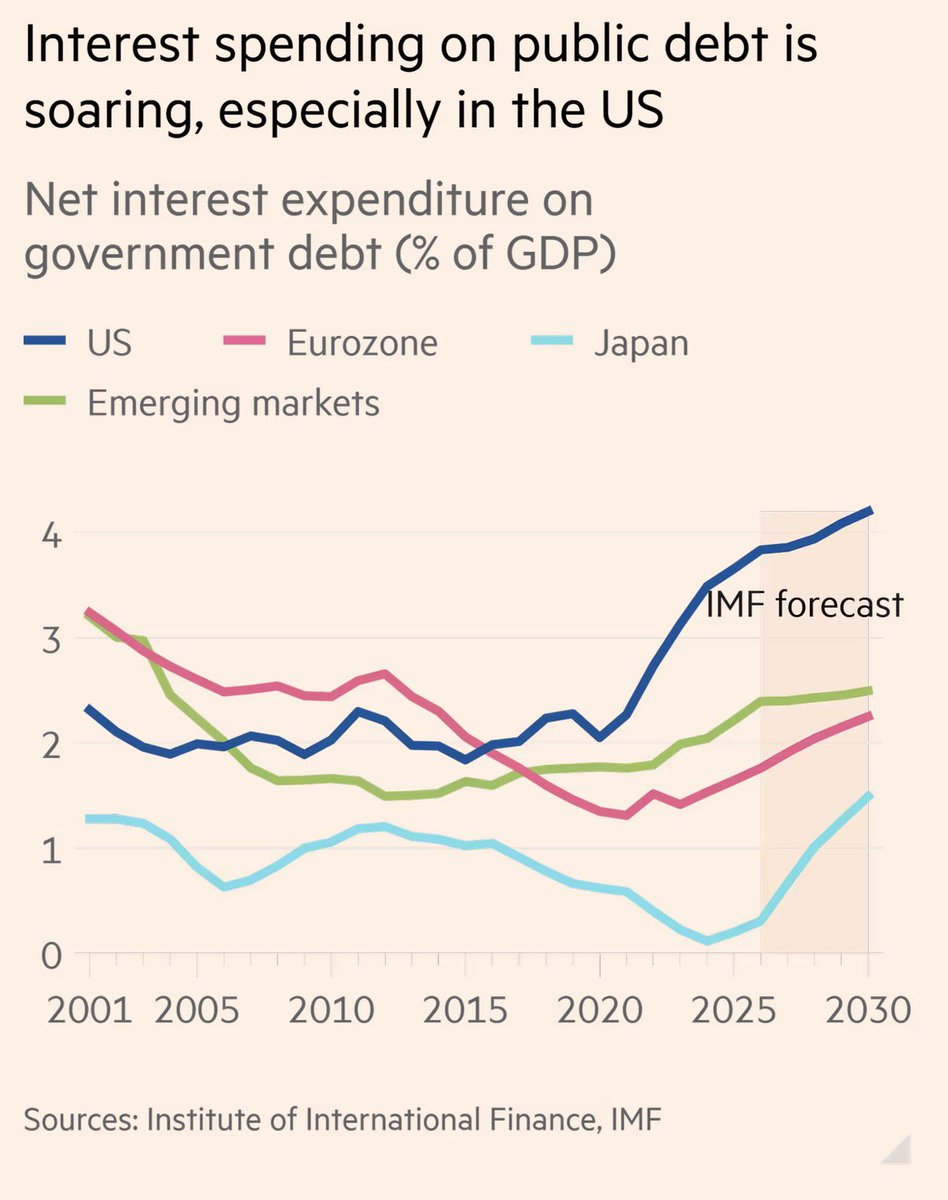
Three things to note when considering the influences on US government bond yields:
1. While Fedspeak this week has struck a hawkish tone, it was not quite as aggressive as the rate-hike trajectory currently priced in by markets.
2. While I have been pointing for months to the widening imbalance between surging higher supply and waning appetite from some dependable long-term buyers, the recent yield spike appears to have overshot this and other main drivers (a dynamic consistent with the growing footprint of hedge funds in this market segment).
3. On a relative valuation basis, US Treasury yields now look distinctly attractive when compared to some other sovereigns.
Even with these stabilizing factors, volatility and dispersion will remain defining market themes amid wider geo-economic crosscurrents. Moreover, I think the migration of interest rate risk into credit risk is still unfolding.
#economy #markets #bonds #yields
Today's US data releases, which come ahead of tomorrow's more comprehensive jobs report, point to continued robust economic activity, solid labor market, and greater cost pressures.
Specifically:
Labor market: With initial jobless claims below 200,000 once again (at 197,000), this partial indicator points to continued strength.
ISM Manufacturing: The slight dip in September to 54.5 (below the consensus forecast of 55.0 and down from 54.6 in September) occurred even though new orders beat expectations (55.3 vs. 54.7).
Price pressures: Costs are well ahead of expectations (79.9 vs. 73.0 consensus, up from August's 71.1). This is contributing to longer lead times for supply deliveries.
#economy #markets #inflation #growth
One should not underestimate the structural and secular challenges facing finance. Notwithstanding digital technologies’ exciting potential to unlock new efficiency gains, companies will face many new uncertainties, @elerianm writes. https://t.co/D0R6Uf8uKR
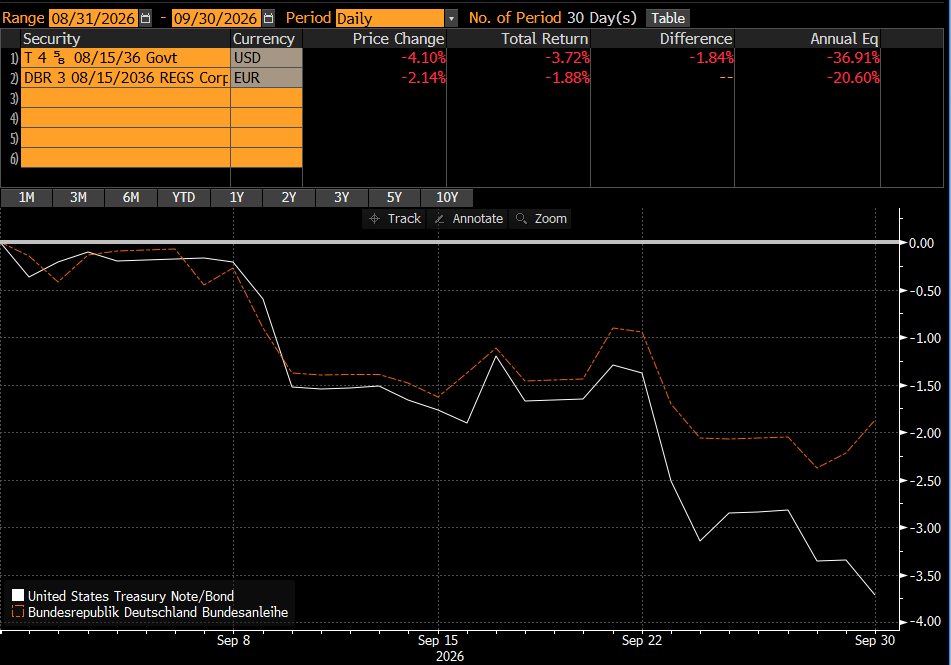
While on dispersion, have a look at this September chart of returns on 10-year government bonds:
US Treasuries were down twice as much as German Bunds (-3.7% versus -1.9%), reversing the prior US relative outperformance.
#economy#markets#bonds#yields
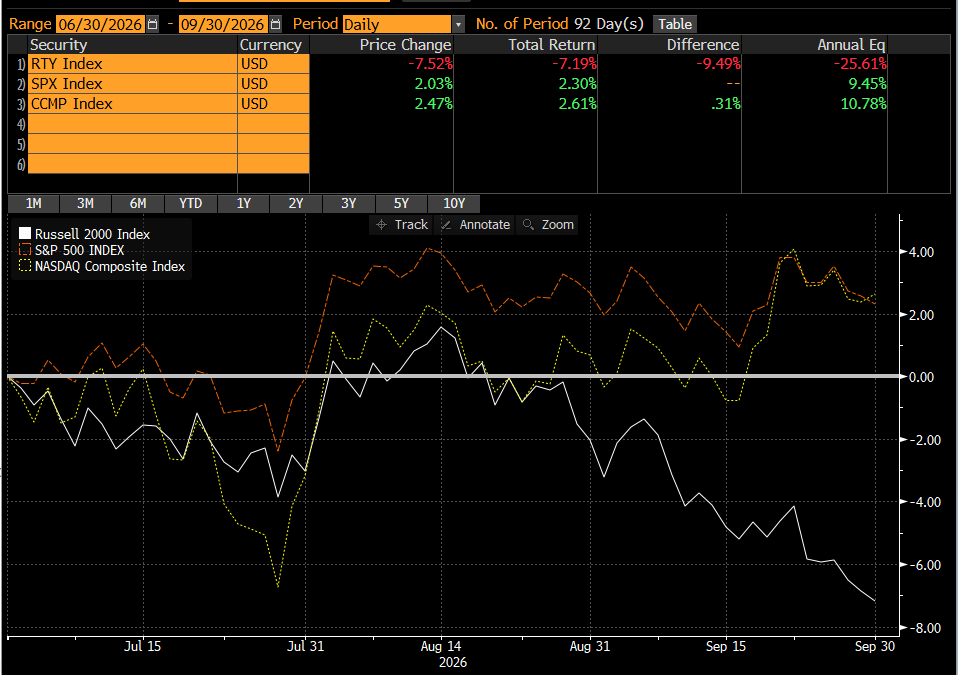
Responding to a question on US stock market dispersion:
This chart gives you a sense. The difference in Q2 returns between the Russell index (white) and both the S&P (red) and NASDAQ (yellow) is 9-10 percentage points.
#economy#markets#stocks#investing#investors
Entering the final quarter of the year, investors in US markets face two important questions:
• Equities: How far can dispersion go within the S&P, and if there's a limit, how does the eventual convergence play out?
• Fixed Income: How high is the bar for yields and spreads to entice buyers in size?
#economy #markets #investors #investing #stocks #bonds
Good morning.
It’s a new month for markets, but the dominant theme remains the same for now: upward pressure on government bond yields.
The UK 30-year gilt has climbed this morning to a level not seen since 1998, while both the US 10- and 30-year yields trade around those of 2002.
#economy #markets #yields #bonds
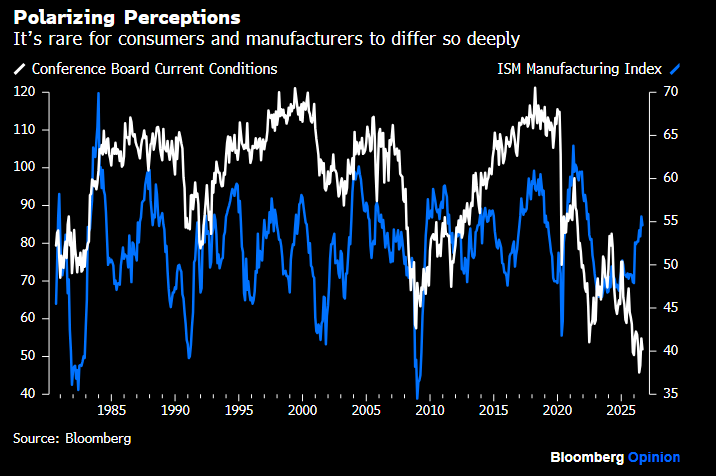
A great chart from John Authers illustrating the unusual decoupling between US consumer confidence and the manufacturing sector.
#economy#markets@johnauthers
US PCE data is out.
The Fed’s favorite monthly inflation measure was better than expected for core (0.2%) and in line at the headline level (0.3%).
#economy#inflation#markets
Good morning.
A busy week of US economic data continues this morning with what's traditionally seen as the Fed’s favorite inflation gauge: August PCE.
Consensus expects headline and core PCE to have risen 0.3% in August, putting annual rates at 3.7% and 3.3%, respectively (both unchanged from July).
Also watching income and spending data this morning ahead of Friday’s jobs report.
#economy #markets #inflation #federalreserve
News out of Europe that will not be welcomed by the ECB:
The latest inflation prints (3.4% for France, 4.1% for Italy, and 5.0% for Spain).
French sovereign spreads now trading 120 basis points over Germany.
#economy#europe#markets#inflation#France#Italy#Spain
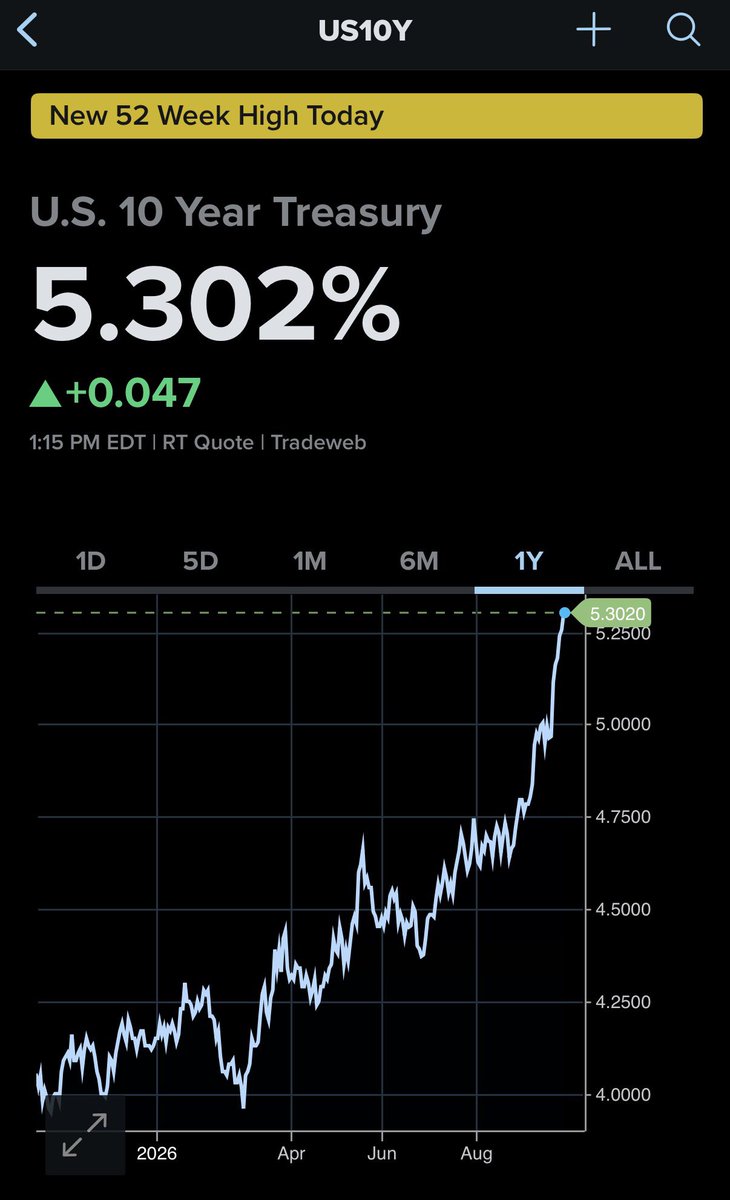
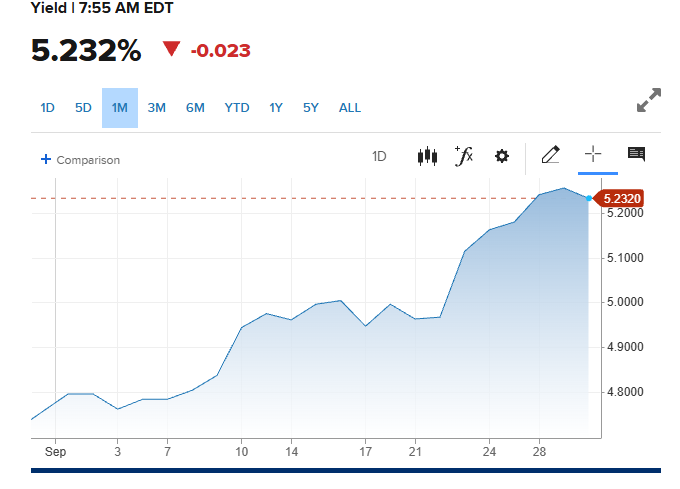
As illustrated in this CNBC chart, it has been quite a month for the fixed-income market.
The 10-year yield has moved up by around 50 bps to its highest level since 2007 (with a slightly larger move for the 2-year, while the 30-year has reached levels not seen since 2002).
Such a move raises two immediate questions for the global economy and markets:
Are we now in a new regime of protracted elevated rates?
Have we already seen the bulk of the spillovers onto other risk factors and the broader economy?
For what it's worth, and for the reasons detailed earlier, my answers would be yes, and no.
#economy #markets #yields #bonds
This is consistent with my prior posts on two major forces driving today's US Treasury market, fueling both higher and more volatile yields:
Fundamental Supply/Demand Imbalance: Greater demand for bond financing (across governments, tech, and other corporates) met with a less consistent pool of long-term buyers.
Market Composition: The growing footprint of "fast money" participants as a result.
#economy #bonds #markets #yields
Hedge funds are becoming a force to be reckoned with in the roughly $30 trillion U.S. Treasury market, stepping in at a time when some traditional long-term investors have been looking at other options.
The shift is helping the government find buyers as its pile of debt grows, but it may also be making the world’s largest bond market more vulnerable: https://t.co/knyk0OyLzX
Good morning.
A busy week of US economic data continues this morning with what's traditionally seen as the Fed’s favorite inflation gauge: August PCE.
Consensus expects headline and core PCE to have risen 0.3% in August, putting annual rates at 3.7% and 3.3%, respectively (both unchanged from July).
Also watching income and spending data this morning ahead of Friday’s jobs report.
#economy #markets #inflation #federalreserve