National State Support for Innovative Drone Startups Is Necessary for Global Leadership
National state support for highly innovative drone startups is necessary to help them to reach a global leadership. @BaykarTech is the best example. In October 2005, the then 26-year old engineer @Selcuk Bayraktar made a historical speech on the test side of Turkish Aerospace and said the following:
"If this project is supported, Türkiye could become number one in the world in unmanned aerial vehicles within five years. Seizing this opportunity is a great opportunity for Türkiye."
October 2005: Selçuk Bayraktar Mini UAV Flight Demo closing speech
https://t.co/G7jRUzIGaW
Four weeks before his important speech in Ankara, I was presenting a breakthrough in plasma wave propulsion and the world's first plasma-propelled airship in Esslingen in September 2005. It was a project funded by the Festo owner Dr. Wilfried Stoll who had already sponsored my diploma thesis on experimental plasma aerodynamics in 2000 at the @TUBerlin (Technische Universität Berlin).
Festo - b-IONIC Airfish
https://t.co/oQWDC1WyZ1
b-Ionic Plasma Wave Propulsion for Airships / 2005 - Ion Thruster
https://t.co/wR3hz0thJ5
Electroaerodynamics - History of the World's First Plasma Propelled Airships 2005 - 2008
https://t.co/fahsNrs7Cl
The project had originally started with full state support from the German Federal Ministry of Education and Research (BMBF) in 2004 and was named "Electrostatic Plasma Wave Propulsion by Polyphase Plasma Actuators". I had left the Future Projects Division of @RollsRoyce Germany to work on those 2012-2050 visions which I had defined for the company. I envisioned plasma technologies which would help us to reach global leadership by 2030.
Now I am calling the responsible person in the German Federal Agency of Breakthrough Innovation @SPRIND and @DoroBaer (Dorothee Bär) in Germany and @Tubitak (TÜBİTAK) in Türkiye: When my projects on plasma drones and novel air-breathing plasma jet propulsion systems at @ElectroFluidSys (Electrofluidsystems) are state supported now, we will reach global leadership in the next generation of aircrafts and unmanned systems within five years.
After the first flight of the Baykar Bayraktar Mini UAV in 2005, the family teamed up with financially strong company @kalekalipofcl (Kale Kalıp) to propose a professional product to the @TSKGnkur (Turkish Armed Forces). By end of 2006, they received a procurment contract and started to deliver the first mini UAVs in 2007.
In 2005, Selçuk and me did not know each other personally. We met the first time ten years ago in May 2015 at the International Defence Industry Fair @idefintl (IDEF 2015) in Istanbul. He even proposed me to do some CFD work for @BaykarTech. I was a bit proud then and had rejected his offer.
2015 was the year when Baykar finished the joint venture with Kale Kalıp after IDEF 2015. They were already in conflict since 2012 or even before when the since 1986 existing Baykar company independently received about 1 Mio USD state support to develop the first prototype for the now world-famous TB-2.
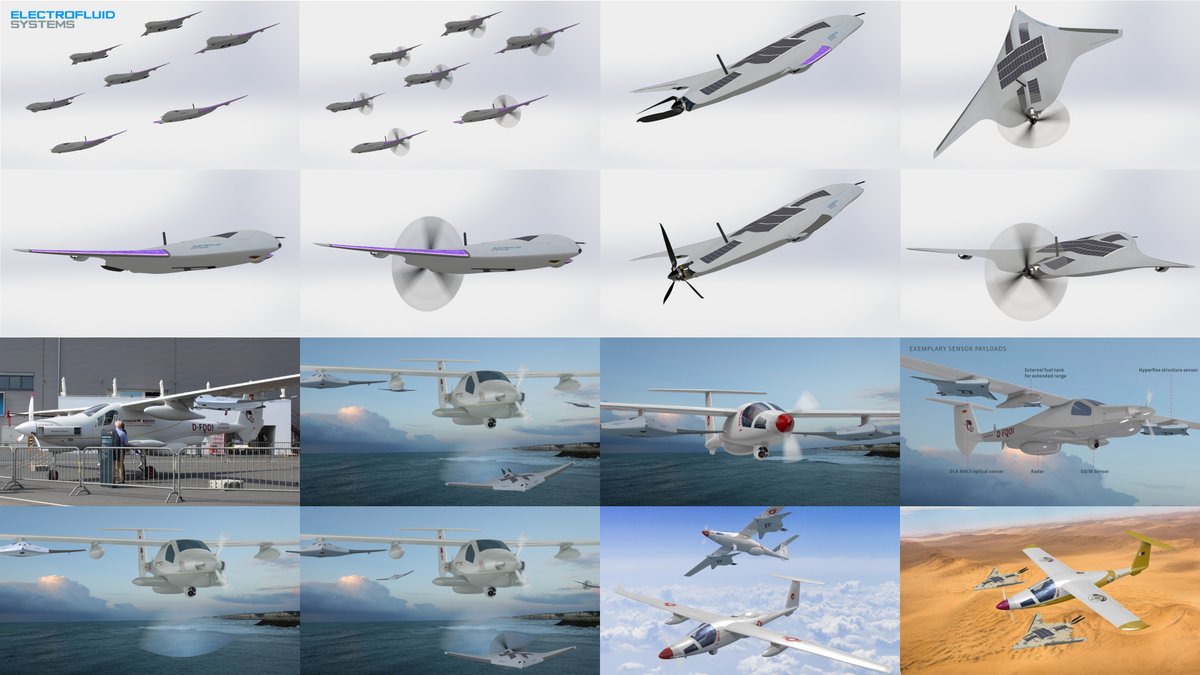
Our mini UAV concept Plasma Falcon was a bit different. I had already envisioned a fast flying wing interceptor in 2014 and presented the concept with a half ready preserial prototype at @ILA_Berlin 2016. When almost every reconnaissance drone and even the Baykar Bayraktar mini UAV were cruising with just 55-70 km/h, we designed an efficient flying wing UAV with a cruise speed of 130 km/h and a top speed of 180-200 km/h then.
In 2014-2018, everybody was laughing about the higher speeds as FPV drones were flown by freaks and kids then and nobody thought about that one day those quadrocopters with 130 km/h could be a serious threat for slowly flying mini and tactical UAVs. Today, these FPV drones are even a threat for the much more expensive Bayraktar TB-2 which was later modified and can now fly much faster and at higher altitudes to escape the new threat.
See also for my post about the new Ukrainian flying wing interceptor drone at
https://t.co/IRHvO3KmaK
At ILA 2016, we had a 15 sqm booth with @Airbus as our neighbor on the right and @roketsan in front of us. As mentioned above, the intercoptor idea was ahead of its time then. So there was no real interest except from General Khalid al-Kuwari from the Qatar Air Force who visited our booth with his delegation for a Turkish tea.
The General invested Millions of Euros to develop an optionally piloted multirole aircraft named Q01 with Dr. Reiner Stemme whose company previously developed the world's best motorgliders but was almost bankrupt before the development programme with Qatar had started.
The Q01 was scheduled to become the key aircraft of the Reconnaissance and Surveillance Center (RSC) of the Qatari military. It was designed in such a way that it fits in the hold of a Qatar Air Force C-17 military transport aircraft. And it was expected to procure an initial stock of seventeen Q01 aircrafts for service beginning in mid 2017.
The Q01 venture was funded by the government of Qatar and designed and developed by Reiner Stemme and engineers in Germany. The operational altitude was 30,000 ft. The aircraft could fly 12 hours with a payload of 1,322 lb including a Thales "Searchwater" system, a L-3 Wescam MX-20 and MX-25 electro-optical camera system and an unmanned Textron system. The endurance when flying unmanned was up to 50 hours.
The aircraft was powered by a Technify Motors CD-300 series diesel-fueled, twin-turbocharged engine with 310 horsepower and a three-bladed propeller. The max speed was 208 mph or 335 km/h. The operational range was 3,368 miles (5,420 km or 2,927 nm). The first flight of the prototype was in November 2015.
Unfortunately, the project was cancelled as no export permission was given for Qatar. So General Al-Kuwari stopped the project, took all the Qatari state money out of the venture in Germany and finished the company. That was a big loss for Germany then. Later on, we started a collaboration to develop new concepts until 2018. But that time, the General was settled in Paris where we also met.
The General was also responsible for the purchase of Baykar Bayraktar Mini UAVs for Qatar in 2012. That was a time when the Bayraktar family had some trouble. The cousin of Selçuk responsible for finance and accounting was killed and so on. So the order placed by the Qatari General was a big help. Bayraktar Mini UAV is the first Turkish drone which was exported to a foreign country. That was a big success story then.
https://t.co/vk024CqEuU
On 16 June 2025 at the Paris Air Show, @Leonardo_IT and @BaykarTech established a 50:50 joint venture for unmanned technologies named LBA Systems and based in Italy:
https://t.co/7iiyr9hle3
In 2008, Electrofluidsystems and AleniaAermacchi were partners in the European FP7 Project Proposal PALERCo (Plasma Actuators for Lift Enhancement and Rolls Control). I had invited all my European university and company customers and built a consortium for a five Million Euro project. My customer ONERA was invited to work on spark discharge actuators. But they wanted to be the coordinator, split my team which met in Berlin and invited me to join their new team. I rejected and continued with everybody except ONERA.
ONERA instead invited some universities which had few or no experience in plasma actuators then, used a French lobbying company and the advantage that France was leading the presidency of the Council of the EU in 2008. So our more advanced proposal PALERCo led by Electrofluidsystems was rejected and the PLASMAERO project led by ONERA was approved to receive 5 Million Euros.
As the PALERCo demonstrator, we wanted to use a plasma-controlled flying wing based on my Plasma Falcon which originally goes back to my hybrid flying wing megaliner studies from 1998 at TU Berlin. AleniaAermacchi and EADS Innovation Works were my industrial customers and team members in PALERCo.
My company provided AleniaAermacchi's new plasma lab with six or eight of our most powerful plasma generators and trained their engineers to build and experiment with plasma actuators. In 2016, Alenia Aermacchi became part of Leonardo as a result of a corporate restructuring. They were integrated into Leonardo's Aircraft and Aerostructures Division.
Today is start of the 17th IDEF 2025 in Istanbul. There will be a lot of new products and technologies from all around the world.
22 July 2025
BG @TolgaOzbek_com
Yartura DANCER 4.5.0 - Interceptor Drone with 450 km/h Max Speed - World's Fastest Propeller Driven Fixed-Wing Interceptor Drone from Ukraine
We could recently read in the Ukrainian news about an extremely fast interceptor drone which was unveiled by the Kyiv-based Yartura company. The propeller-driven drone has an interesting name and is called DANCER 4.5.0. During first test flights, the automatic target acquisition system (ATTS) demonstrated the ability to re-engage while performing complex dance-like flight patterns around the target.
The "4.5.0" next to it shall be a reference to a radio code in military slang. The Ukrainian Armed Forces shall use the numbers 4.5.0 to say "all is calm," "everything is alright," or "situation under control." So when a soldier radios this number, it shall mean there is no enemy activity and no danger in their sector.
The new drone is most interesting but was almost unnoticed in the Western news. It exactly addresses the maximum speed limit which we at Electrofluidsystemswere also looking for as we are always ambitious to make a world's first. That's why we often publish competitor studies and challenge the outdated low cruise speed range from 60-75 km/h:
https://t.co/10SGQjUkfX
Flying 7 or 5 hours with 60 km/h is not impressive anymore when you can now reach the same flight range of 440 or 310 km with 142 or 179 km/h in 3 or 1.8 hours. You also have a better chance to fly away from interceptor drones by reaching maximum speeds beyond 250+ km/h in horizontal flight.
Today, it is still not well known that 450 km/h is currently about the top speed which can be reached with off-the-shelf speed propellers for drones with a maximum take-off weight from 6 to 12 kg. Anything smaller would have not sufficient range as the battery weight and energy density would be too small.
The best maximum takeoff weight seems to be from 9-12 kg as we have for the Corona Bat 1.11. Then, we can find new batteries with about 300 Wh/kg and an acceptable maximum continous discharge current higher than 190 A. That's important to save the expensive pneumatic launcher and let the drone make an almost vertical high-speed self-launch from 60-90° ramps.
In this regard, our Corona Bat 1.11 with 12 kg won't be the fastest propeller driven interceptor drone anymore but would have the world's best range at extreme speeds.
B. Göksel / Electrofluidsystems
8 June 2026
YARTURA unveils DANCER 4.5.0 drone that intercepts targets at 450 kmh
https://t.co/6Ba1LJlqVW
Ukrainian Firm YARTURA Unveils DANCER 4.5.0 Interceptor Drone - And it Speeds Up to 450 km/h
https://t.co/PzMLloYtiO
#Asterion #Auterion #CoronaBat #CUAV #Dancer #Intelligence #IntelligenceDrone #Interceptor #InterceptorDrone #HitchHiker #HitchHikerOrionE #PlasmaFalcon #SiriusIntelligence #SiriusInterceptor #UAV
Boeing F-47 Phoenix - Futuristic Klingon-Style or XB-70 Valkyrie-Type of 6th-Generation Plasma Stealth Fighter with Mach 3+ Capabilities based on Plasma Shock Wave Mitigation, Plasma Controlled Infrared Signature Masking of Exhaust Plumes and Plasma Contrail Suppression??
@ChrisSchmitz made interesting comments regarding the "cold jet with no discernable exphaust plume" and noticed that "this is, if real, godtier thermal management." And yesterday, he uploaded an interesting video also discussing the exhaust nozzle and thermal management system of the F-47's three-stream adaptive cycle engine P&W XA103. That engine "can direct air to the bypass third stream for increased fuel efficiency and cooling or to the core and fan streams for additional thrust and performance."
https://t.co/ycmEfptrCD
https://t.co/VqrS2kG4Sv
But is sophisticated air mixing alone sufficient to make an almost perfect infrared masking of the exhaust plumes as we can see on the @ProjectFearX regarding @Boeing's Penetrating Counter-Air (PCA) X-plane demonstrator for @DARPA and the @USAirForce Next-Generation Air Dominance (NGAD) Fighter Program?
We don't know for sure but would like to show you some interesting open-source publications about more exotic thermal management and shock wave splitting systems based on High-Tech Plasma Processes (HTPP).
Were these plasma technologies originally developed for the @NorthropGrumman B-2? The question is highly speculative but it is quite possible. And @Boeing was principal subcontractor on the B-2 Spirit program and also initially involved in the B-21 Raider program's preliminary stages including wind tunnel testings.
In 1979, Northrop studied two basic mission profiles: 1. Low Altitude Penetrator as a low-span lifting body and 2. High Altitude Penetrator as a long-span flying wing. The first concept was based on a supersonic slender delta wing. And both concepts were aerodynamically designed by Hans Werner Grellmann. See here for his AIAA-paper "B-2 Aerodynamic Design" from 1990: https://t.co/qRzaxZzKQM
From the end 60s to the 70s, Northrop published a series of interesting papers on supersonic plasma aerodynamics (electroaerodynamics). They used negative corona discharges to split shock waves but never went into details or discussed any theory. They obviously knew what they were doing as only negative discharges have a so-called Trichel regime, a transitional state between a low-current Townsend and high-current glow regime.
The charge density is important and must reach a criticial point. But it is even more important to have a pulsed regime to generate controlled or use uncontrolled plasma solitary waves. The uncontrolled case is a series of Trichel pulses with usually 50-100 kHz. These are nanosecond high voltage discharges and produce very fast ionization waves. Those ion-acoustic solitons travel with speeds far beyond the speed of sound and can act as "phantom bodies" and split shock waves even at hypersonic speeds.
There are different methods based on pulse modulation, wave mixing and so on. The wave drag of the sum of those weaker shocks is much lower than the drag of the previous strong shock. In such a case, there should be no sonic boom anymore. The final effect is partly comparable with the action of mechanical bumps or ramps to split transonic shock waves on wings or supersonic inlets. In the same way, shortly pulsed plasma discharges can be also used to damp the shocks on fast running helicopter blades and propellers. Imagine stealth helicopters which can be made silent by just switching on a plasma field.
"In 1968, Aviation Week reported that Northop was evaluating “electrical forces to condition the air flowing around an aircraft at supersonic speeds“ to reduce drag, heating and sonic boom effects. The findings were promising enough to justify funding of additional research (AW&ST Jan. 22, 1968, p. 21). By negatively ionizing air molecules ahead of an aircraft, then charging the nose to the same polarity, an electrostatic field was formed. The field tended to repel or alter the molecules‘ path as the aircraft approached, according to the article.
If the “black world“ actually has developed feasible ways to reduce airframe drag substantially with controlled electrostatic fields, commercial aircraft manufacturers and airlines should be campaigning mightily for the technology. The potential fuel and cost savings for just American, United and Delta would be staggering."
W. B. Scott, “Black world engineers, scientists encourage using highly classified technology for civil applications,” Aviation Week & Space Technology, March 9, 1992, pp. 66-67.
---
Today, researchers at Arizona State University (@ASU) and @NorthropGrumman are working on a new project to create power transistors from diamond. Power transistors have traditionally been made with silicon. But the ASU Advanced Materials team, working with Northrop Grumman Mission Systems, is investigating diamond because it dissipates heat 8 to 10 times more efficiently than current materials. This means harnessing diamond to its full potential could reduce the size of power transistors by 90 percent.
Silicon has long been the standard material for semiconductor devices. Power transistors regulate the flow of electrical power and have traditionally been made with silicon, while more advanced modern transistors are made of materials such as silicon carbide or gallium nitride." This was a news by Techbriefs from January 27, 2023. https://t.co/7yIBrWrfDw
Frank A Koeck from ASU published papers on microwave plasma chemical vapor deposited (CVD) diamond films and their applications as field electron emitters since 2003.
https://t.co/MwxAU9DWxN https://t.co/TqCwDaVyXI https://t.co/UW58qqAikV
His latest paper about diamond diodes was published with colleagues from Northrop Grumman in February 2024. https://t.co/Oc7Pfo0AeY
But the breakthrough for diamond transistors came in Januar 2024 from Japan which is currently also leading the world in the field of plasma metamaterials.
https://t.co/QrkHvqlZVN https://t.co/hYnlyLR5iu
"The 1980s witnessed the first growth of diamond by CVD, followed by the exploration of doping processes in the 1990s. Since then, those involved in developing synthetic diamond have expanded their knowledge of this material, in terms of characterisation, manufacturing and processing. As a material for power electronics, what is the promise of diamond? Well, it has an ultra-wide band gap, an exceptional carrier mobility, a breakdown voltage estimated at a tantalizing 10 MV/cm, and the best-known thermal conductivity.
Thanks to these phenomenal attributes, diamond has been called the ultimate power semiconductor. Devices made from this form of carbon have the potential to boost the voltage of components while increasing their efficiency, trimming losses and cutting costs."
Please find more about the pioneering Japanese work on plasma metamaterials in our essay from 14 November 2021 on "How to Use Plasma Metamaterials to Make Aircrafts Invisible" and follow our Linkedin page at
https://t.co/S3k8ofispV
We can see in the second synchronized video with the optical camera that the X-Plane demonstrator for the F-47 is using a very bright lamp or an extreme light emitting coating based on smart skin electrochromic materials as extreme brightness can overhelm and saturate infrared (IR) sensors by excess noise. But the modern IR camera from @ProjectFearX is obviously less vulnerable and can highly effectively filter out IR noise and ambient interference via digitial signal processing algorithms to isolate the target signal from background noise.
Extreme brightness can be also used for other means of visual stealth: "Yehudi lights are lamps of automatically controlled brightness placed on the front and leading edges of an aircraft to raise the aircraft's luminance to the average brightness of the sky, a form of active camouflage using counter-illumination. They were designed to camouflage the aircraft by preventing it from appearing as a dark object against the sky.
The technology was developed by the @USNavy from 1943 onwards, to enable a sea-search aircraft to approach a surfaced submarine to "within 30 seconds of flying time"[1] before becoming visible to the submarine's crew. This in turn enabled the aircraft to engage the submarine with depth charges before it could dive, to counter the threat from German submarines to allied shipping. The concept was based on earlier research by the Royal Canadian Navy in its diffused lighting camouflage project."
https://t.co/D8qMMuEv8p
Today, flashlights use no classical lamps anymore and are based on high-powered LED arrays. In 2019 for instance, we could read that "an even more exotic skin is being tested on two stealth aircraft in Nevada. The smart skin is derived from an electromagnetically conductive polyaniline-based radar-absorbent composite material. It is optically transparent except when electrically charged, much like the LCDs used in laptop computers. What makes this new material attractive is that it can change brightness and color instantaneously.
Photo-sensitive receptors, mounted on all sides of the plane, read the ambient light and color of the sky and ground. An onboard computer adjusts the brightness, hue, and texture of the skin to match the sky above the plane or the terrain below it."
LumiLor for instance is a such a conductive, colour-changing paint that turns on and off by reacting to an electric charge. It can change cars to driving mega-displays. BMW also presented such a paint on the iX E Ink at CES 2022:
https://t.co/jVovbelI8P
https://t.co/XYCxA0qiGj
Today, "lightweight panels that are able to change colour on demand" can give even mini "defence drones the chameleon effect, letting it change colour matching the background."
https://t.co/r4OPiLFeVH
https://t.co/etLFA95BTX
"UAV visual signature suppression via adaptive materials" was already demonstrated 2005 on a mini drone with 2m wingspan. It was fitted with optically adaptive electroluminescent sheets to drop the Visual Cross Section (VCS) from 4,200 cm² to less than 1.8 cm² at 100 m. That's very impressive and could be easily adopted on future high-tech mini drones using more lightweight paints and panels. https://t.co/JVmFVHzowV
So imagine what might be already possible on very expensive high-tech stealth aircrafts and drones like the B-21 Raider or the RQ-180 to make them almost invisible to the naked eye.
https://t.co/N9Zg8rP2PC
In this regard, a futuristic Klingon-style or XB-70 Valkyrie-type @Boeing F-47 Phoenix might be very stealthy. It might even use high-tech plasma tech to fly faster than the legendary Mig-31 and Mig-25 Foxbat which still keeps the world altitude record with 37.65 km (123,523 ft) and could pass Mach 3.2 at 27 km (89,000 ft).
But now let's come back to exotic thermal management and contrail suppression techniques using high-tech plasma processes. Hold on and read what was written in the above mentioned legendary @AviationWeek & Space Technology article "Black world engineers, scientists encourage using highly classified technology for civil applications" published by William B. Scott in the March 9, 1992 issue on page 66-67:
"Engineers working on highly classified programs cited other technologies that appeared to this editor as only military related. They said that – if the principles were widely understood – though, there would be definite commercial applications. One was a ��thermal signature masking technology … which is used on the B-2 [stealth bomber],“ an engineer said.
“Basically, it‘s an electrostatic heat transfer phenomena that charges the jet engine exhaust stream to disperse the heat by a factor of about 800. It does a remarkable job of altering the thermal signature.“ He said the same basic technology, used in wing leading edges, can reduce a flying vehicle’s radar cross section (RCS) by masking thermal signatures created by aerodynamic perturbations of the air.
“The radar signature of an incoming warhead can be reduced to less than 10%“ of its normal value, the engineer said. “We found that radar cross section had a lot to do with aerodynamics and turbulence - past certain speeds.“ Electrostatic field-generating techniques in the B-2’s wing leading edges may help reduce ist RCS. The bomber’s leading edges posed a particularly challenging production problem on the first aircraft, and may have been the source of diminished results during early stealth flight test.
In 1968, Aviation Week reported that Northop was evaluating “electrical forces to condition the air flowing around an aircraft at supersonic speeds“ to reduce drag, heating and sonic boom effects. The findings were promising enough to justify funding of additional research (AW&ST Jan. 22, 1968, p. 21). By negatively ionizing air molecules ahead of an aircraft, then charging the nose to the same polarity, an electrostatic field was formed. The field tended to repel or alter the molecules‘ path as the aircraft approached, according to the article.
If the “black world“ actually has developed feasible ways to reduce airframe drag substantially with controlled electrostatic fields, commercial aircraft manufacturers and airlines should be campaigning mightily for the technology. The potential fuel and cost savings for just American, United and Delta would be staggering. A scientist said other, more dramatic, classified technologies are applicable to lasers, aircraft control and propulsion.
However, the scientists and engineers were especially hesitant to discuss these projects. One said they are “very black. Besides, it would take about 20 hr. to explain the principles, and very few people would understand them anyway.“"
---
Imagine hypersonic aircrafts and drones with turbojet engines running from horizontal take-off to hypersonic speeds beyond Mach 7+. In combination with a bow shock-splitting nanosecond pulse plasma triggered MHD counterflow jet system those "shockless" vehicles would be really cool without a sonic boom. Here you can find a Vision for a MHD-Controlled Turbojet Engine for Sustained Hypersonic Flight by the Legendary Isaiah Blankson from @NASA who openly writes here on his presentation from 2014 that “shockless” supersonic flow is possible!
https://t.co/fj4INa9t9H
So let's go back to the roots and start with Robert von Helmholtz, the son of the German physicist Hermann von Helmholtz who first demonstrated the amazing effect of corona discharges and sulfide acid on water vapor condensations almost 139 year ago: "Versuche mit einem Dampfstrahl" ("Experiments with a steam jet") (1887).
The former research group around professor Charles Krüger at @Stanford University pioneered some of the cutting-edge work on plasma stealth using (structured) electron clouds from diamond emitters and plasma controlled thermal infrared signature masking by air plasma radiation. See here for some of his public reports:
Final Technical Report on INFRARED SIGNATURE MASKING BY AIR PLASMA RADIATION for the Period June 1, 1997 to October 31, 2000 submitted by Charles Krüger and Christophe Laux. https://t.co/NU1094hdY2
Annual Scientific Report on INFRARED SIGNATURE MASKING BY AIR PLASMA RADIATION for the Period June 1, 1997 to July 31, 1998 submitted by Charles Krüger and Christopher Laux.
https://t.co/cWQ3Oyc5BF
Charles Krüger was one of the leading scientists who pioneered atmospheric diamond synthesis for aerospace applications in the 80s and 90s.
Today, these are also key technologies for novel plasma anti-/de-icing methods as we use on our Corona Bat 1.11. More details about the world's most advanced high-tech mini UAV will be soon released. So please keep following us. We make dreams fly.
B. Göksel / Electrofluidsystems
7 June 2026
@Aviation_Intel @MMcMillin @ProjectFearX @RodrigoAvella @RotorFocus @RupprechtDeino @SentDefender @Test_User_X1 @TheAviationist @TheNewArea51 @TheWoracle @TheWarZoneWire @TolgaOzbek_com @UncannyEx @ValkStrategy
#Area51 #Boeing #Breakthrough #BreakthroughInnovation #Camouflage #ChameleonEffect #Cloak #Cloaking #ColoumbClusters #ConductingPolymers #CounterIllumination #DisruptiveTechnology #DustyPlasma #Electroaerodynamics #ElectrochromicCamouflage #ElectroluminescentLight #ElectroluminescentPaint #Electromagnetism #GroomLake #F47 #F47Phoenix #Innovation #Insivibility #LightEmittingCoating #MagnetizedPlasma #MagnetoPlasma #Metamaterial #Phoenix #Plasma #PlasmaAerodynamics #PlasmaCrystals #PlasmaMetamaterial #PlasmaSolitons #PlasmaStealth #Polyanilines #Polythiophenes #Polypyrroles #ProjectFear #QDPolymerParticles #QuantumDotPolymers #SmartSkin #Soliton #SolitonWave #Stealth #StealthFighter #Tesla #VisualCloaking #VisualStealth #Yehudi #YehudiLights
Boeing's 6th-Gen Stealth Fighter F-47 Phoenix Based on Northrop Grumman's "Christmas Tree" Fighter Concept Crafted 1983 by Darold Cummings (Designer of the YF-23 Black Widow)
Yesterday, we have seen a first video release of the X-Plane demonstrator for @Boeing's new 6th-gen stealth fighter F-47 Phoenix which is obviously based on @NorthropGrumman's "Christmas Tree" fighter concept crafted 1983 by Darold Cummings, the chief-designer of the joint Northrop Grumman - McDonnell Douglas (Boeing) stealth fighter demonstrator YF-23 Black Widow.
The latest 2025 renderings by Reddington777 from https://t.co/7lkgloc2Yw and @RodrigoAvella are amazingly close to what we have see yesterday in the video released by @ProjectFearX. You can find 22 high-resolution images on Rodrigo's project page named "F47 Concept - V4" at https://t.co/hVx7vjOEvY
These are amazing synchronicities. So will the Trump administration allow us to see new F-47 details just before the start of the next @NATO Summit in Ankara from 7-8 July 2026?
We don't know but there is an almost unnoticed video from Pratt&Whitney which was released by @RTX_News on 24 June 2025 without an official press article just before the start of the @NATO Summit in The Hague from 24-25 June 2025 and shows an interesting front view for F-47 type of next-generation fighter: P&W XA103 https://t.co/1SZBXpOQpj
On 18 February 2026, RTX released the official press article "Fast-tracking the fighter jet engine of the future: How Pratt & Whitney is using digital tools to speed development of its adaptive engine" with a video of the XA103 engine inside a hypothetical design of the Next-Generation Air Dominance (NGAD) fighter. The XA103 engine is currently under development for the @USAirForce's Next Generation Adaptive Propulsion (NGAP) program: https://t.co/m05HoHHaHC
Is this maybe the final production version of the F-47 Phoenix?
It has at least amazing similarities with a design presented by Darold Cummings for a F-47 Navy version named F-47N. See here for more details:
https://t.co/S4pB5yqCGN
Darold writes that he "used (his) original F-47 wing planform, and added a canard for more low speed lift and control. The canard design (inspired by the X-36), coupled with the Multi-Axis Thrust Vectoring (inspired by the X-44), provided a very reasonable first cut at a Navy version. In general, a canard layout has been treated as adding more radar signature to a fighter.
However, on the YF-23 we found that if the all-moving surface (it was a V-tail on the YF-23) was kept "ported", in this case aligned with the wing plane during cruise, the impact on LO was not a large impediment to signature reduction. The ability to keep the canard ported is achievable using thrust vectoring for trim in cruise and penetration modes."
Regarding the "Chrismas Tree" Fighter Concept, please have a look at
https://t.co/v48tVZZX6Z
Analysis and Composition by
B. Göksel from Electrofluidsystems
6 June 2026
@Aviation_Intel@TheNewArea51@TheWarZoneWire@TolgaOzbek_com@ValkStrategy
#Area51 #Boeing #F47 #F47Phoenix #Phoenix #ProjectFear #StealthFighter
Boeing F-47 - Futuristic Klingon-Style 6th-Gen Stealth Fighter
Here is a video regarding the X-Plane for the futuristic Klingon-style 6th-gen stealth fighter Boeing F-47 which might have some spanwise morphing wing elements, fluidic thrust vectoring and very advanced flow control technologies based on fluidics and plasma flow control. The original video was released by @ProjectFearX just three hours ago:
https://t.co/xOWU9ow4wH
See also for my previous comment regarding the almost forgotten stealth fighter design signed by Darold Cummings in 14 June 1983:
https://t.co/RkFycwuWLR
The new sixth-generation fighter F-47 has indeed design elements of the legendary Bird of Prey ("YF-118G") and X-36 which both were scale-models of tailless fighter aircrafts with first flights in 1996-1997:
https://t.co/otLZ0DHo6z
https://t.co/Bl6OBFzUGB
There are some very interesting renderings by an artstation user named indowflavour which we had already discovered almost one year ago. He just name his design interpretation "F-47A Harpy Eagle" and "F-47A Thunderbolt III":
https://t.co/loua8JLgi8
See here for a previous LinkedIn post at
https://t.co/e2RjQ93CfW
Today, @Boeing has the capabilities to make an almost flapless aircraft like the Chinese 6th-gen fighter J-36, which looks like a multirole fighter-bomber for low altitude and high altitude penetration.
@AuroraFlightSci as a @Boeing company built and just tests the flapless X-65 for the Defense Advanced Research Projects Agency (@DARPA) programme "Control of Revolutionary Aircraft with Novel Effectors" (#CRANE).
The X-65 was designed to demonstrate the benefits of active flow control (AFC) at different flight conditions. See here for a video:
https://t.co/FHADgmwzq9
Boeing (McDonnell Douglas) already used boundary layer control (BLC) on a Naval F-4 Phantom derivative in the 1950s:
https://t.co/ovQJq95Fi2
In 2019, Will Roper was the assistant secretary of the United States Air Force for acquisition, technology and logistics. He said that “NGAD has come so far, that the full-scale flight demonstrator has already flown in the physical world and it’s broken a lot of records in the doing."
What does it mean? Has one of the NGAD prototypes broken the altitude and speed records of the legendary SR-71 mentioned in the video?
We also don't know the top speed of the new Chinese 6th-gen fighter J-36. Has it Mach 3+ capabilities at extreme altitudes using variable cycle engines and plasma-based shock-wave mitigation methods?
Some of the new 6th-generation fighters may exceed Mach 3+ and thus be faster than the MiG-31 (22.62 m, 46 t, 2x 152 kN) with Mach 2.83 (3.20) at 21,500 m (25,000 m) and SR-71 (32.74 m, 78 t, 2x 151 kN) with Mach 3.36 at 26,000 m.
The J-36 (23 m, 55 t, 3x 180-200 kN) with advanced variable cycle engines can be a Mach 2+ but also have Mach 3+ capabilities at extreme altitudes.
At 15-26 km (50,000-85,000 ft), the engines need active flow control. The use of megawatts for lasers and plasma systems will make active flow control a must to be. Follow @Electrofluidsys tems as We Make Dreams Fly.
B. Göksel / Electrofluidsystems
5 June 2026
PS: Last year I already analysed the J-36 and F-47 in an interview with @TolgaOzbek_com where we have also shown those amazing renderings seen here:
https://t.co/lZjp83tpj4
https://t.co/V4R1wPjbNc
@Aviation_Intel@ProjectFearX@TheNewArea51@TheWarZoneWire@ValkStrategy
#F47 #Area51 #HarpyEagle #ProjectFear #StealthFighter #ThunderboltIII
Boeing F-47 - Futuristic Klingon-Style 6th-Gen Stealth Fighter
Here is a video regarding the X-Plane for the futuristic Klingon-style 6th-gen stealth fighter Boeing F-47 which might have some spanwise morphing wing elements, fluidic thrust vectoring and very advanced flow control technologies based on fluidics and plasma flow control. The original video was released by @ProjectFearX just three hours ago:
https://t.co/xOWU9ow4wH
See also for my previous comment regarding the almost forgotten stealth fighter design signed by Darold Cummings in 14 June 1983:
https://t.co/RkFycwuWLR
The new sixth-generation fighter F-47 has indeed design elements of the legendary Bird of Prey ("YF-118G") and X-36 which both were scale-models of tailless fighter aircrafts with first flights in 1996-1997:
https://t.co/otLZ0DHo6z
https://t.co/Bl6OBFzUGB
There are some very interesting renderings by an artstation user named indowflavour which we had already discovered almost one year ago. He just name his design interpretation "F-47A Harpy Eagle" and "F-47A Thunderbolt III":
https://t.co/loua8JLgi8
See here for a previous LinkedIn post at
https://t.co/e2RjQ93CfW
Today, @Boeing has the capabilities to make an almost flapless aircraft like the Chinese 6th-gen fighter J-36, which looks like a multirole fighter-bomber for low altitude and high altitude penetration.
@AuroraFlightSci as a @Boeing company built and just tests the flapless X-65 for the Defense Advanced Research Projects Agency (@DARPA) programme "Control of Revolutionary Aircraft with Novel Effectors" (#CRANE).
The X-65 was designed to demonstrate the benefits of active flow control (AFC) at different flight conditions. See here for a video:
https://t.co/FHADgmwzq9
Boeing (McDonnell Douglas) already used boundary layer control (BLC) on a Naval F-4 Phantom derivative in the 1950s:
https://t.co/ovQJq95Fi2
In 2019, Will Roper was the assistant secretary of the United States Air Force for acquisition, technology and logistics. He said that “NGAD has come so far, that the full-scale flight demonstrator has already flown in the physical world and it’s broken a lot of records in the doing."
What does it mean? Has one of the NGAD prototypes broken the altitude and speed records of the legendary SR-71 mentioned in the video?
We also don't know the top speed of the new Chinese 6th-gen fighter J-36. Has it Mach 3+ capabilities at extreme altitudes using variable cycle engines and plasma-based shock-wave mitigation methods?
Some of the new 6th-generation fighters may exceed Mach 3+ and thus be faster than the MiG-31 (22.62 m, 46 t, 2x 152 kN) with Mach 2.83 (3.20) at 21,500 m (25,000 m) and SR-71 (32.74 m, 78 t, 2x 151 kN) with Mach 3.36 at 26,000 m.
The J-36 (23 m, 55 t, 3x 180-200 kN) with advanced variable cycle engines can be a Mach 2+ but also have Mach 3+ capabilities at extreme altitudes.
At 15-26 km (50,000-85,000 ft), the engines need active flow control. The use of megawatts for lasers and plasma systems will make active flow control a must to be. Follow @Electrofluidsys tems as We Make Dreams Fly.
B. Göksel / Electrofluidsystems
5 June 2026
PS: Last year I already analysed the J-36 and F-47 in an interview with @TolgaOzbek_com where we have also shown those amazing renderings seen here:
https://t.co/lZjp83tpj4
https://t.co/V4R1wPjbNc
@Aviation_Intel@ProjectFearX@TheNewArea51@TheWarZoneWire@ValkStrategy
#F47 #Area51 #HarpyEagle #ProjectFear #StealthFighter #ThunderboltIII
Yesterday, Thomas Newdick, Howard Altman and Tyler Rogoway from
@TheWarZoneWire published the amazing news titled "Is This A Glimpse Of The Aircraft That Gave Birth To The F-47?" https://t.co/IsWgnO8viV
"A thermal image purportedly shows a previously unseen aircraft design, said to have been captured when it was flying at night over the secretive Groom Lake facility, better known as Area 51. While the quality of the image is poor due to the sensor type that was supposedly used, from what we can see, the shape seems to be a relatively close match for what we know so far about the F-47 sixth-generation stealth fighter for the U.S. Air Force."
---
See here for a first analysis. The exotic design has some similarities with an almost forgotten stealth fighter design signed by Darold Cummings in 14 June 1983. Let's see what Darold wrote a few months ago on linkedin:
"In August of this year I created the following post on my DP-21 "Christmas Tree" stealthy fighter design. "After the YouTube video "The YF-23 is Back" was released, I received a DM asking about the "Christmas Tree" ATF fighter design. Interesting story! I was hired by Bob Sandusky in 1982 to be the Chief Configurator for the Northrop ATF program (YF-23).
In early 1983 Bob said that Northrop had tried to develop a "4-spike" (like the B-2) fighter, but it couldn't be done, since a flying wing fighter was not possible. I told him I could design one, and he said to give it a try. The only way to accomplish this was with a series of highly swept (55 degree) surfaces over the entire length of the aircraft. The result was the DP-21, created in June of 1983. Since I still did all my drawings in pencil, the only copy remaining is a "blue print", see below. Signed Cummings, June 14, 1983.
I never considered this to be a serious contender for the ATF program, as the aircraft was unstable beyond 10 degrees angle of attack!" Gil Hezkia has created some fantastic art of the DP-21, including a 2-seat version that could be a CCA "Swarm" controller mothership."
https://t.co/tUJCu0nDPF
Darold Cummings also worked on a F-47 Navy version named F-47N and writes that he "used (his) original F-47 wing planform, and added a canard for more low speed lift and control. The canard design (inspired by the X-36), coupled with the Multi-Axis Thrust Vectoring (inspired by the X-44), provided a very reasonable first cut at a Navy version.
In general, a canard layout has been treated as adding more radar signature to a fighter. However, on the YF-23 we found that if the all-moving surface (it was a V-tail on the YF-23) was kept "ported", in this case aligned with the wing plane during cruise, the impact on LO was not a large impediment to signature reduction. The ability to keep the canard ported is achievable using thrust vectoring for trim in cruise and penetration modes."
https://t.co/3It0xJTXDf
Analysis and Composition by
B. Göksel from Electrofluidsystems
5 June 2026
Bugün @TolgaOzbek_com programında ilk defa 2016-2017 sürecinde Katarlı Havacı General Khalid al-Kuwari'nin isterleri üzere geliştirdiğimiz insanlı-insansız hava aracını ifşa ettik. Sohbette gösterilen görseli buradan tekrar paylaşıyoruz.
Khalid Paşa ile Berlin ILA 2016 havacılık fuarındaki kendi standımızda tanışmış, sonra da Berlin ve Paris'te bu tasarım üstüne ortak çalışmıştık. Tasarım daha sonra çok fütüristik diye gerçekleştirilmedi ve uykuya çekildi. Dokuz sene önce TB2'nin ana gövde planformundan esinlenerek başlattığımız çalışma doğru bir yere işaret ettiğini bugün @BaykarTech'ın #K2 ihasıyla artık görebiliyoruz.
Bir sene içinde detaylıca geliştirdiğimiz uzun menzilli stratejik hayalet uçağı henüz gerçekleşmedi ama ileride Plasma Falcon 22.2 projemizde de kullandığımız 500 beygirlik @REDAircraft1 motoruyla tekrar canlanabilir diye düşünüyoruz.
Kendi mini iha sistemimiz yenilikçi katmanlı lazer sinter üretim ve plazma akışkanlar kontrol teknolojisiyle 10 sene önce fazla öncüydü. Ordularımız o yıllarda planör tipi 60-80 km/s hızında uçan gözlemci mini ihaları tercih ederken bizler 120-160 km/s bandından konuşuyor ve ihamızı bir savaş uçağı gibi sert manevralara dayanacak hale getiriyorduk.
2016-2022 sürecinde askeri amaçlı bir ihtiyaç görünmedi. Bizde projeyi 2023 sonlarına kadar uykuya çekip daha çok uçan taksi Plasma Ray 6.66 yani vatoz, hava emici manyetik plazma jet motorumuza ve plazma vatoz zeplin projemize odaklandık.
2024'den bugüne plazma ihayı en son sistemler kullanarak tamamen yenileyip yeniden Haziran'da tanıtmaya hazırlanıyoruz.
Kimliksiz hesaptan sohbet kesiti alıp dağıtmak hoş olmamış ama konu önemli ve açılmışken bari bir açıklık getirelim. İsrail menşeli NightHawk2 bizim Corona Bat 1.11'nin burun bölgesine güzel uyuyor ama IR çözünürlüğü 640x480 ile artık zayıf kalıyor.
Daha önce DASAL'ın Arıkuşu döner kanat ihasında da bulunan İsrail menşeli Colibri2 gimbalini kullanıyorduk. Colibri zaten Türkçe arıkuşu demektir. Bu 53 mm'lik gimbal son aylarda üretimden kaldırıldı. O küçük çapta Türkiye'de şu an hiçbir muadili bulunmuyor ve bazı iha üreticileri bu mini gimbali zorlu hava şartlarına pek dayanıklı olmamasına rağmen kullanmaya mecbur kalıyorlardı. @DASALhavacilik sayfasında hatta halen Colibri2 gimbalini görebiliyoruz. https://t.co/NVhn0Pm1AO
64 mm'lik NightHawk2'den aynı çapta daha yüksek çözünürlüklü NightHawk2-UZ gimbalin bir tarafında bir yuvarlak çıkıntı bulunuyor. Bu çıkıntı gimbali burun kısmına gereksiz büyüklükte bir oyuk açmadan entegre etmesini zorlaştırıyor. UZ modelinin IR kamerası 4x zoom ve 1280x720 ile iyi bir çözünürlük sunuyor. EO-kamerası ise 10x4 yani 40x zoom faktörü ile 1080p HD gösteriyor.
Spectrum 300 gimbalinin de broşürlerde NightHawk2-V benzeri bir yuvarlak yan çıkıntısı görülüyor. Bu halde biraz dışarıya çekilirse en azından gövde altında uygun şekilde yerleştirilebiliyor. Lakin paylaşılan son üretim modelinde çıkıntı gimbalin ihaya bağlanan kısmına kadar uzanıyor ve bırakın burun entegrasyonunu, gövde altı entegrasyonunu bile zorlaştırıyor. Yani gimbal gövdeden çok fazla aşağa sarkmak zorunda kalıyor ve ihanın sürtünmesini boş yere çoğaltıyor.
Gördüğümüz gibi vidalar da tam gömülü yerleştirilmemiş ve gimbalin çapını gövdeye giriş kesimlerinde boş yere büyütüyorlar. Arkadaşlar bu konular üstüne biraz daha çalışıp gimbali maksimum 70 mm çapında çok zorlu hava şartlarına karşı dayanıklı hale getirirlerse tekrar değerlendirmek isteriz. Bu minvalde arkadaşlar mutlaka bir lazer işaretleme cihazı da ekleyip fiyatlarını İsrail menşeli gimbalin %90 seviyesinden aşağa çekmelidirler. Yoksa lazer işaretleme cihazını çıkartırsak Türkiye'de üretilen gimbal İsrail'de üretilen gimbal ile nerdeyse aynı fiyata geliyor. Bu en azından bize sunulan fiyatlarda böyle görünüyor.
Lazer işaretleme cihazı tasarımı kökten değiştirir denilsede bunun aslında mümkün olduğunu İsrail ve Fransız menşeli rakipleri gösteriyorlar. Biz sonunda bize özel -40 derece testlerden geçirilmiş 70 mm'lik Merio Milvus7HD gimbalini seçtik. Gimbalin hiçbir gereksiz çıkıntısı bulunmuyor ve IR çözünürlüğü 1280x1024 ile 8x zoom faktörüyle NightHawk2-UZ'ye karşı öne çıkıyor. Milvus7HD'nin 1080p'li EO-kamerası da 10x16 yani 160x zoom ile ayrı bir avantaj sağlıyor ve kontrol ünitesi de yine İsrail menşeli sistme ile aynı ölçü ve hafiflikte sunuluyor.
Şu an Türkiye'de çok acil bir Colibri2 benzeri 53mm'lik ve NightHawk2-UZ'den daha iyi bir 64 mm'lik gimbal gerekiyor. -40 derecelere dayanıklı halde gimbal çapları belki 60 ve 70 mm'lere kadar çıkarak mutlaka bir lazer işaretleme sistemi de içermesi gerekiyor. Fransız gimbalinde olduğu gibi MIL-STD-461 ve MIL-STD-80 sertifikalarıyla beraber arabalardaki gibi gimbal ile kamera IP67K ve ısıtmalı lensler ise IP69K standardında olmalıdır artık. O vakit arkadaşlar buyursunlar bizden AB veya Batı fiyatlarının %90 hatta %100'ünü istesinler. Bizde onlara gönül rahatlığı ile en iyisini yapmışlar diye fazlasını verelim.
ANKA-3'ten K-2'ye, GÖLGE'den RQ-180'e farklı tasarımları Uçak Mühendisi Berkant Göksel ile konuştuk. Hangi avantajlar var? Dünya nereye gidiyor?
Keyifli bir pazar sohbetine hazır mısınız? https://t.co/VeFwlJid8M @ElectroFluidSys
GÖLGE (SHADOW) - Turkish Stealth Flying Wing Drone with German Two-Stroke Boxer Motor
Competitor Analysis by B. Göksel from Electrofluidsystems
Turkish Aerospace @TUSAS_EN has recently presented its new long range tactical stealth flying wing drone #GÖLGE (SHADOW) with 5 m wingspan and 100 kg maximum takeoff weight (MTOW) at @SahaExpo 2026 in Istanbul from May 5 to 9. It obviously uses the German two-stroke boxer motor 4201 from Hirth Engines GmbH @h_hirth and has a flight range of 1,300 km at a cruise speed of 130 km/h or 70 knots.
The newly presented reconnaissance variant with a retractrable EO/IR gimbal payload has thus an endurance of 10 hours. The maximum payload capacity is 15 kg. Last year, Turkish Aerospace had already shown a vertical takeoff and landing (VTOL) variant with 120 kg MTOW at the International Defence Industry Fair #IDEF2025 @idefintl in Istanbul.
It was assumed to be a more advanced competitor for the tactical VTOL #KALKAN from @BaykarTech with 5 m wingspan and 78 kg MTOW. KALKAN was first presented in 2019. It has only a cruise speed of 100 km/h (55 knots) and an endurance of 6 hours. So Turkish Aerospace might also continue the developments for the VTOL variant.
The same German boxer motor once also powered the legendary Killerbee which was designed by Mark Page during his time at Swift Engineering. The tactical stealth flying wing drone Killerbee with originally 3 m wingspan and 74 kg MTOW had its maiden flight in March 2006. It was acquired by @NorthropGrumman in April 2009 and renamed Bat UAS.
Bat has now an extended wingspan of 4.3 m with 159 kg MTOW and uses a more powerful Yamaha heavy fuel engine. The official brochure gives a maximum endurance of 18 hours which corresponds to a flight range of 2,160 km with a cruise speed of 120 km/h or 65 knots. See here for more information on the Northrop Grumman website at https://t.co/uJq2eYIyit
The design of GÖLGE looks partly inspired from the legendary @LockheedMartin Fury 1500 UAS which had its maiden flight in November 2010. #Fury has 5.2 m wingspan and 200 kg MTOW. So it is as twice as heavy as the new Turkish stealth flying wing at about the same wing span and was already used in Ukraine. It has a maximum endurance of 16 hours at a cruise speed of 175 km/h. So the flight range is 2,800 km and thus extraordinary.
Turkish Aerospace might very probably also work on more heavy variants and even derivatives with bigger wingspan. The overall planform has also similarities with the legendary Lockheed Martin RQ-170 #Sentinel UAV which was brought down by Iran in 2011 and copied in different variants starting with the jet powered Shahed 171 going up to Shahed 181/191/197.
GÖLGE and Shahed 141 have about the same size and are both powered by piston engines. The Iranians use it as attack aircraft with up to four 34 kg Sadid-345 precision-guided glide bombs. Here is a video about 161/181: https://t.co/kInA1VkIY8
Will Turkish Aerospace present GÖLGE at @ILA_Berlin? They will be in Hall D on booth 385.
Tolga Özbek @TolgaOzbek_com
Tyler Rogoway @Aviation_Intel
Mini and tactical UAVs flying at altitudes above 9 km
That's the new trend indeed. Flying mini and tactical UAVs at altitudes above 9 km (30000 to 36000 ft) will be an important security capability in the upcoming future.
Most nations have not enough capacities to buy and fly tens of strategic UAVs for border security. So small tactical drones with a span width of two to four meters will take over some part of that mission and look for high-flying Shaheed 238 or Geran-3 types of attack aircrafts using small synthetic aperture radar (SAR) systems and ruggedized gimbals able withstand harsh operating environments from -55°C to -40°C.
And that's exactly the critical issue here. The Raybird from @Skyeton_Inc originally used the ruggedized gyro-stabilized multi-sensor gimbals Epsilon 140Z and Epsilon 175 from Octopus ISR Systems (A Division of Edge Autonomy) which is now a division of @Redwire Corporation via the acquisition of Edge Autonomy in Januar 2025.
In 2025, Gyrolab Electronics as part of Skyeton Holding introduced their own ruggedized multi-mission gimbal systems GLE-6 Orion and GLE-7 with diameters from 140 to 180 mm. See here for more information at https://t.co/T3rmYENT2Q
The whole system is protected according to IP64 and thus sealed and dry gas filled, whereby the sensor modules are IP68-rated. That means that the gymbal can at least withstand operating temperatures from -40°C to 55°C which is quite good but still behind the IP67 and IP69K standard for automotive cameras for -40°C to 85°C.
We urgently have to update our gimbal systems even for the diameters 64 - 95 mm. It's not enough anymore to seal against splash water according to IP54 as we can now see at least for the 90 mm Raptor-360-Sealed from NextVision Stabilized Systems. The EO/IR systems of the Raptor and NightHawk2-V/UZ gimbals are amazingly good but the sealing and protection against harsh environments is in no way sufficient anymore.
The gimbals of the NextVision competitor @BlitzTeknoloji are also not well protected and are all only rated for -20°C for all relevant smaller diameters. That's not enough anymore. Our nations have to set new rules here as we are in critical times now and will have to follow the new trends in the upcoming future.
In this regard, the @Redwire (former Octopus) E95 with 95 mm diameter is currently the most ruggedized gimbal for mini to tactical UAVs. It is overall IP64 sealed and IP-68 rated for the sensor modules. So it can withstand -40°C to 55°C and thus enable high altitude flights.
The Raybird-3 from Skyeton is also a direct competitor to the rugged long-endurance, long-range UAV platform Penguin Mk2X from Redwire which has an endurance of up to 25 hours (payload dependent) and a line-of-sight range of 180 km using Silvus Technologies dual radios.
The Raybird-3 from Skyeton is using the 41.2cc four-stroke engine FG-41X from Tomo Saito's company Saito Saisakusho Co., Ltd. but also used the 40.2cc four-strone engine GF40 from O.S. engines.
The Raybird has an overall length of 1.83 m, a height of 0.32 m, a wingspan of 3 m and a wing area of 0.9 m².
https://t.co/4wqE1JSGjj https://t.co/6TkafVxYkB https://t.co/jyQrWND6cj https://t.co/u8QAqI05YW
Skyeton is also working on a modified hybrid version of the Raybird with a much quieter electric engine powered by a hydrogen fuel cell:
"As of January 2026, the hybrid version of the drone can remain airborne for approximately 12 hours. ... The mass-produced Raybird, which runs on an internal combustion engine (ICE), allows for a flight endurance of over 28 hours."
https://t.co/Bsomkt8ZvB
https://t.co/ipvVLmRPZo
Next generation gasoline and fuel-cell powered flying wing UAVs like our Plasma Falcon / Corona Bat and Plasma Ray will have an even longer endurance and range with a wing span of 1.66 to 3.33 m as the wing area is much higher for blended wing body configurations than for standard types.
So we at Electrofluidsystems @PlasmaAero will integrate a 64 mm gimbal in nose / underbelly configuration on the Plasma Falcon 1.11 and a 95 mm one on the Corona Bat 1.66 with plasma anti-/de-icing.
World's Fastest Drone - Ben Biggs Is the First FPV-Pilot Passing the Magick 600 km/h Speed Barrier
Ben Biggs is the first UAV pilot passing the magick 600 km/h speed barrier for FPV drones. For now, it is still no official world record but the design shows us that much more is still possible.
Luke Bell and his father Mike Bell cracked the Guinness World Records of Samuele Gobbi for the fastest ground speed by a battery-powered remote-controlled (RC) quadcopter on 22 June 2025. The new world record is still 580 km/h.
They were already the world record holders with an average top speed of 480 km/h in 2024 before Samuele Gobbi officially cracked that record with 557 km/h on 7 March 2025. And until 7 March 2025, there were no racing propellers officially available which could push a drone beyond an average top speed of 480-490 km/h.
It was impossible without a new faster propeller but Ben Biggs had already inspired the community almost 40 weeks ago that a new propeller with high pitch is necessary to crack 600 km/h. He even designed and produced one himself and posted it on his instagram channel at https://t.co/V7aRbXWDXs
https://t.co/zgQyZKrz9y
In 2022, the fastest propellers were the APC 5x75E with about 450 km/h at 36,000 rpm, the APC 7x9 with useful dynamic thrust values up to 490 km/h at 32,000 rpm and the APC 8x10 with 480 km/h at 26,000 rpm. The 7x9 and 8x10 were very critical and reached tip speeds up to Mach 0.98 at 480-490 km/h.
At high transonic speeds beyond Mach 0.8, there are supersonic regions with normal shock waves and shock-induced flow separation phenomena on the propeller blades. Without active flow control, the noise gets louder and louder and starts to sound like a jet engine.
In 2023, APC added the more optimized 7x11E with a maximum speed of about 470-480 km/h at 26,000 rpm. The tip speed was now lower and only reached up to Mach 0.83. But it was still not sufficient to pass the 500 km/h barrier in level flight. Luke and Mike used what was available and set a new Guinnes World Record (@GWR) in July 2024. They pushed the limits to an average top speed of 480.23 km/h (298.47 mph): https://t.co/r9eLzfAwgM
The propeller performance is the key driver which limits us to crack a record. Anything else can be solved after design interations and good engineering. Your success to break a world record comes from an early access to the fastest racing propellers.
There are three ways: 1. You contact the propeller manufacturer and make a new proposal or request for a new propeller with higher pitch, or 2. you just take what is available, or 3. develop your own propeller.
Samuele had an early acces to the amazing 5x11E and 7x15E propellers which were officially released on 7 March 2025 and now enable drone speeds up to 650 km/h, whereby the tip speed is still below Mach 0.93.
Now we need a 5x13E and 7x17E to break through the 700 km/h barrier. Time will show if it is possible without active flow control. If not, we have the means to apply active plasma flow control on rotors and wings to make dreams fly.🚀
See here Ben's 17 months journey to the fastest FPV drone ever built
https://t.co/hO3EGbxFxg
See here for the motor, flight and speed controller (ESC):
https://t.co/mHpZzn4lIU?
https://t.co/QlvGusAGVa
https://t.co/ImATNnduj5
https://t.co/RBqT9RbL5X
See here for the previous analysis for the FastBoy 2 from 08/01/2025.
https://t.co/3NxppNK1zO
Analysis by B. Göksel - 11/11/2025 Electrofluidsystems @PlasmaAero
It is an interesting coincidence that after the Chinese, the American are now also coming up with new flying wing projects. Our Plasma Falcon 1.11 with a 5 kW engine will also take off vertically from a ramp. 🚀
Shield AI’s idea of landing with a Cobra maneuver is just the right solution. To do this, they use intelligent thrust vector control, which can now also be realized without moving parts using fluidics.
Experienced model aircraft pilots use a post-stall Cobra maneuver near the ground to make a belly landing on the shortest distance. This is also a possible landing variant for the Plasma Falcon Interceptor from @PlasmaAero Electrofluidsystems.
With the integrated compact radar velocity system and inertial navigation system, such a post-stall or just a simple belly landing can be automated. With the on-board plasma technology, we can reduce the stall speed by active separation flow control.
The variant with EO/IR camera would have to be captured with a net when a parachute or optional eVTOL kit is not integrated. Such a net landing is also used by the tactical flying wing drones Northrop Bat and Lockheed Fury.
The Plasma Falcon can take-off without a catapult and shoot almost vertically into the air like the interceptor drone from TYTAN Technologies.
With a tractor propeller on the nose or the wingtips, vertical take-off and landing is no problem. The drone simply hangs on the propeller and has no serious stability issues. This is also the case with the Swiss Wingtra-Ray drone and later followed Twister from Quantum Systems. Vertical landing with a pusher propeller is not easy and needs stability control.
In horizontal flight, a pusher configuration for flying wings has advantages and allows better space utilization for system components and payload. The aerodynamics of the entire wing is also not disturbed.
There are two different Plasma Falcon variants:
1. Plasma Falcon Intelligence (220 km/h) and
2. Plasma Falcon Interceptor (440+ km/h).
B. Göksel, Electrofluidsystems
October 22, 2025
Germany on the Way to Long-Range Flying Wing Drone Carriers (Arsenal Planes) - Paradigm Shift in Aviation
A new paradigm shift is emerging in aviation. The new trend is toward flying wings. This applies to everything from small drones to giant stealth aircraft. The world hasn't seen such rapid change in aviation since the Horten era. The new trend has been moving at full speed toward delta and flying wing configurations since the war in Ukraine.
China and the USA are currently leading the developments. In Germany, we have the know-how and the necessary engine technology to join the race and even take the lead. With the RED A03 from Raikhlin Aircraft Engine from Germany, we have the world's only 500 HP aircraft diesel engine. We now need to use it.
With this engine and the European, ITAR-free 1300 HP Turboprop #Catalyst from @AvioAero for #Eurodrone, we can take the lead and be competitive in building long-range flying-wing drones in Germany and Europe.
In the USA, this paradigm shift has been underway in secret for years. The next generation of flying wings is being developed in so-called "black projects". China has anticipated this trend and is now forging ahead with various very advanced models. See also for Tyler Rogoway's (@Aviation_Intel) recent article on "Flying Wing Arsenal Plane Packed With Air-To-Air Missiles Eyed By USAF":
https://t.co/8X6U1xfQCf
We at @Electrofluidsys tems also recognized this trend over ten years ago and began with the conceptual design of a series of innovative flying-wing drones. Now we are at the center of what we call a turning point, helping to shape the drone world from small to large. We are using technologies that are currently being discussed for sixth-generation aircraft.
Plasma flow and fluidic circulation control, as well as their combination as plasma fluidics, are the core technologies for next-generation flapless aircraft. We will soon be setting a new standard and forging ahead with the Plasma Falcon 1.11, which can reach speeds of 400+ km/h at ground level. Until now, the use of heated pitot probes in small drones was unthinkable due to insufficient installation space in standard fuselage-wing configurations. See here:
https://t.co/iu5ltJDxEX
Our all-weather small drone with heated Pitot tube is a 1:20 scale model of the optionally manned flying-wing drone carrier Plasma Falcon 22.2 shown here, which we briefly introduced in 2022 as the CoronaBat 22.2. See for the article in @TolgaOzbek_com from 22 June 2022:
https://t.co/euICLjPT5h
The original concept has been further developed and can now drop 48 Plasma Falcon 1.11's from an altitude of up to 11,000 meters (36,000 ft). With camera and radar technology from the German manufacturer @Hensoldt , it can track up to 1,000 targets simultaneously. This is necessary for identifying and intercepting attacking swarms of combat drones from high altitudes and distances of 300-600 km.
Germany will spend €10 billion on drones in the coming years. We must invest a portion of this money in the development of innovative flying wings and flying-wing drone carriers in order to be at the forefront of the new paradigm shift and take a pioneering role.
B. Göksel, Electrofluidsystems
19 October 2025
WINGED SEEDS WHICH INSPIRED AVIATION PIONEERS TO BUILD FLYING WINGS
Javan Cucumber (Alsomitra Macrocarpa)
Did you know it was this unique seed which inspired several early aviation pioneers such as Igo Etrich to build flying wings?
These are the seeds of the Javan cucumber tree (Alsomitra macrocarpa), a climbing tree that belongs to the pumpkin family (Cucurbitaceae). They grow tall attached to host trees and have fruits like coconuts. The fruit measures about 30 cm and when it is ripe one side will split so that many ‘samara‘ or winged seeds will come out and fly away from the mother plant.
Samara has flat very thin ‘bracts‘ measuring 13 cm wide thus allowing the samara to glide over long distances even when there is no wind. More higher the fruits, more farther the seeds will spread. Javan cucumber seed evolution is very efficient in spreading its seeds.
https://t.co/yKinxXSm3W
Future Mini UAVs with Heated Pitot and 5-Hole Probes - Definition of New Standard for All-Weather Capability
Mini UAVs usually have not enough space or payload volume to carry an advanced Air Data Computer (ADC) with integrated or external heater. That's even more critical when we deal with standard fuselage-wing configurations and is still problematic for flying wings with a very high, sailplane-like aspect-ratio.
So small to medium sized motor gliders even in X-wing configuration with span widths up to 2.6 meters and maximum take-off-weights (MTOWs) up to 12 kg have almost no extra payload volume inside the narrow fuselage to carry a bulky ADC with heater, extra batteries and thus about 400-500 gram extra weight.
The payload weight ratio to MTOW in standard configurations is usually 16 to 25%. That means 2-3 kg for a 12 kg or only 1.3-2.0 kg for a 8 kg drone. That's not much. So there are still no mini UAVs available which are capable to fly at all-weather conditions.
Many mini UAVs can withstand higher wind velocities which is good but are not operational or lost at heavy rain, snowy and frosty weather conditions. In such kind of difficult situations, you definetly need a high-end heated pitot or 5-hole probe with a working rain water drainage.
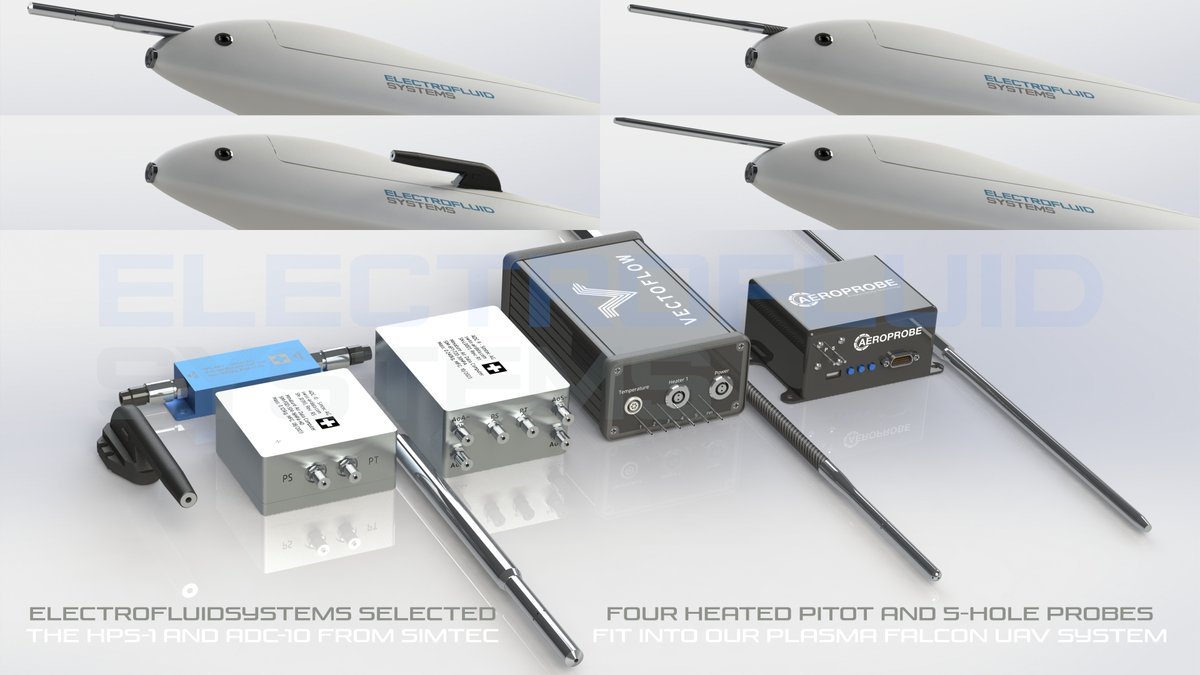
We at @ElectroFluidSys tems have obviously developed the world's first high-end mini UAV system with a certified heated pitot tube with rain water drainage. It will be available on both the intelligence and interceptor variants. In our case we selected the ADC-10 with the heated HPS-1 pitot tube from the Swiss Simtec AG (@swissairdata). All three Western manufacturers (@AeroprobeCorp, @SwissAirData, @Vectoflow) of high-end pitot and 5-hole probe systems with advanced ADC were surprised and told us that they have no mini UAV customers so far. Their products are usually designed for bigger drones like tactical or strategic UAVs.
For our onboard plasma flow control system, we would prefer a heated 5-hole-probe which is usually only available at bigger diameters beyond 10 or 15 mm. More than 9 mm would be not acceptable anymore. But Vectoflow is developing a 5-hole-probe with 8 mm using advanced additive manufacturing. Unfortunately, their ADC has the heater integrated as it was never considered for mini UAVs.
They could be interested to work on highly miniaturized versions as we will need ten thousands of all-weather capable high-end mini UAVs in the upcoming years. In any case, we think about to combine Vectoflow's 5-hole-probe with the ADC-9 from Simtec for the next bigger model Plasma Falcon 1.66.
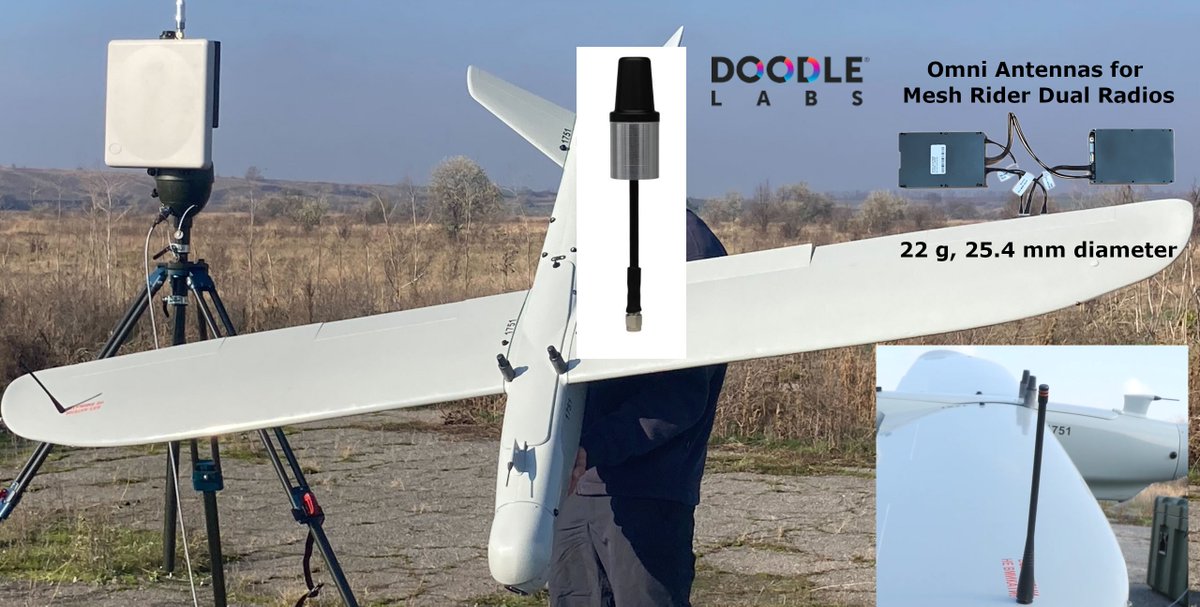
Doodle Labs Mesh Rider Dual Radio with multipolarized antennas are also used on the Deviro Leleko reconnaissance drone from Ukraine. Leleko is not a very fast ISR drone but can at least reach speeds up to 115 km/h in emergency situations.
Mesh Rider Dual Radio https://t.co/B1buepzb7w
Multipolarized Antennas https://t.co/nS8ZjZLe4L
@ElectroFluidSys tems will soon release an updated version of the Plasma Falcon UAS for civil security and dual-use applications. We have now added a high-end heated pitot tube with an advanced air data computer.
The new production-ready system will be the world's first fixed wing high-speed ISR drone which can be released (also as swarms) from high-altitude reconnaissance UAVs.
Standard low-cost components usually limit almost all mini UAVs to a maximum altitude of 5,500 meters or a minimum temperature of -20°C. That's not sufficient anymore. Sometimes the temperatures can even fall at sea level far below -20°C. Most of the existent mini and tactical UAVs cannot be safely operated then.
The dual radio with three high-end antennas from @DoodleLabs, a dual artificial intelligence avionics, a GNSS anti-jamming module, a compact inertial navigation system and a radar velocity system enable operations in contested airspace and GNSS-denied environments.
Dubai Police (@DubaiPoliceHQ), Luke Bell and his father Mike Bell cracked the Guinness World Records of Samuele Gobbi for the fastest ground speed by a battery-powered remote-controlled (RC) quadcopter on 22 June 2025. The new world record is now 580 km/h.
Luke and Mike were already the world record holders with an average top speed of 480 km/h in 2024 before Samuele officially cracked that record with 557 km/h on 7 March 2025. And until 7 March 2025, there were no racing propellers officially available which could push a drone beyond an average top speed of 480-490 km/h. It was impossible without a new faster propeller. How could Samuele do it then?
In 2022, the fastest propellers were the APC 5x75E with about 450 km/h at 36,000 rpm, the APC 7x9 with useful dynamic thrust values up to 490 km/h at 32,000 rpm and the APC 8x10 with 480 km/h at 26,000 rpm. The 7x9 and 8x10 were very critical and reached tip speeds up to Mach 0.98 at 480-490 km/h.
At high transonic speeds beyond Mach 0.8, there are supersonic regions with normal shock waves and shock-induced flow separation phenomena on the propeller blades. Without active flow control, the noise gets louder and louder and starts to sound like a jet engine.
In 2023, APC added the more optimized 7x11E with a maximum speed of about 470-480 km/h at 26,000 rpm. The tip speed was now lower and only reached up to Mach 0.83. But it was still not sufficient to pass the 500 km/h barrier in level flight. Luke and Mike used what was available and set a new world record in July 2024. They pushed the limits to an average top speed of 480.23 km/h (298.47 mph):
https://t.co/r9eLzfAwgM
The propeller performance is the key driver which limits us to crack a record. Anything else can be solved after design interations and good engineering. Your success to break a world record comes from an early access to the fastest racing propellers.
There are two ways: You contact the propeller manufacturer and make a new proposal or request for a new propeller with higher pitch or just take what is available. Samuele made professional simulations and had an early acces to the amazing 5x11E and 7x15E propellers which were officially released on 7 March 2025 and now enable drone speeds up to 650 km/h, whereby the tip speed is still below Mach 0.93.
See here for the performance data of the APC propellers: https://t.co/bYZD7qFdCr
And see here for the fantastic world record flight by Samuele with 557 km/h: https://t.co/MmqDAIIHiC
https://t.co/SFgsET3XTt
So far there is no video available for Luke's flight with 580 km/h but the new record is already officially listed at
https://t.co/yPAgDsxqMr
According to my analysis, Samuele's Fastboy 2 can easily pass the 600 km/h barrier and reach about 624 km/h. With more powerful motors with 4.0 kW continous power, it is even possible to challenge 650 km/h. We at @ElectroFluidSys tems and @PlasmaAero now ask for a 5x13E and 7x17E to break through the 700 km/h barrier using active plasma shock wave control. 🚀
https://t.co/JInzGIbNx6
https://t.co/Ac6rNo0RiO
As a science-fiction enthusiast, I love the @Volonaut Airbike. And as an aerospace engineer, I always want to know how flight vehicles are working. So I did a simple analysis on 1 May 2025 and found out that it is indeed a feasible design based on six small SWIWIN SW400PRO jet turbine with each having a static thrust of up to 40 kg. These turbines are from China.
Unfortunately, @TomaszPatan removed me from his linkedin network and was obviously unhappy about my post. But why man? You just applied physics and used off-the-shelf components from China. Each turbine just costs about 6,000 USD. So the overall material cost is less than 50,000 USD. Okay, the "secret" is the flight control but that's no real magick for an advanced control engineer. Today, engineers at @SpaceX can even balance and capture huge rockets of the size of skyscrapers.
The #Volonaut is very cool. But it is no real speederbike with a compact fusion reactor to power magnetoplasma-jet engines for hours and more. No, it can just fly with mini jet turbines and has only an endurance of three to seven minutes according to my first analysis from May 2025.
We at @ElectroFluidSys tems work on the basics for future Star Wars technologies. One day, we will really have compact fusion reactors which will even work at high atmospheric pressures. One day, we will have novel air-breathing magnetoplasma jet engines which will replace modern jet engines and bring us from ground to space. And one day, we will also have warping plasma-soliton drives to reach out to the stars and beyond when we stop being greedy and running crazy on earth.
But so far, we start with jet engines and continue with plasma hybrids before we can go ahead with real Star Wars Tech as we know on the Millenium Falcon for instance. For now, Electrofluidsystems also work on a jet powered manned flying "hypercar". We released the new startup name on 20 May 2025:
@PlasmaAero will be promoting the Plasma Falcon and Plasma Ray series. We preferred Western jet turbines. But after the release of the Volonaut, I also contacted #SWIWIN and had promptly received 3D STEP models for the SW400PRO and SW800PRO to check the system integration.
Maybe it is okay to charge first customers with 880,000 USD to build up a new company. So they may act as business angels with no shares. But we should always keep in mind that it is 18 times higher than the real material cost. So the first Volonaut just has a a price of a special edition @Ferrari.
A special edition motorbike would usually not cost more than 220,000 USD. Maybe the first Volonaut is overpriced by factor 4 even when we consider costs for development and engineering. The final price could be around 110,000 USD. Anything else would simply cause the development of better variants made in China. A Chinese competitor could even sell it for prices below 88,000 USD later on.
But in any case, it would be amazing to fly a Volonaut over the sea on a cool beach. That's less risky and might be the first application when prices fall far below 100,000 USD.
#NBC @NBCNews #Volonaut #FutureTech #VolonautAirbike #StarWars #Speederbike #ScienceFiction
---
That was my analysis from 1 May 2025 which I had later deleted from the Electrofluidsystems page here but kept it posted on linkedin:
https://t.co/nNZCm2p4oU
Feasibility Analysis of the Volonaut Airbike - the Star Wars Inspired Future Personal Hoverbike
Just analyzed the Star Wars inspired futuristic @Volonaut airbike by @TomaszPatan. It is indeed a genius and feasible design based on six small SWIWIN SW400PRO jet turbines with each having a static thrust of up to 40 kg.
In two posts from 2022, we see how Tomasz keeps such an engine with just 146 mm diameter and 342 mm length in his hand and uses the hashtag #Volonaut.
Tomasz obviously designed the first single seater prototype with a maximum take-off weight of about 150 kg. That's corresponding with six SW400PRO engines running at medium power with each having 25 kg static thrust. Each of the three jet vectors may slightly point outwards.
The futuristic vehicle might be controlled in a similar way like a modern multicopter with six rotors. The air inlets are just beside and under the seat. So air suction via small holes or perforation might act as a virtual "seat belt". The pilot and a rescued person would be just sucked onto the seat.
In the future, additional lift augmentation and extended agility might be possible by using fluidic jets and fluidic thrust vectoring. These are also key technologies which we are discussing regarding 6th-generation aircrafts.
So far, the overall thrust generated by those six lightweight jet engines with each having about four kilograms seems to be more than sufficient to lift up to 240 kg when necessary. And this would enable rescue missions but also short fun flights with a second person.
The overall flight time should be limited to three to seven minutes depending on the overall weight of the pilot and second person. Additional lift or lift augmentation might exist as air around and between the engines would be accelerated and mixed with the fast, hot jets.
We at @ElectroFluidSys tems work on a futuristic flying hypercar named #PlasmaRay with a span width of 6.66 meters. It can accelerate as fast as a modern hypercar and reach speeds up to 300 km/h.
The PlasmaRay 6.66 can carry up to 6 passengers and is powered by 14 JetCat P1000-PRO jet engines for vertical take-off and landing and 4 engines for horizontal flight. Each engine has 110 kg static thrust. A jet pack of 14 engines can lift up to 1540 kg. Alternatively, 20 SWIWIN SW800PRO jet engines with each having up to 80 kg static thrust can be used for vertical take-off and landing. We may release more details and the new startup name on 20 May 2025.
It was 20 May 1933, when the provinces of Mersin and İçel were merged. The new province was named "İçel" and the city of Mersin was made its capital. Previously the capital of the İçel province was Silifke.
We Make Dreams Fly
Electrofluidsystems
1 May 2025
#AirBike #BlendedWingBody #BWB #Breakthrough #Flying #FlyingWing #FlyingHyperCar #GTA #IronMan #JetPack #BreakthroughInnovation #Volonaut #Speederbike #HoverBike #StarWars #FutureTech #OppressorMkII #SWIWIN #SW400PRO #SW800PRO #JetCat #P1000PRO
Thank you @NBCNews for featuring the Volonaut Airbike following our viral release!
It is great to hear how much excitement there is watching sci-fi dreams being realized by engineering and brought to real-life.


![ElectroFluidSys's tweet photo. Boeing F-47 Phoenix - Futuristic Klingon-Style or XB-70 Valkyrie-Type of 6th-Generation Plasma Stealth Fighter with Mach 3+ Capabilities based on Plasma Shock Wave Mitigation, Plasma Controlled Infrared Signature Masking of Exhaust Plumes and Plasma Contrail Suppression??
@ChrisSchmitz made interesting comments regarding the "cold jet with no discernable exphaust plume" and noticed that "this is, if real, godtier thermal management." And yesterday, he uploaded an interesting video also discussing the exhaust nozzle and thermal management system of the F-47's three-stream adaptive cycle engine P&W XA103. That engine "can direct air to the bypass third stream for increased fuel efficiency and cooling or to the core and fan streams for additional thrust and performance."
https://t.co/ycmEfptrCD
https://t.co/VqrS2kG4Sv
But is sophisticated air mixing alone sufficient to make an almost perfect infrared masking of the exhaust plumes as we can see on the @ProjectFearX regarding @Boeing's Penetrating Counter-Air (PCA) X-plane demonstrator for @DARPA and the @USAirForce Next-Generation Air Dominance (NGAD) Fighter Program?
We don't know for sure but would like to show you some interesting open-source publications about more exotic thermal management and shock wave splitting systems based on High-Tech Plasma Processes (HTPP).
Were these plasma technologies originally developed for the @NorthropGrumman B-2? The question is highly speculative but it is quite possible. And @Boeing was principal subcontractor on the B-2 Spirit program and also initially involved in the B-21 Raider program's preliminary stages including wind tunnel testings.
In 1979, Northrop studied two basic mission profiles: 1. Low Altitude Penetrator as a low-span lifting body and 2. High Altitude Penetrator as a long-span flying wing. The first concept was based on a supersonic slender delta wing. And both concepts were aerodynamically designed by Hans Werner Grellmann. See here for his AIAA-paper "B-2 Aerodynamic Design" from 1990: https://t.co/qRzaxZzKQM
From the end 60s to the 70s, Northrop published a series of interesting papers on supersonic plasma aerodynamics (electroaerodynamics). They used negative corona discharges to split shock waves but never went into details or discussed any theory. They obviously knew what they were doing as only negative discharges have a so-called Trichel regime, a transitional state between a low-current Townsend and high-current glow regime.
The charge density is important and must reach a criticial point. But it is even more important to have a pulsed regime to generate controlled or use uncontrolled plasma solitary waves. The uncontrolled case is a series of Trichel pulses with usually 50-100 kHz. These are nanosecond high voltage discharges and produce very fast ionization waves. Those ion-acoustic solitons travel with speeds far beyond the speed of sound and can act as "phantom bodies" and split shock waves even at hypersonic speeds.
There are different methods based on pulse modulation, wave mixing and so on. The wave drag of the sum of those weaker shocks is much lower than the drag of the previous strong shock. In such a case, there should be no sonic boom anymore. The final effect is partly comparable with the action of mechanical bumps or ramps to split transonic shock waves on wings or supersonic inlets. In the same way, shortly pulsed plasma discharges can be also used to damp the shocks on fast running helicopter blades and propellers. Imagine stealth helicopters which can be made silent by just switching on a plasma field.
"In 1968, Aviation Week reported that Northop was evaluating “electrical forces to condition the air flowing around an aircraft at supersonic speeds“ to reduce drag, heating and sonic boom effects. The findings were promising enough to justify funding of additional research (AW&ST Jan. 22, 1968, p. 21). By negatively ionizing air molecules ahead of an aircraft, then charging the nose to the same polarity, an electrostatic field was formed. The field tended to repel or alter the molecules‘ path as the aircraft approached, according to the article.
If the “black world“ actually has developed feasible ways to reduce airframe drag substantially with controlled electrostatic fields, commercial aircraft manufacturers and airlines should be campaigning mightily for the technology. The potential fuel and cost savings for just American, United and Delta would be staggering."
W. B. Scott, “Black world engineers, scientists encourage using highly classified technology for civil applications,” Aviation Week & Space Technology, March 9, 1992, pp. 66-67.
---
Today, researchers at Arizona State University (@ASU) and @NorthropGrumman are working on a new project to create power transistors from diamond. Power transistors have traditionally been made with silicon. But the ASU Advanced Materials team, working with Northrop Grumman Mission Systems, is investigating diamond because it dissipates heat 8 to 10 times more efficiently than current materials. This means harnessing diamond to its full potential could reduce the size of power transistors by 90 percent.
Silicon has long been the standard material for semiconductor devices. Power transistors regulate the flow of electrical power and have traditionally been made with silicon, while more advanced modern transistors are made of materials such as silicon carbide or gallium nitride." This was a news by Techbriefs from January 27, 2023. https://t.co/7yIBrWrfDw
Frank A Koeck from ASU published papers on microwave plasma chemical vapor deposited (CVD) diamond films and their applications as field electron emitters since 2003.
https://t.co/MwxAU9DWxN https://t.co/TqCwDaVyXI https://t.co/UW58qqAikV
His latest paper about diamond diodes was published with colleagues from Northrop Grumman in February 2024. https://t.co/Oc7Pfo0AeY
But the breakthrough for diamond transistors came in Januar 2024 from Japan which is currently also leading the world in the field of plasma metamaterials.
https://t.co/QrkHvqlZVN https://t.co/hYnlyLR5iu
"The 1980s witnessed the first growth of diamond by CVD, followed by the exploration of doping processes in the 1990s. Since then, those involved in developing synthetic diamond have expanded their knowledge of this material, in terms of characterisation, manufacturing and processing. As a material for power electronics, what is the promise of diamond? Well, it has an ultra-wide band gap, an exceptional carrier mobility, a breakdown voltage estimated at a tantalizing 10 MV/cm, and the best-known thermal conductivity.
Thanks to these phenomenal attributes, diamond has been called the ultimate power semiconductor. Devices made from this form of carbon have the potential to boost the voltage of components while increasing their efficiency, trimming losses and cutting costs."
Please find more about the pioneering Japanese work on plasma metamaterials in our essay from 14 November 2021 on "How to Use Plasma Metamaterials to Make Aircrafts Invisible" and follow our Linkedin page at
https://t.co/S3k8ofispV
We can see in the second synchronized video with the optical camera that the X-Plane demonstrator for the F-47 is using a very bright lamp or an extreme light emitting coating based on smart skin electrochromic materials as extreme brightness can overhelm and saturate infrared (IR) sensors by excess noise. But the modern IR camera from @ProjectFearX is obviously less vulnerable and can highly effectively filter out IR noise and ambient interference via digitial signal processing algorithms to isolate the target signal from background noise.
Extreme brightness can be also used for other means of visual stealth: "Yehudi lights are lamps of automatically controlled brightness placed on the front and leading edges of an aircraft to raise the aircraft's luminance to the average brightness of the sky, a form of active camouflage using counter-illumination. They were designed to camouflage the aircraft by preventing it from appearing as a dark object against the sky.
The technology was developed by the @USNavy from 1943 onwards, to enable a sea-search aircraft to approach a surfaced submarine to "within 30 seconds of flying time"[1] before becoming visible to the submarine's crew. This in turn enabled the aircraft to engage the submarine with depth charges before it could dive, to counter the threat from German submarines to allied shipping. The concept was based on earlier research by the Royal Canadian Navy in its diffused lighting camouflage project."
https://t.co/D8qMMuEv8p
Today, flashlights use no classical lamps anymore and are based on high-powered LED arrays. In 2019 for instance, we could read that "an even more exotic skin is being tested on two stealth aircraft in Nevada. The smart skin is derived from an electromagnetically conductive polyaniline-based radar-absorbent composite material. It is optically transparent except when electrically charged, much like the LCDs used in laptop computers. What makes this new material attractive is that it can change brightness and color instantaneously.
Photo-sensitive receptors, mounted on all sides of the plane, read the ambient light and color of the sky and ground. An onboard computer adjusts the brightness, hue, and texture of the skin to match the sky above the plane or the terrain below it."
LumiLor for instance is a such a conductive, colour-changing paint that turns on and off by reacting to an electric charge. It can change cars to driving mega-displays. BMW also presented such a paint on the iX E Ink at CES 2022:
https://t.co/jVovbelI8P
https://t.co/XYCxA0qiGj
Today, "lightweight panels that are able to change colour on demand" can give even mini "defence drones the chameleon effect, letting it change colour matching the background."
https://t.co/r4OPiLFeVH
https://t.co/etLFA95BTX
"UAV visual signature suppression via adaptive materials" was already demonstrated 2005 on a mini drone with 2m wingspan. It was fitted with optically adaptive electroluminescent sheets to drop the Visual Cross Section (VCS) from 4,200 cm² to less than 1.8 cm² at 100 m. That's very impressive and could be easily adopted on future high-tech mini drones using more lightweight paints and panels. https://t.co/JVmFVHzowV
So imagine what might be already possible on very expensive high-tech stealth aircrafts and drones like the B-21 Raider or the RQ-180 to make them almost invisible to the naked eye.
https://t.co/N9Zg8rP2PC
In this regard, a futuristic Klingon-style or XB-70 Valkyrie-type @Boeing F-47 Phoenix might be very stealthy. It might even use high-tech plasma tech to fly faster than the legendary Mig-31 and Mig-25 Foxbat which still keeps the world altitude record with 37.65 km (123,523 ft) and could pass Mach 3.2 at 27 km (89,000 ft).
But now let's come back to exotic thermal management and contrail suppression techniques using high-tech plasma processes. Hold on and read what was written in the above mentioned legendary @AviationWeek & Space Technology article "Black world engineers, scientists encourage using highly classified technology for civil applications" published by William B. Scott in the March 9, 1992 issue on page 66-67:
"Engineers working on highly classified programs cited other technologies that appeared to this editor as only military related. They said that – if the principles were widely understood – though, there would be definite commercial applications. One was a ��thermal signature masking technology … which is used on the B-2 [stealth bomber],“ an engineer said.
“Basically, it‘s an electrostatic heat transfer phenomena that charges the jet engine exhaust stream to disperse the heat by a factor of about 800. It does a remarkable job of altering the thermal signature.“ He said the same basic technology, used in wing leading edges, can reduce a flying vehicle’s radar cross section (RCS) by masking thermal signatures created by aerodynamic perturbations of the air.
“The radar signature of an incoming warhead can be reduced to less than 10%“ of its normal value, the engineer said. “We found that radar cross section had a lot to do with aerodynamics and turbulence - past certain speeds.“ Electrostatic field-generating techniques in the B-2’s wing leading edges may help reduce ist RCS. The bomber’s leading edges posed a particularly challenging production problem on the first aircraft, and may have been the source of diminished results during early stealth flight test.
In 1968, Aviation Week reported that Northop was evaluating “electrical forces to condition the air flowing around an aircraft at supersonic speeds“ to reduce drag, heating and sonic boom effects. The findings were promising enough to justify funding of additional research (AW&ST Jan. 22, 1968, p. 21). By negatively ionizing air molecules ahead of an aircraft, then charging the nose to the same polarity, an electrostatic field was formed. The field tended to repel or alter the molecules‘ path as the aircraft approached, according to the article.
If the “black world“ actually has developed feasible ways to reduce airframe drag substantially with controlled electrostatic fields, commercial aircraft manufacturers and airlines should be campaigning mightily for the technology. The potential fuel and cost savings for just American, United and Delta would be staggering. A scientist said other, more dramatic, classified technologies are applicable to lasers, aircraft control and propulsion.
However, the scientists and engineers were especially hesitant to discuss these projects. One said they are “very black. Besides, it would take about 20 hr. to explain the principles, and very few people would understand them anyway.“"
---
Imagine hypersonic aircrafts and drones with turbojet engines running from horizontal take-off to hypersonic speeds beyond Mach 7+. In combination with a bow shock-splitting nanosecond pulse plasma triggered MHD counterflow jet system those "shockless" vehicles would be really cool without a sonic boom. Here you can find a Vision for a MHD-Controlled Turbojet Engine for Sustained Hypersonic Flight by the Legendary Isaiah Blankson from @NASA who openly writes here on his presentation from 2014 that “shockless” supersonic flow is possible!
https://t.co/fj4INa9t9H
So let's go back to the roots and start with Robert von Helmholtz, the son of the German physicist Hermann von Helmholtz who first demonstrated the amazing effect of corona discharges and sulfide acid on water vapor condensations almost 139 year ago: "Versuche mit einem Dampfstrahl" ("Experiments with a steam jet") (1887).
The former research group around professor Charles Krüger at @Stanford University pioneered some of the cutting-edge work on plasma stealth using (structured) electron clouds from diamond emitters and plasma controlled thermal infrared signature masking by air plasma radiation. See here for some of his public reports:
Final Technical Report on INFRARED SIGNATURE MASKING BY AIR PLASMA RADIATION for the Period June 1, 1997 to October 31, 2000 submitted by Charles Krüger and Christophe Laux. https://t.co/NU1094hdY2
Annual Scientific Report on INFRARED SIGNATURE MASKING BY AIR PLASMA RADIATION for the Period June 1, 1997 to July 31, 1998 submitted by Charles Krüger and Christopher Laux.
https://t.co/cWQ3Oyc5BF
Charles Krüger was one of the leading scientists who pioneered atmospheric diamond synthesis for aerospace applications in the 80s and 90s.
Today, these are also key technologies for novel plasma anti-/de-icing methods as we use on our Corona Bat 1.11. More details about the world's most advanced high-tech mini UAV will be soon released. So please keep following us. We make dreams fly.
B. Göksel / Electrofluidsystems
7 June 2026
@Aviation_Intel @MMcMillin @ProjectFearX @RodrigoAvella @RotorFocus @RupprechtDeino @SentDefender @Test_User_X1 @TheAviationist @TheNewArea51 @TheWoracle @TheWarZoneWire @TolgaOzbek_com @UncannyEx @ValkStrategy
#Area51 #Boeing #Breakthrough #BreakthroughInnovation #Camouflage #ChameleonEffect #Cloak #Cloaking #ColoumbClusters #ConductingPolymers #CounterIllumination #DisruptiveTechnology #DustyPlasma #Electroaerodynamics #ElectrochromicCamouflage #ElectroluminescentLight #ElectroluminescentPaint #Electromagnetism #GroomLake #F47 #F47Phoenix #Innovation #Insivibility #LightEmittingCoating #MagnetizedPlasma #MagnetoPlasma #Metamaterial #Phoenix #Plasma #PlasmaAerodynamics #PlasmaCrystals #PlasmaMetamaterial #PlasmaSolitons #PlasmaStealth #Polyanilines #Polythiophenes #Polypyrroles #ProjectFear #QDPolymerParticles #QuantumDotPolymers #SmartSkin #Soliton #SolitonWave #Stealth #StealthFighter #Tesla #VisualCloaking #VisualStealth #Yehudi #YehudiLights](https://pbs.twimg.com/media/HKQRNJdW8AEmo9C.jpg)


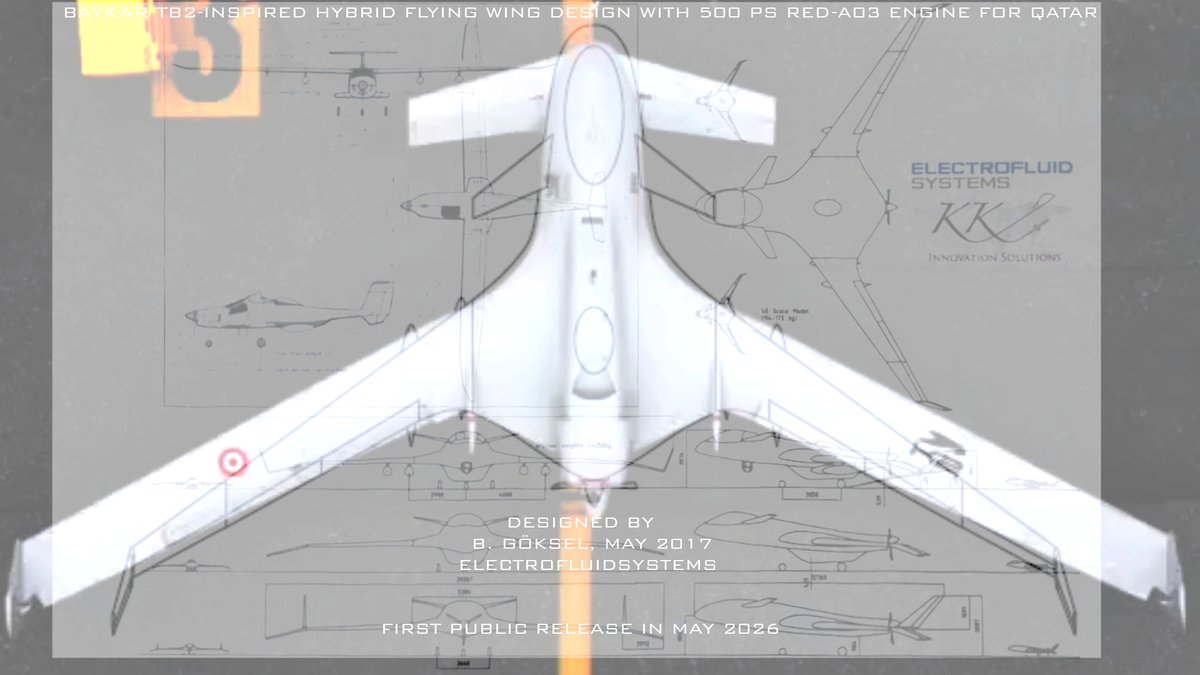


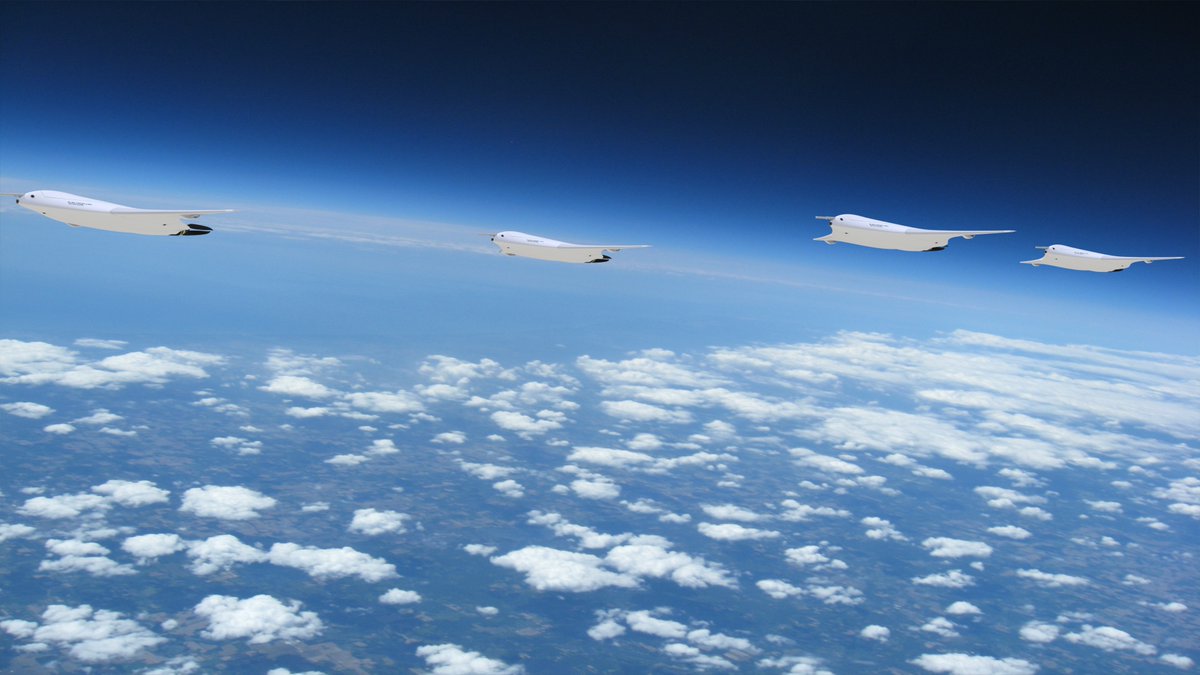

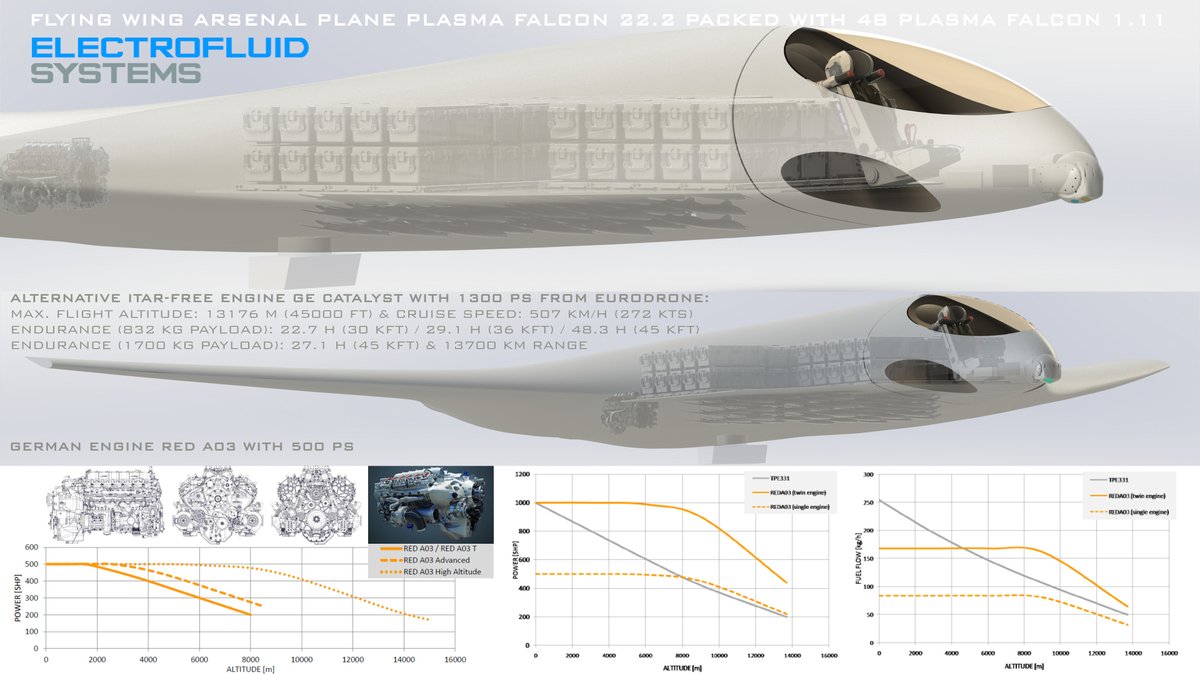

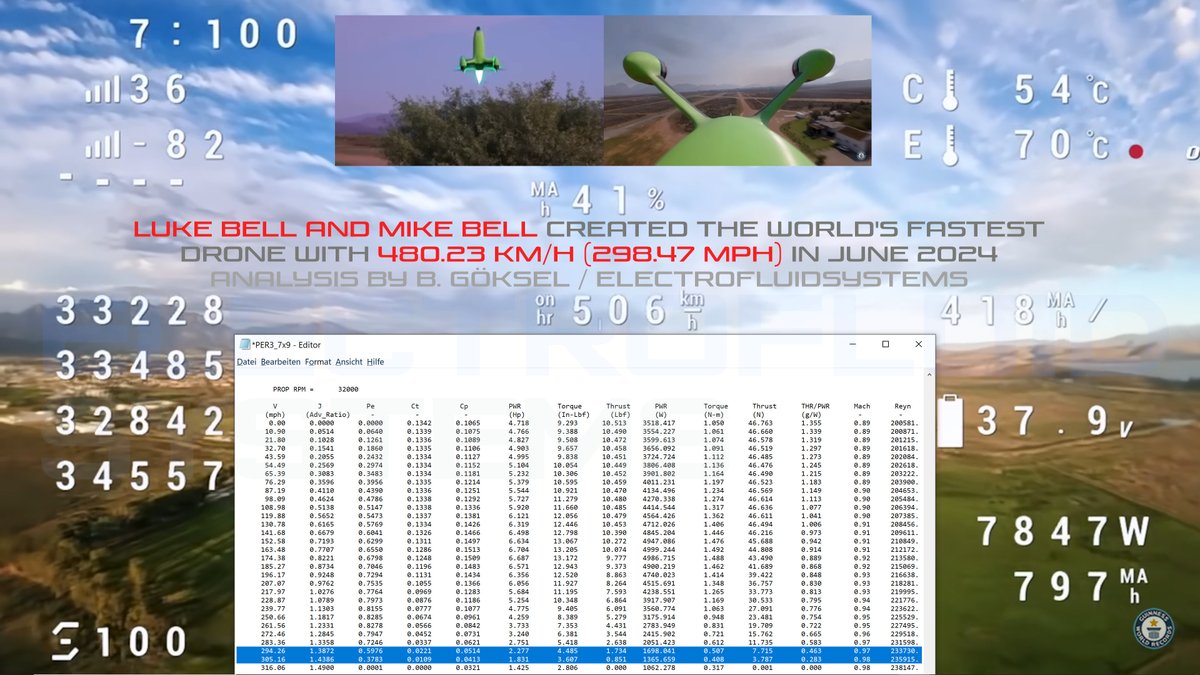
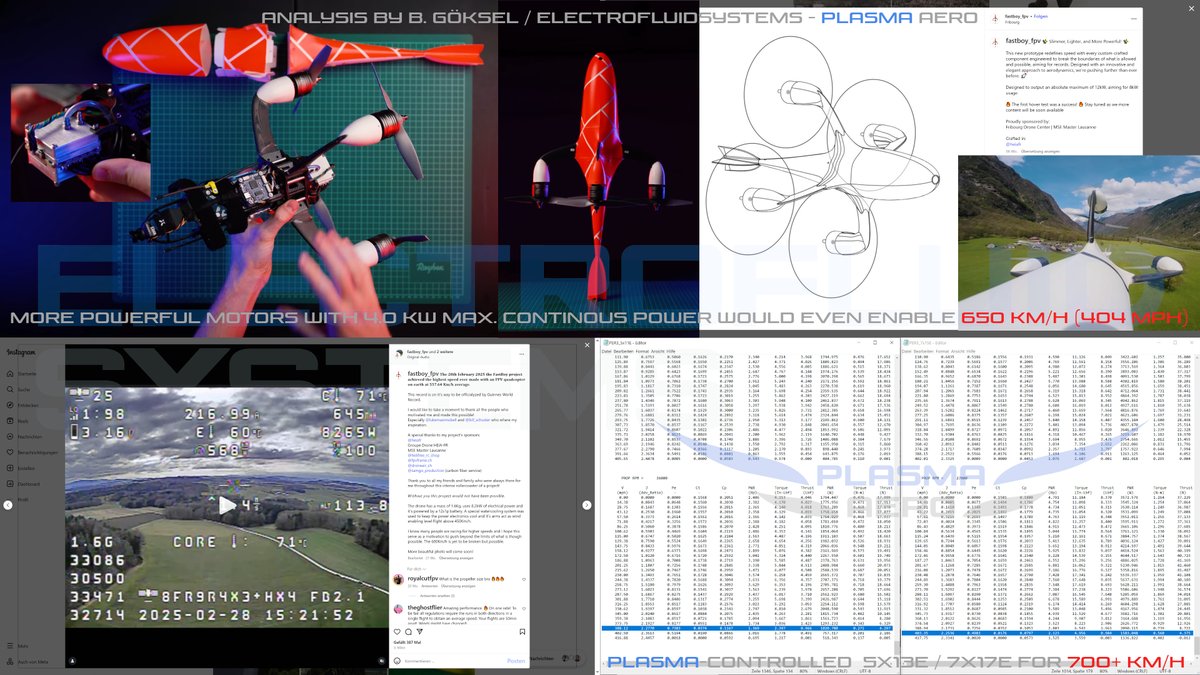


![ElectroFluidSys's tweet photo. Boeing F-47 Phoenix - Futuristic Klingon-Style or XB-70 Valkyrie-Type of 6th-Generation Plasma Stealth Fighter with Mach 3+ Capabilities based on Plasma Shock Wave Mitigation, Plasma Controlled Infrared Signature Masking of Exhaust Plumes and Plasma Contrail Suppression??
@ChrisSchmitz made interesting comments regarding the "cold jet with no discernable exphaust plume" and noticed that "this is, if real, godtier thermal management." And yesterday, he uploaded an interesting video also discussing the exhaust nozzle and thermal management system of the F-47's three-stream adaptive cycle engine P&W XA103. That engine "can direct air to the bypass third stream for increased fuel efficiency and cooling or to the core and fan streams for additional thrust and performance."
https://t.co/ycmEfptrCD
https://t.co/VqrS2kG4Sv
But is sophisticated air mixing alone sufficient to make an almost perfect infrared masking of the exhaust plumes as we can see on the @ProjectFearX regarding @Boeing's Penetrating Counter-Air (PCA) X-plane demonstrator for @DARPA and the @USAirForce Next-Generation Air Dominance (NGAD) Fighter Program?
We don't know for sure but would like to show you some interesting open-source publications about more exotic thermal management and shock wave splitting systems based on High-Tech Plasma Processes (HTPP).
Were these plasma technologies originally developed for the @NorthropGrumman B-2? The question is highly speculative but it is quite possible. And @Boeing was principal subcontractor on the B-2 Spirit program and also initially involved in the B-21 Raider program's preliminary stages including wind tunnel testings.
In 1979, Northrop studied two basic mission profiles: 1. Low Altitude Penetrator as a low-span lifting body and 2. High Altitude Penetrator as a long-span flying wing. The first concept was based on a supersonic slender delta wing. And both concepts were aerodynamically designed by Hans Werner Grellmann. See here for his AIAA-paper "B-2 Aerodynamic Design" from 1990: https://t.co/qRzaxZzKQM
From the end 60s to the 70s, Northrop published a series of interesting papers on supersonic plasma aerodynamics (electroaerodynamics). They used negative corona discharges to split shock waves but never went into details or discussed any theory. They obviously knew what they were doing as only negative discharges have a so-called Trichel regime, a transitional state between a low-current Townsend and high-current glow regime.
The charge density is important and must reach a criticial point. But it is even more important to have a pulsed regime to generate controlled or use uncontrolled plasma solitary waves. The uncontrolled case is a series of Trichel pulses with usually 50-100 kHz. These are nanosecond high voltage discharges and produce very fast ionization waves. Those ion-acoustic solitons travel with speeds far beyond the speed of sound and can act as "phantom bodies" and split shock waves even at hypersonic speeds.
There are different methods based on pulse modulation, wave mixing and so on. The wave drag of the sum of those weaker shocks is much lower than the drag of the previous strong shock. In such a case, there should be no sonic boom anymore. The final effect is partly comparable with the action of mechanical bumps or ramps to split transonic shock waves on wings or supersonic inlets. In the same way, shortly pulsed plasma discharges can be also used to damp the shocks on fast running helicopter blades and propellers. Imagine stealth helicopters which can be made silent by just switching on a plasma field.
"In 1968, Aviation Week reported that Northop was evaluating “electrical forces to condition the air flowing around an aircraft at supersonic speeds“ to reduce drag, heating and sonic boom effects. The findings were promising enough to justify funding of additional research (AW&ST Jan. 22, 1968, p. 21). By negatively ionizing air molecules ahead of an aircraft, then charging the nose to the same polarity, an electrostatic field was formed. The field tended to repel or alter the molecules‘ path as the aircraft approached, according to the article.
If the “black world“ actually has developed feasible ways to reduce airframe drag substantially with controlled electrostatic fields, commercial aircraft manufacturers and airlines should be campaigning mightily for the technology. The potential fuel and cost savings for just American, United and Delta would be staggering."
W. B. Scott, “Black world engineers, scientists encourage using highly classified technology for civil applications,” Aviation Week & Space Technology, March 9, 1992, pp. 66-67.
---
Today, researchers at Arizona State University (@ASU) and @NorthropGrumman are working on a new project to create power transistors from diamond. Power transistors have traditionally been made with silicon. But the ASU Advanced Materials team, working with Northrop Grumman Mission Systems, is investigating diamond because it dissipates heat 8 to 10 times more efficiently than current materials. This means harnessing diamond to its full potential could reduce the size of power transistors by 90 percent.
Silicon has long been the standard material for semiconductor devices. Power transistors regulate the flow of electrical power and have traditionally been made with silicon, while more advanced modern transistors are made of materials such as silicon carbide or gallium nitride." This was a news by Techbriefs from January 27, 2023. https://t.co/7yIBrWrfDw
Frank A Koeck from ASU published papers on microwave plasma chemical vapor deposited (CVD) diamond films and their applications as field electron emitters since 2003.
https://t.co/MwxAU9DWxN https://t.co/TqCwDaVyXI https://t.co/UW58qqAikV
His latest paper about diamond diodes was published with colleagues from Northrop Grumman in February 2024. https://t.co/Oc7Pfo0AeY
But the breakthrough for diamond transistors came in Januar 2024 from Japan which is currently also leading the world in the field of plasma metamaterials.
https://t.co/QrkHvqlZVN https://t.co/hYnlyLR5iu
"The 1980s witnessed the first growth of diamond by CVD, followed by the exploration of doping processes in the 1990s. Since then, those involved in developing synthetic diamond have expanded their knowledge of this material, in terms of characterisation, manufacturing and processing. As a material for power electronics, what is the promise of diamond? Well, it has an ultra-wide band gap, an exceptional carrier mobility, a breakdown voltage estimated at a tantalizing 10 MV/cm, and the best-known thermal conductivity.
Thanks to these phenomenal attributes, diamond has been called the ultimate power semiconductor. Devices made from this form of carbon have the potential to boost the voltage of components while increasing their efficiency, trimming losses and cutting costs."
Please find more about the pioneering Japanese work on plasma metamaterials in our essay from 14 November 2021 on "How to Use Plasma Metamaterials to Make Aircrafts Invisible" and follow our Linkedin page at
https://t.co/S3k8ofispV
We can see in the second synchronized video with the optical camera that the X-Plane demonstrator for the F-47 is using a very bright lamp or an extreme light emitting coating based on smart skin electrochromic materials as extreme brightness can overhelm and saturate infrared (IR) sensors by excess noise. But the modern IR camera from @ProjectFearX is obviously less vulnerable and can highly effectively filter out IR noise and ambient interference via digitial signal processing algorithms to isolate the target signal from background noise.
Extreme brightness can be also used for other means of visual stealth: "Yehudi lights are lamps of automatically controlled brightness placed on the front and leading edges of an aircraft to raise the aircraft's luminance to the average brightness of the sky, a form of active camouflage using counter-illumination. They were designed to camouflage the aircraft by preventing it from appearing as a dark object against the sky.
The technology was developed by the @USNavy from 1943 onwards, to enable a sea-search aircraft to approach a surfaced submarine to "within 30 seconds of flying time"[1] before becoming visible to the submarine's crew. This in turn enabled the aircraft to engage the submarine with depth charges before it could dive, to counter the threat from German submarines to allied shipping. The concept was based on earlier research by the Royal Canadian Navy in its diffused lighting camouflage project."
https://t.co/D8qMMuEv8p
Today, flashlights use no classical lamps anymore and are based on high-powered LED arrays. In 2019 for instance, we could read that "an even more exotic skin is being tested on two stealth aircraft in Nevada. The smart skin is derived from an electromagnetically conductive polyaniline-based radar-absorbent composite material. It is optically transparent except when electrically charged, much like the LCDs used in laptop computers. What makes this new material attractive is that it can change brightness and color instantaneously.
Photo-sensitive receptors, mounted on all sides of the plane, read the ambient light and color of the sky and ground. An onboard computer adjusts the brightness, hue, and texture of the skin to match the sky above the plane or the terrain below it."
LumiLor for instance is a such a conductive, colour-changing paint that turns on and off by reacting to an electric charge. It can change cars to driving mega-displays. BMW also presented such a paint on the iX E Ink at CES 2022:
https://t.co/jVovbelI8P
https://t.co/XYCxA0qiGj
Today, "lightweight panels that are able to change colour on demand" can give even mini "defence drones the chameleon effect, letting it change colour matching the background."
https://t.co/r4OPiLFeVH
https://t.co/etLFA95BTX
"UAV visual signature suppression via adaptive materials" was already demonstrated 2005 on a mini drone with 2m wingspan. It was fitted with optically adaptive electroluminescent sheets to drop the Visual Cross Section (VCS) from 4,200 cm² to less than 1.8 cm² at 100 m. That's very impressive and could be easily adopted on future high-tech mini drones using more lightweight paints and panels. https://t.co/JVmFVHzowV
So imagine what might be already possible on very expensive high-tech stealth aircrafts and drones like the B-21 Raider or the RQ-180 to make them almost invisible to the naked eye.
https://t.co/N9Zg8rP2PC
In this regard, a futuristic Klingon-style or XB-70 Valkyrie-type @Boeing F-47 Phoenix might be very stealthy. It might even use high-tech plasma tech to fly faster than the legendary Mig-31 and Mig-25 Foxbat which still keeps the world altitude record with 37.65 km (123,523 ft) and could pass Mach 3.2 at 27 km (89,000 ft).
But now let's come back to exotic thermal management and contrail suppression techniques using high-tech plasma processes. Hold on and read what was written in the above mentioned legendary @AviationWeek & Space Technology article "Black world engineers, scientists encourage using highly classified technology for civil applications" published by William B. Scott in the March 9, 1992 issue on page 66-67:
"Engineers working on highly classified programs cited other technologies that appeared to this editor as only military related. They said that – if the principles were widely understood – though, there would be definite commercial applications. One was a ��thermal signature masking technology … which is used on the B-2 [stealth bomber],“ an engineer said.
“Basically, it‘s an electrostatic heat transfer phenomena that charges the jet engine exhaust stream to disperse the heat by a factor of about 800. It does a remarkable job of altering the thermal signature.“ He said the same basic technology, used in wing leading edges, can reduce a flying vehicle’s radar cross section (RCS) by masking thermal signatures created by aerodynamic perturbations of the air.
“The radar signature of an incoming warhead can be reduced to less than 10%“ of its normal value, the engineer said. “We found that radar cross section had a lot to do with aerodynamics and turbulence - past certain speeds.“ Electrostatic field-generating techniques in the B-2’s wing leading edges may help reduce ist RCS. The bomber’s leading edges posed a particularly challenging production problem on the first aircraft, and may have been the source of diminished results during early stealth flight test.
In 1968, Aviation Week reported that Northop was evaluating “electrical forces to condition the air flowing around an aircraft at supersonic speeds“ to reduce drag, heating and sonic boom effects. The findings were promising enough to justify funding of additional research (AW&ST Jan. 22, 1968, p. 21). By negatively ionizing air molecules ahead of an aircraft, then charging the nose to the same polarity, an electrostatic field was formed. The field tended to repel or alter the molecules‘ path as the aircraft approached, according to the article.
If the “black world“ actually has developed feasible ways to reduce airframe drag substantially with controlled electrostatic fields, commercial aircraft manufacturers and airlines should be campaigning mightily for the technology. The potential fuel and cost savings for just American, United and Delta would be staggering. A scientist said other, more dramatic, classified technologies are applicable to lasers, aircraft control and propulsion.
However, the scientists and engineers were especially hesitant to discuss these projects. One said they are “very black. Besides, it would take about 20 hr. to explain the principles, and very few people would understand them anyway.“"
---
Imagine hypersonic aircrafts and drones with turbojet engines running from horizontal take-off to hypersonic speeds beyond Mach 7+. In combination with a bow shock-splitting nanosecond pulse plasma triggered MHD counterflow jet system those "shockless" vehicles would be really cool without a sonic boom. Here you can find a Vision for a MHD-Controlled Turbojet Engine for Sustained Hypersonic Flight by the Legendary Isaiah Blankson from @NASA who openly writes here on his presentation from 2014 that “shockless” supersonic flow is possible!
https://t.co/fj4INa9t9H
So let's go back to the roots and start with Robert von Helmholtz, the son of the German physicist Hermann von Helmholtz who first demonstrated the amazing effect of corona discharges and sulfide acid on water vapor condensations almost 139 year ago: "Versuche mit einem Dampfstrahl" ("Experiments with a steam jet") (1887).
The former research group around professor Charles Krüger at @Stanford University pioneered some of the cutting-edge work on plasma stealth using (structured) electron clouds from diamond emitters and plasma controlled thermal infrared signature masking by air plasma radiation. See here for some of his public reports:
Final Technical Report on INFRARED SIGNATURE MASKING BY AIR PLASMA RADIATION for the Period June 1, 1997 to October 31, 2000 submitted by Charles Krüger and Christophe Laux. https://t.co/NU1094hdY2
Annual Scientific Report on INFRARED SIGNATURE MASKING BY AIR PLASMA RADIATION for the Period June 1, 1997 to July 31, 1998 submitted by Charles Krüger and Christopher Laux.
https://t.co/cWQ3Oyc5BF
Charles Krüger was one of the leading scientists who pioneered atmospheric diamond synthesis for aerospace applications in the 80s and 90s.
Today, these are also key technologies for novel plasma anti-/de-icing methods as we use on our Corona Bat 1.11. More details about the world's most advanced high-tech mini UAV will be soon released. So please keep following us. We make dreams fly.
B. Göksel / Electrofluidsystems
7 June 2026
@Aviation_Intel @MMcMillin @ProjectFearX @RodrigoAvella @RotorFocus @RupprechtDeino @SentDefender @Test_User_X1 @TheAviationist @TheNewArea51 @TheWoracle @TheWarZoneWire @TolgaOzbek_com @UncannyEx @ValkStrategy
#Area51 #Boeing #Breakthrough #BreakthroughInnovation #Camouflage #ChameleonEffect #Cloak #Cloaking #ColoumbClusters #ConductingPolymers #CounterIllumination #DisruptiveTechnology #DustyPlasma #Electroaerodynamics #ElectrochromicCamouflage #ElectroluminescentLight #ElectroluminescentPaint #Electromagnetism #GroomLake #F47 #F47Phoenix #Innovation #Insivibility #LightEmittingCoating #MagnetizedPlasma #MagnetoPlasma #Metamaterial #Phoenix #Plasma #PlasmaAerodynamics #PlasmaCrystals #PlasmaMetamaterial #PlasmaSolitons #PlasmaStealth #Polyanilines #Polythiophenes #Polypyrroles #ProjectFear #QDPolymerParticles #QuantumDotPolymers #SmartSkin #Soliton #SolitonWave #Stealth #StealthFighter #Tesla #VisualCloaking #VisualStealth #Yehudi #YehudiLights](https://pbs.twimg.com/media/HKQRORCXcAACl4t.jpg)