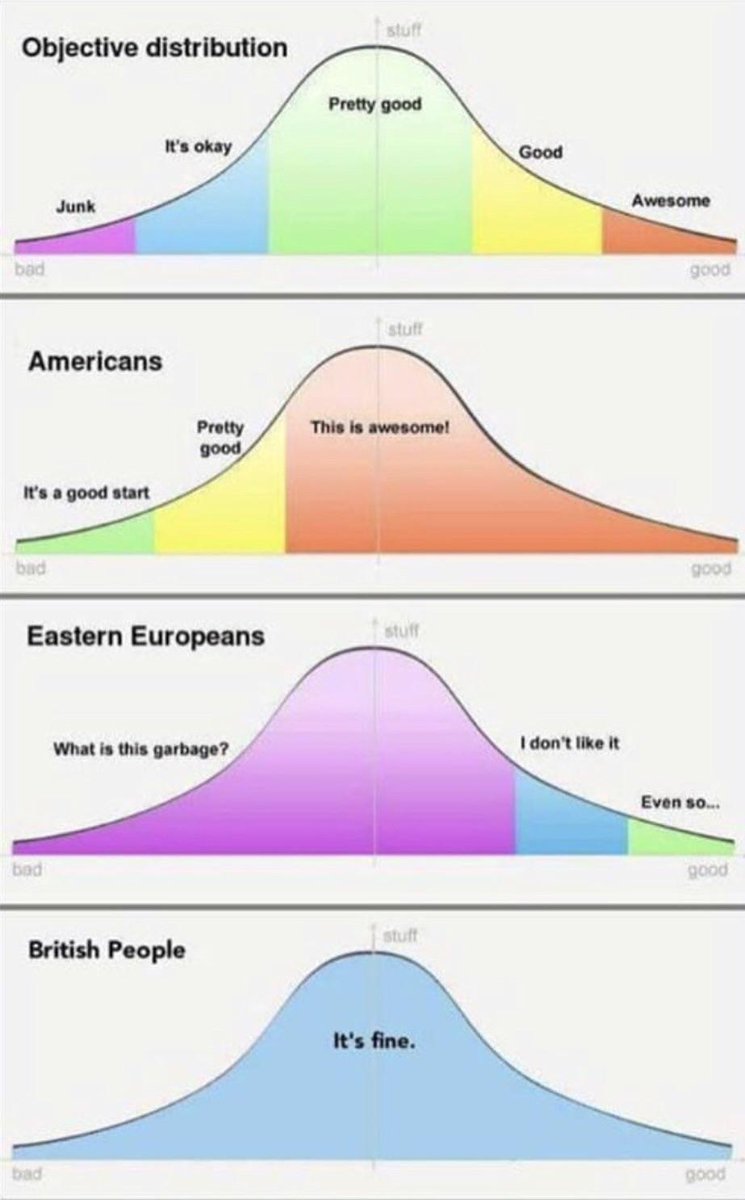
In this paper, I provide empirical evidence for objective_distribution.jpg and identify a useful proxy for private quality assessments across different cultural communication norms.
I was talking to an international student who told me that since moving here he started translating his feedback "into American" before giving it.
I was reminded of this meme and then took claude code and $100 down a rabbit hole to see if the meme shows up in data
If you take these N = 100 results seriously, it suggests that instead of asking "what did you think of my work?" asking "what do you think I should do next?" gets you closer to the person's private rating, and that relationship holds across three cultures.
@BhaktaVee Not sure- I think the fact that managers appear to trust work that comes from AI more than they trust work that comes from a human employee is a double edged sword.
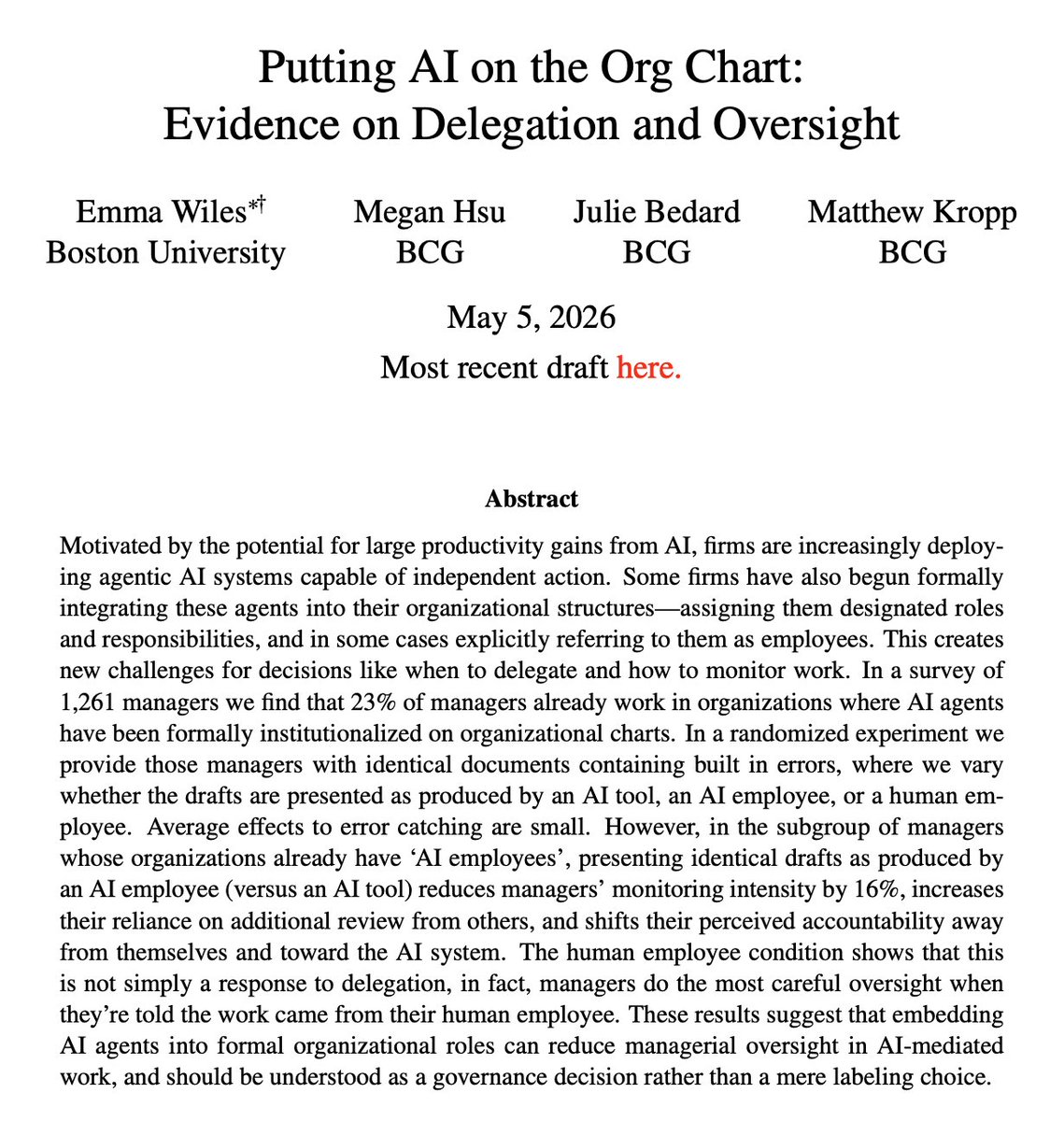
Excited to share a new HBR article on some of my recent research with colleagues at BCG about the phenomenon of AI Employees, and why governance is so important for integrating AI agents into your organizations work processes.
https://t.co/QUjAnSrWbi
For more, here's the WP tackling the Q: when AI systems are treated as organizational actors rather than tools, do managers oversee them like software, delegate to them like human subordinates, or treat them as something distinct? https://t.co/RAWOFfOwro
@johnjhorton@abhishekn I honestly don't think it would be that hard to communicate asymmetric information to a baby, its not complicated like "negative numbers" or something
@AmirSariri@abhishekn@johnjhorton planning experiments with GE in mind is tough- one computationally costly thing you could do is run a simulation with agents. lower hanging fruit is just having more nuanced outcomes: here the goal of the experiment was to increase "job posts" and it did! need to redefine success