So excited to chair my first symposium, From Theory to Application: Formal Computational Modeling in Clinical Psychology, at APS 2025 with these amazing researchers! 🥳 @PsychScience@KyraCEvers@EmmaRToner@ShirleyBWang and Don Robinaugh
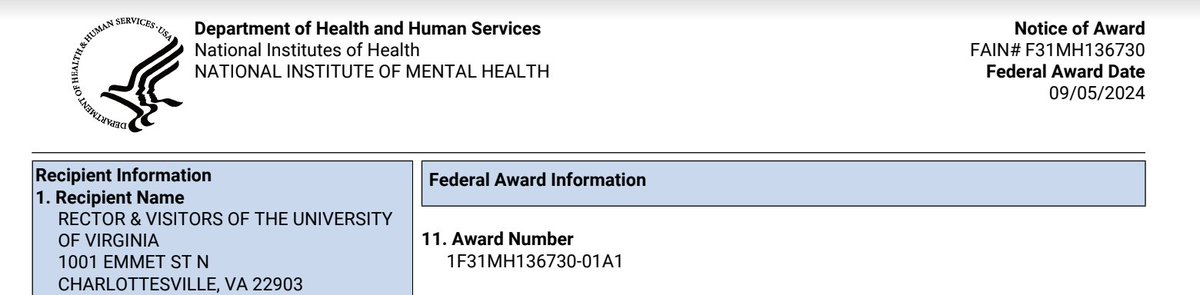
Beyond thrilled to have been rewarded an #F31 from #NIMH!
My F31 aims to formalize a psychosocial theory of loneliness using agent-based modeling and differential equation modeling.
Huge thanks to my mentors, collaborators, family, and friends!
Beyond grateful to share that I’ll be joining the faculty @MedicineUVA as an Assistant Prof in @cbhtuva this August! I’m excited to bring my focus on emotion reg & digital mental health to help those managing the stress of living with cancer.
Excited to present our work at #Ubicomp2023 in Cancun 🌴 on using mobile sensing to understand the social context of socially anxious individuals. Join me on Oct 12 in the 7B "Brain and Mental Health" session! 🧠
Paper 📄: https://t.co/2yIlbyDr83
Blog 📖: https://t.co/8eGh2i1C5Y
@VeraJVine @ABCTNOW In my masters thesis I looked at concordance among affective, cognitive, physiological, and behavioral indicators of social anxiety under different levels of social threat with network analysis. Let me know if that would be of interest!
🚨New method alert🚨
https://t.co/fEn8XCHajV
People switch between using many different emotion regulation strategies over time. But how do we quantify the extent to which people switch between these ER strategies throughout their daily life?
A 🧵:
7/8 Future work should focus on identifying the time scale on which different emotion components operate and using analytical approaches that allow for the modeling of time-dependent relationships among components.
1/ Many are fairly asking why there's a push for retracting old conversion therapy research. So here, I did your homework for you. Take a few minutes and buckle up.
Here's how old behavioral conversion therapy research still impacts people today: