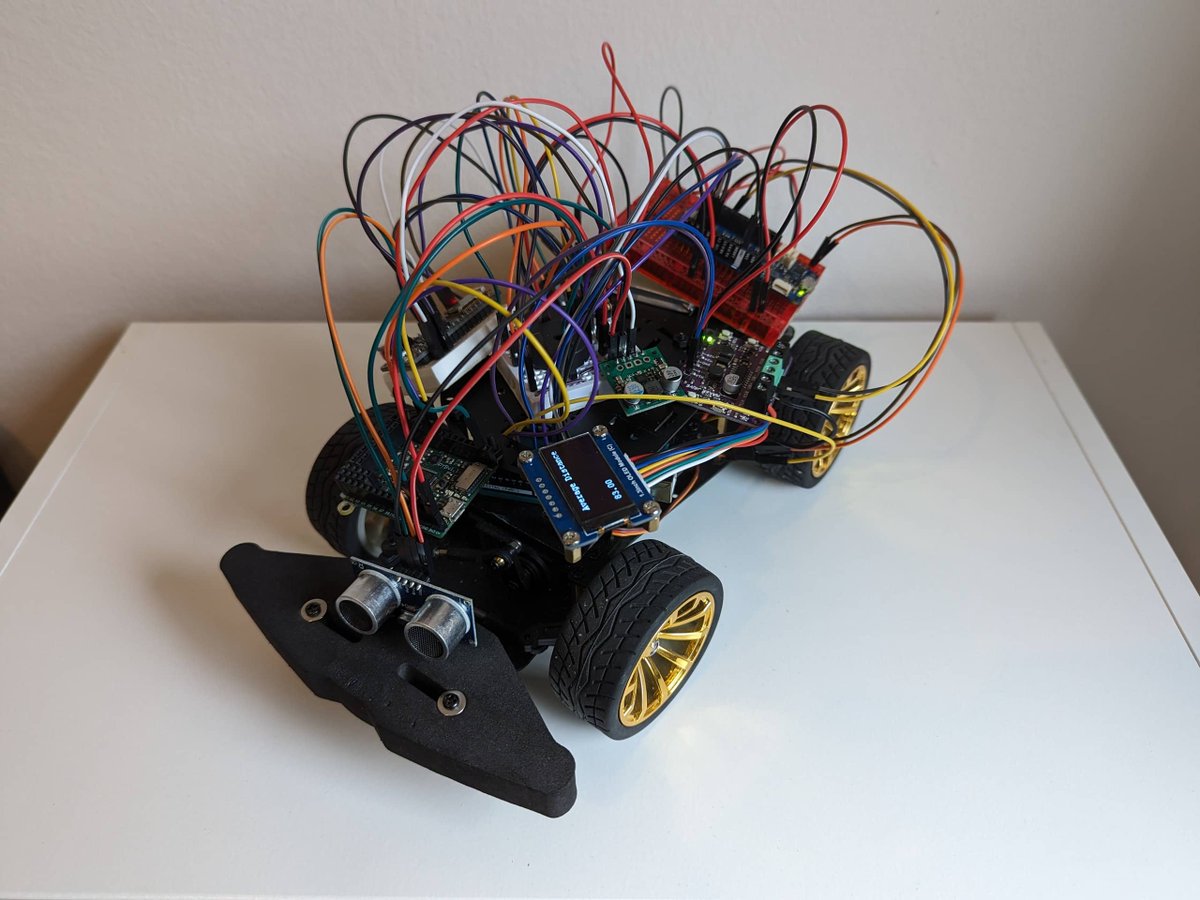
Quite happy with this one!
Managed to build an @arduino IoT RC Car with Wi-Fi control, distance sensor, a "radio", 4 MCUs, OLED display and @awscloud integration.
The next step is to make the data sent to the cloud more useful.
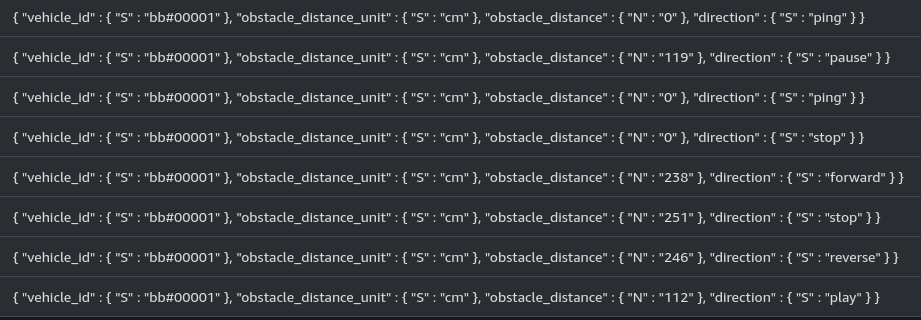
I'm working on building a simple telematics service for the IoT car. Yesterday, I got the data into a DynamoDB and created a backend today using AWS Lambda and API Gateway.
Took maybe an hour, quite nice how easy it was. Good documentation and tutorials from AWS. Kudos!
Actually pretty simple. No code needed. Used the following tutorial.
You create an AWS IoT rule to send data to a DynamoDB table, and voila!
https://t.co/MM7kZwpobk
If you are curious about the build, the code, the circuit diagram or reading about some of the challenges faced while building, I've written a small post about it:
https://t.co/szaeh9bUGe
Quite happy with this one!
Managed to build an @arduino IoT RC Car with Wi-Fi control, distance sensor, a "radio", 4 MCUs, OLED display and @awscloud integration.
The next step is to make the data sent to the cloud more useful.
Putting the final touches on the latest version of the RC car. Going full-on IoT, from Wi-Fi control to AWS integration.
Also working on an article on the project. Hopefully, it will be out around next Tuesday.
Been learning about what components are involved in the fuel system and getting a basic understanding of what each part does. Wrote a high-level overview of it ⤵️
Let me know what you think and if I missed anything!
https://t.co/BbPkSj71NW
The third and most modern design is the double overhead camshaft (DOHC). Yes, you guessed it, it has two camshafts in the cylinder head—one for the intake valves and the other for the exhaust valves. A "V" shaped engine has a total of four camshafts.
After the explosion, on the other hand, the exhaust valves open and let out the burnt gases after the explosion. 📤
It also serves as a base for the valvetrain, which is the system that controls the valves and flow in and out of the engine. More on that later. 👀
The cylinder head is not just a cover but orchestrates the flow through the engine!
A cylinder head, often called a "head," is a piece of metal that sits on top of the engine block.
In the head are rounded indents where the action happens, called combustion chambers.
The head has ports that open into the combustion chamber.
In these ports are valves that, on the one hand, let in a mixture of air and fuel, called intake valves. 📥
The spark plug, also located in the head, ignites this mixture, causing an explosion. 🔥
This is crucial because the crankshaft must spin quickly and stay securely inside the engine block.
Rod bearings do a similar job but for the connecting rods. They reduce friction as they move up and down, which allows the pistons to push the crankshaft.
With all the movement and spinning in the engine, why doesn't the engine wear out quickly?
That's where the main and rod bearings come in and save the day! 💪
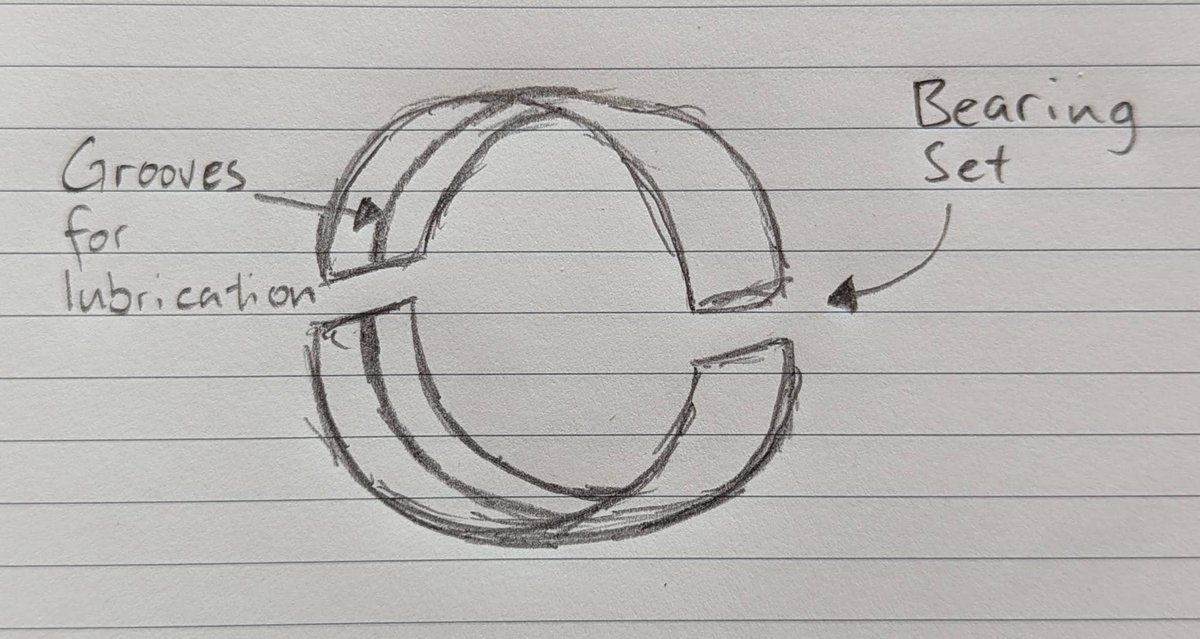
The main bearings and rod bearings are metal half-circular rings.
They ensure that the crankshaft works smoothly and without causing damage.
The bearings come in sets of two. There are usually five or more of these main bearing sets to keep the crankshaft in place.