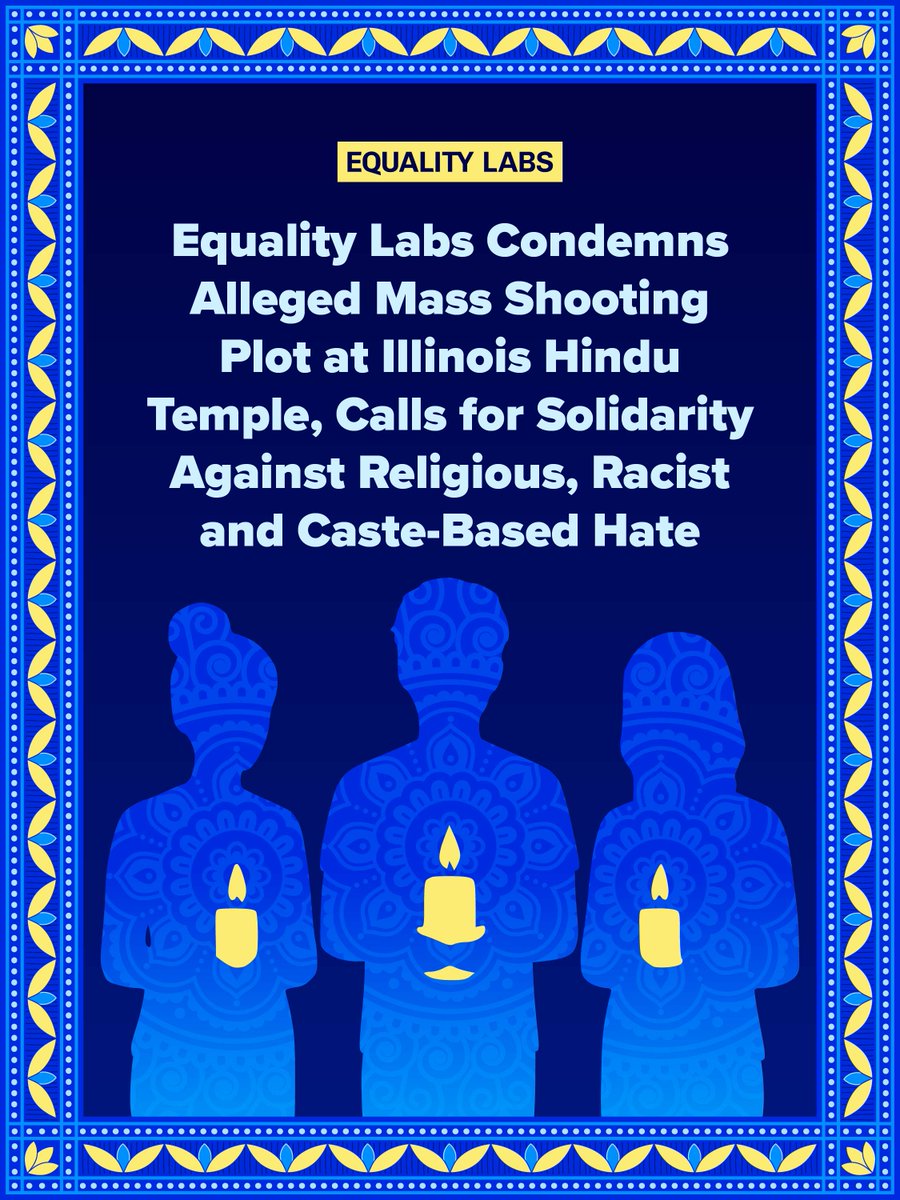
3/ Authorities say the 19-year-old suspect drove to the temple with a rifle and body armor, but the weapon jammed. He was arrested after a coworker alerted police. A manifesto attributed to him reportedly called for a “mass shooting of Indian people.
2/ South Asian communities across faiths, castes, and backgrounds and is a direct attack on our constitutionally protected rights to religious freedom, freedom of assembly, and freedom from discrimination. These fundamental human rights violations undermine our democracy.
1/ Equality Labs condemns the alleged white supremacist plot to carry out a mass shooting at a Hindu temple in Aurora, Illinois. The reported targeting of South Asian people at a place of worship is a chilling reminder that violence driven by white nationalism threatens
1/ Today marks the 20th anniversary of the #MeToo movement founded by Tarana Burke to catalyze awareness about survivorship and demanded collective action against sexual assault and gender based violence.
For caste-oppressed survivors, the legacy of #MeToo falls under a
2/ centuries-long struggle we have led against caste-based sexual violence. We honor the named and unnamed leaders, writers, artists, healers and survivors who have spoken courageously about the intersections of caste and Brahminical patriarchy, and the many forms of
8/ us that equality is not only about laws and political rights. It is also about how people see themselves, how societies value one another, and whether every person can live with dignity, freedom and equality.
7/ movement in India, particularly among Dalit communities. Each year, Deekshabhoomi remains a place of remembrance and collective gathering.
We remember Ambedkar’s Dhamma Deeksha not only as a historic moment, but as part of a continuing struggle for human dignity. It reminds
6/ the Buddha. The vows therefore gave the conversion a distinct social dimension: they represented a conscious rejection of inherited religious practices and an assertion of dignity and equality.
The 1956 ‘Dhamma Deeksha’ became foundational to the modern Navayana Buddhist
5/ historic ceremony followed by hundreds of thousands of his followers.
A central feature of the ceremony was the administration of the ‘22 vows’. These included commitments to reject practices and beliefs associated with caste hierarchy and to follow the teachings of
4/ prajna (reason and understanding), karuna (compassion) and samata (equality). He saw Dhamma less as a system of ritual belief and more as a basis for ethical conduct and social relations.
On 14 October 1956, Ambedkar formally embraced Buddhism at Deekshabhoomi in a
3/ he publicly declared that although he had been born a Hindu, he would not die a Hindu.
Over the next two decades, he studied different religious traditions and reflected deeply on the ethical foundations of an equal society. His understanding of Buddhism was shaped by
2/ this was part of his search for ethical order based on equality, dignity and liberation.
Babasaheb had long argued that political and legal rights alone could not dismantle entrenched social hierarchies. In 1935, at the Yeola conference in Nashik District, Maharashtra,
1/ Dr. B. R. Ambedkar’s conversion to Buddhism in 1956 was one of the largest mass religious conversions in modern history. It marked the culmination of his lifelong struggle against caste, untouchability and inequality. For Ambedkar, more than a change in religious identity,
7/ the resignation of Chief Election Commissioner Gyanesh Kumar, and accountability for alleged electoral irregularities.
The right to vote, dissent and peacefully assemble are fundamental to democracy. The Indian authorities must uphold their constitutional obligations and
6/ rather than repression.
We call for the release of any arbitrarily detained protesters, journalists and lawyers, and an independent investigation into police brutality. We further demand the restoration of Jantar Mantar as a designated protest site, the scrapping of the SIR,
5/ The protests reflect serious concerns over the Special Intensive Revision (SIR) of electoral rolls, allegations of mass deletion of voters' names and the threat of electoral disenfranchisement. These concerns demand transparency, accountability and institutional scrutiny
3/ The use of police force, intimidation and arbitrary detention to suppress peaceful demonstrations undermines these constitutional guarantees.
The decision announced on 12 October to remove Jantar Mantar as a designated protest site in Delhi represents another blow to
4/ this fundamental right. For decades, Jantar Mantar has been an important space for democratic dissent. Its removal as a protest site further shrinks the space for citizens to voice their grievances and hold authorities accountable.
2/ internet shutdowns and restrictions on movement constitute a serious assault on democratic freedoms and the right to dissent.
The right to peaceful protest is not a privilege granted by the state but a fundamental right guaranteed by the Indian Constitution.