On this day in 1863, Robert E. Lee bet the entire war on twelve thousand men walking a mile across an open field into the center of the Union line, and he did it over the loud objection of the general he trusted most.
Lee had spent two days hammering the ends of the Union army and gotten nowhere. So on the third day he reasoned it out like this. If the enemy had reinforced both flanks to survive all that pounding, then the middle must be thin now. Hit the center, hard, with everything, and break it, and the road to Washington opens up and the South wins its independence in an afternoon. It was bold and it was logical and it was, as it turned out, a catastrophe.
James Longstreet begged him not to do it. Longstreet had walked that ground with his eyes, measured the distance, seen the guns waiting on the ridge, and he told Lee flatly that no fifteen thousand men who ever lived could cross that field and take that position. He said it more than once. Lee heard him and said do it anyway. When the moment finally came to launch the attack, Longstreet was so sick with certainty that it was murder that he couldn't say the word. He just bowed his head and nodded, and the assault went forward on a nod.
First came the guns. The Confederates opened the largest artillery barrage of the entire war on this continent, well over a hundred cannon roaring at once, trying to smash the Union center to rubble before the infantry stepped off. The ground shook for miles. But most of the shells sailed just a little long, screaming over the heads of the front line troops and blowing up the rear. When the smoke drifted off, the Union center was battered but very much alive, and the gunners there were waiting, loaded, and furious.
Then the infantry came out of the tree line, and even the men about to kill them said it was one of the most beautiful and terrible things they ever saw. About twelve thousand Confederates, dressed in neat parade lines nearly a mile wide, battle flags up, stepping off in perfect order into the open like it was a drill. They had almost a mile of naked field to cross, uphill, in the July heat, with nowhere to hide.
The Union artillery went to work on them the whole way. First long range shells punched holes clean through the marching ranks, whole files of men vanishing at a time. The survivors closed up the gaps and kept coming, which somehow made it worse to watch. As they got closer the cannon switched to canister, basically giant shotgun blasts that scythed men down in swaths. Then the rifles opened up from behind the stone wall. The neat lines dissolved into a struggling mob still pushing forward into the storm.
And they almost, almost did it. A few hundred men under a general named Lewis Armistead actually reached the wall, Armistead out front with his hat jammed on the tip of his sword so his men could see him in the smoke. He climbed over, put his hand on a Union cannon, and for one heartbeat the Confederacy was physically inside the Union line at the very center. That spot is called the High Water Mark now, because it is the farthest the tide of the Confederacy ever reached. Armistead was shot down right there, dying a few feet past the wall. The handful who got over with him were killed or captured in minutes. The breach slammed shut.
And that was it. That was the whole war, decided in about an hour. The survivors streamed back across that awful field, and Lee rode out among them with his hat off, saying over and over, it's all my fault, it is all my fault. He told Pickett to rally his division for a possible counterattack, and Pickett looked at him and said, General Lee, I have no division. It was gone. Roughly half of the men who made that charge were dead, wounded, or captured.
The next day was the Fourth of July. Lee started his beaten army on the long, rainy retreat back to Virginia, and he would never invade the North again. And far away on that same Fourth of July, the river fortress of Vicksburg surrendered out west, cutting the Confederacy in two. The high tide had crested and broken on the same little Pennsylvania ridge, and from here on the water only ran one way.
@BiggerTruth@KimBradbur38205 Sometimes I wonder if foreign powers are involved with industry concentration and the abuse of children to justify malign communist narratives.
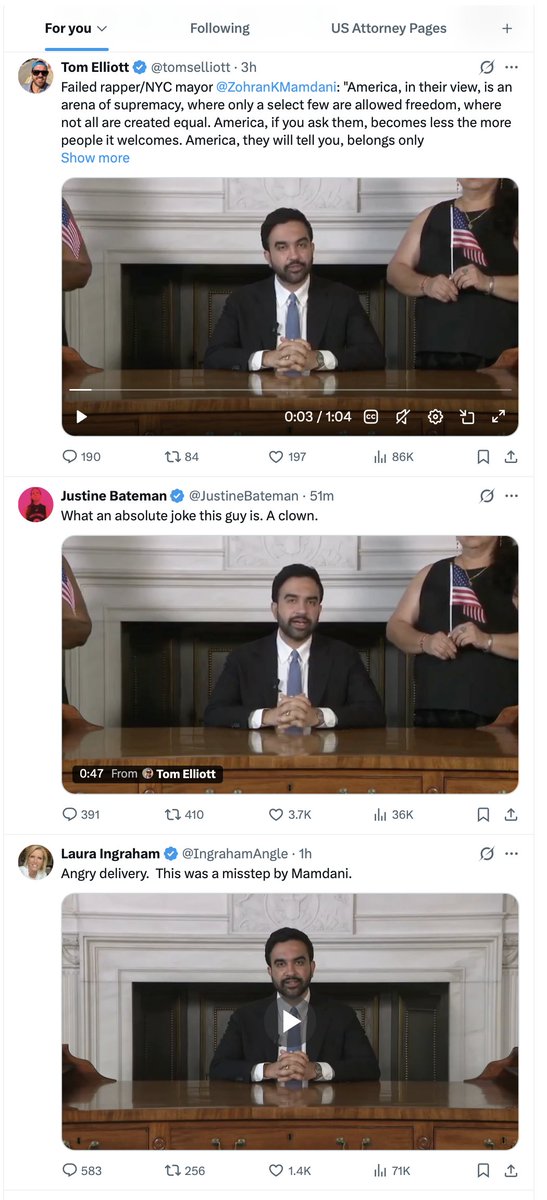
Incidentally, I downloaded the text of his speech for analysis.
BLUF: Standard U.S. patriotic sentiments mixed with socialist rhetoric. National, not mayoral tone.
5/10, boring.