A husband, father, and Realtor in San Antonio, TX. Praise God, I am forgiven and am pursued by His love. 2021 Bowman's Best - BB50 and the Thoughtful 30 RC's
@YodaStockInvest The market is so short sided, hence the massive alpha for those on X that choose to listen to wisdom and go heavy long $IREN knowing the "wen deal" crowd will miss the move. Its not like they're NOT going to sell their compute, duh.
The Market’s Current Obsession and $IREN’s “Bottleneck-First” Principle
Today, IREN announced that it has signed a transmission connection agreement to support the development of an 800MW data center campus at Bundey in South Australia. The project has secured a high-voltage transmission connection to a utility substation and is expected to begin energization in 2028. Through submarine cable connectivity, it will be able to serve major demand centers across the Asia-Pacific region. The power supply will be primarily supported by renewable energy sources.
Under the agreement, IREN has secured access rights to four 330kV feeder bays at the utility substation, providing support for up to 800MW of load capacity without requiring grid upgrades. Subject to regulatory approvals and the satisfaction of conditions associated with the transmission connection agreement, IREN intends to commence early-stage construction activities and equipment procurement.
Several key points stand out from this announcement:
No grid upgrades required means the project can be deployed as quickly as possible, making this aspect particularly valuable.
South Australia’s high penetration of renewable energy provides long-term access to green power.
The 800MW scale creates significant economies of scale—and this is only the beginning.
Australia serves as a launch point for reaching the broader Asia-Pacific market.
Overall assessment: considering scale, expandability, environmental sustainability, grid integration, geographic reach, population served, and economic significance of the surrounding region, this is an A+ class scarce asset.
IREN’s current portfolio of 5.8GW power sites broadly meets the criteria of A+ scarcity assets. AI data centers are increasingly becoming an important financial asset class and will gradually emerge as a key valuation anchor. At today’s relatively early and unsophisticated stage, the market has not yet fully recognized this reality. The prevailing attitude is still “as long as there is power available, that’s enough.” However, sovereign AI initiatives are already demanding much more than that, and the value of these attributes is likely to become increasingly important as the sovereign AI market develops.
Sovereign AI is not limited to governments. It revolves around ownership and control of data. Industries such as finance, healthcare, energy, and defense cannot tolerate data leakage or dependence on opaque cloud infrastructure, and are increasingly moving toward sovereign computing environments. This migration shifts AI data centers with sovereign-AI characteristics away from low-margin customers and toward strategic customers with larger budgets and stricter compliance requirements, creating substantial premium opportunities.
Through segmented compute zones and physical isolation, operators can transform closed environments into certainty and trust, providing localized, high-value operating environments for financial institutions, governments, healthcare organizations, and advanced foundation-model developers. As a result, data centers can move beyond commoditized competition and become high-barrier sovereign infrastructure.
These assets provide not only large-scale dispatchable green energy but also a form of irreplaceable exclusivity. Once such sites become foundational infrastructure for sovereign AI training, their asset characteristics may eventually support securitization.
Because these assets combine multiple forms of physical scarcity, each one secured reduces the pool of available opportunities. They are fundamentally difficult to replicate. Due to the background and experience of IREN’s management team, they recognized this years ago. Site selection efforts were conducted globally long before the market appreciated these dynamics. Work that began eight years ago has evolved through continuous learning and industry development into a highly refined understanding of what constitutes a truly valuable site.
This is fundamentally different from today’s industry behavior, where many participants simply pursue any available power source without regard for broader considerations. The commercial outcomes of these two approaches may ultimately prove dramatically different.
In a recent article that I refer to as the “IREN Development White Paper,” CEO Daniel Roberts argued that these scarce, high-quality sites have already been largely secured by early movers. New entrants may soon discover that even if they are willing to wait, sites of comparable quality are simply no longer available. Even paying a premium lease rate may not be enough to gain access.
That opportunity window has effectively closed. Over the next two years, additional windows may close as well. The ladder leading to the top tier of infrastructure operators with genuine pricing power is gradually disappearing. While AI still presents many opportunities, much of the remaining space is likely to become increasingly commoditized and competitive.
The market today has not fully interpreted these dynamics. As a result, $IREN’s stock merely finished positive while broader indices declined. The market’s current obsession is straightforward: companies such as $NBIS that continue signing contracts with hyperscale customers are viewed as the winners.
Questions such as:
How much power has actually been secured?
What is the source and quality of that power?
Does the project depend on third-party partners?
Could delays occur?
Is it environmentally sustainable?
Could environmental objections force a redesign?
Will more expensive behind-the-meter solutions eventually be required?
are entirely ignored.
As long as contracts are being signed, early access to systems such as Vera Rubin is secured, and high-profile supporters are involved, investors are eager to buy.
Meanwhile, IREN’s advantages in scarce resource positioning and cost structure receive far less attention. Some NBIS supporters argue that these advantages can simply be purchased later—that NBIS could buy IREN, lease IREN’s facilities, or otherwise replicate these capabilities. As amusing as that may sound, many people genuinely believe it.
Markets naturally focus on what is immediately visible. Looking purely at reported financial results, NBIS currently presents stronger numbers, while IREN has missed expectations. Share-price divergence under those circumstances is understandable. But if investing were only about reading surface-level metrics, the process would be much simpler than it actually is.
Anyone familiar with IREN during the Bitcoin mining era will recognize a recurring pattern. In HPC infrastructure, being first is not always advantageous.
For years, IREN remained a secondary player in mining. It waited until its own data center infrastructure was complete and mining hardware efficiency had improved dramatically. Only then did it move aggressively, eventually leaving competitors behind and becoming the only consistently profitable miner.
The AI cloud industry is significantly more complex, but the principle remains similar.
Consider CoreWeave. It moved fastest, but is its current situation ideal? Its debt has been rated below investment grade, resulting in high borrowing costs. Regardless of how attractive the industry may be, many sophisticated investors avoid businesses that develop credit-related concerns. Operational mistakes can be forgiven; credit problems are far less acceptable.
NBIS currently appears to be performing best. But is it truly operating optimally?
Forget software advantages for a moment and focus on basic business logic. Its own secured power resources are relatively limited, yet it has already committed portions of those valuable resources to customers through bare-metal contracts. While positioning itself as a full-stack cloud platform, it has sold its most important resource at bare-metal economics.
By contrast, IREN is often viewed as the pure bare-metal provider despite the fact that it has not sold a single watt.
At the same time, NBIS relies heavily on third-party power arrangements. Environmental approval issues have already forced alternative plans, increasing costs while still leaving uncertainty regarding successful execution. Similar challenges may continue to emerge in the future.
Forget about how ‘brilliant’ this team claims its tech is — just look at these two decisions. Most corner‑shop owners would’ve shown better judgment. Running a business doesn’t magically change just because you sprinkle some AI on it.
IREN has returned to a position of patience. It has spent more than six months without signing major contracts. During that time, The unit price for GPU compute leasing has surged by roughly 30% compared with the levels when CRWV and NBIS signed their contracts, while demand remains extremely strong.
Yet IREN continues to wait.
Its approach is different. I call it the “bottleneck-first” principle: solve the hardest problems first, and you gain both optionality and pricing power.
Bottleneck #1: Power Resources
IREN began working on this challenge years ago and focused on securing high-quality assets rather than simply accumulating capacity. Those efforts are now beginning to produce visible results.
Over the past six months, investors have watched IREN nearly double its portfolio of premium power assets across major economic regions worldwide. I believe we will continue to see additional sites secured.
Bottleneck #2: High-Performance Data Center Technology
This encompasses rack density, liquid cooling, orchestration, networking, topology optimization, operational management, and overall performance at gigawatt scale.
IREN has now advanced to the point of partnering with NVIDIA to build the DSX AI Factory, which is expected to become the flagship deployment site of its kind.
Bottleneck #3: Large-Scale Compute Deployment
IREN now controls approximately 5.8GW of power capacity. Much of this infrastructure can be energized before 2028. Leaving such resources unused would represent an enormous waste.
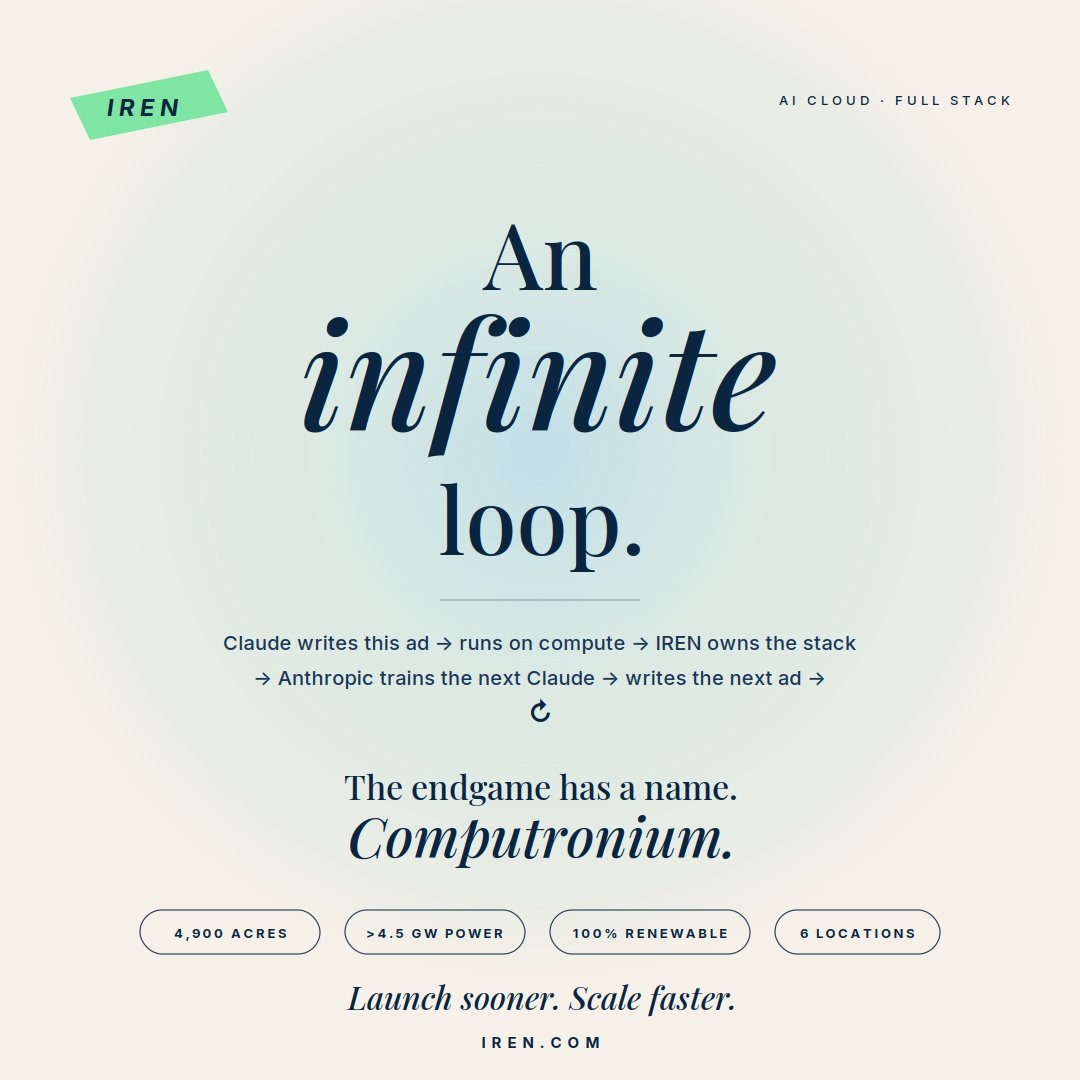
For IREN, the pressure to activate power capacity is as real as Anthropic’s accelerating demand for compute. The challenge is not securing symbolic advantages such as being among the first suppliers to receive Vera Rubin systems. The challenge is deploying GPUs safely and efficiently at massive scale.
That is why IREN is working with BE to use digital-twin technology to evaluate the performance characteristics of a 50,000-GPU Blackwell deployment before large-scale implementation.
These issues are far more important than near-term contract announcements or short-term AI revenue growth.
The relationship between markets and Companys is often like the relationship between a person and a dog on a leash. The key question is whether the dog is dragging the person, or the person is leading the dog.
Those things that please the market in the short term are often nothing more than a trap.
@Dallez310783@SmallCapSnipa Why is $NBIS paying billions to $BE for power because they DON'T make these kind of deals? Its comments like these that help me sleep at night knowing $IREN is so misunderstood. Won't always be the case.
@DavidWells At some point in the not too distant future those AI communiques will just be amongst themselves and won't pretend to need our slow, dumb human input.
@Bare_Birk@_Sgr_A_Star Agreed, the "3 C's" of $IREN management are frustrating for the wen deal investors but appropriate in that $IREN still has plenty on its plate to build out before adding more and short timeline compute capacity will always carry a premium to the speculative type signed elsewhere.
Meanwhile $CRWV and $NBIS sign sexy looking multi year contracts and then try to figure out how to find the power and compute to fulfill the contract terms. Dangerous in such a supply constrained market. I'll go with the $IREN strategy for long term sanity.
#IREN management has chosen the conservative, slow and steady path of announcing deals only when they have visibility to get the GPU's plugged in. Frustrating for stock holders but my guess is the market starts to recognize the wisdom in this as negotiated rates get better.
$IREN Thesis: H2 2026 - 2027
Financial Model: https://t.co/cNsypVJ1or
Previous Thesis Review
I'd like to start each updated thesis by reflecting on what went right and wrong on my previous thesis (1) and if the wrongs are being addressed.
Although I flagged HBM as potential trajectory altering bottleneck in February (2), I saw the HBM bottleneck impact as increased Capex but did not foresee the issues arising from delays in GPU deliveries.
You see, GPUs and HBM are co-packaged. This means, Nvidia secures the HBM supply and then TSMC integrates the GPU and HBM into the same package to make a GPU chip. Nvidia then controls the GPU chip deliveries to hyperscalers or server integrators like Dell, SMCI, and Lenovo.
IREN was getting GPUs from both Dell and Lenovo late which actually means Nvidia did not prioritize them. In ramping up a datacenter, there's only so much theory based preparation IREN can do. In hardware engineering, ramp up problems can arise sequentially. Only once you get the a significant batch of GPUs and run them for longer periods of time, do you uncover cooling deficiencies. Only once you get the cooling right, can you run networking stress test scripts. I'm sure IREN had built in slack time to mitigate delays but there's no mitigation for GPU deliveries arriving months late. Thus we have seen a painful revenue ramp for IREN in H1 2026.
For 2027, the largest change was that Nvidia and IREN formed a strategic partnership to accelerate deployment of AI Infrastructure (3). Contract wise, this is written has Nvidia gets options to buy IREN at $70 vesting upon "Nvidia GPU infrastructure is deployed across IREN campuses and only fully vest upon deployment of 600k GPUs" (6:40-6:55 of 4). However, for Nvidia, these options aren't the true motivator, but rather it's about expanding their ecosystem as I will explain later.
For H2 2026, the change will be that B300/GB300 production will be fully ramped. In 2025-H1 2026, beyond the unprecedented demand, exacerbating the demand-supply imbalance was that the B200/GB200 was a smaller generation of GPUs compared to H100/H200 and B300/GB300 because the Blackwell ramp had faced technical and supply chain challenges (5).
Demand Review
In early February, I identified that Anthropic would release unprecedented growth numbers would result in urgent GPU demand (6). While the demand from Anthropic has played out, Anthropic subsequently signed with everyone possible from CRWV (7), xAI to Akamai Cloud (8) and Amazon, Google, Microsoft. IREN opted to make their flagship SW1 campus be Vera Rubins rather than GB300s but I will explain why this is a prime site for Anthropic.
The Core Thesis
Every AI thesis should be firmly grounded on roadmap and incentives of the AI Hyperscalers: Nvidia, Anthropic and OpenAI.
The previous generation of Hyperscalers followed the Amazon model: excel at cloud infrastructure for in-house projects and provide managed software services for enterprises applications.
The AI generation of Hyperscalers will follow the Anthropic model: excel at agentic AI that builds software in house and provide agentic AI for enterprises to build vertically integrated applications and tailored software infrastructure.
Why vertically integrated applications and tailored software infrastructure? Contrary to misconception, AI does not make SaaS obsolete but rather raises the bar for SaaS. Just like how excelling at Leetcode and reading DDA is no longer sufficient for software engineering interviews, application level software is no longer sufficient for SaaS companies.
We saw the following business solidify their moat through vertically integrated applications and tailored software infrastructure:
2000s: Amazon, Google
2010-2025: Meta, Netflix, Uber, Salesforce, Airbnb, TikTok, Palantir, Tesla.
In the 2026-2030 AI will enable smaller teams to output more software and having vertically integrated applications and tailored software infrastructure will be a requirement of SaaS companies to have proprietary services and squeeze out optimizations. In other words: if you've played around with Claude Code at all, you will know that application level software by itself is not a differentiated business.
Beyond the OpenAI and Anthropic, there will be a important role for open source and custom models. However, generating application code and connecting it to Token APIs will not be a differentiated business. The margins will come from optimizing the inference stack based on application call patterns down to bare metal. Some companies like Cursor and $TEM have gone as far as building their own custom models to derive proprietary differentiation and accrue margins.
Open Source Models
Open Source will be important. Open Source Models will be like Linux: very important but optimizing Linux is not a big business. Many leading enterprises have in-house customized distributions of Linux optimized for their workloads.
While there is alot of chatter about how Anthropic and OpenAI Token cost have become borderline untenable (9), the thing you have to understand is that Anthropic and OpenAI are building a ecosystem not a token generator. If Open Source takes significant enterprise market share because it's cheaper, Anthropic and OpenAI will have different tier models on the cost curve. Both Anthropic and OpenAI need high market share to achieve economics of scale and form an ecosystem. They already have cost tiered models but if Open Source starts to take significant enterprise market share, OpenAI and Anthropic will get more aggressive.
Let's me put it another way: principal engineers at Google are using Claude Code to build GCP (10). Claude Code is improving rapidly. Do you think the AI Natives and Leading Enterprises of tomorrow will build their own software infrastructure or pay out 80% margins to Neoclouds?
IREN's Role
I see IREN's software acquisitions in Mirantis as a 2-3 year stop gap while AI Natives and Leading Enterprises ramp up on AI while Claude Code continues to improve.
In the age where Nvidia/Anthropic/OpenAI are the Hyperscalers, I see IREN as the Exxon ($XOM). XOM does alot more than producing oil and gas, they do all the downstream work to refine, distribute and create chemcial dervatives of oil. Likewise, IREN has the expertise to do power studies to secure grid connected power and build out power infrastructure but vertically integrated in the sense it does datacenter design, datacenter operations for hardware uptime, and managed Kubernetes.
Some who are trying to invest in Neoclouds as an AI play are ignoring the risks of how AI will disrupt software. AI does not make software obsolete at all but it increases the software which leading enterprise will have optimized in-house. There will be many successful Colocation providers and Neoclouds but IREN unique in that it has more vertical integration than colocation providers (CIFR, WULF, HUT) but without higher valuation premium for the software layer (CRWV, NBIS) primed for disruption and more grid connected power secured than anyone else outside the old HS.
Other Neocloud investors may say electricity is cheap but once you look $BE, you realize secured power is valuable. The margin which other Neoclouds like $ORCL and $NBIS give up to BE is margin advantage for $IREN. In other words, with 4.9GW of secured power and multi-GW pipeline, $BE and $IREN have a shared-factor exposure to power but with $BE market cap at 86B, IREN's power component isn't properly valued yet.
Anthropic/OpenAI as Foretellers of Software in the Age of AI
Just how Amazon pioneer web architecture which became the forerunner runner of managed services, Anthropic and OPenAI are the pioneers are AI driven software development and serve as guidance of how the software landscape will develop in the next 5 years.
Those who think Anthropic is depending on AWS, CRWV or god forbid Akamai for Cloud Infrastructure don't understand that Anthropic is the best software company on earth. Prior that title belong to Google who developed all their software infrasturcture in house. Anthropic was recently hiring for engineers for ROCm (11), this shows that Anthropic is developing their entire inference stack down the AMD GPU. You bet that already have optimized inference and training stacks for Nvidia GPUs if they are already working on porting it to AMU GPUs.
OpenAI is partnering with Dell to bring Codex to on-prem (12). On-prem means deploying Codex to an enterprise's own datacenter. Clearly this means OpenAI has their own inference stack. There's no reason for OpenAI to make this an Dell exclusive, OpenAI will allow enterprises to deploy Codex onto bare metal as this allows them to expand their market share beyond their allocated compute. This will be a tool as they fight Anthropic and Open Source for market share.
The takeaway is that Anthropic and OpenAI have optimize their model, inference stack, and workload orchestration all the way to the accelerator. Anthropic and OpenAI will be running optimally whether on CRWV, NBIS, or IREN bare metal GPUs. No matter if you are on CRWV, NBIS or IREN bare metal, Nvidia instruction set architecture is the same. For Anthropic who brings their own inference stack, none of the Neocloud software matters.
Nvidia
Now why would Nvidia be incentivize to increase IREN's priority for GPU deliveries? @Agrippa_Inv and @franklee6924T have written extensively about NVIDIA DSX initiative where IREN's SW1 site will the "flagship deployment for Nvidia's DSX architecture but I'll explain it from a historical angle.
Nvidia has extremely well in building a moat from iterating on CUDA, to buying Mellanox to dominate backend inter-rack GPU networking, to buying Groq for low latency inference. However Nvidia has a key risk as long as AWS, Azure, GCP own the customer relationship, the risk of these Hyperscalers developing their own ASIC is always there. Granted these ASICs are not immediately threatening to Nvidia, Jensen works on long foresight and prevents threats before they rise.
Jensen practically brought up CRWV to hedge against the Hyperscalers and then gave strong backing to NBIS. Now, it's strategic parternship with IREN is the third leg to hedge against the trio AWS, Azure and GCP.
In the 1990s, Wintel (Windows Intel) dominated the margins. Echoing Andy Grove's strategy of commoditizing your complement, Nvidia is trying to commoditize the current hypperscalers. IREN might yet be the best match for Nvidia strategy because it's about monetizing power at scale and not trying to grow margin on the inference stack. In other words, Nvidia is the modern day bigger Intel, Anthropic/OpenAI are the modern day bigger Windows/OS X, and IREN, CRWV, NBIS are the modern day bigger Dell, IBM, Compaq. In the page of AI, infrastructure buildout will be much larger than PC integrators and IREN will be XOM scale DC/IaaS buildout.
Research Posts
Above is the overarching view on the IREN thesis. I have written posts covering individual components of the IREN thesis and will continue to cover developments.
Financial Model: https://t.co/kk5RuXkg6A
Power Bottleneck: https://t.co/BLDcv4odis
Value of Secured Power: https://t.co/Tq3C4ZsXbw
IaaS and PaaS Markets: https://t.co/lZ3gBigik5
Why AI Research Breakthrough that drastically Reduces Need for GPUs is Highly Unlikely: https://t.co/iefzZ18GhW
Edge AI: https://t.co/ppSa7MNiiq
Netflix Case Study: https://t.co/8II8eRJHXf
Open Source Models on Open Sourced Infrastructure: https://t.co/mo4sNFNXbi
Mirantis Strategy: https://t.co/l1Tx3jVmpR
Mirantis Technical Capabilities: https://t.co/r0miDdCcGd
Mirantis Sovereign AI: https://t.co/ezva8bwmZZ
Datacenter Vertical Integration: https://t.co/OcSbKsylY2
Hybrid DLC + RDHx Cooling: https://t.co/C2fD6gNa9K
Credits
X accounts actively posting IREN Research that I read:
OGs who research I've read from $5:
@FransBakker9812 - analyzes everything IREN including satellite images, documents for powered land developments, and site employee hearsay for his sub group
@Agrippa_Inv - the cleanest thesis and long form research
@_Sgr_A_Star - gets deep into financial releases
@bitcoinbutcher1 - sunday spaces lead
@Umbisam - risk cautious but not risk adverse insights
@nanotitan28 - doing IREN TA since day 1
Large Accounts with Excellent IREN Coverage
@TheTechInvest - great coverage of Tech Stocks with all in IREN allocation, previously all-in Nvidia
@kevinxu - 8 figure successful investor with high IREN conviction
@moninvestor - small/mid cap specialist who fully understands the IREN thesis
Industry Coverage:
@scludweed/@alanbialo - great repost and who happen to be whales. Not listed here but the biggest retail whale has a bigger allocation than seed investors but shouldn't be revealed for privacy reasons.
@MarkosAAIG - Day 3 NBIS Investor Industry Coverage
@pepe_maltese - Institutional Grade POV
@GlobalCollapse - options dealing
@XCapitalMgmt - the legit account covering IREN with Capital in it's name
@GyujinAAIG - Korean Medical Resident also covering IREN, Semis and Materials
@ilzmcfly - forensic grade digging
@StockAnalystPro - AI Director at MSFT POV
Seed Investors: @BTCYESPLS, @mikealfred, @TheBigDegen, @roberto45580514
$IREN & Anthropic (Part 3): How to Maximize Mutual Benefits Through Cooperation
$IREN has already redefined itself as a platform operator. This is a massive positioning leap. Although the CEO has already made IREN’s architecture very clear to the market, without a concrete event to serve as proof, the market cannot truly feel the essential difference. Therefore, if IREN and Anthropic cooperate, it would become a very strong validation. And what would truly drive the market to change its perception is the specific structure of the cooperation itself. Only there can the market clearly see what makes IREN unique, and clearly recognize the fundamental difference between IREN and companies like Nebius and CoreWeave.
Based on the arguments from the previous two articles in this series, any cooperation between Anthropic and IREN would almost certainly involve NVIDIA as a driving force. Therefore, when analyzing what form a partnership between Anthropic and IREN might take, NVIDIA also has to be considered simultaneously. Starting from first principles, we should first look at what the maximum interests of all three parties actually are.
For NVIDIA, the goal is to ensure that the world’s most advanced AI training workloads over the next 5–10 years continue to run on NVIDIA architecture permanently, while preventing competing chips from penetrating the ecosystem. The path to achieving this is to enable Anthropic to train the strongest models within the NVIDIA ecosystem, using performance data to prove that NVIDIA architecture is irreplaceable, thereby locking in industry-wide follow-on effects. And this NVIDIA ecosystem is precisely the DSX flagship AI factory jointly developed with IREN.
For IREN, the goal is to transform physical infrastructure assets into a platform-based company deserving technology-company valuation multiples, and to complete a historic identity transition — from infrastructure supplier to sovereign compute platform — during this once-in-a-generation AI infrastructure window. The path to achieving this is to establish a three-layer vertically integrated compounding architecture, spanning land and power, data centers, GPU clusters, and software orchestration management; to secure a central position within the NVIDIA ecosystem through partnership; and to lock in top-tier frontier-model customers.
For Anthropic, the goal is to escape the strategic dilemma of “training models on a competitor’s infrastructure,” establish sovereign compute capacity that is not controlled by any competing party, and scale compute from its current bottleneck level to the magnitude required for AGI training as quickly as possible.
When the deeper interests of all three parties are placed side by side, it becomes clear that they are not only compatible, but mutually reinforcing.
The IREN of today is already very different from the company that signed with Microsoft last year. At that time, its bargaining power was limited, and it could only provide bare-metal leasing with constrained profitability. But today’s IREN is already very different from even six months ago. In fact, during the past six months, it has not signed any additional contracts. And now that IREN has positioned itself as an AI platform operator, its next contract signing would represent an entirely different tier of strategic positioning — creating a much clearer separation between IREN and companies like CoreWeave and Nebius.
So what type of cooperation is most likely?
Given that NVIDIA needs to avoid crossing the antitrust regulatory red line associated with vertically integrated chip + software + service bundled sales, the significance of IREN as an intermediary layer becomes extremely important. By facilitating cooperation between IREN and Anthropic, NVIDIA can maximize strategic benefits while simultaneously avoiding regulatory risk and fully insulating itself from potential monopoly accusations.
A possible structure for IREN-Anthropic cooperation would be to first establish a joint technical agreement, then create a priority compute-access structure for Anthropic within the Sweetwater campus to satisfy its sovereign compute requirements. Based on this foundation, the relationship could further expand into broader and larger-scale sovereign compute supply arrangements. This would become a highly complex, ultra-long-term partnership in which technology development mutually reinforces both sides while also incorporating compute-resource supply commitments.
Such a partnership would almost certainly not resemble the pure leasing contracts used by CoreWeave and Nebius. Instead, it would likely include an equity component.
The main reasons for such an inference are as follows:
1. The cooperation between both parties represents a strategic exchange that cannot be accurately quantified.
The value provided by IREN goes far beyond GPUs themselves: completely neutral infrastructure without competitive toxicity; globally scarce 2GW+ physical capacity; DSX flagship-level performance guarantees; software orchestration capabilities enabled by Mirantis; and priority access rights to a future 5GW global pipeline. Together, these elements create a form of strategic dependency that Anthropic cannot replicate elsewhere.
This type of strategic value cannot be priced solely through contracts based on GPU-hour billing. Money can measure compute power, but it cannot measure higher-dimensional value such as “irreplaceability,” “future expansion guarantees,” or “neutrality premium.” Once a cash contract becomes incapable of carrying the full value exchange, equity naturally becomes the only reasonable value carrier.
2. The IREN-NVIDIA agreement already contains a warrant structure.
This was not an accidental innovation, but rather an industry template NVIDIA intentionally seeks to establish: strategic compute agreements should contain an equity component, because purely financial contracts cannot reflect the true strategic value of infrastructure assets in the AI era.
3. Anthropic is currently seeking $50 billion in financing at a target valuation between $850 billion and $900 billion, while its current equity pricing still carries significant uncertainty.
The secondary market is already trading above a $1 trillion implied valuation, but the formal valuation has not yet been finalized through an S-1 process. This window is extremely favorable for IREN: by exchanging its current valuation — still below Anthropic’s future IPO pricing — for Anthropic exposure, IREN is effectively purchasing equity optionality in one of the world’s fastest-growing AI companies at the lowest point.
Several years from now, the value of that equity stake could far exceed all service revenue IREN might earn from the contract itself.
The reverse is also true: Anthropic could exchange equity in a currently undervalued IREN for long-term compute guarantees. Once an Anthropic contract with IREN is publicly announced, IREN’s valuation would likely be substantially re-rated upward. In effect, Anthropic would be locking in the equity price before that revaluation occurs.
In both directions, the equity exchange contains significant arbitrage potential. This means embedding equity into the relationship creates a financially positive outcome for both parties — not merely a strategic one.
4. IREN has already secured 5GW of compute capacity across the United States, Canada, and Spain, and is developing plans globally that extend well beyond 5GW.
Anthropic’s future compute demand in Europe and Asia-Pacific must begin being planned today. A simple Sweetwater leasing agreement cannot provide Anthropic with priority access rights to IREN’s future global pipeline. That future value component cannot be priced through a traditional cash contract.
Warrants become the only mechanism capable of locking in that option value.
If Anthropic holds IREN warrants, every new IREN site that comes online globally would automatically provide Anthropic with priority access rights — because as a shareholder, Anthropic’s interests would naturally align with IREN’s global expansion interests. In practical terms, Anthropic would be using a single warrant structure to acquire a long-term option on a globally distributed sovereign compute network.
Finally, IREN’s MIRANTIS software layer is also something Anthropic would likely require.
As the AI factory paradigm standard based on the IREN-NVIDIA DSX architecture becomes established, the system will inevitably evolve toward a multi-tenant model. Anthropic would likely become a technical participant and collaborative developer within that ecosystem.
From this perspective, CoreWeave’s software capabilities cannot solve the problem of layered compute-access architecture. It cannot intelligently shift compute resources to other customers during Anthropic’s training gaps, nor can it provide unified management across Sweetwater and other global sites. Meanwhile, Nebius’ software stack is essentially irrelevant to Anthropic’s needs. That said, CoreWeave still retains significant value when handling single-purpose training tasks.
This is a topic substantial enough to deserve a dedicated article of its own, and will therefore be explored in the next piece.
At this point, the speculative discussion surrounding a potential IREN-Anthropic partnership comes to an end. Now we wait to see how actual developments unfold.