✈️🌱 Glad to announce that we are an Official Media Partner of SAF Global Summit 2026!
We are excited to announce our partnership with SAF Global Summit 2026 (#SAFGlobal26), taking place in London on 22–23 September 2026.
The summit arrives at a pivotal moment for commercial aviation, as the industry moves from ambitious net-zero commitments toward the practical challenge of scaling Sustainable Aviation Fuel (SAF) and building the infrastructure, investment and partnerships required to decarbonize air transport.
With more than 1,000 aviation and energy executives, 150+ industry speakers, and 85+ sponsors and partners, SAF Global Summit 2026 is shaping up to be much more than another industry conference.
It is becoming a key execution platform for the global aviation and energy sectors to turn SAF ambitions into reality.
🌱 SAF | Aviation | Energy | Net Zero | Innovation
📍 London
📅 22–23 September 2026
🔖 #SAFGlobal26
We look forward to being part of this important conversation and helping amplify the developments that will shape the future of aviation.
Read more: https://t.co/PaiygR9M9U
#SAFGlobal26 #SAF #SustainableAviationFuel #SustainableAviation #NetZero #Aviation #AviationIndustry #Energy #Decarbonization #FutureOfAviation #AviationNews #MediaPartner
📡✈️ Old radar out. Next-generation ASDE-X/ASSC surface surveillance in.
Newark Liberty International Airport (EWR) is moving toward modern surface surveillance technology as the FAA replaces aging equipment that has been in service for nearly 30 years.
Systems such as ASDE-X/ASSC (Airport Surface Detection Equipment, Model X / Airport Surface Surveillance Capability) use multiple sensors to provide high-resolution surveillance of aircraft and vehicles on or near runways and taxiways.
Unlike traditional surface radar alone, this multi-sensor approach can provide clutter-free, precise situational awareness of both moving and stationary targets — helping air traffic controllers monitor the airport surface in all weather and visibility conditions, including at night, in rain, fog and other challenging conditions.
🔹 High-resolution surface surveillance
🔹 Multi-sensor technology
🔹 Tracks aircraft and vehicles
🔹 Works in all weather and visibility conditions
🔹 Improves controllers' awareness of runway and taxiway activity.
Today, aviation is replacing aging infrastructure with modern sensors, advanced software and digital systems designed for the future of air traffic.
30 years of technology — replaced by a new generation of aviation surveillance.
#NewarkAirport #EWR #FAA #ASDEX #ASSC #AirTrafficControl #Radar #SurfaceSurveillance #AviationTechnology #Aviation #AirSafety
🌑 A live eclipse broadcast… from an airplane? ✈️
At Iberia, they’re getting ready. 🌌
This Wednesday, starting at 8:20 p.m., join us live on our social media channels as we bring this incredible celestial event to you from the sky.
Don’t miss it.
#Iberia#Eclipse #LiveFromTheSky #Aviation #Astronomy
Iberia to Livestream Total Solar Eclipse on a Special Flight as aviation and astronomy come together on 12 August with a group of 30 astronomers onboard.
Iberia will offer aviation and astronomy enthusiasts a unique view of the total solar eclipse by broadcasting the event live from a specially operated flight cruising at 10,000 meters (approximately 33,000 feet).
The aircraft will be equipped with three onboard cameras and Starlink satellite connectivity, enabling a real-time broadcast from above the clouds. Around 30 astronomers will also be on board to observe and analyze the eclipse throughout the flight.
One of the highlights of the livestream will be footage from a GoPro camera mounted in the cockpit, which is expected to capture the eclipse's shadow sweeping across the Earth's surface—or the cloud tops, depending on weather conditions.
Ahead of the main event, the aircraft will conduct a test maneuver between 7:42 p.m. and 7:44 p.m. to align with the Sun and verify camera framing, tracking, and the planned flight trajectory, ensuring optimal viewing conditions for the live broadcast.
The mission promises to deliver a rare perspective of one of nature's most spectacular celestial events, combining cutting-edge aviation technology with scientific observation high above the clouds. ✈️🌒
📸 For Reference Only/ Digitally created (AI).
#airlines #paxex #aviation
American Airlines Flight 1760 returns safely to Myrtle Beach after suspected bird strike
American Airlines Flight 1760 (AA1760), operating from Myrtle Beach (MYR) to Charlotte (CLT), is believed to have struck a bird shortly after takeoff on August 10.
The Boeing 737 returned safely to Myrtle Beach International Airport after passengers reported seeing sparks and what appeared to be flames from the left engine area.
🎥 Video shared by passenger Lindsey Mackey captures the incident, with Mackey describing the situation as the “left engine on fire.”
The aircraft landed safely, and no injuries were reported. Emergency crews were on standby following the reported bird strike, and the aircraft was subsequently taken out of service for inspection.
While the video appears to show flames or sparks, an engine fire has not been officially confirmed. The available information indicates a suspected bird strike and reports of smoke/visible activity around the engine.
Flight: American Airlines AA1760
Route: Myrtle Beach ✈️ Charlotte
Aircraft: Boeing 737-800
Incident: Suspected bird strike
Outcome: Safely returned to Myrtle Beach
#AmericanAirlines #AA1760 #BirdStrike #Boeing737 #Aviation #AviationNews #MyrtleBeach #Charlotte #AirSafety #AvGeek
Could be among first for the latest Saudi carrier, Riyadh Air RX27, operated by a month old Boeing 787-9 Dreamliner, makes an air turn back (ATB) to Riyadh after take-off.
Riyadh Air flight RX27, operating from Riyadh to Jeddah on August 10, experienced an unusual return to its departure airport.
The aircraft, a Boeing 787-9 Dreamliner departed Riyadh but stopped climbing at around 8,000 feet and remained on a holding pattern over the Riyadh area before returning to King Khalid International Airport (RUH).
The aircraft details:
🔹 Registration: HZ-RXAF
🔹 Aircraft: Boeing 787-9 Dreamliner
🔹 Delivery date: 03/07/2026
🔹 Operator: Riyadh Air
🔹 Flight: RX27 — Riyadh ✈️ Jeddah
🔹 Event Date: August 10, 2026
Following the return to Riyadh, the aircraft assigned to the flight was changed to another Riyadh Air Boeing 787, registration HZ-RXAB, which then operated the service.
The reason for the return has not been officially confirmed. The flight profile could be consistent with a technical or operational issue, but without an official statement, it would be premature to conclude that a technical fault was responsible.
HZ-RXAF is one of Riyadh Air's very recently delivered Boeing 787-9s, having been delivered on July 3, 2026.
Flight: https://t.co/tVRldydiXN
#RiyadhAir #RX27 #Boeing787 #Dreamliner #HZRXAF #HZRXAB #Aviation #SaudiAviation #Riyadh #Jeddah #AviationNews
This is how the powerful earthquake was experienced from the cockpit of an aircraft at Pereira’s Matecaña Airport.
An Airbus A320, waiting on the ground for its turn to depart, captured the frightening moment the strong earthquake struck Colombia. The aircraft was still on the airport surface when the tremor began, with the shaking clearly felt from inside the cockpit and cabin.
Once the earthquake subsided and the airport was assessed as safe for the aircraft’s movement, the A320 resumed its taxi and subsequently took off from Pereira, one of the areas significantly affected by the earthquake.
🎥 The footage offers a dramatic perspective of the event — from the cockpit, as pilots and passengers experienced the sudden shaking while preparing for departure.
🎥 Credit: EL TIEMPO
#Colombia #Earthquake #Pereira #PereiraAirport #Matecaña #A320 #AirbusA320 #Aviation #AviationNews #AviationSafety #Earthquake2026
VISUALS OF THE APRON DURING THE EARTHQUAKE THAT HAS FORCED PREVENTIVE CLOSURES AT SIX COLOMBIAN AIRPORTS — SERIOUS DAMAGE REPORTED
Colombia’s Civil Aeronautics Authority (Aerocivil) has confirmed the preventive suspension of commercial operations at six airports following the powerful magnitude 7.4 earthquake that struck western Colombia on August 10.
The affected airports are:
✈️ Pereira – Matecaña (PEI)
✈️ Manizales – La Nubia (MZL)
✈️ Quibdó – El Caraño (UIB)
✈️ Armenia – El Edén (AXM)
✈️ Cartago – Santa Ana (CRC)
✈️ Buenaventura – Gerardo Tobar López (BUN)
The closures are intended to allow technical teams to assess structural integrity and the condition of critical aviation infrastructure before normal operations resume.
Reports indicate that Pereira’s Matecaña International Airport suffered significant damage, while parts of the roof at Quibdó’s El Caraño Airport reportedly collapsed.
#airport #travel #safety
🚨 JUST IN: This is how Matecaña International Airport in Pereira, Colombia, looks following the 7.4-magnitude earthquake that struck the country on Monday, August 10, 2026.
Authorities are assessing the damage and safety of airport operations.
📍 Pereira, Colombia
🌎 Stay safe and follow official updates.
#Colombia #Earthquake #Pereira
TRUMP SECRETLY MOVED FROM AIR FORCE ONE TO A C-32A IN TURKEY AMID LIFE THREAT
A remarkable security operation has been revealed after newly released footage showed how President Donald Trump was secretly transferred from the legacy Air Force One to a U.S. Air Force C-32A at Ankara Esenboğa Airport, Turkey.
According to a Washington Post investigation, a credible threat involving Trump or his aircraft prompted a highly unusual deception operation during his departure from Turkey on July 8.
🎥 Video released by the Washington Post shows an airport catering truck being positioned alongside the presidential 747. The vehicle's elevated catering container was raised to aircraft-door level, allowing Trump and aides to leave the 747 without being seen by the press.
The truck then drove to a nearby:
✈️ U.S. Air Force C-32A
🛩️ Aircraft type: Modified Boeing 757
📡 Reported callsign: RCH18 / Reach 18
The C-32A was not an ordinary passenger aircraft. It is a specially configured U.S. government transport used for senior officials and can transport the president or vice president.
🎭 AIR FORCE ONE BECAME THE DECOY
The legacy Boeing 747 continued its scheduled-looking departure with journalists and some White House personnel aboard, creating the impression that Trump was still on the aircraft.
The C-32A's presidential identity was further concealed through the use of “Reach 18”, rather than the Air Force One call sign.
The operation effectively created two separate narratives:
🔵 Publicly: Trump departed aboard the familiar blue-and-white Air Force One.
🟢 Actually: Trump had been transferred covertly to the smaller C-32A.
🇬🇧 ANOTHER AIRCRAFT SWITCH
The deception continued after the aircraft reached Britain.
The C-32A arrived at RAF Mildenhall before the legacy Air Force One. Trump later appeared publicly descending from the legacy 747, maintaining the appearance that he had traveled aboard that aircraft.
He then transferred to the newer Bridge Boeing 747-8 (Ex-Qatar) for the onward journey to Washington. The Post says the exact manner in which Trump moved from the C-32A back to the legacy 747 has not been established publicly.
🔐 WHY THE OPERATION IS SIGNIFICANT
This was not simply an aircraft change.
It was a deliberate movement-security and deception operation designed to make it difficult for potential adversaries to determine:
📍 Trump's actual location
✈️ Which aircraft he was aboard
📡 Which flight was carrying the president
🕐 His precise departure and arrival sequence
The most remarkable part? The catering truck wasn't just moving meals — according to the reporting and released imagery, it became part of a presidential security deception operation.
⚠️ Authenticity: The catering-truck footage and the C-32A transfer are supported by the Washington Post's investigation and visual analysis.
🎥 Credit: John Hudson/ @John_Hudson
#Trump #AirForceOne #C32A #Boeing757 #Boeing747 #USAirForce
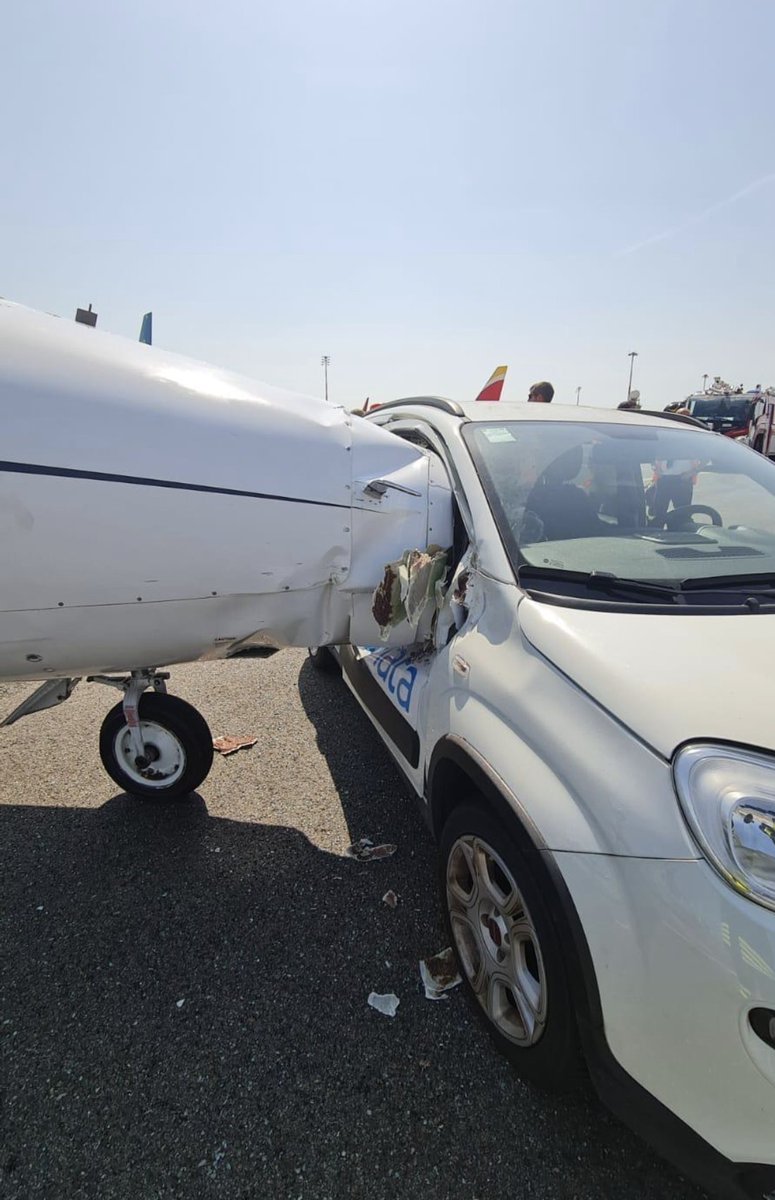
More visuals of the ground collision incident of a Hawker Beechcraft 400A (I-AERB) private aircraft at Milan Linate Airport (LIN) on Monday morning, August 10.
Shared by: Virutas de Goma™ / @VirutasF1 , Input: Francisco Cunha/ @OnDisasters#aircraft#aviation
GROUND HANDLING VEHICLE COLLIDES WITH PRIVATE JET AT MILAN LINATE
A ground-handling vehicle was involved in an unusual ground collision with a Hawker Beechcraft 400A (I-AERB) private aircraft at Milan Linate Airport (LIN) on Monday morning, August 10.
The incident occurred at approximately 11:20 local time in the airport's General Aviation area, when a Fiat Panda operated by a handling company struck the nose/front fuselage section of a private jet while maneuvering on the apron.
🚒 Emergency services, including firefighters, local police and medical responders, attended the scene.
Fortunately, no injuries have been reported.
✈️ AIRPORT OPERATIONS TEMPORARILY DISRUPTED
Following the collision, departures from Linate were temporarily suspended while the aircraft stand and surrounding operating area were checked.
Two arriving flights were reportedly diverted to Milan Bergamo (BGY) and Milan Malpensa (MXP) during the disruption.
Airport operations returned to normal after approximately 30 minutes.
🎥https://t.co/eTKYbVPxGa and FroostTh (reddit)
#MilanLinate #LinateAirport #LIN #LIML #Milan #Italy #AircraftDamage #ApronSafety #AviationSafety #AirportOperations #BusinessAviation
Colombia’s Civil Aeronautics Authority (Aerocivil) has suspended flight operations at Guillermo León Valencia Airport in Popayán (PPN) following ash emissions from the Puracé volcano.
The precaution comes as Puracé remains under an orange alert, with authorities monitoring increased volcanic activity, including ash and gas emissions.
⚠️ Importantly, Colombia’s Geological Service has ruled out a direct link between the volcanic activity and today’s magnitude 7.4 earthquake in western Colombia. The two events are being treated as separate phenomena.
#airport
EARTHQUAKE DISRUPTS OPERATIONS AT AT LEAST 7 COLOMBIAN AIRPORTS, CALI AIRPORT (CLO) OPERATIONS RESUME.
A powerful magnitude 7.4 earthquake struck western Colombia on Monday, August 10, triggering temporary disruptions at airports across several regions as aviation authorities carried out safety inspections.
According to Colombia’s Aerocivil, commercial air operations were temporarily suspended at:
✈️ Pereira – Matecaña (PEI)
✈️ Manizales – La Nubia (MZL)
✈️ Quibdó – El Caraño (UIB)
✈️ Armenia – El Edén (AXM)
✈️ Cartago – Santa Ana (CRC)
✈️ Buenaventura – Gerardo Tobar López (BUN)
Cali’s Alfonso Bonilla Aragón International Airport (CLO) was also affected, although operations subsequently resumed after a delay of more than 1½ hours.
🚒 Aerocivil said its aeronautical firefighting and search-and-rescue teams were activated and that regional authorities were being supported while infrastructure damage was assessed.
At affected airports, only medical and government flights were initially being permitted in some locations while inspections continued.
⚠️ Popayán's Guillermo León Valencia Airport (PPN) was operating under separate restrictions because of emissions from Puracé volcano, according to Aerocivil.
🔎 The situation remains dynamic as engineering teams continue assessing infrastructure across the affected regions.
#Colombia #Earthquake #Earthquake2026 #AviationNews #AviationSafety #Aerocivil #Cali #CLO #Pereira #Cartago #Buenaventura #Airport #AirportSafety #FlightOperations #CaliAirport #NaturalDisaster
🛫 WHY EARTHQUAKES CAN CLOSE AIRPORTS
An earthquake does not need to damage a runway to make an airport temporarily unsafe. Airport authorities must inspect critical infrastructure including:
🔹 Runway and taxiway pavement for cracks, deformation or displacement
🔹 Aprons and aircraft parking stands
🔹 Terminal structures and ceilings
🔹 Control towers and air-navigation facilities
🔹 Approach and runway lighting systems
🔹 Navigational aids and communications equipment 🔹 Bridges, fuel systems and other airport infrastructure
🔹 Potential FOD and structural debris on movement areas Even if the runway itself appears intact, damage to navigation, communications or other safety-critical systems can require operations to be restricted until functionality is verified.
#airport
EARTHQUAKE DISRUPTS OPERATIONS AT AT LEAST 7 COLOMBIAN AIRPORTS, CALI AIRPORT (CLO) OPERATIONS RESUME.
A powerful magnitude 7.4 earthquake struck western Colombia on Monday, August 10, triggering temporary disruptions at airports across several regions as aviation authorities carried out safety inspections.
According to Colombia’s Aerocivil, commercial air operations were temporarily suspended at:
✈️ Pereira – Matecaña (PEI)
✈️ Manizales – La Nubia (MZL)
✈️ Quibdó – El Caraño (UIB)
✈️ Armenia – El Edén (AXM)
✈️ Cartago – Santa Ana (CRC)
✈️ Buenaventura – Gerardo Tobar López (BUN)
Cali’s Alfonso Bonilla Aragón International Airport (CLO) was also affected, although operations subsequently resumed after a delay of more than 1½ hours.
🚒 Aerocivil said its aeronautical firefighting and search-and-rescue teams were activated and that regional authorities were being supported while infrastructure damage was assessed.
At affected airports, only medical and government flights were initially being permitted in some locations while inspections continued.
⚠️ Popayán's Guillermo León Valencia Airport (PPN) was operating under separate restrictions because of emissions from Puracé volcano, according to Aerocivil.
🔎 The situation remains dynamic as engineering teams continue assessing infrastructure across the affected regions.
#Colombia #Earthquake #Earthquake2026 #AviationNews #AviationSafety #Aerocivil #Cali #CLO #Pereira #Cartago #Buenaventura #Airport #AirportSafety #FlightOperations #CaliAirport #NaturalDisaster
🚨 JUST IN: This is how Matecaña International Airport in Pereira, Colombia, looks following the 7.4-magnitude earthquake that struck the country on Monday, August 10, 2026.
Authorities are assessing the damage and safety of airport operations.
📍 Pereira, Colombia
🌎 Stay safe and follow official updates.
#Colombia #Earthquake #Pereira
Striking the nose section can require a detailed technical inspection.
The forward fuselage may contain or be close to:
🔹 Weather radar and radome structure
🔹 Nose landing-gear systems and steering components
🔹 Avionics and electrical wiring
🔹 Flight-deck equipment and sensors
🔹 Structural frames and skin panels
🔹 Aircraft pressure-boundary components
#aircraft
GROUND HANDLING VEHICLE COLLIDES WITH PRIVATE JET AT MILAN LINATE
A ground-handling vehicle was involved in an unusual ground collision with a Hawker Beechcraft 400A (I-AERB) private aircraft at Milan Linate Airport (LIN) on Monday morning, August 10.
The incident occurred at approximately 11:20 local time in the airport's General Aviation area, when a Fiat Panda operated by a handling company struck the nose/front fuselage section of a private jet while maneuvering on the apron.
🚒 Emergency services, including firefighters, local police and medical responders, attended the scene.
Fortunately, no injuries have been reported.
✈️ AIRPORT OPERATIONS TEMPORARILY DISRUPTED
Following the collision, departures from Linate were temporarily suspended while the aircraft stand and surrounding operating area were checked.
Two arriving flights were reportedly diverted to Milan Bergamo (BGY) and Milan Malpensa (MXP) during the disruption.
Airport operations returned to normal after approximately 30 minutes.
🎥https://t.co/eTKYbVPxGa and FroostTh (reddit)
#MilanLinate #LinateAirport #LIN #LIML #Milan #Italy #AircraftDamage #ApronSafety #AviationSafety #AirportOperations #BusinessAviation
🚨 JUST IN: This is how Matecaña International Airport in Pereira, Colombia, looks following the 7.4-magnitude earthquake that struck the country on Monday, August 10, 2026.
Authorities are assessing the damage and safety of airport operations.
📍 Pereira, Colombia
🌎 Stay safe and follow official updates.
#Colombia #Earthquake #Pereira
🛠️ WHAT WILL THE INVESTIGATION EXAMINE?
With reported hydraulic and flight-control abnormalities now part of the investigative picture, investigators will likely examine:
🔹 Hydraulic-system pressure and reservoir data
🔹 Flight-control computer and actuator behavior
🔹 Elevator, aileron and rudder control inputs
🔹 Autopilot/flight-director operation
🔹 ECAM warnings and system messages
🔹 Flight-data recorder parameters
🔹 Cockpit voice recordings
🔹 Weather and turbulence data
🔹 Aircraft maintenance history and previous defects 🔹 The relationship between any system failures and the sudden altitude change
The flight-data recorder (FDR) will be particularly important because it can establish exactly what the aircraft, flight-control systems and crew were doing in the seconds surrounding the altitude excursion.
🇫🇷 WHY BEA & AIRBUS EXPERTISE MATTERS
BEA participation is significant because the aircraft is an Airbus A320neo. Specialist technical assistance can help investigators analyse Airbus-specific systems, flight-control architecture, recorded parameters and aircraft technical data.
However, AAIB remains the independent investigation authority. Airbus personnel, if involved, would provide technical assistance rather than determine the findings independently.
⚠️ SEPARATE PILOT TOXICOLOGY QUESTION
The investigation has also attracted attention because the pilot-in-command's preliminary psychoactive-substance screening was reported as “non-negative.”
The sample has been sent to a designated laboratory for confirmatory testing. A non-negative preliminary screening is not the same as a confirmed positive result. Both pilots have reportedly been removed from flying duties pending the investigation and testing outcome.
The toxicology issue should therefore remain a separate investigative line unless evidence ultimately establishes a connection with the flight event.
🔍 THE KEY QUESTION
Was AI2379's sudden 300-foot altitude change caused by severe turbulence alone, a technical malfunction, an interaction between weather and aircraft systems, or another factor?
That is precisely what the AAIB investigation must establish.
Until the investigation produces evidence-based findings, reported technical failures should not be treated as the confirmed cause of the incident.
✈️ AI2379 landed safely — but the investigation now has to explain exactly why the aircraft suddenly lost altitude and what role, if any, the reported system abnormalities played.
#investigation
AIR INDIA AI2379: BEA FRANCE TO PARTICIPATE AS INVESTIGATION EXAMINES REPORTED TECHNICAL FAILURES
France’s Bureau of Enquiry and Analysis for Civil Aviation Safety (BEA) is set to participate in the investigation into Air India flight AI2379, the Phuket–Delhi service that suffered a sudden altitude loss during cruise on August 4, 2026.
The Aircraft Accident Investigation Bureau (AAIB) of India is leading the investigation under ICAO Annex 13, while BEA’s participation could bring additional expertise from France and potentially Airbus technical specialists into the probe.
🔎 REPORTED CASCADE OF TECHNICAL FAILURES
According to reports, AI2379 was operated by an Airbus A320neo, registration VT-EXO.
The aircraft departed Phuket at 06:56 local time and, approximately 2½ hours later, at around 09:32 IST, reportedly experienced a cascade of abnormalities involving its hydraulic and flight-control systems.
The aircraft subsequently suffered a sudden loss of approximately 300 feet (about 91 metres) in altitude during cruise.
The aircraft later stabilised and continued safely to Delhi, where it landed at approximately 11:07 IST.
⚠️ These reported technical failures have not yet been established as the cause of the altitude excursion. Investigators will need to determine the precise sequence of events and whether the system abnormalities were a cause, consequence or coincidental occurrence associated with the turbulence event.
👥 145 PEOPLE ON BOARD
AI2379 was carrying:
👨👩👧 137 passengers, including three infants
👨✈️ 2 pilots
👩✈️ 6 cabin crew
Total: 145 people
The sudden vertical movement resulted in injuries to passengers and crew. Early reports put the number of injured at 17 — 13 passengers and four crew members.
#AviationSafety #AviationInvestigation #FlightSafety #Turbulence #HydraulicFailure #FlightControls #AviationNews