FORCeS is an #H2020-funded project. It will provide more precise climate projections by reducing the uncertainty on how particles in the air affect climate.
Want to know more about the results and conclusions from the FORCeS project, now that it has wrapped up? Read about our project on the @CORDIS_EU website below. 👇
https://t.co/X5vWUfh6U4
Aktypis et al. conducted dual chamber experiments using ambient air in a polluted and a pristine forested area, and found that the two environments had completely different potentials of forming additional SOA.
@FORCeS_H2020@atmo_access@ELIDEK_HFRI
https://t.co/fnYiW0FVA8
📢Paper out in @NatureGeosci!
@PhilipStier et al. have studied the multifaceted aerosol effects on precipitation. Curious about the results? Access the paper here: https://t.co/zYYmp2Rn3k
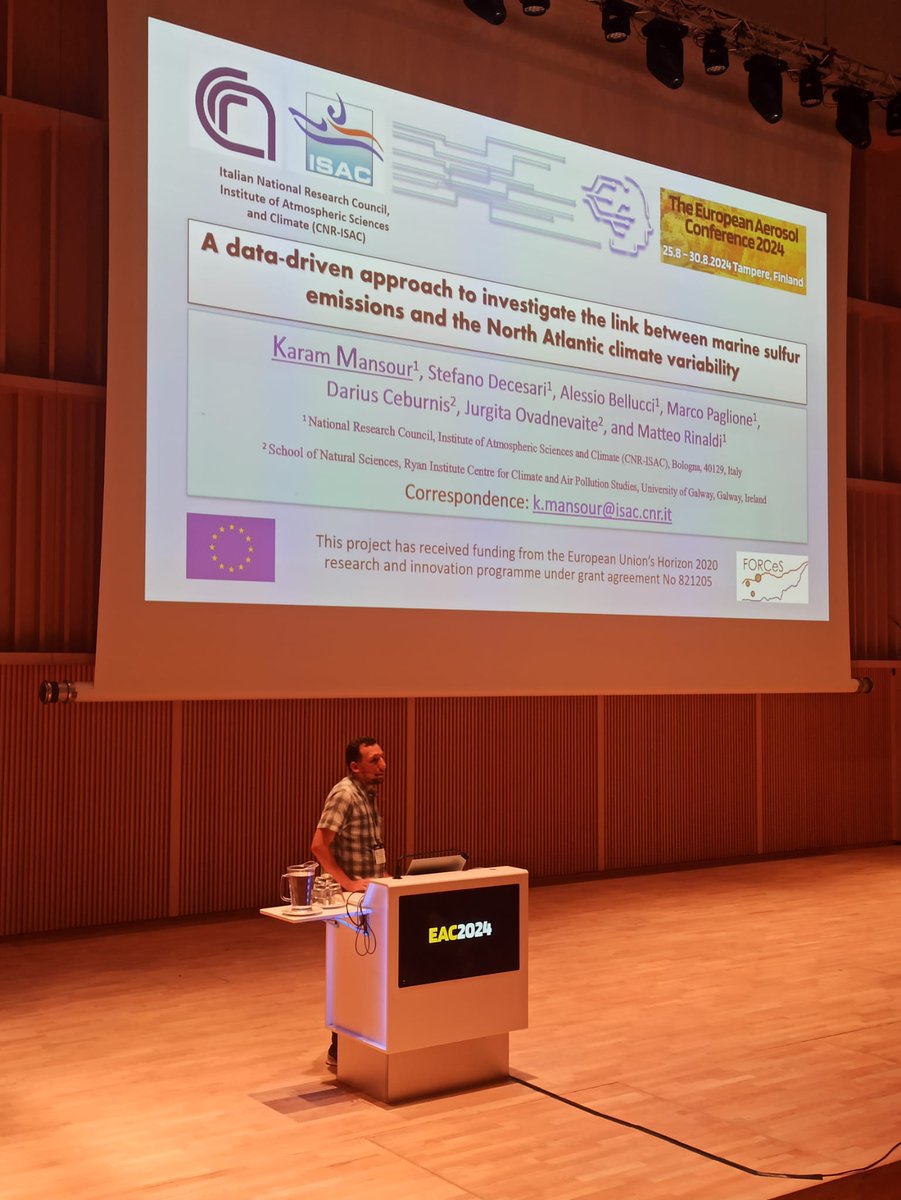
Our findings on how natural marine biogenic emissions influence long-term climate variability in the North Atlantic are present in @EAC2024@ovadnevaite@CnrIsac@FORCeS_H2020
Accurately modeling mixed-phase clouds (MPCs) is key for climate sensitivity and Arctic amplification. This is the topic of investigation in this new study by FORCeS participants Paraskevi Georgakaki & @LAPI_epfl.
Curious? Learn more👇
https://t.co/iPjWaoJY4Y
Our new research article is published. 20 ML/DL (5 types) were assessed to predict Biogenic MSA and nss-Sulfate sealevel concentrations. The first high-resolution publicly available daily gridded dataset covering the North Atlantic.
@ovadnevaite@Mace_Head@CnrIsac@FORCeS_H2020
🗓️FORCeS Nordic Seminar, 10 June!
Join us on Monday when we will be concluding our understanding of aerosol-cloud interactions in the climate system, and what the new knowledge implies for policy- and decisionmakers, and the 2-degree target. More info 👉 https://t.co/vZOne35zmn
🗓️FORCeS Nordic Seminar, 10 June!
Join us on Monday when we will be concluding our understanding of aerosol-cloud interactions in the climate system, and what the new knowledge implies for policy- and decisionmakers, and the 2-degree target. More info 👉 https://t.co/vZOne35zmn
FORCeS participants at @KITKarlsruhe just published a new study in @MDPIOpenAccess. The results suggest that the suppression of precipitation is an important factor in how marine stratocumulus clouds respond to changes due to aerosols. ☁️ Read more👇
https://t.co/I1qeP8TlXy
Curious about the contribution of fluorescent primary biological aerosol particles to low-level Arctic cloud residuals? 🤔This new study shows that bioaerosols act as cloud seeds and may influence the presence of ice within clouds, access it here: https://t.co/UAlsrPUT7E
@EGU_ACP
Anna Possner is looking for a PostDoc in her group cloud physics in the climate system at @goetheuni, focusing on microphysical processes in the context of secondary ice multiplication in mixed-phase clouds in frame of the @CleanCloud_HE project.
https://t.co/kX2R62M4li
🌲☁️Just published in @EGU_ACP!
FORCeS participants have observed that organic vapors that condense along with water vapor increase the number of aerosol particles that form cloud droplets.
Curious about these results? Read the summary below. https://t.co/lSV7WVD2tc