Two days, two FWA recognitions ✨
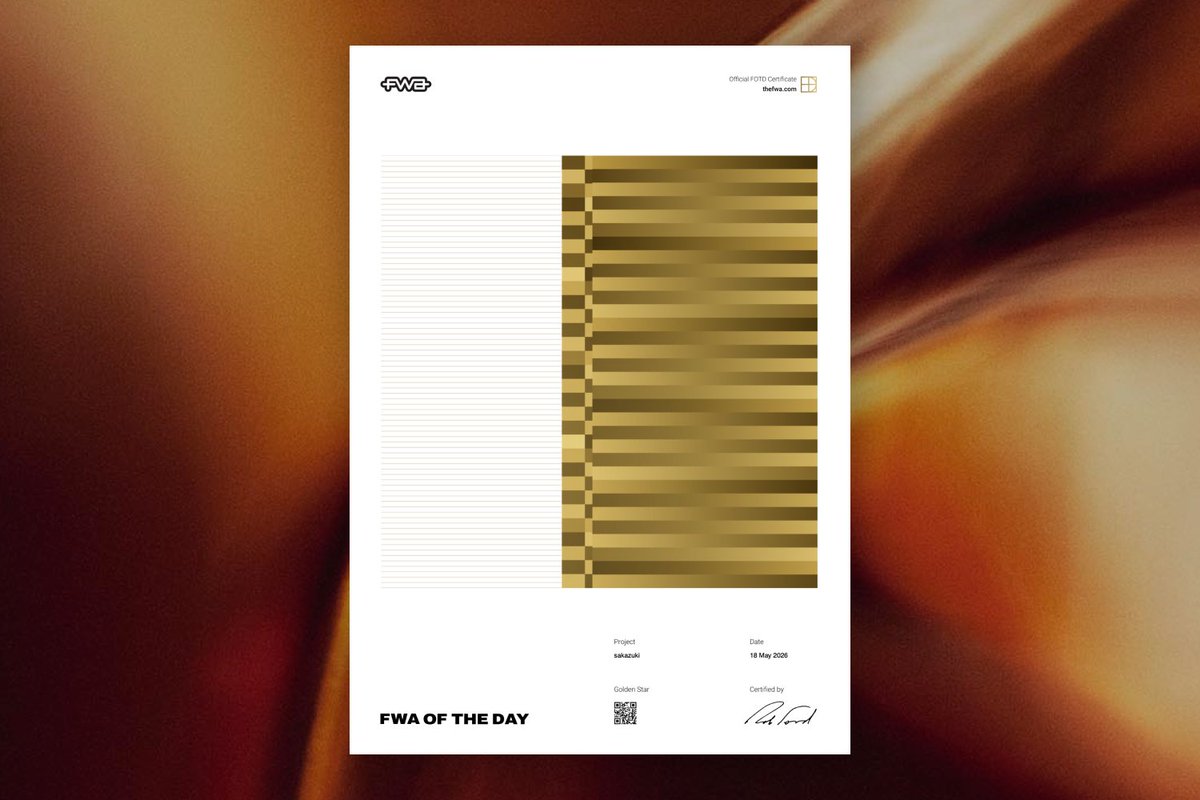
After IVRESS became FWA of the Month yesterday, our latest work for Vectr is @fwa of the Day today.
Built with #threejs and #webgpu.
The Power of Digital Storytelling is @fwa of the day ❤️🔥
Immersive scroll, hidden surprises, micro-interactions — all the things we love.
Go check it out: https://t.co/bu7vRs8uHw
#creativedesign#creativedev#threejs#webgl
1/5
GRID ARCHITECT for Google Flow
Over the last few weeks, I worked with the Google Flow team on an applet I thought would be useful for anyone working with grids.
The goal is simple: automate the annoying parts of grid-based asset creation.
Creating a grid is one thing but extracting clean individual frames from it has always been the painful part.
This tool lets you choose the kind of grid you want, define the size, generate it, then automatically parse the image into individual frames. From there, the grid becomes immediately usable.
You can upscale the entire grid to 1K in one click and download it, or download every image individually.
More info on 'The Keysey Signal' @ the FWA dossier page - The First thriller born from Flash
https://t.co/nV0A2zb9UD
The plot is built on the digital breadcrumbs we all remember and the following websites play "starring" roles: MONO*crafts, 2Advanced Studios, Subservient Chicken, Get the Glass!, Hotel 626, The Wilderness Downtown, and more.
What if the truth were embedded in the source code of archived Flash sites? 'The Kesey Signal' - a book by Rob Ford (@fwa), in print + digital. Field Station 02: a love letter by 2Advanced x FWA to the early web + a shot at a limited-edition signed poster.
https://t.co/En8uVsiuIk
dear apple, the iPod needs to come back. not for nostalgia. for the parents who want their kids to love music and audiobooks without a browser, social media, and the whole internet attached to it
Spent about $1000 in credits on Seedance 2.0 over the last few weeks,and here are a few thoughts:
First, the main thing that strikes me using a state-of-the-art model from this new generation is how hard it still is to scale beyond short form.
Getting great animation is fast.
Getting multi-cut sequences that make sense is possible.
Consistency with Omnireference is actually very good.
But the moment you move into real narrative work, things change.
Multi-character exchanges, long sequences, maintaining visual continuity across shots, keeping tone, pacing, and staging consistent… it’s not impossible, but it is still a lot of work. And with generation costing somewhere between $2 and $7 per ~15 seconds, it adds up very quickly.
As models improve, producing good looking short content is becoming trivial.
Building something that holds together as a story is still not.
Continue Video in Seedance is clearly trying to address part of this, but in my case it has been broken for the last couple of weeks, so none of my longer attempts would go through.
In theory, you could imagine a small team of 5–10 people generating all day from the same storyboard, using a shared visual reference as a single source of truth. That alone shows how close we are to something that starts looking like a real production pipeline.
But we are not fully there yet.
Right now it still feels like we can touch the future with the tip of our fingers, while at the same time struggling to precisely steer a model using mostly words, references, and iterations when the narrative becomes complex.
Short clips are easy.
Worldbuilding is not.
And storytelling is still the hardest part.