Tomorrow is the last stage of the Decentralised Justice Tour UK 2026! 🇬🇧
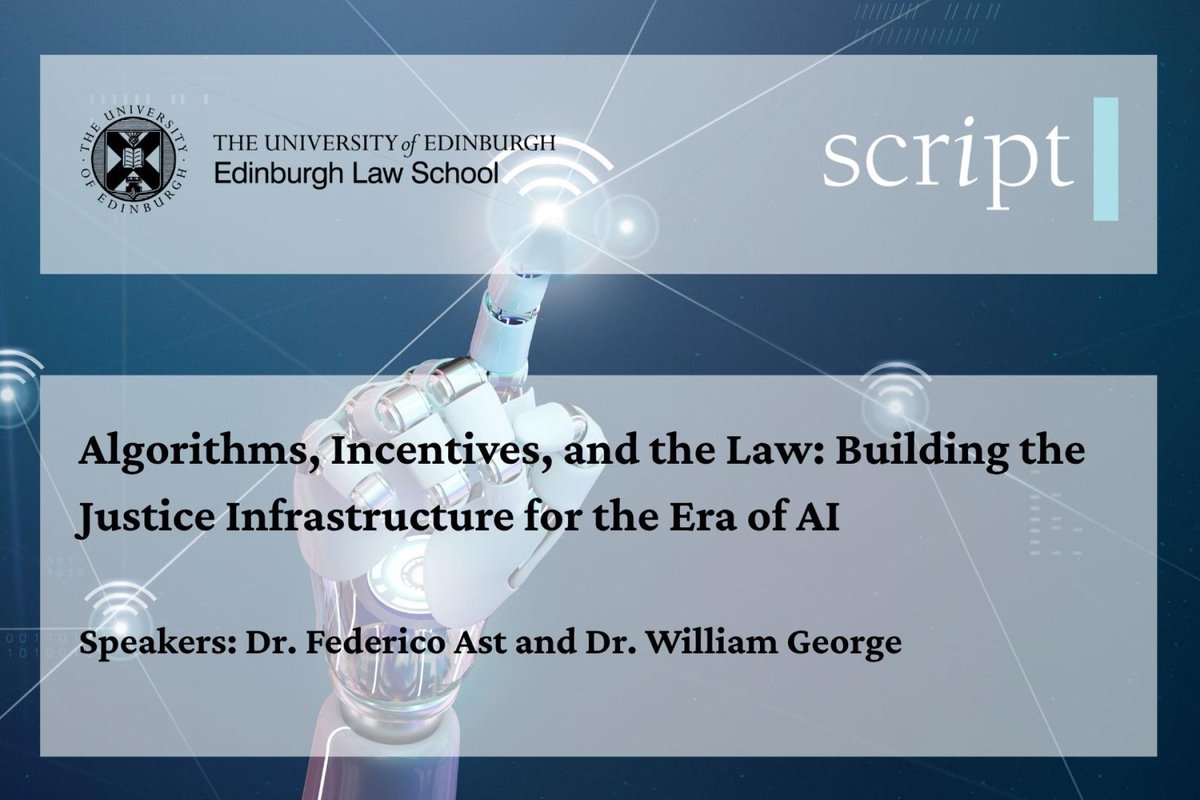
After our conference at Oxford, we will be presenting with William George at the University of Edinburgh. 🏴
A unique opportunity to learn about the future of law and how AI and blockchain are transforming legal systems as we know them.
See you!
On June 11, I will be presenting @Kleros_io with @williamhwgeorge at the University of Edinburgh! 🏴
Algorithms, incentives, and the justice infrastructure for the age of AI agents.
Scottish Enlightenment vibes.
Sign up here! 👇
https://t.co/93b3FnS17Z
It’s a wrap!
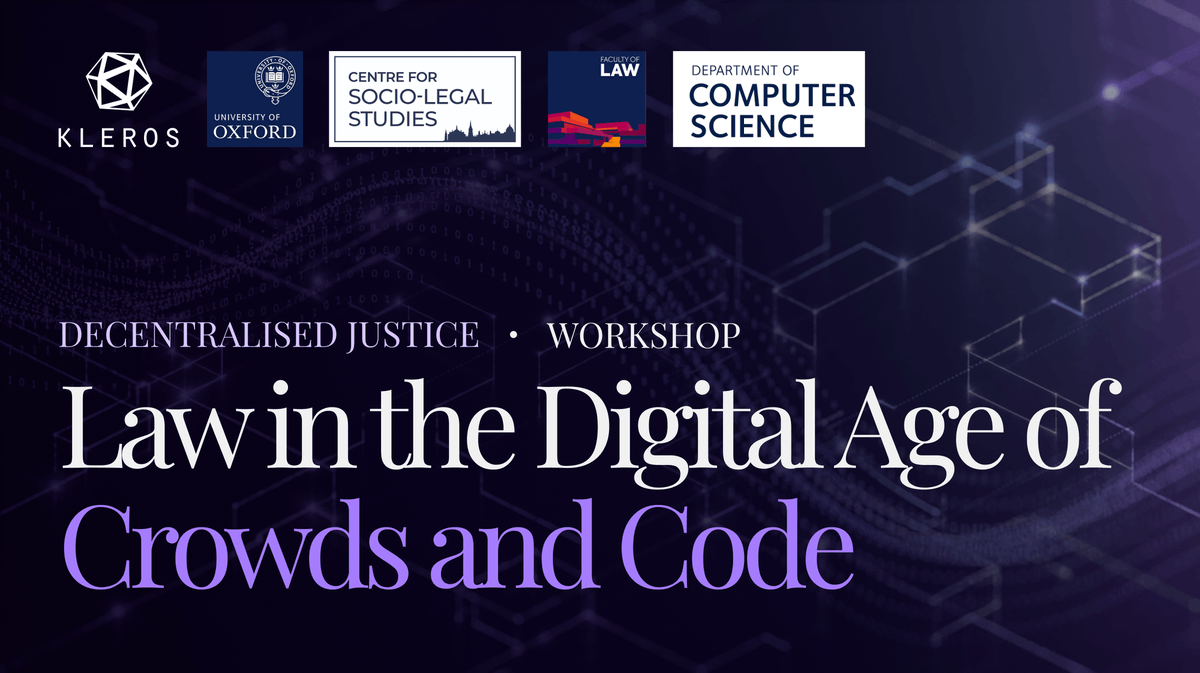
In collaboration with the Centre for Socio-Legal Studies and the Department of Computer Science from the @UniofOxford, we co-hosted “Law in the Digital Age of Crowds and Code”.
The workshop brought together legal scholars, arbitration practitioners, computer scientists, and institutional designers to discuss the future of law in the era of algorithms.
We structured the afternoon around two conversations that rarely happen in the same room.
In the first panel, we discussed the legal implications of the rise of decentralised justice systems.
Traditional legal systems were built for physical courts, national jurisdictions, and usually slow-moving disputes. The digital age has rendered those assumptions unstable. Cross-border e-commerce, autonomous AI agents, and decentralised organisations are already the new normal, yet legal infrastructure hasn’t caught up.
Together with Florian Grisel (CNRS/Oxford) and Nicole Stremlau (Oxford), and moderated by Fernanda Pirie (Oxford), we explored how decentralised dispute resolution systems interact with (and challenge) existing legal institutions, and what the transformation of international arbitration looks like in this new context.
In the second panel, we went deep into mechanism design.
With our Research Director @williamhwgeorge and @robertgdean (Diales and Kleros Supervisory Board), we discussed the architectural frontiers of decentralised justice: better jury selection models, more sophisticated incentive design, and above all the integration of AI into decentralised adjudication.
At the core of this work is the transition to second-generation decentralised justice systems, protocols with significantly more robust identity mechanisms, better jury selection frameworks, and architectures built for mass adoption.
It was a memorable afternoon with a convergence of arbitration practitioners, philosophers of law, game theorists, legal anthropologists, and cryptographers, all working on the same problem from different angles.
The questions raised in that room about fairness, automation, the rule of law, and the limits of algorithmic governance are no longer theoretical. They are live.
Many thanks to Fernanda Pirie, the Centre for Socio-Legal Studies and @KebleOxford for hosting this conference with us!
Recording coming soon!
It’s a wrap!
In collaboration with the Centre for Socio-Legal Studies and the Department of Computer Science from the @UniofOxford, we co-hosted “Law in the Digital Age of Crowds and Code”.
The workshop brought together legal scholars, arbitration practitioners, computer scientists, and institutional designers to discuss the future of law in the era of algorithms.
We structured the afternoon around two conversations that rarely happen in the same room.
In the first panel, we discussed the legal implications of the rise of decentralised justice systems.
Traditional legal systems were built for physical courts, national jurisdictions, and usually slow-moving disputes. The digital age has rendered those assumptions unstable. Cross-border e-commerce, autonomous AI agents, and decentralised organisations are already the new normal, yet legal infrastructure hasn’t caught up.
Together with Florian Grisel (CNRS/Oxford) and Nicole Stremlau (Oxford), and moderated by Fernanda Pirie (Oxford), we explored how decentralised dispute resolution systems interact with (and challenge) existing legal institutions, and what the transformation of international arbitration looks like in this new context.
In the second panel, we went deep into mechanism design.
With our Research Director @williamhwgeorge and @robertgdean (Diales and Kleros Supervisory Board), we discussed the architectural frontiers of decentralised justice: better jury selection models, more sophisticated incentive design, and above all the integration of AI into decentralised adjudication.
At the core of this work is the transition to second-generation decentralised justice systems, protocols with significantly more robust identity mechanisms, better jury selection frameworks, and architectures built for mass adoption.
It was a memorable afternoon with a convergence of arbitration practitioners, philosophers of law, game theorists, legal anthropologists, and cryptographers, all working on the same problem from different angles.
The questions raised in that room about fairness, automation, the rule of law, and the limits of algorithmic governance are no longer theoretical. They are live.
Many thanks to Fernanda Pirie, the Centre for Socio-Legal Studies and @KebleOxford for hosting this conference with us!
Recording coming soon!
💼 Case #141 at the Corte de Defensores del Cliente (Kleros 2.0, Junín, Argentina).
A consumer against a dealership and an automaker over a pickup truck under factory warranty.
The respondents argue the failure was caused by the fuel used; the consumer invokes the warranty.
AR$6.04M in dispute. Five certified jurors are deliberating.
Our great director of research @williamhwgeorge presenting on @Kleros_io mechanism design at @aiatkings. 🇬🇧
In the audience, AI researchers interested in dispute resolution for the agentic economy. 🤖
On June 11, I will be presenting @Kleros_io with @williamhwgeorge at the University of Edinburgh! 🏴
Algorithms, incentives, and the justice infrastructure for the age of AI agents.
Scottish Enlightenment vibes.
Sign up here! 👇
https://t.co/93b3FnS17Z
⚖️ On June 9, we'll be at the University of Oxford for "Law in the Digital Age of Crowds and Code."
Two panels with the Centre for Socio-Legal Studies and the Department of Computer Science on where dispute resolution goes when humans, mechanism design, and AI share the bench.
With @federicoast, @williamhwgeorge, Nicole Stremlau, Florian Grisel, @robertgdean, and Fernanda Pirie.
Free, registration required:
https://t.co/4WSyAmITZL
interesante este caso de arbitraje de Kleros en curso, ¿Debe o no cumplirse el contrato y comprarse el auto? El cliente dice que lo presionaron
cc @federicoast
New episode of Disputes Decoded, the podcast by arbitration innovation association @ArbTech_Hub, hosted by Sophie Nappert.
@williamhwgeorge and I joined Sophie to discuss the latest developments at @Kleros_io this year and broader ideas about how the blockchain industry is beginning to engage with traditional finance and commercial law... and what this means for the future of decentralized justice.
Listen here! 👇
https://t.co/82ndMxo3kf
On June 9, we're hosting "Law in the Digital Age of Crowds and Code" at @UniofOxford, together with the Centre for Socio-Legal Studies and the Computer Science Department. 🇬🇧
Two sessions:
- Decentralized justice vs. legacy legal institutions.
- Mechanism design & AI in adjudication.
Learn more and register! 👇
https://t.co/bq0IZ7PEKM
If you have some time to read, let me give you my opinion about Kleros as of May 2026.
I'm going to start by mentioning that the resolution of a medical-related case is, in my opinion, an enormous step forward for Kleros legitimacy as a suitable solution for dispute resolution in the legal landscape, since medical cases are generally subject to very strict regulations and heavy legal oversight.
Even if this kind of applicable verdict may seem like small steps to some people, it shows that Kleros is becoming increasingly integrated into the legal landscape. As of 2026, Kleros real-world usage (if we define it as legally bound usage) is mainly focused in Latin America.
If you look at the complaints about Kleros since 2021 (most of them started that year as it marked the end of the crypto frenzy in which most web3 projects were pumping without any real reason), you'll see that most of the criticism is focused on the V2 deployment, which is supposedly the main unachieved stepping stone for Kleros.
But I don't think V2 is that important for now (even if I'd like to see it live too). Let me explain why.
As weird as it may seem, I think that most of the work of the Kleros Coop isn’t in the coding/development part (maybe it’s half the job) but in the integration with legal public institutions and private companies (even if it's only with V2 Beta or even V1).
As time passes, less costly and more efficient AI tools will make smart-contract deployment and reviewing easier and cheaper. Deploying a decentralized dispute resolution system will become doable for anyone capable of using AI with a bit of money and time. To keep it short, in ~5 to 10 years, any small team could be able to deploy a Kleros-like decentralized dispute resolution system.
But why are the chances of Kleros being replaced by a competitor almost non-existent? Two things: institutional trust and juror-based staking.
Institutional trust is extremely hard to replicate. Kleros has built real credibility over years with proven cases, successful resolutions, and partnerships. Companies and institutions won't easily trust a new fork with no track record.
Juror-based staking creates a strong self-reinforcing loop. More cases attract more staked PNK, which improves quality and security. A competitor would start with almost no jurors and no staked capital, making it slow, expensive, and vulnerable to Sybil attacks, vote manipulation, or low-quality rulings.
Aragon Court is dead. Celeste is dead. Jur is dead.
Kleros survived thanks to a much stronger network effect driven by its critical mass of jurors and cases, a more mature and effective incentive system, a strong focus on real-world adoption with fintechs, companies and universities, and consistent long-term development since 2017.
I think that the pilot cases in legal institutions, such as the ones in Mendoza Court, are the real stepping stones, because they show that the game theory behind Kleros is applicable to legal templates for fast resolution of almost any type of dispute.
This is also why Kleros is focusing so much on working with universities. Having partnerships and research collaborations with institutions like the University of Oxford or Ohio State University validates the theory that the incentive principles behind Kleros indeed produce applicable and robust verdicts. I personally believe it is the best initiative and the smartest move from the Kleros Coop.
And yes, Kleros had and probably still has some flaws in its development speed and in building certain side tools that weren’t really necessary.
But today, you are witnessing what began as a small theoretical project 9 years ago transform into a fully functional decentralized justice system, applicable across the globe and to an almost unlimited number of use cases.
You will have noticed that I only mentioned Kleros Court’s main use case and didn’t even cover all its derivatives (only Curate and Scout could be standalone projects by themselves).
Better use Kleros $PNK.